
Most families in the United States pay somewhere between nothing and a lot, depending almost entirely on the route they take. Adopting from the public foster care system can cost a family USD 0 to USD 5,000, while a private agency or international adoption commonly runs USD 25,000 to USD 60,000 or more before tax credits. The adoption path is the single biggest cost driver, and it is worth knowing the full picture before you sign anything.
Families comparing routes usually find that the advertised fee is the smallest part of the total. Legal work, a home study, medical and birth expenses, travel, and months of post-placement supervision sit on top of the headline number, and each one lands at a different moment in the process.
This guide walks through typical ranges for each adoption type in the United States, what the money actually pays for, why two families can get very different totals for the same kind of adoption, and how to cut the bill without cutting corners.
Table of Contents
- How Much Adoption Costs in the United States: Typical Ranges
- What Adoption Costs Usually Include
- Fees paid to an agency, attorney or facilitator
- Pass-through expenses that rarely come back
- Where the tax credit does and does not apply
- What Affects the Price
- Why quotes for how much adoption costs in the United States vary so widely
- A worked example: two families, one adoption type
- How to Compare Adoption Providers and Ask About Fees
- Ways to Save on Adoption Costs
- Frequently Asked Questions
- Is adoption tax deductible in the United States?
- Do foster parents pay adoption placement fees?
- Why is international adoption usually more expensive?
- Are adoption costs refundable if no placement occurs?
- Can adoptive parents use loans or employer benefits?
- How can families avoid hidden adoption fees?
How Much Adoption Costs in the United States: Typical Ranges
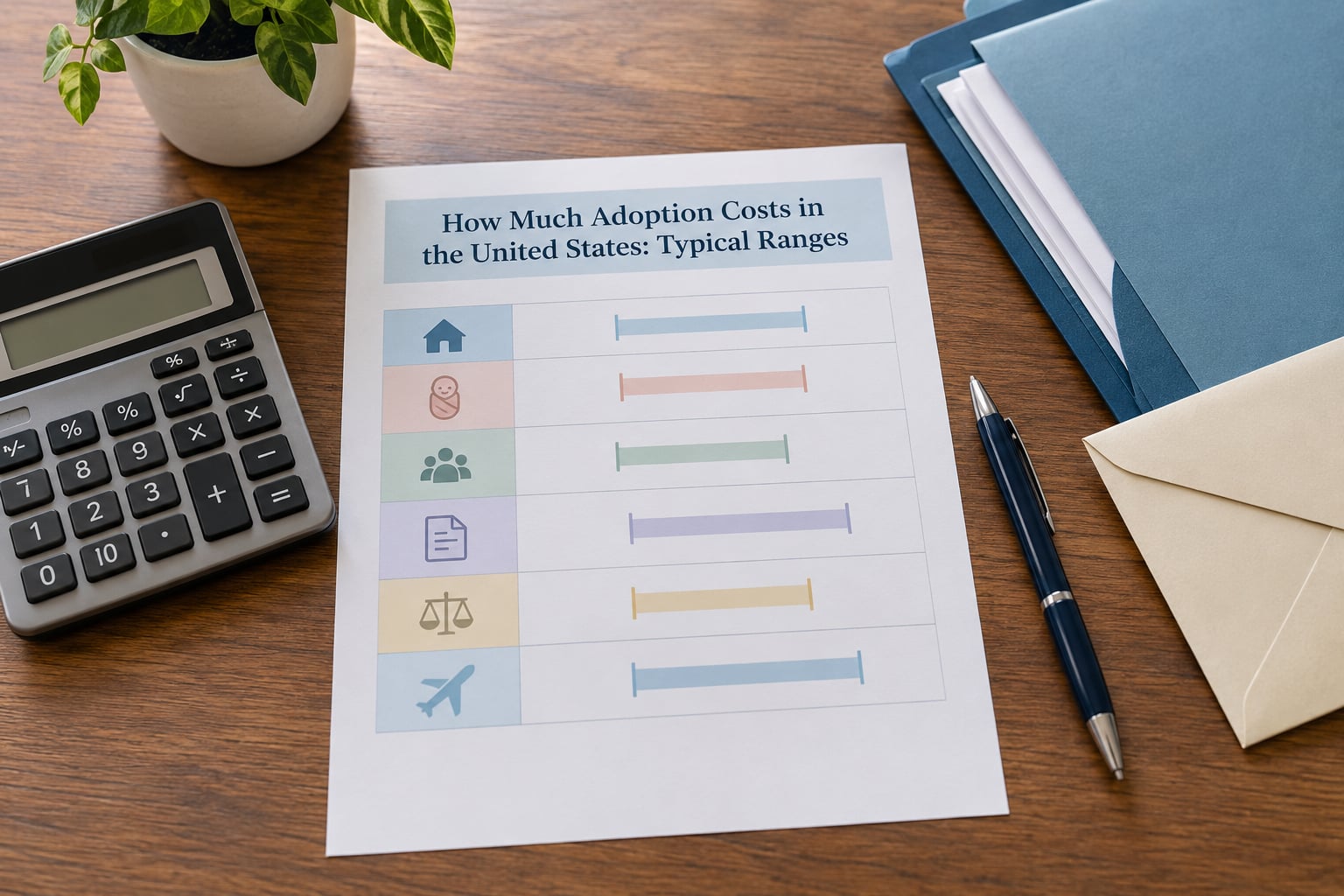
The table below gives typical low-to-high ranges for each route. Treat them as typical US ranges rather than quotes. They vary by region and change over time, and no two agencies price a case the same way.
| Adoption type | Typical low | Typical high | Who pays the bulk |
|---|---|---|---|
| Public foster care adoption | USD 0 | USD 5,000 | The county or state, usually through subsidy and reimbursement |
| Kinship or relative adoption | USD 0 | USD 6,000 | Often mostly reimbursed; legal fees are the usual family expense |
| Stepparent or second-parent adoption | USD 1,500 | USD 15,000 | The adopting parent, for the attorney and court process |
| Independent domestic adoption | USD 15,000 | USD 40,000 | The adoptive family, working through an attorney or facilitator |
| Private agency domestic adoption | USD 25,000 | USD 60,000 | The adoptive family, through the agency fee schedule |
| International adoption | USD 25,000 | USD 60,000+ | A mix of the agency, the foreign program fees, and travel |
Families on the public routes are often surprised that the adoption itself costs them nothing at all. Foster care adoption is funded by the state, and the family out-of-pocket costs usually amount to a home study fee, a few court filing charges, and sometimes an attorney. The money instead arrives as a monthly maintenance subsidy for the child, plus medical coverage through Medicaid and sometimes an ongoing adoption assistance payment under Title IV-E.
What makes that route expensive is time, not fees. A family waiting for an infant placement through foster care may wait years, and the child placed is most often not a newborn. Adopters on r/AdoptiveParents describe the emotional trade-off plainly: near-zero cost, unpredictable timing, and often a child who is older, or who has medical needs or a sibling group.
At the other end, private agency and international adoptions carry the highest totals because they buy something scarce: an identifiable match, often an infant, delivered through a coordinated process with staff, counseling, advertising, legal work, and travel. The fee is also how agencies cover the birth parent support they are required to provide, which is a real cost in the business model even when the adoptive family never sees it itemized.
Independent and facilitator-led adoptions usually land between the public and private routes. Families here usually arrive with an existing connection to a birth parent, which removes the searching, matching, and advertising work that an agency charges most heavily for.
Stepparent and second-parent adoptions are the cheapest private route, because the legal groundwork already exists. The family is usually paying for an attorney and a court order rather than for a match. Costs can rise sharply if the adoption is contested, which puts a contested stepparent adoption into a very different financial territory from an uncontested one.
On adopters’ forums, the recurring complaint is not the size of the fee but the opacity of it. People report being quoted one number and then discovering that the birth parent’s medical bills, the travel, and the post-placement supervision were never part of that figure. That is why the line-item section below matters as much as the ranges.
What Adoption Costs Usually Include
Almost every adoption total is a stack of smaller charges. Knowing which are organizational fees and which are pass-through expenses tells you what you can negotiate, what you can claim on the federal tax credit, and what you should expect to lose if the adoption does not go through.
Fees paid to an agency, attorney or facilitator
The agency or facilitator fee is the core charge for the service: recruiting and advertising, matching and case management, home study coordination, counseling, preparation of the case file, and court representation in many arrangements. A private domestic agency fee commonly sits between USD 20,000 and USD 45,000 on its own, before any of the pass-through expenses.
The home study is usually bundled, but sometimes billed separately. Standalone home study fees, when charged at all, tend to fall between USD 0 and USD 1,000. Legal expenses are another line that surprises people, particularly in an independent adoption where the family has to pay for legal representation on both sides, typically USD 5,000 to USD 10,000.
Pass-through expenses that rarely come back
These are costs the family pays on someone else’s behalf or on the family’s behalf that flow straight through the case. Birth parent expenses are the big one. Medical costs for the birth parent and newborn, living expenses during the pregnancy, counseling for a birth parent, and sometimes lost wages. In many states and under federal law, a birth parent cannot be required to repay support they received, so ask specifically whether that money is refundable. Most of it is not.
Court and filing charges are small, usually a few hundred dollars, but they appear on nearly every budget. Travel is the next one: flights, lodging, rental cars, and per diem for the trip to meet a child, plus local transport in a foreign country. Families who travel internationally should assume two trips, one before placement and one to bring the child home, and add a third trip for the in-country waiting period of several weeks that most programs require.
Post-placement supervision is the cost most first-time families forget. Depending on the route, this means reports, phone check-ins, or in-home visits spread over six to twelve months after placement, plus ongoing counseling for the new parents. Some agencies include it. Some bill per visit, which can add up quickly over a year.
Where the tax credit does and does not apply
The federal adoption tax credit is the most misunderstood cost-reduction tool in this process. It applies to qualified adoption expenses, which include agency and attorney fees, court and legal costs, home study expenses, temporary foster care for a child placed in your home before placement, and some travel and medical costs tied to the adoption. It does not apply to your living expenses after the child arrives.
Some qualified expenses come with a dollar cap per child, and the credit itself depends on your overall tax bracket, which is why you cannot take a number off the top without your return in front of you. The IRS publishes the current figure and the qualifying rules, and they change more often than most guides admit. Check the IRS guidance for the tax year in which you finalize rather than trusting a figure from an older article.
What Affects the Price
Two families can both be quoted a private domestic adoption and land USD 20,000 apart. That is not a mistake. Several variables move the number, and understanding them is how you build a budget you can actually hit.
Why quotes for how much adoption costs in the United States vary so widely
The adoption type sets the baseline, and everything else adjusts it. Regional differences are real: agency fees in high-cost metropolitan areas and in states with few agencies run above national averages. The agency model matters too, because some agencies charge a flat fee that bundles legal work and post-placement, while others bill by the hour and by the visit.
Legal complexity is a big one. A straightforward uncontested case moves quickly. A case where parental rights must be terminated, or where the other parent must be located and served, adds hours and sometimes a separate legal process. Sibling placement often reduces the fee because agencies are heavily invested in keeping siblings together, so ask whether a discount applies. Adoptions involving children with medical needs can add medical review costs, though they can also qualify for additional subsidy.
Waiting time shapes the budget as much as the price does. An eighteen-month process means eighteen months of fees. If you are financing, ask whether installments accrue interest and whether the fee is due in stages or as a single payment at placement.
Access to help also changes the total. A family with an employer adoption benefit, a nonprofit grant, or access to Title IV-E adoption assistance can end up several thousand dollars ahead of a family with the same adoption type and no outside resources. International adoptions add a layer of regulation on top of that, since the foreign country’s own fees, in-country agency requirements, translation, notarization, and immigration processing all sit either inside or outside your agency’s fee.
A worked example: two families, one adoption type
Take two families pursuing an independent domestic infant adoption in the same state. Family A uses an attorney who bills a flat combined fee, has a birth parent connection already in place, and stays within driving distance. They land near USD 22,000, most of it legal fees plus reimbursed birth parent medical expenses.
Family B works with a facilitator who charges separately for advertising, matching, counseling, and each post-placement visit. Their birth parent lives three states away, so they pay for travel and a hotel stay, and they are billed for six post-placement visits. They land near USD 41,000. Same adoption type, same state, same year, and neither family was overcharged. The difference is entirely in how the services were packaged and delivered.
This is exactly why the request for an itemized written fee schedule matters. It turns an opaque number into a list you can compare like-for-like.
How to Compare Adoption Providers and Ask About Fees
Whether you are talking to an agency, an attorney, a facilitator, or an international program, the questions are basically the same. Ask them before you sign anything, and get the answers in writing.
- Request an itemized fee schedule. Ask what is included, what is billed separately, and which items are estimates subject to change. Adoptive families on Reddit say this single request often shifts the conversation from marketing to specifics.
- Ask about refund and disruption policy. If a match falls through or a birth parent changes their mind, what portion of the fees is refunded, and what is not? Get the answer in the contract, not in a conversation.
- Verify credentials. For agencies, check state licensing and accreditation by the Council on Accreditation. For attorneys, check bar membership and that adoption is a real part of their practice rather than an occasional referral.
- Ask how long they have been placing children and whether they serve birth parents. A provider supporting birth parents on both sides of the adoption is working within a regulated system. One that describes them as clients to be managed is telling you something about how the case will run.
- Ask what happens to the fee if the case ends early. Failed matches are a real risk in matching-based routes, and the money at risk in the first weeks is usually non-refundable.
- Ask for a realistic timeline with the cost attached to each stage. A stage-by-stage schedule tells you when money moves and how much of it you will have spent before the placement call.
Red flags are simple: pressure to pay before the home study is complete, a promise of a guaranteed match, refusal to give a written breakdown, or any request to route money through an intermediary rather than the licensed organization itself.
Ways to Save on Adoption Costs
Most savings come from choosing the right route and stacking benefits, not from cutting corners. Start with the route itself. If you are genuinely open to an older child or a sibling group, the foster care system is the least expensive path by a wide margin, and a relative or kinship adoption is often even cheaper because the state reimburses more of the legal work.
Apply for everything that is designed to be applied for. The federal adoption tax credit is automatic if you qualify and file it, but you have to claim it. Nonprofit grants are the most overlooked source, and they are often earmarked for families who could not otherwise afford the adoption, with awards ranging from a few hundred dollars to several thousand. Employer benefits are worth checking carefully, because some cover a reimbursement amount for adoption expenses and some only cover the leave. Military families may have separate adoption reimbursement programs.
Public-system families should ask the caseworker about Title IV-E adoption assistance and Medicaid enrollment early, rather than at finalization. Both can be life-changing for ongoing costs, and both have eligibility rules tied to the child’s needs and the state’s criteria.
Then handle the money deliberately. Negotiate the fee schedule before you sign, and ask for a payment plan rather than a lump sum. Build a 10 to 15 percent contingency buffer into the budget, because the line items almost always move. Using a crowdfunding platform for a specific, itemized need works better than a general appeal, and using a retirement loan rather than a credit card keeps the cost of borrowing far lower. A tax professional can also tell you whether a child or dependent care deduction is worth pursuing once the child is home.
What not to do is simple. Do not pay anyone who guarantees an adoption. Do not send money through an unverified intermediary, and do not hand over a full fee to a provider before the home study and background checks are complete. Nothing about a legitimate route works that way, and every one of those patterns shows up in scam reports.
Frequently Asked Questions
Is adoption tax deductible in the United States?
Partly. The federal adoption tax credit is a credit against income tax for qualified adoption expenses, not a deduction, and it depends on your tax bracket and the expenses incurred in the year the adoption is finalized. Qualified costs typically include agency or attorney fees, legal and court costs, the home study, and certain medical and travel costs. You still itemize medical expenses separately on your return. Ask a tax professional about your specific situation.
Do foster parents pay adoption placement fees?
Usually not. When a child is adopted from the public foster care system, the state pays the placement costs, so the family out-of-pocket expense is often limited to a home study fee, court filing charges, and occasionally an attorney. Instead of a fee, a foster-to-adopt family generally receives a monthly maintenance subsidy for the child and Medicaid coverage, and some families qualify for ongoing adoption assistance. Ask your caseworker which payments apply to your specific case.
Why is international adoption usually more expensive?
Because the cost is stacked rather than single. On top of the US agency fee you pay the foreign country’s program fees, in-country agency or orphanage costs, document translation and notarization, immigration and visa processing, and travel for an extended in-country stay. Most families make two trips, one before placement and one to bring the child home, plus several weeks of local travel during the waiting period. A third trip for the child’s first passport and exit paperwork is common.
Are adoption costs refundable if no placement occurs?
It depends entirely on your contract. Home study, application, and background check fees are usually spent regardless of outcome and are rarely refunded. Agency or facilitator fees paid before a match are often refundable in part if the disruption was not the family’s doing, but many contracts cap the refund or exclude fees earned for work already completed. Birth parent expenses are generally not recoverable. Ask for the refund and disruption policy in writing before you pay, not after a match falls through.
Can adoptive parents use loans or employer benefits?
Both are common. Many families fund an adoption through a combination of savings, a low-interest retirement loan, and a portion of the federal tax credit, which is why it is worth holding the tax figure in reserve rather than spending the gross amount. Employer benefits vary widely: some reimburse adoption expenses up to a set amount, some offer paid leave only, and some have a waiting period for eligibility. Ask your benefits department for the plan document language, not a summary.
How can families avoid hidden adoption fees?
Ask for an itemized written fee schedule before signing, and read it line by line against a written timeline. You are entitled to know which expenses are estimated, which are fixed, what happens to the money if the case ends early, and which items qualify for the federal tax credit. Compare two providers using the same list. If a provider resists itemizing, will not put the refund policy in the contract, or asks for full payment before the home study is complete, walk away.
One more question comes up constantly on parenting forums, so it is worth answering plainly. The 3-3-3 rule describes the first three months, three days, and three weeks after a child joins your home, when many adoptive parents feel exhausted, disoriented, and unsure of themselves. It started as a framework for dogs but families borrow it because it names something real about adjustment. Treat it as a rough marker, not a deadline, and talk to your adoption counselor or pediatrician if something feels off.
So what should you do first? Ask two providers, ideally on different adoption routes, for an itemized written fee schedule with a refund policy attached. Compare the line items, add 10 to 15 percent for what always moves, and decide on your route from there rather than from the headline number.