Safe sleep means placing your baby on their back, alone, on a firm flat mattress in a crib or bassinet with nothing else in it, ideally with the sleep space in your own room. That short definition covers most of what pediatric guidance asks for, and this article explains where each rule comes from and how to make it work in a real house.
Safe sleep guidelines for babies are easier to follow once you know which parts are about airway safety and which are about habits. Some rules are absolute, like keeping the mattress flat and firm. Others, like swaddling, are conditional and have a clear stop point. And some, like sleeping in a car seat overnight, are simply not recommended at all.
Everything below draws on the American Academy of Pediatrics policy statement on sleep-related infant deaths, plus CDC, NIH and NHS guidance. It is general information, not advice about your baby. Positioning, feeding, reflux and medical needs need your own clinician’s input.
Table of Contents
- Safe Sleep Guidelines for Babies at a Glance
- What Are the Current Recommendations for Infant Sleep?
- What do SIDS and SUID actually mean?
- Why is the risk highest between 2 and 4 months?
- Why Should Babies Sleep on Their Backs?
- What Sleep Surface Is Safest for a Baby?
- Should a Baby Share Your Room or Bed?
- What about twins, shift work, or a small room?
- How Should a Baby’s Sleep Space Be Set Up?
- How to Follow Safe Sleep Guidelines for Babies at Home
- What Should a Baby Wear or Use During Sleep?
- Is Swaddling Safe, and When Should It Stop?
- Is swaddling allowed in daycare?
- How Do You Make Naps Safer Than Nighttime Sleep?
- What About Premature Babies and Babies with Medical Needs?
- Why Can Safe Sleep Advice Feel Unrealistic for Some Families?
- How to Talk with a Pediatrician About Baby Sleep
- What changes should prompt a call?
- Frequently Asked Questions
- What are the safest sleep guidelines for a newborn?
- What is the safest sleep position for a baby?
- Can a baby sleep in a swaddle at night?
- Is it safe to use a weighted swaddle or weighted blanket?
- What should I do if my baby falls asleep on my chest?
- The Safest First Step for Baby Sleep
Safe Sleep Guidelines for Babies at a Glance
This table is the whole recommendation set on one screen. Read it before you set up a space, then come back to it whenever something changes.
| Rule | Why it matters | What to do |
|---|---|---|
| Back to sleep, every time | Back sleeping keeps the airway open; side and stomach sleeping raise the risk of suffocation and rebreathing | Place your baby on their back for every nap and every night, including after rolling |
| Alone on the surface | An adult or another child beside a baby can roll over, press, or cover them without noticing | Give your baby their own sleep space, even for short naps |
| Firm, flat, fitted sheet only | A soft or angled surface lets the head sink in and the body slide down | Use a firm, flat mattress with a tightly fitted sheet and nothing underneath it |
| Empty sleep space | Loose items can trap air, block a face or cause strangulation | Keep out blankets, pillows, bumpers, toys, positioners and weighted products |
| Room-share, not bed-share | Nearby sleep lowers risk; sharing a surface raises it | Keep the crib or bassinet in your bedroom for at least the first six months |
| Light sleepwear | Overheating is a documented contributor to sleep-related death | Use a wearable blanket or a one-piece; skip loose blankets and hats indoors |
| Swaddle only until rolling starts | A swaddled baby who rolls cannot use their arms to free their face | Stop at the first signs of rolling, and place a swaddled baby on their back |
| Smoke-free air and breastfeeding | Both are associated with lower risk | Keep your home and car smoke-free and feed your baby breast milk as much as you can |
What Are the Current Recommendations for Infant Sleep?
The current recommendations come from the American Academy of Pediatrics, whose most recent policy statement on sleep-related infant deaths is the 2022 update. The CDC, the NIH Safe to Sleep campaign and the NHS publish guidance built on the same core evidence, and the wording differs slightly between them but the substance lines up.
One distinction worth holding onto: these are clinical recommendations, not laws or product rules. Nothing requires you to buy a particular crib, and a state or country may have its own requirements that go further. A safe sleep practice is also not a guarantee. Families who follow every rule can still lose a baby, which is the honest and important caveat the AAP itself makes.
What do SIDS and SUID actually mean?
SIDS stands for Sudden Infant Death Syndrome. SUID stands for Sudden Unexpected Infant Death, a broader term that covers SIDS, accidental suffocation and strangulation, and deaths with no cause identified. Roughly 3,500 sudden unexpected infant deaths are recorded in the United States each year, and sleep-related deaths are the leading cause of injury death in infancy.
When researchers report these numbers, they cannot always tell which babies were sleeping safely. Death certificates rarely record the sleep position or the surface, so safe and unsafe sleep get lumped together in the data. That is why the statistics look worse than the risk for a baby in a prepared space, and it is a genuine source of confusion for parents trying to read the numbers.
Why is the risk highest between 2 and 4 months?
Risk peaks in the second and third months and tapers after about 4 to 6 months. Babies at that stage have less head control, spend more time in one sleep position, and are more likely to be swaddled or covered. Rolling is also just beginning, so the timing lines up exactly with the window when a swaddle becomes a hazard.
The curve also reflects who dies. Black and Native American and Alaska Native infants die at more than twice the rate of white infants, and in many of those deaths the baby was not on a firm, flat, empty surface. That is an access and information problem, not something a parent did wrong.
Why Should Babies Sleep on Their Backs?
Back sleeping keeps an infant’s airway open and makes it harder for a face to end up pressed into bedding. It is the single most effective thing in the recommendation set, and the reason behind it is mechanical rather than mysterious.
The two objections I hear most are gas and comfort. Some babies seem to fuss more on their backs, and a baby who has reflux may arch. Neither is a reason to change position on your own; bring it to your clinician, because reflux has its own management and repositioning a baby without advice can make things worse.
What you do about rolling is different. Once a baby can roll from back to side or stomach on their own, you stop trying to turn them back. Instead, keep placing them on their back at the start of sleep, keep swaddling stopped, and make sure the space is bare so they can move freely and free their own face.
What Sleep Surface Is Safest for a Baby?
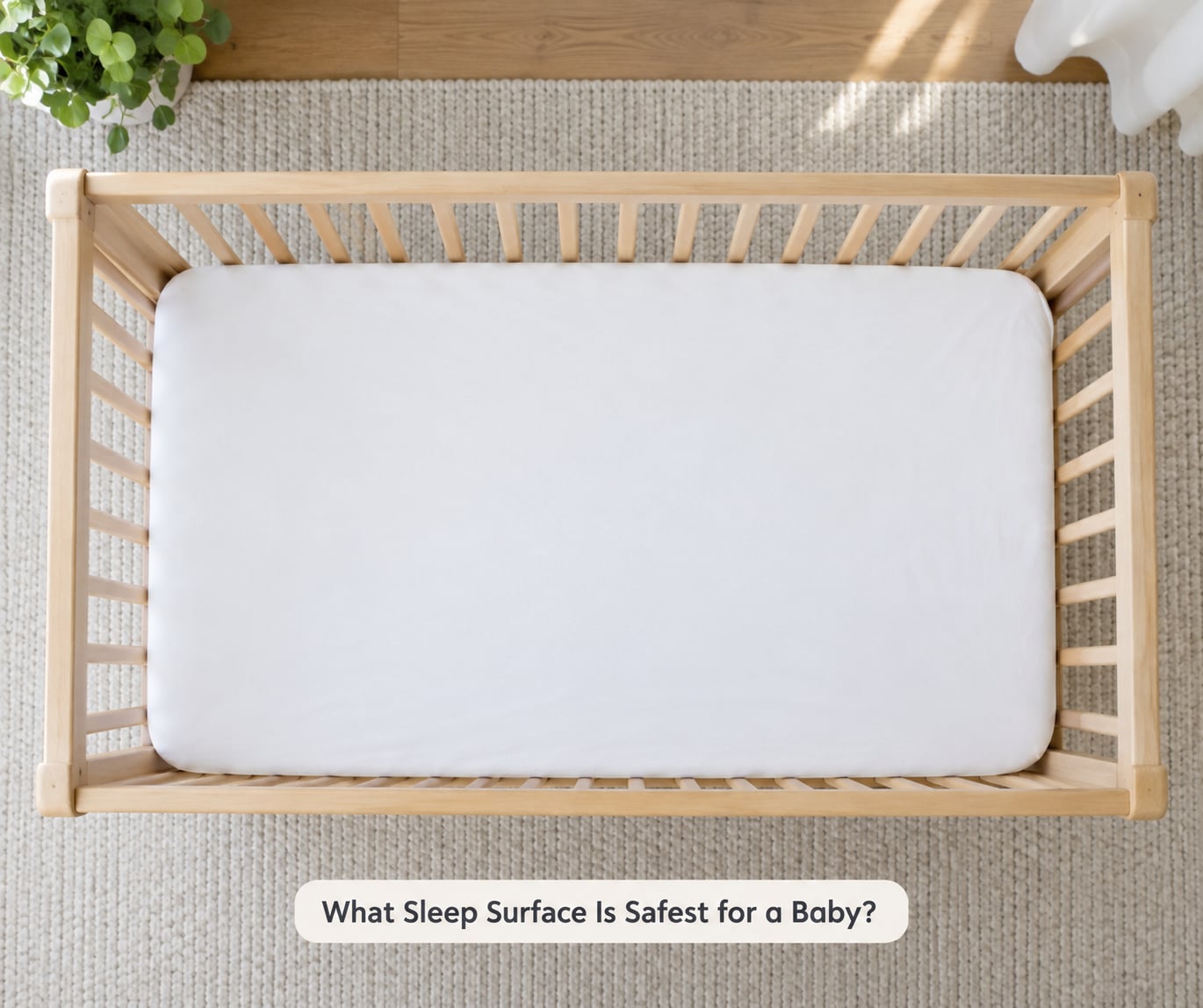
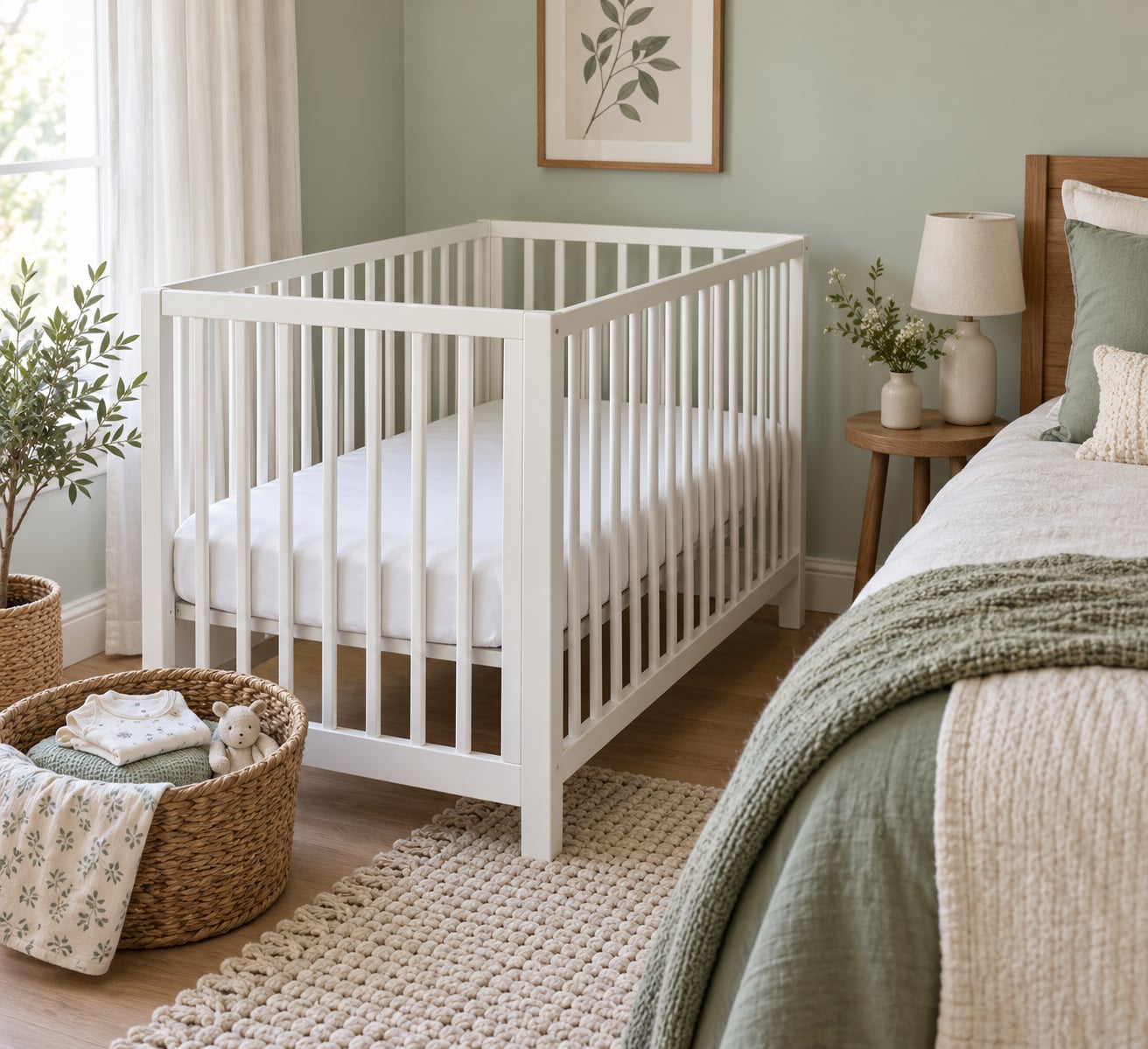
The safest surface is firm, flat, level, and covered only with a tightly fitted sheet. A crib, bassinet or portable play yard that meets current safety standards all work, and a mattress that passes the two-finger squeeze test is the practical version of firm.
Surfaces rank very differently. Here is how the common ones compare.
| Surface | Rating | Reason |
|---|---|---|
| Crib | Recommended | Firm flat mattress, used from birth |
| Bassinet | Recommended | Firm flat mattress with a fitted sheet; useful for the first few months |
| Portable play yard | Recommended | Only the flat floor-level mattress it comes with |
| In-bed or bedside sleeper | Not recommended | The AAP cannot endorse them; a baby in one is sharing a sleep surface |
| Adult bed | Not recommended | Soft surface, gaps around the mattress, blankets and pillows |
| Couch or sofa | Unsafe | The highest-risk surface there is; cushions create pockets that trap air |
| Armchair or recliner | Unsafe | A drowsy adult sinks, and the baby can slide into a crease |
| Car seat | For travel only | Not for overnight sleep; the position narrows the airway |
| Adult swing, rocker or lounger | Not for sleep | Inclined devices have been involved in recalls and deaths |
Inclined products deserve their own warning. Loungers, nests, docks and some swings place a baby’s head lower than their feet, and that angle can compress the airway. Several have been recalled. The NHS also advises against weighted products of any kind for babies, and the CPSC has recalled infant sleep items for entrapment and suffocation hazards.
Should a Baby Share Your Room or Bed?
Share the room, not the bed. The AAP recommends room-sharing without bed-sharing, ideally for the first six months and certainly through the first year. The two words get collapsed constantly, and they point in opposite directions.
Room-sharing means the baby sleeps in their own crib or bassinet in your bedroom. You hear them, they hear you, and the flat empty space is doing the protective work. Bed-sharing means the baby shares your mattress, and a baby on an adult mattress is in soft bedding surrounded by gaps, even if they are zipped into a sleep sack.
What about twins, shift work, or a small room?
Twins can share a room, and many families put them in separate cribs side by side. If space is genuinely tight, a corner of the room is still much better than an adult bed. For shift workers or families with one small room, talk to your clinician about a plan you can sustain, because a plan you abandon at 3am is worse than a plan you keep.
Breastfeeding families often ask whether feeding at night makes bed-sharing unavoidable. It does not have to. A safe surface plus support with positioning, and honestly, sometimes a temporary deviation while you are both learning, is a better conversation than a rule you feel you have already broken.
How Should a Baby’s Sleep Space Be Set Up?
A safe space takes a few minutes of checking and then stays the same. Run through this list once for each new space: home, grandparent’s house, daycare, hotel.
- Check the surface. Firm, flat, level, with a tightly fitted sheet. Nothing under the mattress, no box spring, no extra pad.
- Check the frame. Crib slats should be no more than about 2 and 3/8 inches apart, the drop side should lock, and hardware should be tight with no sharp edges.
- Empty it. No blankets, pillows, bumper pads, stuffed animals, loveys, toys, sleep positioners, or mattress toppers.
- Place it away from hazards. Keep it away from windows, cords, blinds, heaters, ceiling fans, wall art and anything overhead. Check the wall for outlets and use covers.
- Check the room. Keep a working smoke detector nearby, keep the room at a comfortable temperature, and avoid overheating the room to compensate for a cold baby.
- Check the model. Before buying, search the model and brand on saferproducts.gov for recalls. Cribs for Kids and similar programs provide free or low-cost portable sleep surfaces for families who cannot afford one.
None of these checks can promise safety, and it is worth saying so plainly. They remove known hazards. What they cannot do is account for everything in a home.
How to Follow Safe Sleep Guidelines for Babies at Home
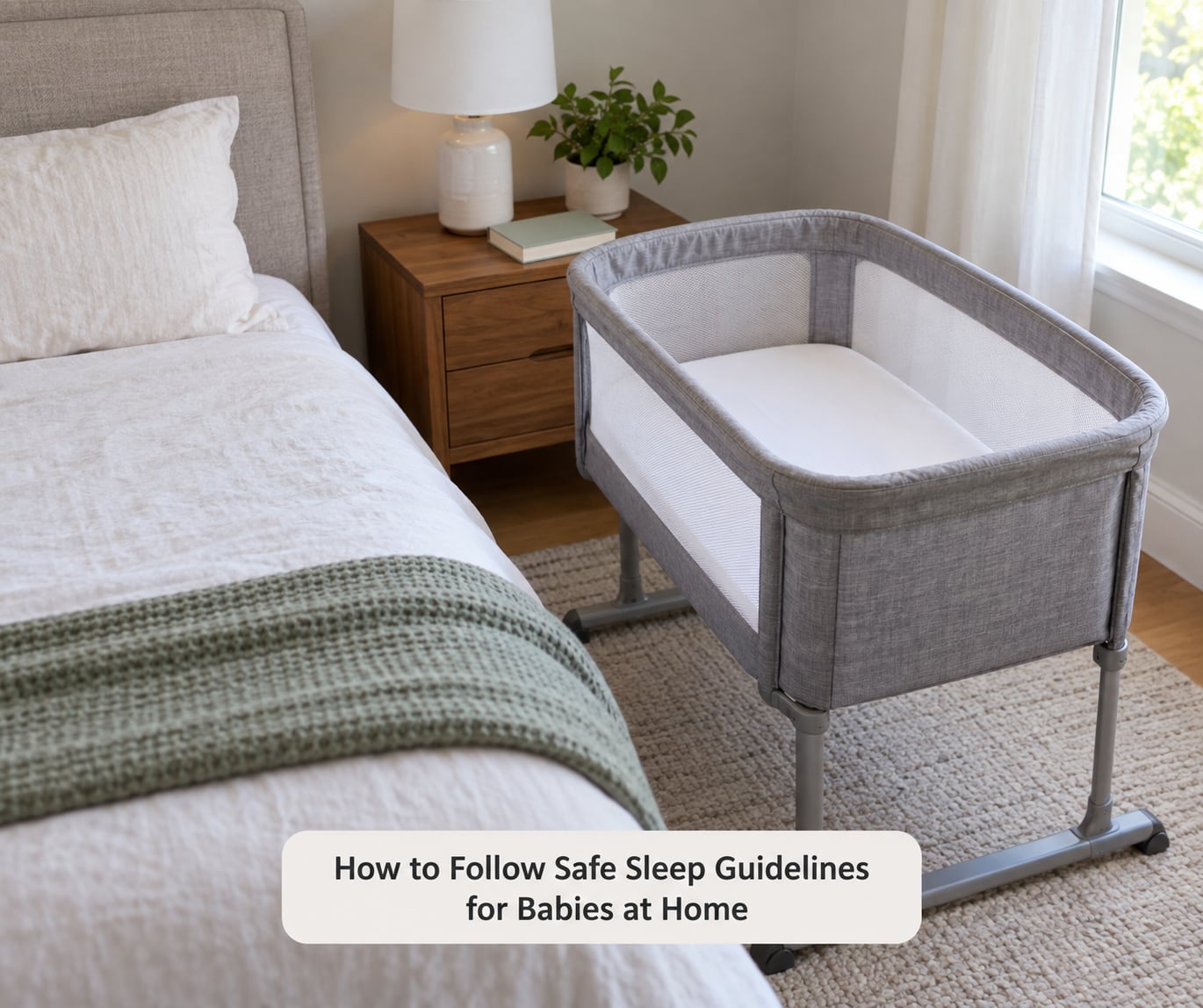
Turn the guidance into a sequence and the rules stop being a list to remember at midnight. The same sequence works for naps and for bedtime.
- Clear the space before the baby is nearby. Take out anything loose, including the comforter that arrived with the bassinet.
- Check the temperature of the room and choose sleepwear. A wearable blanket or a one-piece is usually enough.
- Feed, burp, and settle before placing the baby down. Feeding and falling asleep can happen in the same trip.
- Place your baby on their back in the flat, empty space, on their own.
- Leave the room if you can. Set any monitor where it helps you hear the baby and not where it tempts you to linger.
- Jot down anything unusual for the next visit with your clinician: repeated waking, new sounds, unusual positions, feeding changes.
Two habits make the rest easier. Keep swaddling decisions tied to rolling rather than age, and decide who handles the nighttime feeds before you are exhausted.
What Should a Baby Wear or Use During Sleep?
Dress your baby lightly in a wearable blanket, a sleep sack, or a one-piece with feet, and keep loose blankets and hats out of the sleep space. Socks are fine in ordinary room conditions. The point is to keep your baby warm without covering them, since overheating during sleep raises risk.
Weighted swaddles, weighted sleep sacks, weighted blankets and weighted sleep positioners are not used for infant sleep. Weight makes it harder for a baby to move their head or body if their face ends up against something, and the NHS guidance is explicit that these products should not be used with babies under one year old. It is worth knowing that marketing often blurs this line.
A wearable blanket takes the place of a loose blanket, not in addition to one. Putting a swaddle sleep sack on over a blanket is a common and easily missed double layer.
Is Swaddling Safe, and When Should It Stop?
Swaddling is safe when it is done correctly and stopped at the right time. The technique matters more than the product: arms snug, hips loose enough to bend, no compression across the chest, and nothing tight around the neck or face.
Stop the moment your baby shows any sign of rolling. That is the rule, not a milestone to schedule around. A swaddled baby who can get onto their side cannot use their arms to push themselves clear, and the swaddle fabric is exactly the kind of loose material the empty sleep space rules exist to prevent.
Until you stop, always place a swaddled baby on their back. For families using weighted swaddles, the guidance is simpler still: none.
Is swaddling allowed in daycare?
It depends on the provider’s written policy, and many settings restrict or prohibit it. Ask before you start, ask how staff are trained to place a swaddled baby, and make sure nobody adds bedding or re-swaddles a baby who has started rolling. If the answer is unclear, a sleep sack is the easier option to hand over to someone else.
How Do You Make Naps Safer Than Nighttime Sleep?
Naps follow the same rules. Back, alone, firm flat surface, empty, light sleepwear, in the room with you if you can. A nap is not a lower-risk version of a night, and a baby who naps on their front at daycare is still exposed.
Sleep on the move is where deviations cluster. A stroller or car seat is fine for a journey, not for a long sleep, because the seated angle narrows the airway. A travel cot rented from a hotel or borrowed from a friend should meet current standards, and a travel sleep sack is the sleepwear to pack. If you cannot arrange a firm flat surface, plan the nap times around travel rather than the other way around.
You are also part of the sleep environment. If you feel drowsy while holding your baby for a feed, move to a safer spot or set the baby down in their space before settling anywhere comfortable.
What About Premature Babies and Babies with Medical Needs?
The general environment rules still apply: firm flat empty surface, back to sleep, no soft items, no weighted products. What changes is positioning, monitoring, feeding plans, and the timeline for stopping swaddling.
Babies born early and babies with reflux, apnea, airway anomalies, or cardiac conditions often need a plan written by their neonatal or pediatric team, and sometimes a different sleep position for a specific reason. A hospital discharge is the moment to ask for that plan in writing, including what monitoring equipment to use, what to do between visits, and who to call at 2am.
Do not adapt a general guideline to a medical situation on your own. Ask the team what applies to your baby, then write down the answer.
Why Can Safe Sleep Advice Feel Unrealistic for Some Families?
Because sometimes it is. A family in a one-room apartment with no separate sleep surface, a parent working nights, four generations sharing a bed, a gifted comforter, and a relative who thinks back sleeping is nonsense, is a real household and not a hypothetical one.
Cost is part of it too. Cribs and portable play yards are not always affordable, which is why Cribs for Kids and similar charities exist, and why checking saferproducts.gov before buying matters. Cultural and caregiving preferences also shape how a family sleeps, and guidance delivered without respect for that tends to get ignored rather than followed.
The useful frame is risk reduction rather than perfection. A room that is shared, a surface that is firm even if not separate, a family that knows why back sleeping matters, all of that moves the risk down. It does not move it to zero, and nobody is failing by being honest about their situation.
How to Talk with a Pediatrician About Baby Sleep
A short conversation covers more ground than a long internet search. Bring these questions, and write down the answers.
- Is back sleeping still right for my baby, given their age and any medical conditions?
- How should I handle feeding at night while keeping the baby on a separate surface?
- What should I do about reflux or arching, and should we change anything about position or timing?
- Is my baby showing signs of rolling, and is it time to stop swaddling?
- Does my baby’s age, weight, or prematurity change any part of the plan?
- Who do I call after hours, and what would be a reason to call straight away?
What changes should prompt a call?
Call your clinician for breathing pauses, noisy or labored breathing, blue or very pale color, a feed refusal, vomiting with or without blood, a fever, or a new pattern of sleeping that concerns you. Any article, including this one, cannot diagnose a baby from general symptoms. When something does not look right to you, that instinct is reason enough to make the call.
Frequently Asked Questions
What are the safest sleep guidelines for a newborn?
Place your newborn on their back, on their own firm, flat mattress in a crib, bassinet or portable play yard, covered only with a tightly fitted sheet. Nothing else belongs in the space: no blankets, pillows, bumpers, toys or positioners. Keep the sleep space in your own room, use light sleepwear or a wearable blanket, and stop swaddling at the first sign of rolling.
What is the safest sleep position for a baby?
On the back, for every sleep, including naps, until your baby is at least a year old. Back sleeping keeps the airway open and is the most effective part of the whole recommendation set. If your baby rolls onto their side or stomach on their own, stop swaddling, keep placing them on their back to begin sleep, and leave the surface clear so they can free their own face.
Can a baby sleep in a swaddle at night?
Yes, if the swaddle is done correctly and your baby is placed on their back. Wrap the arms snug and the hips loose enough to bend, with nothing tight near the neck or face. Swaddling is for babies who cannot roll. The moment your baby shows any sign of rolling, stop, because a swaddled baby who rolls cannot use their arms to clear their face.
Is it safe to use a weighted swaddle or weighted blanket?
No. NHS guidance states that weighted swaddles, weighted sleep sacks, weighted blankets and weighted sleep positioners should not be used for babies under one year old. Weight can keep a baby from moving their head or body if their face ends up against fabric. Use a standard sleep sack or wearable blanket instead, and check the weight on any product you already own.
What should I do if my baby falls asleep on my chest?
Move your baby to their own firm, flat, empty sleep space as soon as you notice. If you fall asleep first, that is common, especially at night feeds, and it is a signal that you need more support rather than a reason to feel guilty. If you wake and find you have both dozed on a couch or armchair, move your baby to their space and mention it to your pediatric clinician.
The Safest First Step for Baby Sleep
Put your baby on their back, in a firm, flat, empty sleep space, on their own, with the sleep space as close to your bed as your home allows. Then take the individual questions, reflux, rolling, prematurity and feeding, to your pediatric clinician, because those are the parts no general guide can settle for you.
Sources: American Academy of Pediatrics policy statement on sleep-related infant deaths (2022 update), CDC safe sleep guidance, NIH/NICHD Safe to Sleep, NHS safer sleep advice, and US Consumer Product Safety Commission recall information at saferproducts.gov. Reviewed October 2026.