
Midwives check your blood pressure, weight, urine when indicated, fundal height, and your baby’s heartbeat and position, then review your symptoms, answer questions, plan tests, and help you build a birth plan. Most visits also include a mental health check-in and time to talk through nutrition, activity, and what to expect next.
That short answer covers what midwives do at prenatal visits, but the details change a lot from one appointment to the next. The first visit is mostly history and paperwork. A 28-week visit centers on the glucose screen. A 36-week visit is largely birth planning. Most people also ask the question nobody puts in the brochure: do they check my cervix? The short version is no, not before labor.
This guide walks through U.S. prenatal care as it is typically delivered. Schedules vary by state, by credential, and by practice, and a midwife will lay out your specific plan at your first appointment. Nothing here replaces advice from your own clinician.
Table of Contents
- What Is a Prenatal Visit with a Midwife?
- What Midwives Do at Prenatal Visits, Step by Step
- What Midwives Do at Prenatal Visits in Early and Middle Pregnancy
- How Midwives Check Maternal and Fetal Health
- Tests, Screening, and Referrals During Prenatal Care
- How Midwives Support Emotional and Social Needs
- How Midwives Help You Plan for Birth
- How Often Are Prenatal Visits with a Midwife?
- How to Prepare for a Prenatal Visit
- When Does a Midwife Refer You to Another Provider?
- Frequently Asked Questions
- What happens at a first prenatal visit with a midwife?
- Do midwives usually do ultrasounds during prenatal visits?
- Can a midwife help with anxiety or depression during pregnancy?
- Can I use a midwife if I am planning a hospital birth?
- What should I bring or ask at my first midwife appointment?
- Why might my midwife refer me to an obstetrician?
- What to Do First
What Is a Prenatal Visit with a Midwife?
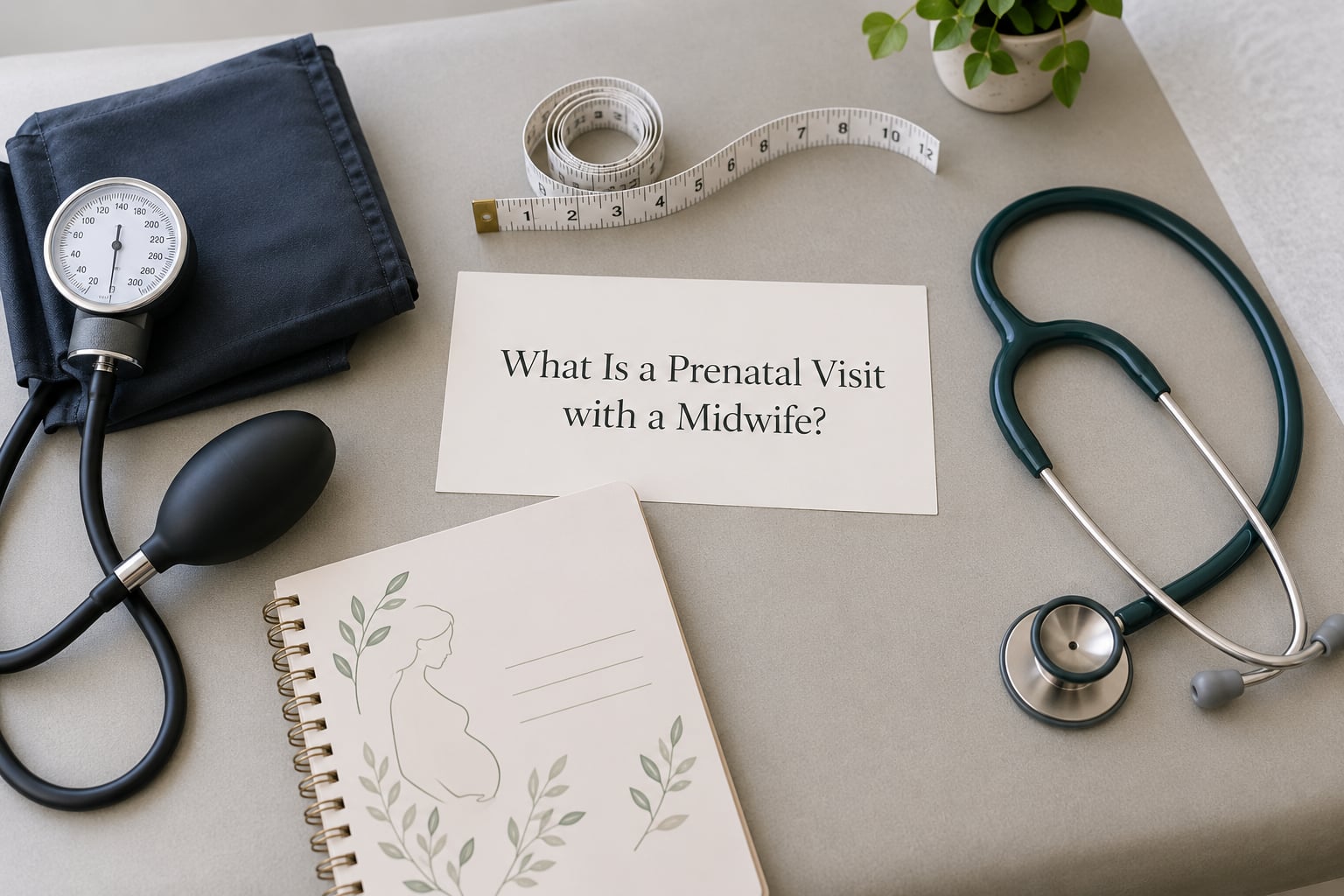
A prenatal visit is a scheduled appointment during pregnancy where a health professional tracks your health and your baby’s growth, screens for problems, and answers your questions before they become urgent.
A midwife is a trained professional who provides that care. In the United States there are three main credentials. A Certified Nurse-Midwife (CNM) is a registered nurse with additional midwifery training, usually working in a hospital, birth center, or clinic. A Certified Professional Midwife (CPM) specializes in out-of-hospital birth and typically attends home births. A Certified Midwife (CM) holds a graduate degree in midwifery without a nursing background. A licensed midwife is any of these, or a grandfathered or state-specific license such as a Licensed Midwife (LM).
What all of them share is a scope built around pregnancy, birth, and postpartum care. Routine prenatal care sits inside that scope. Inductions, surgery, and treatment for serious complications sit outside it, which is why every midwife practice has an arrangement for consultation and transfer with an obstetrician.
One more term you will hear a lot: continuity of care. It means seeing the same midwife, or a small team, across your pregnancy rather than a different stranger each time. It matters more than people expect, because it shapes how quickly someone notices a small change in your history or your baby’s movement pattern.
What Midwives Do at Prenatal Visits, Step by Step
Every visit has three parts: the checks, the conversation, and the plan. Knowing that structure makes the appointment less mysterious.
What Midwives Do at Prenatal Visits in Early and Middle Pregnancy
The early visits are heavy on history. Your midwife asks about past pregnancies, medications, allergies, chronic conditions, family history, and how you handle stress. She writes it all down, and it forms the risk assessment that guides the rest of your pregnancy.
Alongside that comes practical guidance: what to eat, what to avoid, how much activity is safe, how to sleep comfortably, and which over-the-counter medications are okay. First-time parents get more of this by default because there are no prior visits to build on.
Mid-pregnancy visits settle into a rhythm. Symptoms come up repeatedly, so each visit is partly a check-in on how the last two weeks went: nausea, heartburn, sleep, backache, bowel changes, and whatever else is new. Your midwife adjusts advice as the pregnancy changes, because the answer to “is this normal” in week 14 is not the answer in week 30.
How Midwives Check Maternal and Fetal Health
The standard checks at a routine prenatal visit usually include blood pressure, your weight, your baby’s heart rate, and fundal height once you are far enough along. Urine testing, fetal position checks, and growth assessments get added at certain points rather than every time.
- Blood pressure. Taken sitting, usually at the start. High readings can point to pre-eclampsia, which is one of the main things routine prenatal care exists to catch.
- Weight. Tracked against a recommended range for your pre-pregnancy weight and, if you have gestational diabetes, a stricter target.
- Urine. A dipstick may check for protein, glucose, or infection. Some practices test at every visit, others only at booking and when something prompts it.
- Fundal height. From about 20 weeks, the midwife measures from your pubic bone to the top of your uterus with a tape measure to track growth. It is a rough screening tool, not a precise one.
- Fetal heart rate. Heard with a handheld Doppler from roughly 10 to 12 weeks, and with a fetoscope later in pregnancy. The rate is counted over a minute or two.
- Fetal position. Palpated through the abdomen, often using the Leopold maneuvers, to feel how the baby is lying.
- Fetal movement. Counted by you and reviewed at later visits, along with a discussion of patterns that feel different.
What your midwife will not do: a routine internal or cervical exam before labor. You will not be asked to undress for most prenatal visits, and no vaginal exam is done to check your cervix unless there is a specific clinical reason and your consent. If you are offered one, you can ask why, what it involves, and whether it can wait.
Tests, Screening, and Referrals During Prenatal Care
Most lab work in prenatal care is ordered at specific weeks rather than at every visit. A common US pattern looks like this:
- First prenatal blood work: blood type and Rh factor, a screen for anemia, blood glucose, hepatitis B, HIV, syphilis, and rubella immunity, plus a blood group antibody screen if you are Rh negative.
- Genetic and carrier screening: offered around 10 to 13 weeks for conditions such as Down syndrome, and carrier screening for conditions like sickle cell or cystic fibrosis. Timing varies, and declining is a valid choice to discuss in detail.
- Genetic counseling: a one-on-one session, sometimes by video, to walk through screening options, their limits, and what happens next if a screen comes back unusual.
- Anatomy scan: typically around 18 to 22 weeks, done by ultrasound at a hospital, imaging center, or sometimes in-house.
- Glucose testing: a one-step or two-step screen for gestational diabetes, usually between 24 and 28 weeks.
- Group B strep test: between 36 and 37 weeks, to plan antibiotic treatment during labor if you test positive.
- Repeat labs: repeat antibody screens for Rh-negative clients, glucose retesting if the first screen is abnormal, and late-pregnancy testing when clinically indicated.
Immunizations come up at these visits too, including the flu shot and Tdap timing. Your midwife can order or refer for ultrasounds, genetic testing, and specialist consultations, and will arrange backup with an obstetrician if the pregnancy moves outside the low-risk range. Guidance shifts over time, so this guide reflects U.S. practice as of 2026; your midwife will follow what is current where you live.
How Midwives Support Emotional and Social Needs
Good prenatal care treats mental health as part of pregnancy health, not a separate issue. Midwives routinely ask about mood, anxiety, sleep, relationships, and how you are coping day to day.
Common screening tools are brief and standardized. If a score comes back high, that usually starts a conversation rather than ending one. From there a midwife might offer more frequent appointments, a referral to a perinatal mental health provider, practical help finding childcare or food support, or coordination with your obstetrician.
Practical problems come up alongside emotional ones. Feeding plans, childcare for the weeks around birth, transportation to appointments, and what support is available after you bring the baby home are all fair game for a prenatal conversation. If something you raise is outside what the practice can provide, a good midwife knows who to refer you to.
How Midwives Help You Plan for Birth
Birth planning usually starts in the second trimester and becomes concrete in the third. Your midwife will walk through your birth preferences: who you want with you, positions and movement you want to use, how you feel about monitoring, and what pain management options you want available if you are giving birth in a hospital.
Newborn decisions get covered too, including delayed cord clamping, newborn procedures, feeding, and the first hour after birth. Where you plan to give birth shapes the plan. Birth center clients review transfer criteria early. Home birth clients usually get a home visit before the due date so the midwife can see the space and confirm the setup.
Postpartum support is part of the conversation, not an afterthought. Ask about newborn visits, feeding support, healing after birth, and how to reach someone in the first weeks at home. It is a fair question to ask in the third trimester, not a strange one.
How Often Are Prenatal Visits with a Midwife?
Most people in the U.S. have roughly 12 to 14 prenatal visits across a low-risk pregnancy, with the schedule slowing down in the middle and speeding up at the end.
| Weeks of gestation | Typical visit frequency | What usually happens |
|---|---|---|
| 8 to 12 weeks | One booking visit | Full history, risk assessment, baseline vitals, lab requisitions, first ultrasound referral |
| 12 to 16 weeks | One or two visits | Screening discussion, symptom review, early genetic counseling if wanted |
| 16 to 20 weeks | Monthly | Fundal height begins, fetal heart tones, nutrition and activity review |
| 20 to 24 weeks | Monthly | Anatomy scan, position checks, glucose testing scheduled |
| 24 to 28 weeks | Monthly | Gestational diabetes screen, weight trajectory, mental health check-in |
| 28 to 32 weeks | Every two weeks | Growth and position checks, birth plan drafting, feeding preparation |
| 32 to 36 weeks | Every two weeks | Group B strep test at 36 to 37 weeks, presentation checks, hospital or birth center orientation |
| 36 to 40 weeks | Weekly | Presentation and position, induction and membrane sweep discussion, signs of labor review |
| 40 to 41 weeks | Weekly or more often | Ongoing monitoring and a shared decision about timing and options |
Appointments commonly run 30 to 45 minutes, which is long enough for a real conversation. Visits get scheduled more often for a multiple pregnancy, a previous complicated birth, blood pressure concerns, gestational diabetes, or a baby measuring outside the expected range. A midwife also has latitude to see you sooner if something worries you, and you do not need to justify that.
How to Prepare for a Prenatal Visit

Ten minutes of prep turns a vague appointment into a productive one. Write things down. People forget their questions in the parking lot more often than they would like to admit.
- Your questions, in order. Three to five is plenty. Put them where you will see them before you leave home.
- Medications and supplements. Bring names and doses, including anything you take occasionally and any herbal products.
- Symptoms since the last visit. Even small ones. A midwife cannot connect a change they never heard about.
- Nutrition concerns. Food restrictions, appetite changes, nausea, questions about caffeine, fish, or alcohol.
- Home measurements if advised. Blood pressure, fetal movement, or weight, depending on your plan.
- Paperwork. Insurance card, referral forms, lab requisitions you need signed, and records from another provider if care is being shared.
- A support person, if you want one. Most practices allow a partner or friend. Some visits are easier with a second set of ears.
Useful questions to ask early: who will be my primary midwife, what happens if I go into labor out of hours, what is your transfer arrangement, and what do you recommend I do if I have a symptom outside appointment hours?
When Does a Midwife Refer You to Another Provider?
A referral usually means your care now needs a level of expertise or a treatment option outside midwifery scope. It is a planned safety step, not a verdict on your pregnancy.
Common triggers include high blood pressure or signs of pre-eclampsia, gestational diabetes that needs medication, a small or large-for-dates baby, reduced fetal movement, bleeding, fluid concerns, a multiple pregnancy, a prior birth that was traumatic, or a medical condition that was not present before pregnancy. Referrals also happen for things you simply want: genetic counseling, a maternal-fetal medicine specialist, a specific diagnostic test, or an epidural request in a setting that does not provide one.
There are three levels of involvement. A consultation means an obstetrician reviews your chart and offers advice while you stay with your midwife. A co-management arrangement means both providers share your care. A transfer means you move to the obstetrician for the remainder of your pregnancy. Ask your practice which of these it uses for each situation, so the answer is not a surprise later.
If your pregnancy moves into higher-risk territory, you can still keep your midwife involved in postpartum and newborn care. Ask about it rather than assuming everything has been handed over.
Frequently Asked Questions
What happens at a first prenatal visit with a midwife?
Expect history, paperwork, and baseline measurements rather than an exam. Your midwife reviews medical, obstetric, family, and lifestyle history, checks blood pressure, height, and weight, may collect a urine sample, listens for the baby’s heartbeat if you are far enough along, and sends lab requisitions for blood work and genetic screening. Most first visits involve no undressing and no internal exam.
Do midwives usually do ultrasounds during prenatal visits?
Usually not in the room. A dating scan and the mid-pregnancy anatomy scan are typically done at a hospital, imaging center, or in-house facility on a separate date, and your midwife reviews the images with you at a later appointment. Some birth centers offer ultrasound on site. Ask your practice how imaging is arranged and who communicates results to you.
Can a midwife help with anxiety or depression during pregnancy?
Yes. Prenatal visits commonly include a brief mental health screen, and midwives can talk through mood changes, anxiety, sleep problems, and stress at any point. If symptoms are significant, they can refer you to a perinatal mental health provider, increase the frequency of your appointments, or involve your obstetrician. Low mood during pregnancy is common and treatable, so raising it early is worth it.
Can I use a midwife if I am planning a hospital birth?
Most likely yes. Certified Nurse-Midwives and many Certified Midwives attend births in hospitals alongside obstetricians, handling routine prenatal care, labor support, and normal delivery, with the OB available if something changes. Birth center clients may transfer to a hospital partner for a higher-risk situation. Confirm your hospital, your credential, and the backup arrangement before you book.
What should I bring or ask at my first midwife appointment?
Bring a list of medications and supplements, insurance and referral paperwork, your family medical history, and three to five written questions. Good opening questions: who will be my primary midwife, what is your transfer arrangement, what happens after hours, and how do I reach you between appointments. Write the questions down, because they are easy to forget in the room.
Why might my midwife refer me to an obstetrician?
Most often for a complication or a treatment option outside midwifery scope, such as high blood pressure, gestational diabetes needing medication, bleeding, reduced fetal movement, a multiple pregnancy, or an anomaly scan finding. Some referrals are routine, like requesting an epidural or genetic counseling. Ask what your practice’s consultation and transfer criteria are, and you will rarely be caught off guard.
What to Do First
Start with three concrete steps. Find a licensed midwife whose setting matches where you want to give birth, then ask the practice the questions you would ask any provider: who leads your care, what happens after hours, and what are the transfer arrangements.
Before the first appointment, write down your medications, your questions, and anything you are worried about. Bring it with you. Knowing what midwives do at prenatal visits helps, but showing up prepared is what changes the appointment itself.
Any symptom that feels urgent does not wait for your next visit. Contact your midwife, your clinician, or urgent care the same day, and get emergency help for heavy bleeding, severe headache or vision changes, chest pain, difficulty breathing, fever, or a significant decrease in fetal movement.