Learning how to become a midwife in the United States starts with one decision: which of the three credentials you want to hold. You then complete an accredited midwifery program, pass the national certification exam your credential requires, and apply for authorization to practice in the state where you intend to work.
Expect anywhere from three years to eight years from your first class to your first day on the job, depending on where you start. If you already hold a nursing degree, the timeline shortens considerably. If you are coming from a completely different field, the direct-entry route may be faster but narrower.
Table of Contents
- What You Need to Become a Midwife in the United States
- Choose the Midwifery Career Path That Fits You
- Step-by-Step: How to Become a Midwife in the United States
- Step 1: Research Midwifery Careers and Work Settings
- Step 2: Choose CNM, CM, or CPM
- Step 3: Meet the Program’s Prerequisites
- Step 4: Apply to an Accredited Midwifery Program
- Step 5: Complete Didactic Learning and Clinical Rotations
- Step 6: Earn Required National Certification
- Step 7: Get State Authorization or Licensure
- Common Mistakes
- Frequently Asked Questions
- Do you need a nursing degree to become a midwife in the United States?
- What is the difference between a CNM, CM, and CPM?
- How long does it take to become a midwife in the United States?
- Is a certificate or degree required to become a certified professional midwife?
- Can a midwife practice in every US state with the same credential?
- What should I ask before choosing a midwifery program?
- Start With Your Path and State
What You Need to Become a Midwife in the United States
There are three recognized midwifery credentials in this country, and each one comes with a different educational foundation. Certified Nurse-Midwives (CNMs) and Certified Midwives (CMs) complete graduate-level midwifery programs accredited by the Accreditation Commission for Midwifery Education (ACME). Certified Professional Midwives (CPMs) complete a different kind of program, accredited by the Midwifery Education and Accreditation Council (MEAC) or approved through an apprenticeship track, and then earn certification from the North American Registry of Midwives (NARM).
| Credential | Educational Foundation | Professional Organization | Clinical Preparation | Common Work Settings |
|---|---|---|---|---|
| Certified Nurse-Midwife (CNM) | Registered nursing degree, then an ACME-accredited master’s or doctorate | American College of Nurse-Midwives (ACNM) | Graduate clinical rotations plus a national certification exam | Hospitals, birth centers, community clinics, home birth |
| Certified Midwife (CM) | Non-nursing bachelor’s degree, then an ACME-accredited master’s | American College of Nurse-Midwives (ACNM) | Graduate clinical rotations plus a national certification exam | Hospitals, birth centers, community clinics |
| Certified Professional Midwife (CPM) | MEAC-accredited program, approved apprenticeship, or combination | Midwives Alliance of North America (MANA) and similar state associations | Extensive out-of-hospital clinical training; NARM certification exam | Home birth, birth centers, independent practice |
Every pathway asks for some version of the same foundation: a high school diploma or equivalent, solid grades in science courses, and the physical and documentation requirements of a clinical placement. Programs commonly ask for a background check, proof of immunizations, current CPR and neonatal resuscitation certification, and health documentation covering tuberculosis testing and, in many cases, hepatitis B and HIV screening.
Requirements are not identical across accrediting organizations or individual schools. The only reliable way to know what you need is the official checklist from the specific program you are applying to.
Choose the Midwifery Career Path That Fits You
The right pathway depends on where you are starting and where you want to end up. Someone who already works as a registered nurse has a shorter road to a CNM, and that credential is the most widely recognized for practice in hospitals and integrated health systems. A career changer with a bachelor’s degree in an unrelated field can enter through a CM program at the graduate level, though the CM credential is not recognized everywhere.
A CPM route centers on out-of-hospital birth. If your goal is home birth and independent practice, this is the path built for that work. Practitioners who have trained through both routes describe them as genuinely different trainings rather than two versions of the same job, and that distinction is worth sitting with before you sign anything.
Geography should shape your thinking too. Midwifery authorization is handled state by state, and the rules differ by credential. Decide the state or region you want to work in, then confirm that your chosen credential is recognized there before you commit to a program.
What about hours? Hospital-based nurse-midwifery usually includes on-call rotations. Birth-center and salaried clinic positions are more predictable. Independent home-birth practice puts you fully in charge of your own call schedule, which is exactly what some people want and exactly what others do not.
Step-by-Step: How to Become a Midwife in the United States
Step 1: Research Midwifery Careers and Work Settings
Before you apply anywhere, know what the work actually looks like day to day. Midwives do prenatal visits, manage labor and delivery, care for postpartum patients and newborns, and provide well-woman gynecologic care. Some spend most of their time in a hospital labor and delivery unit; others are in a birth center or a home practice with a very different rhythm.
Talk to people doing the work. ACNM, MANA, and state midwifery associations run mentoring programs, and many hospital and birth-center midwifery units host prospective students. Ask about schedule demands, call requirements, and how long people stay in the role.
You have finished this step when you can name a likely credential, a preferred work setting, and a short list of questions you want a program to answer.
Step 2: Choose CNM, CM, or CPM
CNMs start from nursing. You earn a registered nurse license, work in the field, then complete an ACME-accredited graduate program in midwifery and pass the American Midwifery Certification Board (AMCB) exam. CMs take the same graduate midwifery education without the nursing foundation, and they sit for the same AMCB exam. CPMs complete a MEAC-accredited or apprenticeship pathway built for out-of-hospital practice, then take the NARM exam.
Before you decide, check the credential names your target state actually authorizes. Titles get used loosely in job ads, and a job posting calling someone a midwife tells you nothing about the credential behind it. Look up the statute and the licensing authority rather than the job description.
Step 3: Meet the Program’s Prerequisites
Typical prerequisite categories include anatomy and physiology, microbiology, chemistry, physics, math, English composition, psychology, sociology, and public health. Nursing-based routes ask for an associate or bachelor’s degree in nursing and a valid RN license. Non-nursing routes generally ask for a bachelor’s degree in any field, with a minimum grade point average that varies by school.
Get the official prerequisite checklist in writing and have your transcript evaluated before you register for anything. Prerequisite courses are often the slowest and most expensive part of the plan, because you have to take them one term at a time before you are allowed to start the program.
One more thing worth knowing: some people complete a doula certification first. It is not a prerequisite for any of the three pathways, and it is a completely separate non-clinical role, but it is a reasonable way to experience birth work up close before committing.
Step 4: Apply to an Accredited Midwifery Program
Accreditation is the first filter. For CNM and CM programs, look for ACME accreditation. For CPM programs, look for MEAC accreditation or a NARM-approved apprenticeship. Everything else is secondary.
Then compare the practical details: program length, total cost, class format, where clinical placements happen, graduation requirements, and whether the credential is recognized in the state where you plan to practice. A program’s own site should state whether it is accredited and where its students do their placements. If that information is hard to find, treat it as a warning sign.
Applications usually ask for official transcripts, letters of recommendation, a personal statement, an interview, and a background check with results sent directly to the program. A good application ends with a clear enrollment offer and a financial plan you can actually carry.
Step 5: Complete Didactic Learning and Clinical Rotations
Coursework covers pregnancy, birth, postpartum and newborn care, gynecology, pharmacology, diagnostics, evidence-based practice, counseling, ethics, and the social factors that shape health outcomes. Classes are demanding, and most programs pair them with clinical work from early on.
Rotations place you with a preceptor for continuity of care, prenatal care, labor and birth, postpartum care, and newborn assessment. You will write charting, follow protocols, and learn when to call an obstetrician. Some programs include a final year of full-scope clinical placement where you carry a caseload under supervision.
Before enrolling, ask how many placements the program requires, where they are located, and who arranges them. Clinical supply is a real constraint in some regions, and a program that cannot place you is a program that cannot graduate you on time.
Step 6: Earn Required National Certification
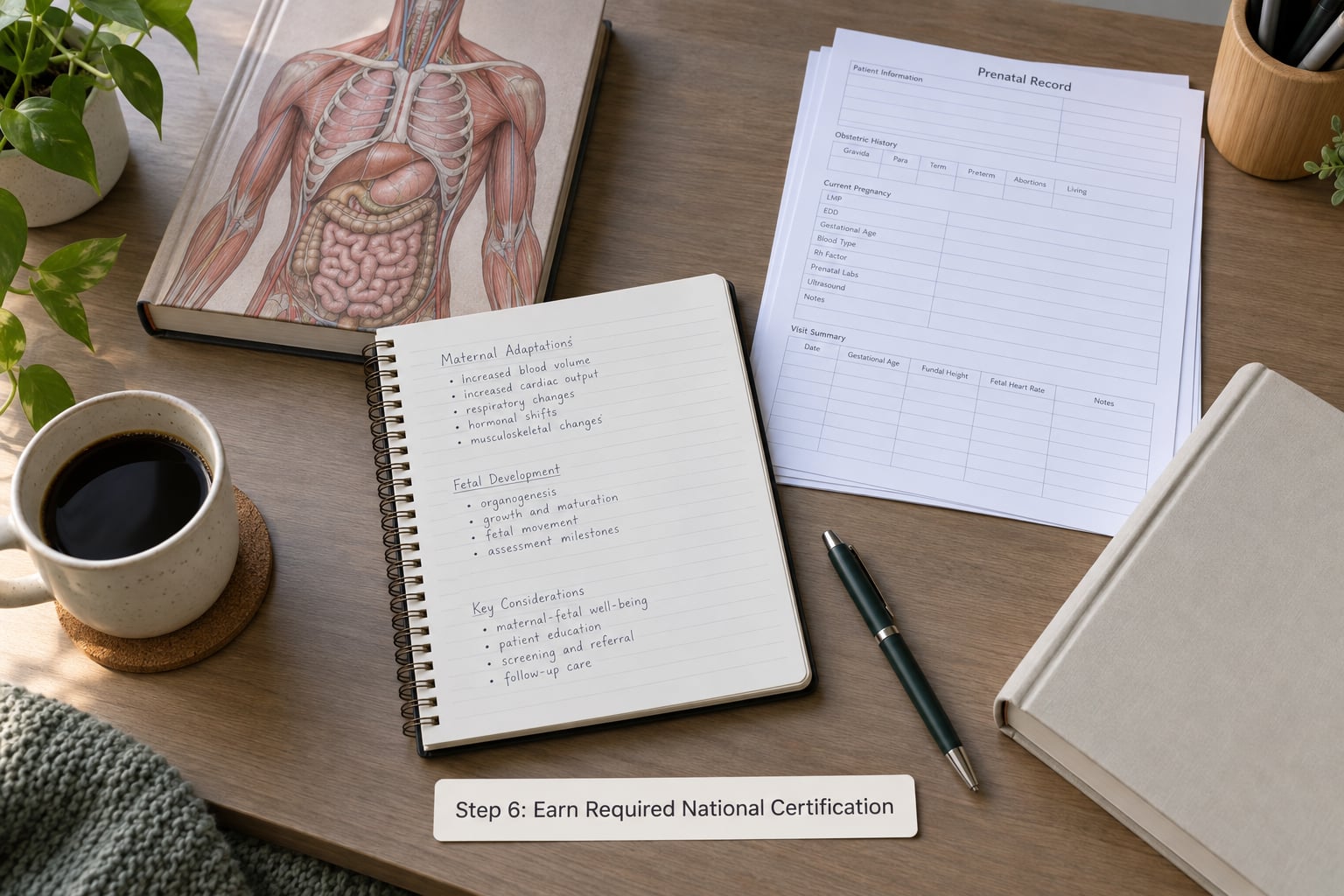
The CNM and CM routes end in the AMCB certification exam, a computer-based exam offered at authorized testing sites. The CPM route ends with the NARM certification exam, which uses a portfolio-based assessment rather than a single written test for many candidates.
Expect registration fees, scheduling, identity verification at the test center, and score reporting. Once certified, both routes require ongoing certificate maintenance on a set cycle with continuing education requirements, and a lapsed credential is a career problem you want to avoid before it happens.
Confirm the current exam format, fees, and maintenance requirements directly with AMCB or NARM. Requirements get updated, and program staff often learn about changes after you do.
Step 7: Get State Authorization or Licensure
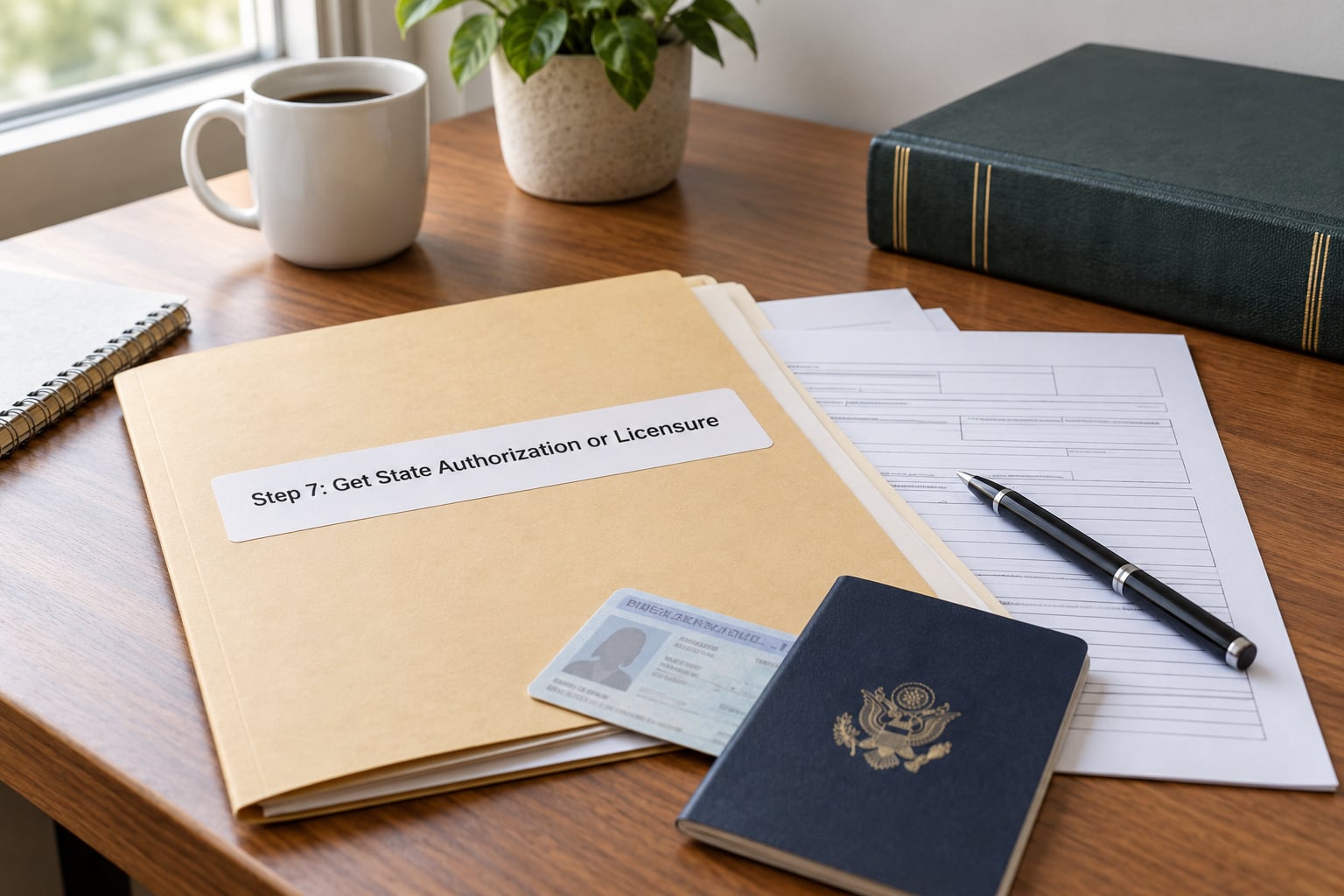
Finishing a program or passing an exam does not authorize you to practice. Every state sets its own rules, and most require a separate application to a state board of nursing, state midwifery board, or health department.
The process usually involves confirming that your credential is recognized in that state, submitting an application with your certificate and transcript, disclosing any disciplinary or criminal history, and completing any state-specific education or testing. Some states require a jurisprudence or orientation course before the first license issues.
If you plan to move after certification, go through this process again in your destination state before you accept a job. Licenses do not transfer automatically, and practicing in a state that does not recognize your credential exposes you and your patients to real risk.
Common Mistakes
Picking a program before picking a state. The fix is simple: decide where you want to practice, then confirm the credential is recognized there. It saves an expensive transfer later.
Assuming nursing is required for every route. It is not. CM and CPM pathways exist precisely for people without an RN license. Assuming otherwise sends career changers down a road they did not need.
Confusing certification with licensure. Passing the AMCB or NARM exam means you are certified. Practicing legally means you are authorized in a specific state. You need both, and they come from different bodies.
Ignoring clinical placement logistics. Ask where rotations happen and how many you need. A program with limited placement access in your area can stretch your timeline by a year.
Waiting to fix prerequisite gaps. If a science course is missing, find out in month one, not month nine. Official transcript evaluation early prevents a surprise that stops your application.
Looking at tuition instead of total program cost. Fees, books, clinical attire, travel to placements, exam registration, and licensing costs add up. Ask for a full-cost estimate for the whole program, and talk to a financial aid office the same week you apply.
Relying on old forum posts and listicles. Midwifery education and state authorization rules change. Use those sources for honest impressions, then verify anything that matters with the accrediting body, the certifying body, and your state board.
For students financing the long route, ask early about federal student aid, state scholarship programs, and whether military education benefits apply to midwifery programs in your situation. Eligibility rules differ by program type, and the answers are not always published clearly.
Frequently Asked Questions
Do you need a nursing degree to become a midwife in the United States?
No. Only the Certified Nurse-Midwife route starts with nursing. The Certified Midwife pathway takes you straight into graduate midwifery school with a non-nursing bachelor’s degree, and the Certified Professional Midwife route is built for people with no nursing background at all, using an accredited program or an approved apprenticeship. All three require a high school diploma or equivalent, and all three end with national certification and state authorization.
What is the difference between a CNM, CM, and CPM?
A CNM begins with an RN license and can practice in any setting a state’s law allows, including hospitals. A CM completes the same graduate midwifery curriculum without the nursing foundation and holds a certificate from the same certifying board. A CPM is trained and certified specifically for out-of-hospital birth, with home and birth-center practice at the center. Recognition varies by state, which is the deciding factor for many students.
How long does it take to become a midwife in the United States?
From high school, a Certified Professional Midwife can finish in roughly three to four years. A Certified Midwife usually needs about four to six, including a bachelor’s degree. A Certified Nurse-Midwife takes six to eight years when you count nursing school, licensure, and a graduate midwifery program. If you already hold an RN license, that number drops sharply. Part-time and bridge options add time.
Is a certificate or degree required to become a certified professional midwife?
A degree is not required, but a recognized training pathway is. CPM candidates complete a MEAC-accredited midwifery program, a NARM-approved apprenticeship, or a combination of both, along with required clinical experience. Apprenticeship models let you learn through a working midwife, often with home birth as the primary setting. Certification then comes through the North American Registry of Midwives.
Can a midwife practice in every US state with the same credential?
No. Nurse-midwives have the broadest recognition, with CNM practice authorized in all 50 states, the District of Columbia, and US territories. Certified Midwife recognition exists in only a small number of states. Certified Professional Midwife registration varies widely by state, and some states have no registration process at all. Check the licensing authority in your intended state before you commit to a program.
What should I ask before choosing a midwifery program?
Ask whether the program is accredited, by which body, and whether your credential will be recognized in the state where you plan to work. Ask how many clinical placements are required, where they take place, and who arranges them. Request a written total cost for the full program, the graduation and certification rates, and the recertification requirements. Then ask current students what they wish they had known.
Start With Your Path and State
Three things to do this week. Name the credential that matches your background and the work you want to do. Look up the licensing authority in the state where you plan to practice and confirm your credential is recognized there. Then request the official prerequisite checklist and program checklist from two or three accredited programs and compare them side by side.
That is how to become a midwife in the United States without expensive surprises: research, choose, apply, complete clinical training, certify, and get authorized. Requirements and authorization rules change, so base every final decision on current information from the accrediting body, the certifying body, and your state board rather than on a forum post or an article written a few years ago.