Indigenous maternal health disparities persist because the systems built to care for pregnant Indigenous women were never designed with them in mind, and because decades of chronic underfunding, geographic isolation and racism compound each other rather than acting as separate problems. No single cause explains the gap. It is the interaction of a care system that treats tribal communities as an afterthought, a workforce with almost no Indigenous clinicians, and data systems that struggle to count these deaths accurately.
This guide walks through the causal chain in plain language, with the year and source attached to every figure. It is educational information, not medical advice, and it does not treat any nation as a single uniform group. Outcomes differ sharply between urban and rural tribal communities, between regions, and between nations, and those differences are part of the story.
Data current as of 2026. Figures are dated individually because the underlying federal surveillance data lag by several years.
Table of Contents
- What Are Indigenous Maternal Health Disparities?
- What maternal mortality and maternal mortality ratio mean
- What severe maternal morbidity means
- What a preventable maternal death means
- What the indicators show
- Why Indigenous Maternal Health Disparities Persist
- How Colonial Displacement Still Shapes Maternal Care
- How Structural Racism Biases Treatment and Diagnosis
- How structural racism biases pain assessment and referral
- Why trust is a clinical variable
- Why Tribal Mothers Face Access Gaps
- Shortages and closures
- Distance, transportation and weather
- Insurance, language, childcare and digital access
- The emergency department substitution
- Why Cultural Support and Indigenous Birth Knowledge Are Often Lost
- How Data Gaps Can Hide the Size of the Problem
- What undercounting looks like in practice
- What Would Help Reduce the Disparities?
- Sustainable funding and tribal governance
- Building an Indigenous workforce
- Removing the practical barriers
- Respectful care and continuity
- Better data systems
- Frequently Asked Questions
- Are Indigenous maternal mortality rates higher in every US state?
- What is the biggest cause of Indigenous maternal health disparities?
- How does structural racism affect Indigenous mothers during childbirth?
- Why are rural Indigenous families more likely to travel far for maternity care?
- What is culturally safe maternal care for Indigenous women?
- How can non-Indigenous hospitals improve care for Indigenous patients?
- Conclusion
What Are Indigenous Maternal Health Disparities?

Indigenous maternal health disparities are the persistent and unequal differences in pregnancy, birth and postpartum outcomes experienced by Indigenous women and birthing people compared with other populations. In the United States that gap shows up as roughly twice the pregnancy-related death rate of non-Hispanic white women, higher rates of severe maternal morbidity, preterm birth and low birth weight, and much less access to early prenatal care.
Four terms carry most of the weight in this field, and it helps to have them straight before looking at causes.
What maternal mortality and maternal mortality ratio mean
Maternal mortality is the death of a person during pregnancy or within about a year after the end of pregnancy. The maternal mortality ratio is the number of those deaths per 100,000 live births. Every other group in the wealthy world, Indigenous or not, has a higher ratio than the United States overall, and the American rate has roughly tripled since 1987.
What severe maternal morbidity means
Severe maternal morbidity describes the near misses: hemorrhage requiring transfusion, infection, blood clots, injury to the uterus or organs, or an intensive care stay. Morbidity data matter because the same things that cause these complications also cause the deaths, and because a near miss is easier to study than a death in a small population.
What a preventable maternal death means
A preventable death is one that a reasonable, well-resourced care system could have avoided or substantially delayed. Reviews typically split responsibility among the patient, the provider, the hospital and the wider system. In Maternal Mortality Review Committee data, provider and system-of-care factors jointly account for a majority of the deaths, which is why the question is not usually whether a patient could have done more.
What the indicators show
| Indicator | Indigenous figure | Comparison | Year and source |
|---|---|---|---|
| Pregnancy-related death rate | 29.7 per 100,000 live births | About twice the non-Hispanic white rate | CDC MMWR, 2007-2018 |
| Risk in a single state review | More than seven times the non-Hispanic white risk | State panel figure | Washington maternal mortality review panel |
| Preventable deaths in surveyed tribal regions | 93 percent estimated preventable | Some regions up to seven times the national AI/AN rate | HRSA, Making Amends |
| Preventability in one state review | Over 80 percent of deaths preventable | State panel figure | Washington panel |
| Missing race and ethnicity data in one national analysis | About 6 percent of observations | Limits every subgroup estimate | Peer-reviewed analysis, PMC 7012336 |
| Provider and system-of-care share | 56.5 percent of patient deaths | Largest single accountability category | Maternal Mortality Review Committees |
Read that table as a floor rather than a ceiling. The most recent surveillance data in this area describe the 2017 to 2019 period, and the reviews above cover only a subset of tribal regions. Better current figures are arriving, but slowly.
Why Indigenous Maternal Health Disparities Persist
The direct answer is a chain, not a list. Each link makes the next one harder to escape, and a person who runs into any one of them is likely to meet several at once.
- Chronic underfunding of tribal health systems. Per-need appropriations that have not kept pace with inflation mean fewer beds, fewer staff and maternity wards that cannot be staffed.
- Geographic isolation and maternity ward closures. When a labor and delivery ward closes, the distance to the next one becomes a clinical fact, not a convenience.
- A workforce with almost no Indigenous clinicians. Native Americans are under 1 percent of the midwifery workforce, and about 90 percent of Native birthing people deliver in a hospital with a non-Native provider.
- Structural and interpersonal racism. Bias shows up in pain assessment, referral decisions, communication style and diagnostic delay, and it is written into institutional policies as well as living in individual behavior.
- Social and environmental conditions. Diabetes and hypertension, housing insecurity, water insecurity and food access all raise risk before anyone reaches a clinic door.
- Eroded reproductive rights. The Hyde Amendment and post-Dobbs state restrictions push some care across state lines and create gaps that tribal facilities then have to absorb.
- Data invisibility. Incomplete tribal identifiers and inconsistent ethnicity coding in vital statistics mean a share of these deaths never make it into the national counts at all.
Each item below takes one of these in turn, and where the evidence is strong I will say so. Where it is thin, I will say that too, because overstating certainty about Indigenous lives is its own kind of harm.
How Colonial Displacement Still Shapes Maternal Care
Colonial displacement shapes maternal care today because land loss and forced relocation changed the physical conditions that make pregnancy and birth safe. Health does not follow policy changes; it follows what those changes did to housing, water, food and family networks, and that effect is still measurable.
Displacement separated families from the multigenerational support structures that make postpartum recovery possible. It moved people onto land where drinking water, sanitation and housing quality are worse than nearly anywhere else in the country, and it placed rural communities hours from a hospital with an obstetric unit. A mother who has to drive four hours to a prenatal appointment is not making an irresponsible choice; she is responding to the distance she was given.
The boarding school and forced sterilization eras left a second legacy. Children raised apart from their families and mothers who were sometimes sterilized without consent are part of the family memory many people bring into a hospital. When a patient is frightened of the clinical setting and does not know who will be allowed in the room, that history is the reason, not a character flaw.
Chronic underfunding is the mechanism that keeps all of this in place. Federal responsibility for tribal health has been defined by a trust responsibility and treaty obligations, yet appropriations per patient have stayed flat for long stretches while costs rose. That produces the exact conditions the mortality reviews describe: maternity wards that close, waiting lists that lengthen, and referral networks stretched across hundreds of miles.
One consequence documented by Indigenous-led health organizations is stark. After labor and delivery wards closed at some Indian Health Service facilities, some Native birthing people waited up to six weeks for a first prenatal visit. In Alaska, some patients are transported to regional maternity homes at around 36 weeks because the care they need does not exist near home.
How Structural Racism Biases Treatment and Diagnosis
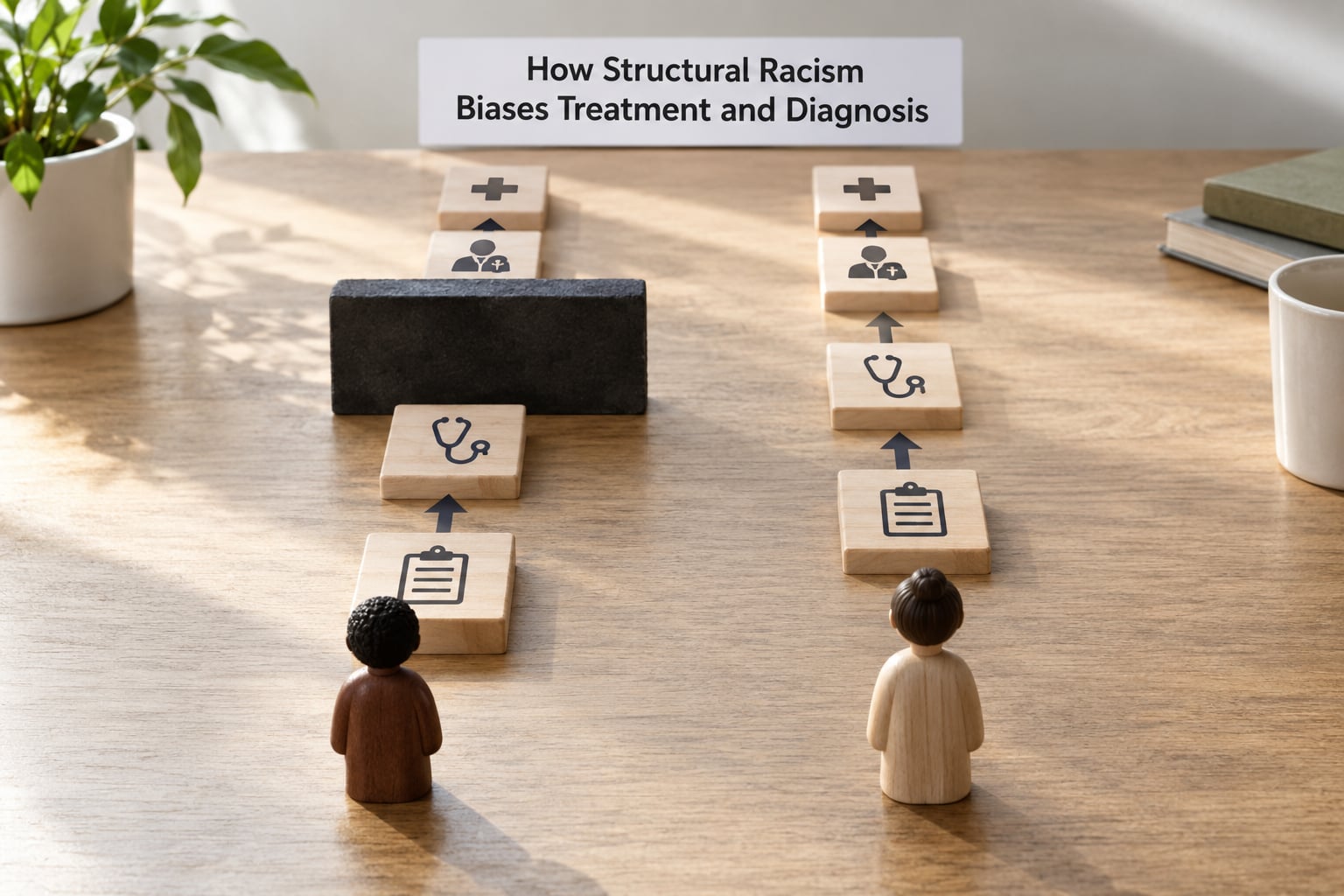
Structural racism biases treatment through two channels that reinforce each other. Interpersonal bias lives in individual judgments about whose pain is real and who is a reliable reporter. Structural racism lives in policies, staffing, triage rules and referral patterns that produce the same outcome regardless of any one clinician’s intent.
How structural racism biases pain assessment and referral
Indigenous women are more likely to have their pain downplayed, their reports questioned and their symptoms attributed to substance use rather than investigated, according to published research on discrimination in Native American birth and midwifery. The mechanism is rarely a single spectacular incident. It is a series of small decisions: pain rated lower, an abnormal vital sign deferred, a referral not placed until the patient returns a third time.
Institutional policies can do this work efficiently. Standing orders that require a specific threshold before a provider must see a patient, triage scripts written around assumptions about who is likely to over-report, and quality improvement reviews that strip out race and ethnicity all produce identical patterns of delay without anyone intending harm. The MMWR literature on pregnancy-related deaths recommends addressing implicit bias and structural racism explicitly, which tells you how seriously the public health agencies take it.
Diagnostic delay matters enormously in the specific conditions that kill most often during and after pregnancy: hemorrhage, hypertensive disorders, cardiac disease, infection and thromboembolism. Each of those has a short treatment window. Every hour of hesitation moves a survivable problem toward a fatal one.
Why trust is a clinical variable
When patients tell researchers that they do not trust the health system, that is not a soft sentiment. It predicts late prenatal care, missed appointments, withheld symptoms and reluctance to return for postpartum warning signs that need action within hours. Distrust of institutions is a rational response to institutional failure, and it belongs in any honest account of why outcomes differ.
Public health and medicine communities generally treat Indigenous maternal mortality as a systems and structural racism problem rather than a patient-behavior problem, which is consistent with how Maternal Mortality Review Committees allocate responsibility. That framing is not new, and neither is the evidence behind it.
Why Tribal Mothers Face Access Gaps
Tribal mothers face access gaps because the practical steps between deciding to get care and receiving it are each a separate place to fail. There is rarely one wall; there are a dozen small ones, and missing any single one can stop the visit.
Shortages and closures
Fewer maternity care professionals in rural tribal communities means appointments get pushed out by weeks. When a labor and delivery ward loses its nursing staff, it closes, and closure is not a scheduling inconvenience. It converts a twenty-minute drive into an overnight stay for every patient who needs it after that point.
Distance, transportation and weather
Tribal lands cover enormous areas, and remote clinics can be separated from referral hospitals by long stretches of road with unreliable service, no cell coverage and severe weather that closes highways. Ground and air ambulance services are unevenly distributed, and air transport can cost more than many families can absorb even when insurance pays part of it.
Insurance, language, childcare and digital access
Coverage gaps, prior authorization requirements for tribal members who receive care through the Indian Health Service and managed-care arrangements, and state-by-state variation in Medicaid all add friction. Language access matters where English is not the language of daily life, and clinic forms and discharge instructions rarely account for it well. Childcare decides whether a second appointment happens at all. And broadband failure on reservation means telehealth, which is often offered as the solution, silently excludes the people with the worst access.
The emergency department substitution
When preventive care is unaffordable or unreachable, the emergency department absorbs the gap. That means more people arrive in crisis, with conditions that would have been caught at a routine prenatal visit, and less attention to the relationship and continuity that make earlier detection possible. It also puts the cost of an underfunded primary system onto the most expensive door in the building.
Why Cultural Support and Indigenous Birth Knowledge Are Often Lost
Cultural support and Indigenous birth knowledge get lost because clinical protocols are written for a standardized patient and staffed for speed rather than continuity. When room standards, visitor policies and monitoring rules allow no flexibility, families, community members and traditional knowledge holders become visitors in their own birth.
Western models of the family also misread multigenerational household structures. Grandparents, aunts and older siblings who manage childcare, transport, food and ceremony are usually counted as dependents rather than as part of the care plan, even though they are the reason a mother can attend an appointment at all. A care plan that ignores them removes the family’s actual support system and then blames her for missing follow-up.
Traditional and customary knowledge includes herbal medicine, Indigenous-led birth practices, ceremony and community-based postpartum care. Some of it is protected or specific to particular nations and should not be published at all. What is useful to say plainly is that these practices were interrupted by forced relocation, boarding schools and criminalization, and that restoring them is a question of tribal sovereignty rather than a clinical preference to be negotiated.
Culturally safe care is not a stereotype. It does not mean assuming a patient wants a particular ceremony or declines a particular intervention. It means the clinician asks what support this person wants, invites family on their terms, explains consent in language they actually understand, and treats a refusal after a long history of unconsented procedures as something to understand rather than override.
How Data Gaps Can Hide the Size of the Problem
Data gaps hide the size of the problem because the people counting deaths make choices about who counts, and those choices change the numbers. Indigenous people are not misclassified in every dataset, and it would be wrong to claim that. But the measurement problem is documented, it is studied in peer-reviewed work, and two of the top research results on this question are about it.
What undercounting looks like in practice
How a state or agency defines its Indigenous identification criteria decides who enters the category at all. Tribes differ in who they enroll, and if a maternal death is recorded against a name or parentage that does not match a tribal roll, it never becomes an Indigenous death in that dataset. In one national analysis of severe maternal morbidity, about 6 percent of observations had missing race and ethnicity data, which is enough to distort every subgroup estimate built on it.
Fragmentation compounds this. A patient may deliver at one hospital, transfer to a tertiary center and receive postpartum care through a tribal clinic, with each record carrying a slightly different identifier. Mortality reviews depend on linking those records, and linking fails quietly. Small numbers add a further problem: in some communities the annual count is small enough that year-to-year swings look dramatic and are mostly noise, which can make a real improvement look like a spike.
Changing tribal data systems have the same effect in reverse. When a tribal health department replaces or retires a system, historical series break, and a gap gets read as a change in health rather than a change in record-keeping.
The consequence is practical. Programs get sized against understated numbers, funding gets allocated against a denominator that is too small, and nobody is held accountable for deaths that were never counted. Tribal data governance, where communities control how their information is collected and shared, is part of the answer precisely because of this.
What Would Help Reduce the Disparities?
What would reduce Indigenous maternal health disparities is a set of changes that are already being tested in tribal and rural programs: durable funding, tribal governance of care, a workforce that reflects the population, better transport and connectivity, paid time off, respect in the clinical encounter, community-based support and data that tribes control. Individual effort helps at the margins. It cannot substitute for any of it.
Sustainable funding and tribal governance
Appropriations that rise with need and with cost, rather than staying flat, are the base condition. Tribal governance matters as much as the money: services designed and run by tribal health authorities for tribal citizens consistently do better on measures of trust and follow-up than services designed centrally for a population the designers did not live among.
Building an Indigenous workforce
Native midwives, Native doulas and tribal community health representatives close distance in a way no cultural competence module does. Under 1 percent of the midwifery workforce being Native is a pipeline problem with a long lead time, and doula training programs run by tribal organizations address the immediate gap while the longer pipeline is built. Emergency obstetric training for rural first responders matters too, because it covers the minutes between a call and a transfer.
Removing the practical barriers
Transport reimbursement, maternity homes where regional care requires relocation, telehealth done with connectivity rather than assuming it, paid family leave that includes birth and postpartum, and childcare at appointments are unglamorous and effective. AIM Bundles, the Alliance for Innovation on Maternal Health’s standardized clinical protocols for hemorrhage, hypertension and sepsis, have been adopted in tribal hospitals and target exactly the complications that kill fastest.
Respectful care and continuity
Training clinicians to ask rather than assume, involving family on the patient’s terms, honoring consent history, and improving postpartum contact in the first six weeks address the bias and distrust that drive late presentation. Continuity of care, so that the same people follow up across prenatal, birth and postpartum, is one of the few interventions that reliably moves both outcomes and trust.
Better data systems
Consistent identifiers, complete race and ethnicity fields, funded review committees with tribal representation and community-controlled data governance would make the size of the problem visible. That visibility is a precondition for everything else on this list.
Frequently Asked Questions
Are Indigenous maternal mortality rates higher in every US state?
No. The national picture is consistently worse for Indigenous women and birthing people, roughly twice the non-Hispanic white pregnancy-related death rate in CDC data covering 2007 to 2018, but individual states vary a lot. Some state reviews report gaps several times the national rate. Where the numbers look better, small populations, missing identifiers and rural maternity ward closures that shift where births happen can all distort the picture, so a single state figure should never be read as the whole story.
What is the biggest cause of Indigenous maternal health disparities?
There is no single cause, but most analyses point to the interaction of chronic underfunding of tribal health systems with structural racism. When Indian Health Service appropriations per patient stay flat, maternity wards close and travel distances grow. When clinicians are implicitly biased, symptoms get delayed. Review committees find that provider and system-of-care factors together account for the majority of deaths, which is why individual patient behavior is rarely the main explanation.
How does structural racism affect Indigenous mothers during childbirth?
It works in two ways at once. Interpersonal bias affects whether a clinician believes a report of pain, how quickly an abnormal reading is acted on, and whether a referral is placed. Structural racism is the layer underneath: policies, triage rules, staffing and quality reviews that slow care regardless of any individual’s intent. Both push diagnosis later, and the conditions that kill most often during birth and postpartum, hemorrhage, hypertension, cardiac disease and infection, all have short treatment windows.
Why are rural Indigenous families more likely to travel far for maternity care?
Because rural clinics cannot always be staffed for obstetric care, and a labor and delivery ward that cannot be staffed closes. After a closure, every patient who needs a higher level of care travels to the next facility, sometimes hours away. Long distances are compounded by unreliable service, limited cell coverage and weather that closes roads. Air transport helps in emergencies but is not always available or affordable, which makes the distance a real clinical risk rather than an inconvenience.
What is culturally safe maternal care for Indigenous women?
Culturally safe care means the clinician asks what support you want rather than assuming it, invites family and community members on your terms, explains consent and options in language you understand, and treats a refusal as something to discuss rather than override. It is not a set of assumptions about ceremonies or preferences, and it is not the same as having an Indigenous provider. It is practice that makes room for your history, your family structure and your decisions.
How can non-Indigenous hospitals improve care for Indigenous patients?
Start by asking rather than assuming: learn the nation, language and family structure of the communities the hospital actually serves. Then fix the operational details, which is where most harm occurs. That means interpreter access, clear visitor policies, pain assessment protocols that work, immediate postpartum contact for warning signs, and transportation help that extends past discharge. Joining a state maternal mortality review committee with tribal representation, and acting on its recommendations, does more than any single training session.
Conclusion
Indigenous maternal health disparities persist because funding, geography, workforce, bias, social conditions and data collection fail each other in sequence, and because the harm begins long before anyone reaches a clinic. They are structural, they are documented, and most of the deaths involved are considered preventable by the very reviews that counted them.
If you take one practical step from this, make it this one: talk with your tribal health authority, an Indigenous-led health organization or a qualified clinician who serves your community before you need care, so you know what services exist and how to reach them. For urgent symptoms during pregnancy or after birth, contact a clinician or emergency services right away rather than waiting to research it. Data in this article is current as of 2026, with source years given inline.