
To find a Black midwife or doula, start searching between 20 and 28 weeks of pregnancy using Black-owned directories, local birth worker collectives, and referrals from the hospital or birth center where you plan to deliver. It usually takes three to six weeks of steady outreach to build a shortlist, verify credentials, and confirm your hospital will admit the person you hire. The search is harder than it should be, so here is the process that actually works.
By 2026, the people who come out of this process are the ones who treated it like a hiring project rather than a phone call to a stranger. They wrote down what they needed, asked the same questions of every candidate, checked certification names against the certifying body, and got the answers in writing.
Table of Contents
- What You Need Before You Start Searching
- Step-by-Step: How to Find a Black Midwife or Doula
- How to Find a Black Midwife or Doula Online
- Ask About Training, Experience, and Birth Setting
- Confirm Availability, Fees, and Services
- Common Mistakes to Avoid While Searching
- Common Mistakes
- Frequently Asked Questions
- What is the difference between a Black midwife and a Black doula?
- How can I confirm that a midwife or doula is Black without making the conversation awkward?
- Does insurance cover doulas or midwives, and should I check before hiring?
- What questions should I ask during a consultation with a birth worker?
- What should I do if I cannot find a Black midwife or doula in my area?
- Can a midwife attend a hospital birth, and can a doula attend a home birth?
- Conclusion
What You Need Before You Start Searching
Five minutes of preparation saves you weeks. Most people who struggle with this search begin with a name and a vague hope, then get stuck when the first two candidates are booked or unqualified.
- The role. Decide whether you want a midwife (a clinical provider who delivers babies), a doula (a non-clinical support person), or both. These are different searches with different verification steps.
- Your location and travel radius. Your city plus a 60-mile radius is a reasonable start. Decide in advance how far you will travel for an in-person birth worker versus a virtual one.
- Your birth setting. Home, birth center, or hospital. A doula who knows your specific hospital is worth more than a famous one who does not.
- Your dates. Note the window between your 37-week mark and six weeks postpartum. Doulas book by those dates, and good ones fill early.
- Payment details. Know your insurance plan, whether it is Medicaid or private, and what you can realistically set aside in monthly installments.
- Your priority credentials. For example: certified through a named body, licensed in your state, experience with high-risk births, or a specific language.
If you already know your hospital, call its labor and delivery unit before you start contacting anyone. Knowing whether your doula is even permitted in the room saves you from contracting with someone your birth setting will not admit.
Step-by-Step: How to Find a Black Midwife or Doula
Work through these steps in order. Each one is quick, and each one tells you something useful about whether the next step is worth your time.
How to Find a Black Midwife or Doula Online
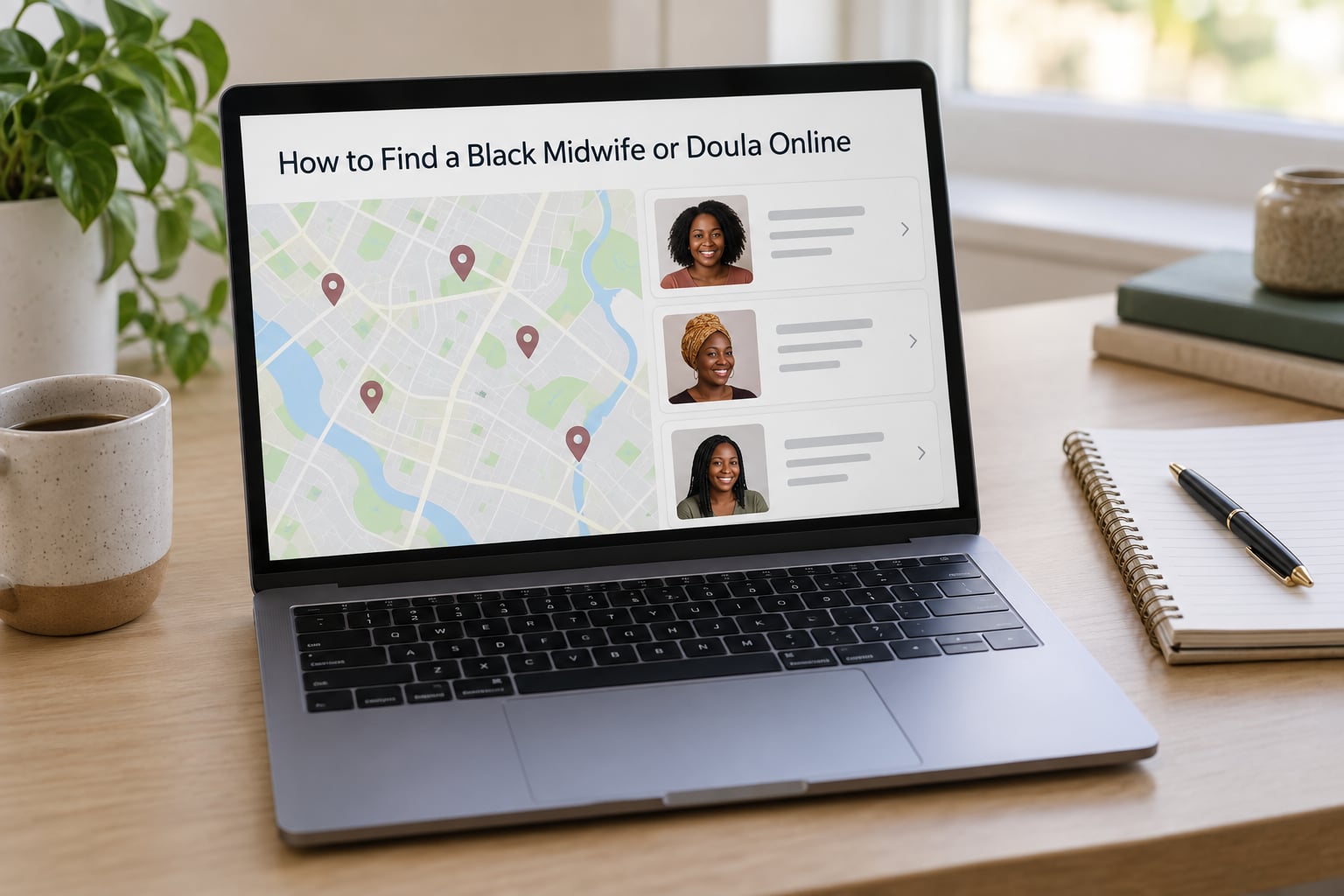
Begin with directories built by and for Black birth workers, then widen outward. Search by city and state, read each profile fully, and shortlist three to five people rather than picking the first profile photo you like.
Here are the starting points worth your time, with the type of provider each one actually lists.
| Directory or organization | Who it lists | How to search |
|---|---|---|
| Black Doula Directory | Black doulas and Black midwives | Browse by state and city, then open provider profiles |
| National Black Doula Association | Doulas of color, with referral guidance | Contact the organization and ask for a match in your area |
| Frontline Doulas directory | Black doulas matched to birth goals | Submit your location and preferences through the directory |
| BWBJ Black Doula Locator | Doulas in its own network database | Sign up for locator access and receive introductions |
| Local doula collectives and birth worker groups | Independent doulas, often with sliding scales | Search your city name plus doula collective, then check local groups |
| Your hospital or birth center | In-house doulas and midwives on staff | Ask the charge nurse or volunteer coordinator directly |
You will know this step worked when you have three to five live contacts rather than a single hopeful name. Directory listings go stale, so treat every profile as a starting point and confirm everything yourself.
Then widen the net. Ask your obstetrician or midwife for a referral by name, since clinicians usually know the Black doulas working their unit even when they will not hand out a list. Call local birth centers directly and ask whether they have a doula program, and whether the people in it reflect the communities they serve.
Ask your own networks too. Peer referral is how most families in cities with thin directories actually find someone, so tell friends, family members, a church or spiritual community, and any parent group you are already in exactly what you are looking for. On Reddit, in parent forums, and in local Facebook groups, posts that specify city, birth setting, and support style get real answers far faster than posts that just say any Black doula.
If your city search comes back thin, do not stop there. Ask nearby cities and state lines, then ask about virtual support. Many doulas offer prenatal and postpartum visits by video and travel in for the birth itself, which widens your options by hundreds of miles.
Ask About Training, Experience, and Birth Setting
Once you have candidates, run the same interview with each one so you are comparing answers rather than impressions. Fifteen minutes of structured questions tells you more than an hour of chatting.
Ask these questions:
- Which organization certified you, and when?
- How many births have you attended, and roughly how many in the last year?
- Which hospital or birth center will you be supporting most often?
- Have you worked with my obstetrician or nurse manager?
- What does your support look like from the first prenatal visit through six weeks postpartum?
- What languages do you support in, and do you work with interpreters?
- Do you take clients with a specific need, such as a VBAC, a high-risk pregnancy, or a previous traumatic birth?
- Who is your backup doula, and when would they step in?
- Can you share a reference I can speak with?
- Do you offer a payment plan or sliding scale?
You will know this step worked when you can picture their actual role on your labor day. If the answer to the hospital question is vague, that is information too.
Confirm Availability, Fees, and Services

The contract conversation is where vague enthusiasm gets tested. Get answers to these five things before any money changes hands.
First, scope. Ask exactly what is included: how many prenatal meetings, a birth call time window, whether they stay through the postpartum period, and how many postpartum visits. Second, availability. Confirm they are holding your dates, not taking them provisionally, and ask what happens if labor starts outside their window.
Third, backup. Every professional doula should have a named backup and a way to introduce you before labor. A provider who has no answer for illness or a conflicting call is a red flag, not a minor gap.
Fourth, money. Ask for a written breakdown of the fee, what it covers, and when each payment is due. Many community doulas run sliding scales because they subsidize care themselves, and plenty offer monthly installment plans. Ask about both directly and plainly, at the first call rather than after you have committed.
Fifth, coverage. Insurance rarely covers doula services, and Medicaid coverage for doulas varies widely by state and often requires the provider to be enrolled with the plan. Midwives are a different story, since certified nurse-midwives are typically covered as clinical providers while certified professional midwives may or may not be covered depending on the state. Ask your insurer directly, in writing, before you assume anything.
Then make the hospital call. Ask the labor and delivery unit whether your doula is allowed in the room, whether she needs to be screened or registered, whether there is an in-house program, and whether there is a limit on the number of support people. If your doula is turned away at the door, that is a preventable crisis, so resolve it in advance and consider an in-house program as a backup.
You will know this step worked when you have a signed agreement covering scope, dates, backup, and payment, plus a written note from the hospital about your doula’s access.
Common Mistakes to Avoid While Searching
These are the mistakes that cost families the most time and money, with the correction for each.
- Trusting a profile without verifying it. Check the certification name against the certifying body’s own directory yourself, and ask how many births they attended last year.
- Confusing a doula with a midwife. A doula cannot deliver your baby or perform clinical procedures. If you want someone to catch and deliver your baby, you need a midwife or obstetrician.
- Skipping the compatibility conversation. Shared identity matters, but so does communication style. Ask how they handle disagreement with your care team.
- Asking vague questions. Replace “tell me about yourself” with “which hospital do you work most, and what happened the last time a client’s plan changed mid-labor.”
- Hiring without a written agreement. Verbal promises about availability and backup are the most commonly broken part of these arrangements.
- Waiting until the third trimester. Good doulas in high-demand cities book between 20 and 28 weeks. Starting late narrows your list to whoever still has space.
Common Mistakes
Most families lose their choice of provider to timing rather than to preference. The practical fix is to start earlier than feels necessary, keep your shortlist at three to five people, and treat every conversation as a two-way check rather than a favor you are asking for.
The second costly mistake is skipping verification because a candidate sounded warm on the phone. Warmth is exactly what you are hoping for, so it is a poor screening tool on its own. Certification name, birth volume last year, hospital familiarity, and a named backup are objective and easy to confirm.
A third mistake is not asking the hospital until labor is imminent. Visitor and support-person rules have shifted repeatedly in recent years, and doulas report repeatedly being treated as guests rather than as part of the care team. Ask at registration, not at the door, and get the answer in writing.
On communication, keep everything in one thread. Email or text is better evidence than a phone call, and it lets you compare several candidates side by side. Ask for a short written summary of scope and payment after each conversation so you are not relying on memory three weeks later.
On privacy, decide what you share before a prenatal meeting and what stays out of a group chat. Doulas are bound by professional confidentiality, and a written agreement should say so explicitly. For anything sensitive, such as trauma history or immigration concerns, ask how they handle records and who else can see them.
Finally, have a backup plan. Keep a second candidate warm, and know your hospital’s in-house doula program or nurse staffing contact in case your chosen person cannot attend. Locally, a sibling, partner or trained friend briefed on your birth plan covers the practical gaps a doula would have filled.
Frequently Asked Questions
What is the difference between a Black midwife and a Black doula?
A midwife is a clinical provider. Certified nurse-midwives and certified professional midwives are licensed or certified to give prenatal care, deliver babies and provide postpartum clinical care. A doula is a non-clinical support professional who provides continuous emotional, physical and advocacy support during pregnancy, labor, birth and postpartum, but cannot deliver babies or perform procedures. Many families hire both.
How can I confirm that a midwife or doula is Black without making the conversation awkward?
Ask during the interview rather than by email. Many directories let you filter by identity, and most Black providers list that openly on their own site. A simple question during a video call works well: I am looking for a provider who shares my background and experience, and part of why I am searching is I want care where I am heard. It is a normal request and rarely met with surprise.
Does insurance cover doulas or midwives, and should I check before hiring?
Yes, check before you hire, always. Insurance rarely covers doula services, and Medicaid doula coverage varies widely by state and usually requires the provider to be enrolled with the plan. Midwives fare better: certified nurse-midwives are typically covered as clinical providers, while certified professional midwife coverage depends on the state. Ask your insurer in writing before you assume either way.
What questions should I ask during a consultation with a birth worker?
Ask which organization certified them and when, how many births they attended last year, which hospital or birth center they support most, whether they have worked with your care team, who their backup doula is, what the fee includes, and whether they offer a payment plan or sliding scale. Ask all candidates the same questions so you can compare answers rather than impressions.
What should I do if I cannot find a Black midwife or doula in my area?
Widen the search in a specific order. Search a 60-mile radius, then nearby cities and state lines, then virtual doulas who do prenatal and postpartum visits by video and travel in for the birth. A hybrid works well too: a local advocate or nurse for in-person support, paired with a Black doula remotely. Ask your hospital whether it has an in-house doula program, and ask community birth organizations about training referrals.
Can a midwife attend a hospital birth, and can a doula attend a home birth?
Yes to both, with conditions. Certified professional midwives and certified nurse-midwives can attend births in hospitals where they have privileges or affiliation, and birth centers and home births depending on state law and their certification. Doulas support both home and hospital births, but the setting must be within their training and their contract, and some states restrict home-birth midwifery. Ask your provider directly about the specific setting you plan.
Conclusion
Write down the role you need, your location and travel radius, your birth setting and your dates before you contact anyone. Build a shortlist of three to five using Black-owned directories, local collectives and referrals from your hospital or birth center, then run the same interview questions across all of them.
Verify certification names, birth volume and hospital familiarity yourself, ask directly about fees, payment plans and sliding scales, and confirm your hospital will admit your doula in writing. Keep a second candidate warm, and confirm your choice in a signed agreement before labor gets close.
None of this is medical advice, and your own midwife or doctor should weigh in on anything clinical. For help building a support team that fits your situation, the pregnancy and motherhood guides on this site cover the surrounding planning.