
Transracial adoption asks more of a family than love. Children adopted across racial lines grow up in a world that reads their skin, hair, and features before it reads their family, and the adults around them need to be ready for that. Understanding identity development, cultural connection, racial mirrors, and how to talk about race honestly is the real preparation work, and this guide covers what families should understand before and after a placement.
Table of Contents
- Transracial Adoption: What Families Should Understand
- What is transracial adoption, in plain terms
- The seven things worth understanding before you go further
- How Children’s Identity Forms After Adoption
- What ethnic-racial socialization actually means
- How the process unfolds by age
- Why you should not push a single identity
- What Parents Should Prepare Before Placement
- Ask the agency or attorney harder questions
- Build cultural connections you can actually sustain
- Get practical about hair, skin, and health
- Plan for school and community, not just for home
- A readiness self-assessment
- How to Support a Child’s Cultural and Racial Identity
- Practice the heritage instead of performing it once a year
- Answer questions in plain language
- Ages three to five
- Ages six to nine
- Ages ten to twelve
- Thirteen and older
- Answering the question every family eventually gets
- How Racism and Differences in Appearance May Affect Family Life
- The challenge-to-response framework
- How to handle a racial slur from a stranger
- When to involve a professional about racism
- What Extended Family and Community Should Know
- Tell people before you have to defend yourself
- Decide who needs time and who needs distance
- Build a wider circle of affirming adults
- How Different Family Members Can Build Connection
- What relatives can do
- What schools can do
- What faith communities and neighbors can do
- When to Ask for Help from an Adoption Professional
- Signs it is time
- Who to call and what to ask for
- Frequently Asked Questions
- How common is transracial adoption in the United States?
- What are the unique challenges faced by transracial adoptees?
- What are racial mirrors and why do they matter?
- How do transracial adoptees develop a racial identity?
- Is transracial adoption right for our family?
- Isn’t love enough for a transracial adoptive family?
- Conclusion
Transracial Adoption: What Families Should Understand
What is transracial adoption, in plain terms
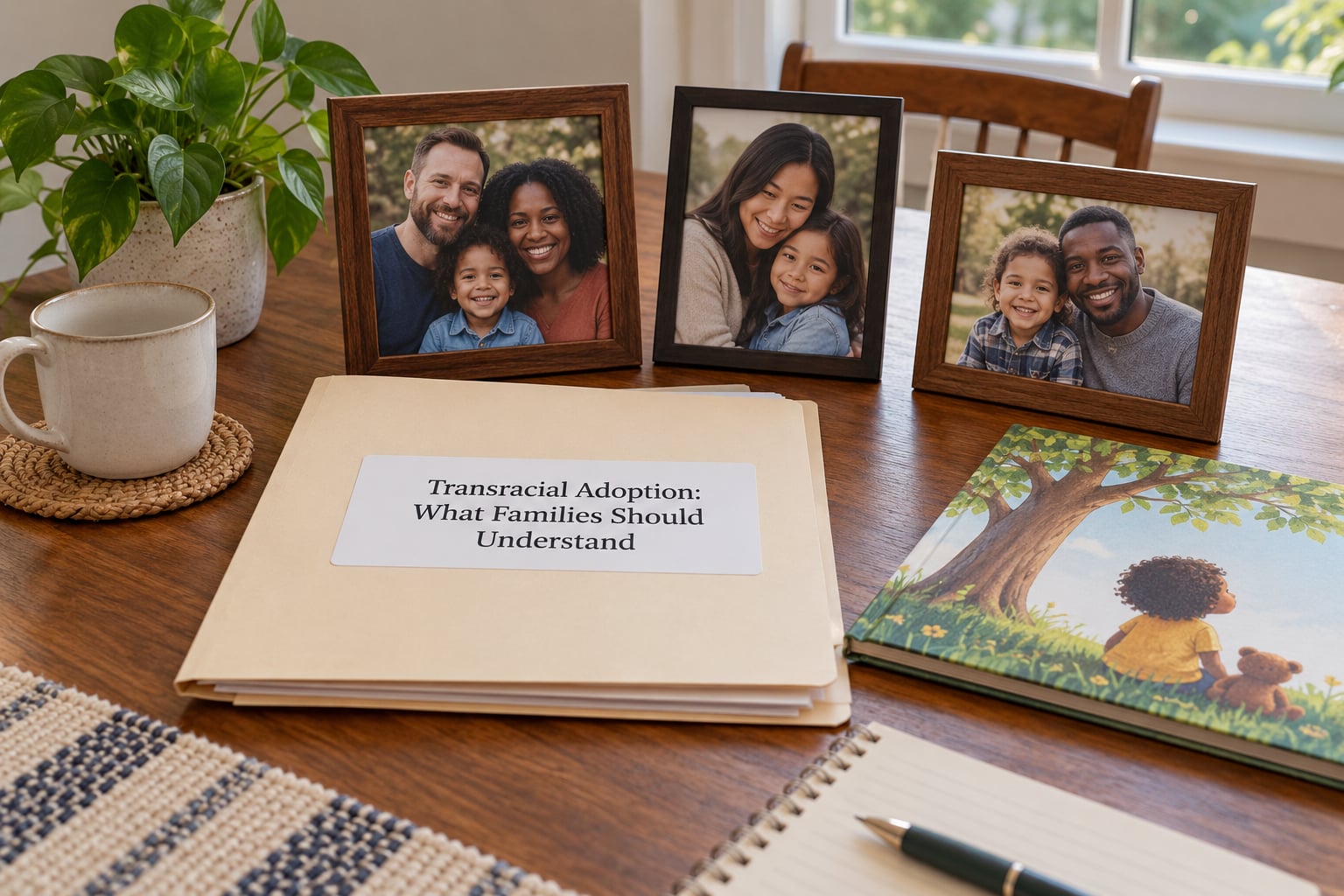
Transracial adoption is the adoption of a child whose race, ethnicity, or birth culture differs from that of the adoptive parents. It covers domestic, foster care, kinship, and international placements. The defining feature is not the child’s race itself but the work that follows: families have to actively support a racial and cultural identity rather than hoping the child simply outgrows the question.
It is also common. Creating a Family reports that more than 40 percent of United States adoptions are transracial across infant, foster care, international, and kinship placements, while research published in Development and Psychopathology puts the figure above 50 percent. The two numbers differ because each counts a different mix of adoption types, and both point to the same conclusion: this is no longer an edge case that families can treat as unusual.
The seven things worth understanding before you go further
- Race does not stay outside the family. Strangers, relatives, and schools will read your child’s race aloud, and your child will have to answer for it long before you do.
- Identity is built, not assigned. Researchers call the process ethnic-racial socialization, and it runs through the whole childhood rather than settling in the toddler years.
- A child’s love for you and their interest in their heritage are not in conflict. A strong bond with adoptive parents and a strong racial identity can coexist without anyone losing.
- Same-race adults matter. Children need mirrors, role models, and later mentors who share their background, and those relationships have to be arranged deliberately.
- Cultural connection is learnable. Food, language, holiday traditions, hair care, and community events can be taught even when you have no background in them yourself.
- Racism will come. Stares, hair-based teasing, questions at the grocery store, and discipline disparities at school are ordinary parts of the road, and rehearsed responses help.
- Support cannot wait until something breaks. Families that connect to other transracial adoptive families and to adoption-competent therapists before placement report fewer surprises later.
How Children’s Identity Forms After Adoption
Children adopted across racial lines develop identity the same way other children do, through relationships, observation, and lived experience, but with one addition most families do not expect. They have to answer a question about belonging that their white counterparts never get asked.
What ethnic-racial socialization actually means
Ethnic-racial socialization is the set of messages, experiences, and relationships through which children learn what their group is and what it means to belong to it. In transracial adoptive families, researchers describe it as transactional: parents send messages about race, children read those messages against what the world does to them, and both sides adjust.
The word transactional matters. A parent can send a thoughtful message and still have it land wrong, because a classmate pulled the child’s hair during recess the same week. Repeated conversations matter less than one that lands at the right time with the right adult behind it.
How the process unfolds by age
Toddlers and preschoolers sort by what is visible and immediate. They notice skin color, hair texture, and names, and they will ask why their hair is different, why their skin is darker than daddy’s, or why they do not have the same family picture everyone else has. Simple, concrete answers hold up better than long explanations.
Early elementary years bring a sharper sense of group belonging. Children start sorting themselves into “us” and “them” and may start using the language they hear at home and at school, sometimes accurately and sometimes carelessly. This is the age when a racial mirror in the neighborhood, a church group, or a Saturday program does more than any book.
Around age ten or eleven, children begin to notice the gap between how their family looks and how their community looks, and many describe an internal debate about whether they belong where they live. Some lean toward their birth culture and pull away. Others lean toward their adoptive family and feel faintly ashamed of it. Both directions are normal and both need a parent who can hold the space without panic.
Adolescence adds the public dimension. Teenagers can choose their own community, and they will be read by it. A transracial adoptee teenager who has strong same-race friendships tends to face fewer identity struggles than one who is the only person of their race in a mostly white peer group, which is why adolescent support matters so much.
Adulthood brings a different set of work. Adult transracial adoptees frequently talk about searching for their birth family, reclaiming names, and re-learning a heritage that was never taught to them. That is a normal part of the arc, not evidence that the adoption failed.
Why you should not push a single identity
Asking a child to pick one identity for you is a common mistake with lasting consequences. A child who is told they are simply Black, or simply Filipino, or simply a member of the family, is being asked to erase a real part of themselves to make an adult comfortable.
The alternative is messier and works better. Let the child hold both relationships without being asked to choose between them, and expect the balance to shift year by year rather than settling once and for all.
What Parents Should Prepare Before Placement
Preparation before a placement is the single biggest lever families control, and the biggest regret reported by parents on adoption forums is waiting until problems appear to look for guidance. These are the conversations and tasks worth finishing first.
Ask the agency or attorney harder questions
Ask what the child’s specific medical, hair care, and cultural needs are, what contact with the birth family looks like, and what post-placement support is included in the agreement. Ask which staff have worked with same-race matches and whether you can speak with them.
Ask how the agency handles the racial dynamics between your family and the child’s community. Any worker who treats race as an inconvenience to be smoothed over is telling you something useful about how they will treat your child later.
Build cultural connections you can actually sustain
Find the church, cultural association, language class, or family network that will still exist in three years. Short-lived exposure turns into a story adults tell at a dinner party rather than a home your child can walk into.
Ask the agency for introductions to families in your area, and connect with national groups that work with transracial adoptive families, including Parents Adopting Children of Color Together and Creating a Family. Parents on r/Adoption repeatedly say the families they reached out to before placement became the ones who called when they were in over their heads.
Get practical about hair, skin, and health
Hair care is not a minor detail. Parents describe it as an early and recurring source of distress for children, and textured hair gets treated as an invitation to comment in school hallways.
Find a stylist who works with your child’s hair texture and take your child there regularly, framing it as care rather than as a correction. Ask your pediatrician about skin care and about any condition more common in your child’s ethnic group, and get a baseline so you know your child’s normal skin.
Plan for school and community, not just for home
Find out how your school district handles hair and dress codes, what its discipline data look like across racial groups, and whether any staff already have experience with transracial families. If your child would be the only student of their race in the class, weigh that before the placement rather than after it.
A readiness self-assessment
Before you commit, work through these honestly rather than with your partner:
- We can name at least two adults of our child’s race or ethnicity in our network, and we know how we will stay in contact with them.
- We have talked through race with our partner without either person minimizing the other’s discomfort.
- Our extended family has been told our stance, and we know who will need time and who will not come around.
- We can say what we will do the first time our child is called a racial slur by a stranger.
- We have a therapist or counselor identified who understands adoption, in case we need one later.
- We accept that our child may grow up more connected to their birth culture than to us, and we can hold that without treating it as a rejection.
- We have looked at our own racial position rather than assuming our good intentions are the relevant fact.
How to Support a Child’s Cultural and Racial Identity
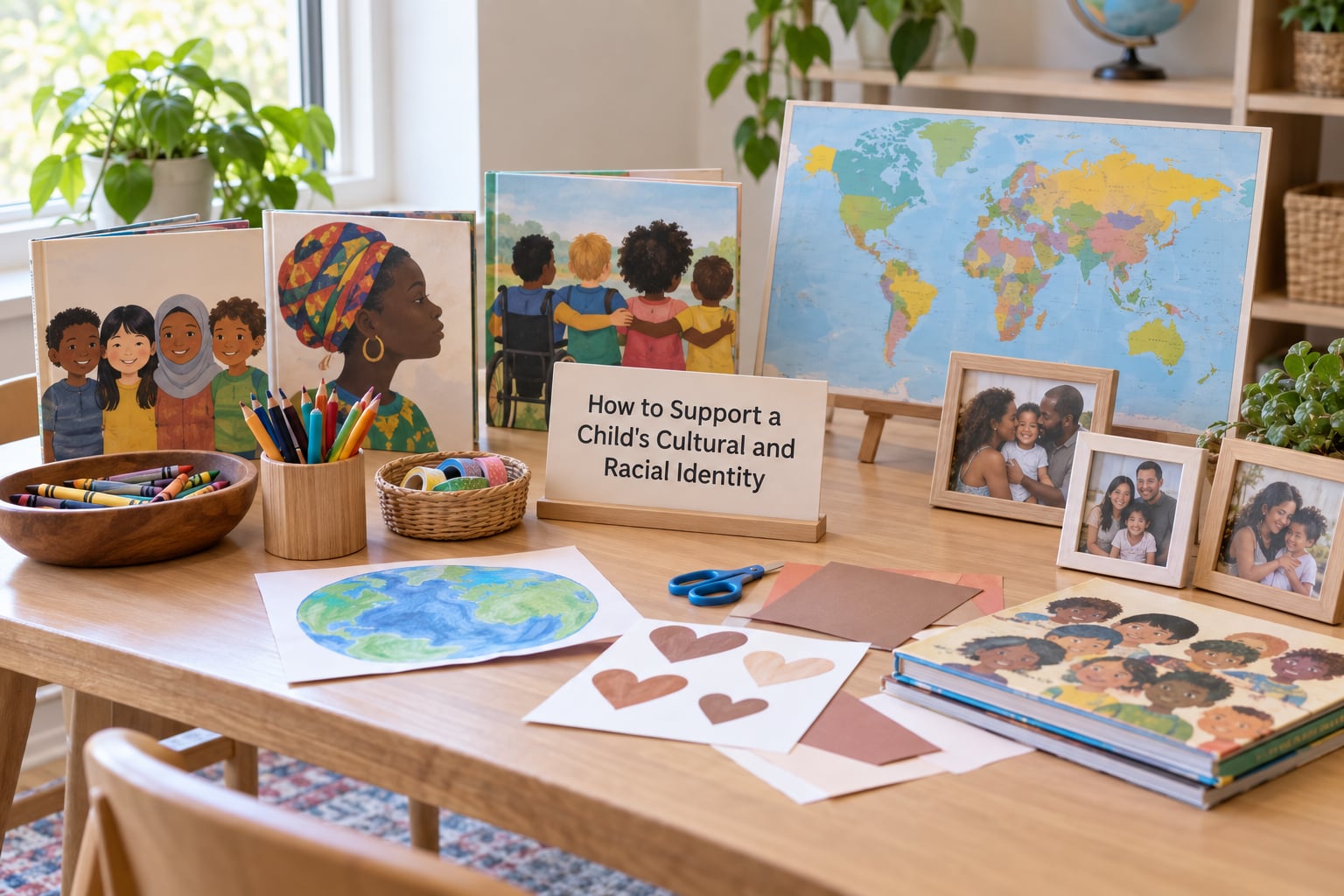
Supporting a child’s identity means adding connection, not adding pressure. The adults who do this well are usually the ones who treat the child’s heritage as something worth knowing rather than something to be managed.
Practice the heritage instead of performing it once a year
Cook the food. Learn the songs. Keep the holiday that matters to your child’s family even when nobody else in the room recognizes it. Consistency tells a child that this part of them was never a phase someone dabbled in and abandoned.
Language is a common question in parent forums and the honest answer is that anything consistent helps. Full fluency may be out of reach, but songs, a few phrases, and regular listening practice give a child the sense that the language was always meant for them.
Answer questions in plain language
Scripts help because the moment rarely gives you time to compose yourself. Here are short lines by age band.
Ages three to five
“You have beautiful hair, and it grows in a curl pattern that most people do not have. Some people do not know how to care for it, and that is on them.”
Ages six to nine
“You were born in a family and a country where people look like you, and you are being raised by us. Both of those are true, and neither one cancels the other.”
Ages ten to twelve
“People treat you differently because of how you look. That is their limitation, not a fact about your worth, and it happens to a lot of people who look like you.”
Thirteen and older
“You are allowed to go deeper on your heritage without it meaning you love us less. If you want to search for your birth family, we will help you do it.”
Answering the question every family eventually gets
The objection that love is enough is asked by people who are trying to believe it, and sometimes by people who want an easy answer. Here is the honest version: love is necessary and it is not sufficient.
Adoption itself rarely causes harm. What causes strain is a family that treats race as a problem to solve, that avoids the subject, or that assumes intent substitutes for preparation. Parents who describe their adoption as worth the difficulty usually say the same thing: the hard part was not loving the child, it was raising them competently in a world that is not color-blind.
That framing matters for you as a reader, because the debate about whether white parents should adopt children of color is real and active on r/Adopted and r/Adoption, and it has people of color in it. If you have heard that critique, treating it as illegitimate rather than listening is the wrong move. Much of it is a demand for preparation, community investment, and honest acknowledgment of who carries the difficulty.
How Racism and Differences in Appearance May Affect Family Life
Stares, comments, and questions are common, and a transracial adoptive family rarely gets to be anonymous in public. What you can do is decide in advance how you will respond, so that your anxiety does not become visible to your child as fear.
The challenge-to-response framework
| Challenge | What it looks like | What parents can do |
|---|---|---|
| Identity questions from strangers | “Why is your child so dark?” or “Are you his nanny?” asked in front of your child | Answer calmly and briefly, model the tone you want your child to use, and move on quickly |
| Hair-based teasing at school | Comments about hair texture, extensions, or braids; hair pulled or targeted under dress codes | Know the dress code by name, document incidents in writing, and ask the school what its policy actually says |
| Being the only one of their race | No same-race friends, no same-race adult role model in the building | Connect them to community groups, weekend programs, and adult mentors outside the neighborhood |
| Microaggressions from adults | “You are so articulate,” touching a child’s hair, complimenting skin tone | Name it out loud later, privately: “That comment was not okay, and it was not meant as a compliment” |
| Isolation of the parents | Relatives who drift away, friends who avoid the topic | Build your own circle of adoptive parents; do not wait for extended family to fill that role |
| Discipline disparity at school | Your child is sent to the office at a higher rate than classmates | Request disaggregated data, keep written records of every incident, and ask for a named contact at the district |
How to handle a racial slur from a stranger
Do not soften it into a lecture and do not punish your child for hearing it. Say something short, honest, and boring in tone: “That word is a lie. You are our child and we are not going to pretend it did not happen.” Then keep walking.
What children take from these moments is not the parent’s anger, which is aimed at them, but the parent’s calm. A practitioner writing about this on r/Adoption put it plainly: take your child’s concerns about racism seriously even when you do not personally understand why something offends them.
When to involve a professional about racism
Move beyond handling it yourself if your child stops telling you things, changes sleep or eating patterns, declines activities they used to like, or says outright that they wish they looked different. Those are signs of weight being carried alone.
What Extended Family and Community Should Know
Extended family is where most transracial adoptive families report their biggest recurring friction, and it is rarely overt racism. More often it is relatives who are not unkind but simply cannot relate, who drift away quietly, or who ask intrusive questions in front of your child.
Tell people before you have to defend yourself
Set expectations early with the relatives who will see your child most. A short conversation that names your family’s stance does more work than repeated private explanations.
For the question everyone asks, try: “We looked at who needed a home and who we could raise well. That is why, and we are not going to discuss it further.” Say it warmly the first time and identically every time after. Inconsistent answers get repeated back at you by people who did not hear the first one.
Decide who needs time and who needs distance
Some relatives adjust within a year. Others never will, and those people do not get unlimited access. Decide in advance what your child’s exposure looks like and stick to it, because a child reads parental boundaries as information about what the adults think of them.
Build a wider circle of affirming adults
If your own family cannot supply this, other families can. Transracial adoptive family groups, cultural associations, sports and church communities, and mentor programs all count. Search for groups by state or region rather than settling for whoever is nearest, and expect a wait if you live somewhere with little diversity.
How Different Family Members Can Build Connection
Connection with your child does not have to run through blood or through the adults who share your child’s race. It runs through consistent, respectful presence, and different people contribute it differently.
What relatives can do
- Learn one thing and get it right, whether that is a dish, a holiday, or a name.
- Treat your child’s questions about their background as normal curiosity, not as an interrogation.
- Do not compliment your child on being articulate, quiet, or well-spoken. Say something about the game they played instead.
- Ask the parents what help would actually be useful rather than assuming.
What schools can do
- Review hair and dress code rules for how they land on textured hair specifically.
- Check discipline data by race before drawing conclusions about a class.
- Connect the child to a same-race student, teacher, or staff member who is not the assigned counselor.
- Include the child’s heritage in classroom learning without requiring the child to represent it.
What faith communities and neighbors can do
Faith communities can host holidays, language events, and family meals that give a child’s culture a building to live in rather than a day on the calendar. Neighbors who are simply curious are fine; neighbors who ask your child to explain their race to them are not, and you can decline politely on your child’s behalf.
Keep the child’s own preferences in view as they get older. A ten-year-old may love every cultural event. A sixteen-year-old may want none of it for a season. Both are developmentally normal, and neither requires you to argue.
When to Ask for Help from an Adoption Professional
Ask for help early rather than at the crisis point. Reaching out when things are stable is normal and gives a professional time to get to know your child before something is urgent.
Signs it is time
- Your child avoids school, stops eating or sleeping well, or withdraws from things they used to enjoy.
- Identity questions become constant, or your child says they wish they looked different.
- Race conversations with your child leave you both upset and stuck.
- Extended family conflict is spilling into the child’s relationships.
- You are trying to find a cultural community and have no idea where to start.
- Adult adoptee questions about birth family searches surface years later and nobody prepared you.
Who to call and what to ask for
An adoption-competent therapist is the most useful starting point for identity and family questions, and one who works specifically with transracial families is better still. A clinical social worker can help with community resources, school navigation, and advocacy. An adoption attorney handles legal questions, including birth family searches and consent agreements.
Ask any of them directly: “Do you work with transracial adoptive families, and what would you want to know about mine?” The answer tells you within a minute whether the call is productive.
Frequently Asked Questions
How common is transracial adoption in the United States?
Transracial adoption is the majority of United States adoptions, not a rare case. Creating a Family reports that more than 40 percent of adoptions across infant, foster care, international, and kinship placements are transracial. Research published in Development and Psychopathology puts the figure above 50 percent. The two numbers differ because they count different mixes of adoption types, and both explain why families, schools, and therapists now treat it as ordinary rather than unusual.
What are the unique challenges faced by transracial adoptees?
The recurring challenges are identity development without same-race family role models, cultural disconnect from their birth heritage, and exposure to racial bias that their adoptive family may not share. Other pressures include being read as belonging to another family, hair and appearance-based teasing, and later questions about birth family searches. None of these are inevitable. Families that build cultural connection and same-race community early tend to see far fewer of them.
What are racial mirrors and why do they matter?
A racial mirror is an adult or older peer who shares the adopted child’s race or ethnicity, so the child can see their reflection in someone who understands the experience from the inside. Parents cannot provide this, and extended family usually cannot either. Mirrors give children language, examples, and an expectation that people like them already belong somewhere, which is why parents are advised to arrange them deliberately rather than waiting for one to appear.
How do transracial adoptees develop a racial identity?
Identity develops through ethnic-racial socialization: the messages parents send about race, the cultural practices the family actually maintains, the same-race adults and peers in a child’s life, and the treatment a child receives from the world around them. It is not a single moment but a shifting balance from toddlerhood into adulthood, and the balance moves. A child who leans toward their birth culture in adolescence may lean back toward their adoptive family as an adult, and both shifts are healthy.
Is transracial adoption right for our family?
It fits families who can name specific same-race adults in their network, have talked honestly about race with each other, and accept that their child may grow up more connected to their birth culture than to them. It does not fit families who want the child to share their background or who expect the child’s differences to disappear. Ask yourself who will model your child’s life at eighteen, because that question tells you more than any placement statistics do.
Isn’t love enough for a transracial adoptive family?
Love is necessary and not sufficient. Adoption itself rarely causes harm, but families who treat race as a problem to solve, avoid the subject, or assume good intentions substitute for preparation tend to struggle more. Parents who describe the adoption as worth the difficulty usually say the work was not loving the child, it was raising them competently in a world that will read their race before it reads their family.
Conclusion
Start with research, not reassurance. Learn about your child’s heritage from people who live it, including the adults your child will need as mirrors. Build the cultural practices early and keep them going, because consistency is what turns a heritage into a home.
Then talk about race plainly, prepare your relatives before you have to manage them, and treat your child’s questions about racism as real information rather than as confusion to correct. When something is genuinely hard, bring in an adoption-competent therapist early. Love carries the relationship. Preparation is what carries everything after it.