
To become a doula, you pick a certifying organization, complete its required reading, attend a multi-day training workshop, then attend births as a trainee to collect evaluations before you submit a certification packet. No nursing degree and no prior birth experience are required, and no US state issues a doula license.
That is the short version. The longer version is that a doula is a trained, non-medical birth professional who provides continuous emotional, physical, and informational support before, during, and after birth. Doulas do not diagnose, do not monitor fetal heart rate, and do not give medication. If you are weighing this career, here is the practical path, the honest timeline, and the costs people forget to ask about.
One thing to set expectations about early: the classroom part is the easy part. A postpartum pathway can be finished in a matter of weeks. A birth doula pathway usually runs six to twelve months or longer, because you still have to be awake and present for real births on someone else’s schedule.
Table of Contents
- What You Need
- Step-by-Step
- 1. Decide Which Kind of Doula You Want to Become
- 2. Research Doula Training Programs and Organizations
- 3. Understand What Doula Training Involves
- 4. Complete a Recognized Training Program
- 5. Build Core Skills Through Practice
- 6. Decide Whether to Pursue Certification
- 7. Create a Professional and Legal Setup
- 8. Gain Experience and Start Working
- Common Mistakes
- Frequently Asked Questions
- Do you need to be certified to become a doula?
- How long does it take to become a doula?
- What should I look for in a doula training program?
- How much does doula training cost in the United States?
- Can I become a postpartum doula without birth training?
- How do new doulas gain their first clients?
- Start With One Research Call
What You Need

Here is what doula training asks of you before it asks for your tuition. Most of it is practical, not academic, and if any of it does not fit your life right now, no amount of enthusiasm will carry you through the birth-attendance stage.
- Stamina for unpredictable schedules. Labor starts at 2 a.m. and a due date is a guess, not an appointment. If your job requires you at a desk at a fixed time, that is a real scheduling problem to solve before enrollment, not after.
- Reliable transportation and a backup plan. A home birth forty minutes away, a hospital parking garage, and a phone that stays charged matter more than people expect.
- Emotional steadiness. You will witness pain, fear, and occasionally loss. Not being fazed is a skill, and it is learnable, but you need some baseline capacity for hard rooms.
- Time for reading. Every reputable program assigns reading. It is the part most trainees underestimate and the part clients notice later in how well you answer questions.
- Professional contacts. Midwives, childbirth educators, lactation consultants, and one working doula who will tell you the truth about the profession.
- A financial buffer. Ask each program for an itemized list of everything the pathway costs beyond the workshop: membership dues, required books, CPR or BLS certification, liability insurance, and recertification. Those recurring items surprise people more than the sticker price does.
Nobody asks whether you have a degree. What they ask is whether you are 18 or older, reliable, and able to commit to a due-date window without promising your other clients too much.
Step-by-Step
1. Decide Which Kind of Doula You Want to Become
Birth doulas support people through labor, birth, and the first hours after. Postpartum doulas support the household in the weeks after birth: newborn care, feeding support, meal preparation, light cleaning, and whatever else lets a new parent rest. Some people do both. Decide before you shop for training, because most organizations sell them as separate pathways.
Then get specific about the clients and setting. Hospital, home, birth center, or a mix? Birth doulas who work on call around hospital schedules live a very different week than doulas who build a steady book of repeat clients. If your reason for wanting this work is that you have a nursing, midwifery, or childcare background, say that out loud to programs, because they shape the practicum around it.
You know this step is complete when you can finish the sentence “I want to support people through blank, in blank, offering blank.” Everything after this gets easier once that sentence exists.
2. Research Doula Training Programs and Organizations
Certification is not legally required to call yourself a doula in the US, but it is the standard clients, hospitals, and payers actually check. It is what makes you creditable in a room where nobody invited you. So treat the credential as a practical tool rather than a formality, and compare programs on the same five things: curriculum, contact hours, mentor access, business instruction, and what your clients can do with it afterward.
Start with the organizations that appear in nearly every discussion: DONA International, CAPPA, Childbirth International, Birth Arts International, and ICEA. Each has a distinct philosophy and a different title attached to the credential, such as CD(DONA) or a CAPPA-certified labor doula designation. Doulas in community forums like r/doulas and The Doula group on Facebook tend to give the same advice: pick the training that resonates with how you want to work, and check that local hospitals and your clients’ reimbursement pathways will accept it. Brand name alone is not decisive.
| Training format | What it looks like | Strength | Watch out for |
|---|---|---|---|
| In-person intensive | Two to four consecutive days, often with skills practice and mentor observation | Fast, hands-on, and the easiest way to build a peer cohort | Travel, time away from work, childcare, and the shortest window to absorb it |
| Online self-paced | Modules and a final quiz on your own schedule, sometimes plus a live element | Cheapest per hour, fits around a job and young kids | Less hands-on practice; trainers themselves say a course alone does not make you a doula |
| Hybrid | Online theory with a shorter in-person or live virtual practicum | A middle path with real feedback built in | Totals often cost more than either pure option |
Ask every program the same six questions on a call, in writing if you can: How many contact hours, how many births do I attend, is mentorship included, is business training included, how long do I have to complete the candidacy requirements, and what does recertification cost later. You know this step is complete when you have two programs narrowed to one, with the total cost written down rather than guessed.
3. Understand What Doula Training Involves
The curriculum is broader than most people picture. Expect anatomy and the physiology of labor, the mechanics of pushing and the immediate postpartum period, and a substantial block on comfort measures: breathing and relaxation support, position changes and movement, massage, counterpressure, warm water, and the practical tools you can offer when someone is asking for something to do.
You will also spend real hours on the harder material. Communication and listening, advocacy without confrontation, cultural humility, informed consent, ethical decision-making, and scope boundaries. A good program is explicit that you are not a medical professional, and it trains you to hand off when something clinical happens. Scope of practice is not paperwork. It is the difference between a calm, respected presence and a provider who gets asked to leave.
You know this step is complete when you can describe, in your own words, what you will do if a client asks you to check a medication dosage. The answer is a clear, kind no, plus a referral to their nurse or provider.
4. Complete a Recognized Training Program
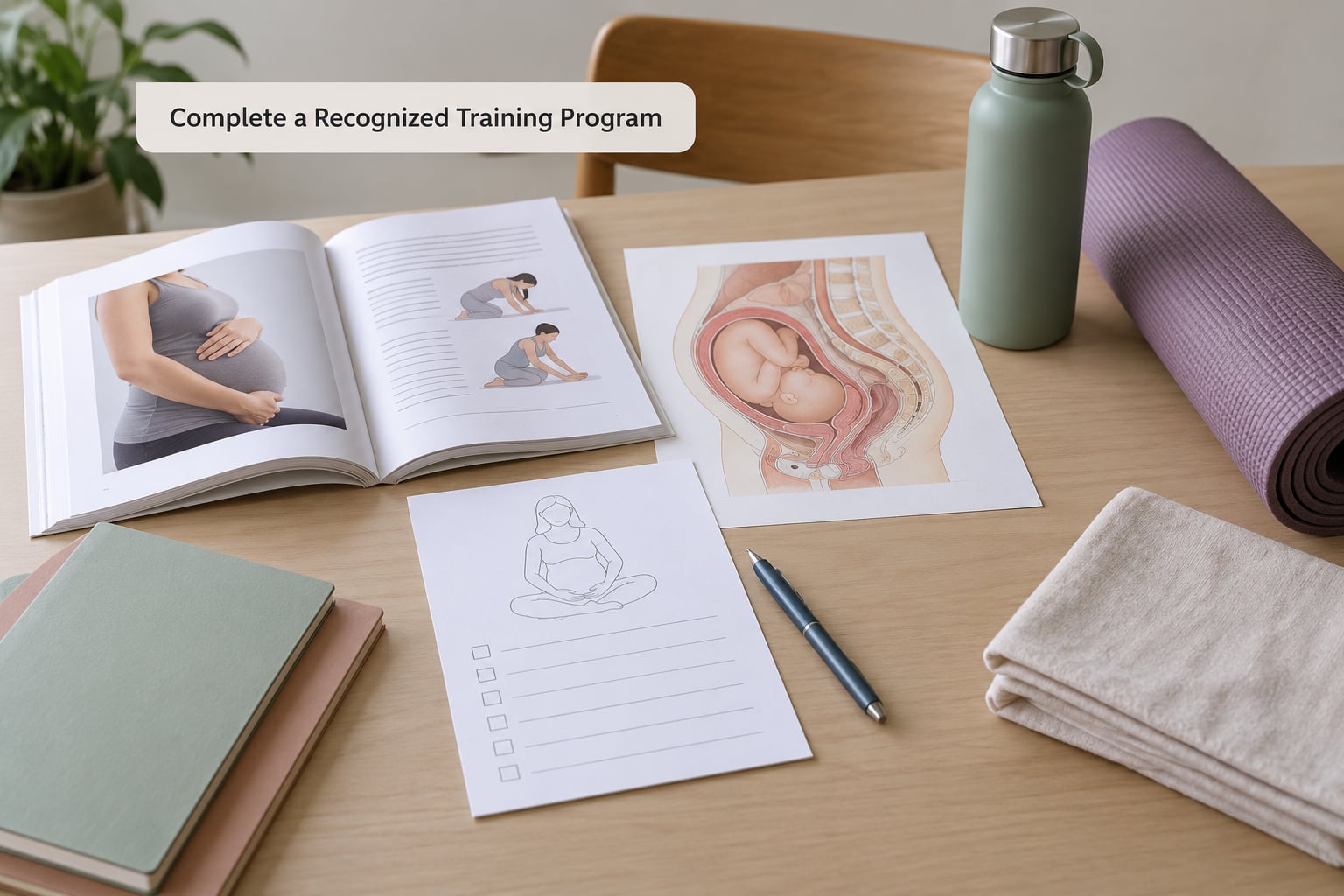
Most pathways have the same skeleton: attend the workshop, log your required reading, complete hands-on skills practice, attend qualifying births, collect evaluations from the families and the professionals you worked with, submit a certification packet, and then maintain the credential with continuing education.
Use this as your completion checklist. Attendance means you were present for the whole workshop, not the first day. Assignments mean reading logs, essays, and scenario work that some programs grade. Skills practice means you demonstrated hip squeezes, counterpressure, breathing support, and role-play of a hard conversation. Mentor feedback means someone with more births behind them watched you work and told you what to change. Births attended means real clients, with written evaluations from them and from the midwife, nurse, or doctor present. The packet means you assembled evaluations, your reading log, and any required essay, then submitted it inside the candidacy window.
That last item is where people get stuck. Candidacy windows are often generous, sometimes running several years, but they are not unlimited, and missing one can mean restarting fees. Put the deadline in your calendar the day you are accepted. You know this step is complete when you hold the credential and have read the organization’s standards of practice and code of conduct at least once.
5. Build Core Skills Through Practice
Rehearsal is where doulas get good, and rehearsal is uncomfortable by design. Practice labor positions with a friend until you can talk while you do it. Run breathing and relaxation support out loud, because silence in a real room feels very different. Role-play the scenario that scares you most: a client who changes her mind at four centimeters, a partner who wants you to leave, a nurse who is short with you.
Work on listening, because it is the skill people underestimate. Most of a birth is not waiting; it is being present without steering. Practice postpartum care separately from birth work, including newborn cues, feeding preparation, and the specific exhaustion of a recovering parent. And rehearse your referral boundaries, because knowing when to hand someone to a midwife, a counselor, or a social worker is part of the job, not a failure at it.
You know this step is complete when your responses feel calm and adaptable rather than scripted. Doulas describe the real learning curve as attending births, not classroom hours. One person put it plainly in a doula forum thread: a few years in, the resume gets impressive on its own.
6. Decide Whether to Pursue Certification
Four things get tangled together here, so separate them. Certification is a credential earned by completing a specific organization’s requirements, with a title attached. Registration is the credential’s listing in that organization’s directory, which is often what clients search. Association membership is ongoing participation that costs money every year and comes with code of conduct and continuing education requirements. Other credentials include postpartum-specific designations, bereavement training, and birth educator or lactation credentials that sit next to doula work rather than replacing it.
Now evaluate it against your actual plans. If you intend to work in hospitals, certification is close to required, because hospital policies and the nurses you work alongside expect it. If you work mostly privately or at home births, the credential still matters, since clients use it to screen. If you live outside the US, check whether your country’s requirements differ before you pay a US membership fee. You know this step is complete when you can name the credential you hold, the title it gives you, and what it lets you do that an uncertified person cannot.
7. Create a Professional and Legal Setup
Treat this like the small business it is, because that is what it is. Decide between a sole proprietorship and an LLC based on your state’s rules, and talk to an accountant about quarterly taxes early, since self-employment tax surprises new doulas more than anything else in the first year. Get professional liability coverage, which is inexpensive and increasingly requested by hospitals. Draft a written contract covering your fee, your due-date window, your on-call expectations, your cancellation and backup policy, and what happens if your client’s provider requests something outside your scope.
Build the rest around client confidentiality. A contract is the first thing that tells people you take privacy seriously, and birth stories are the ones people care about most. Then set boundaries you can actually hold: how many births you take per month, how much notice you need, and what your response time looks like. You know this step is complete when a client can book you without you having to negotiate anything in the moment.
8. Gain Experience and Start Working
The path to a first client runs through people, not advertisements. Ask your training mentor for introductions to midwives and educators in your area, join your local doula association, and offer to volunteer on a hospital doula shift where one exists. Volunteering looks like building: you learn a facility’s rhythm, its staff, and how a labor unfolds there without your family’s expectations riding along.
Shadow an experienced doula at a birth you are not responsible for. That one experience changes how trainees talk, because they see the calm, unremarkable version of a long labor rather than the edited one. Then take your first client, set your fee deliberately, and treat that birth as training you are also paying for. Doulas commonly report that their early births are unpaid or reduced-rate trainee work, which raises a fair question about your time, your gas money, and your own family. Decide in advance how many unpaid or reduced-rate clients you will take, and write that number down so it does not quietly become unlimited.
You know this step is complete when you have a signed contract, a liability policy, and a client who booked you because someone they trust vouched for you.
Common Mistakes
Most new doulas do not fail on skill. They fail on preparation. These are the ones I see repeatedly, with the fix attached.
- Choosing training on price alone. The cheapest pathway is cheap because it drops something. Ask what is excluded, and ask whether your local hospitals and clients’ reimbursement pathways accept the credential before you pay.
- Implying medical authority. Saying “I will monitor the baby” or offering clinical advice puts you in a different category of problem. State your scope in plain language at intake and keep it there.
- Skipping the business setup. No contract, no liability policy, no written payment policy. Clients accept these as professional norms, and having them makes you easier to hire rather than harder.
- Leaving scope undefined. If nobody says out loud what you do not do, the first unusual request becomes a negotiation in front of a laboring person. Define the boundary before you arrive.
- Overpromising availability. Taking four due dates in one window because you wanted the income means being unreliable to everyone at once. Book fewer dates, say so honestly, and let your reputation build slowly.
- Treating certification as competence. The certificate is a beginning. Doulas say it plainly in forum discussions: a weekend of training does not make you a doula. Births do that, and so does good mentorship.
- Ignoring the emotional load. Give yourself a recovery ritual after each birth, write debriefs, find one person who understands the work, and watch for the slow exhaustion that ends careers quietly.
Two habits cover most of the rest. Read your organization’s standards of practice once a year, not just at certification. And keep a written record of every birth, call, and continuing education hour from day one, because that is also the record that makes a strong case for your fee later.
Frequently Asked Questions
Do you need to be certified to become a doula?
No US state issues a license to practice as a doula, so you can call yourself one without a credential. In practice, certification is what clients screen for, what hospital policies expect, and what makes reimbursement through health savings accounts or flexible spending accounts possible. Treat it as a professional standard rather than a legal gate, and check your local hospitals before you start.
How long does it take to become a doula?
A postpartum pathway can be finished in a few weeks to a couple of months, depending on the program. A birth doula pathway usually takes six to twelve months or longer because you must attend qualifying births and collect evaluations, often on an unpredictable schedule. A weekend workshop covers the classroom hours. The births are what take the time.
What should I look for in a doula training program?
Ask six questions: how many contact hours, how many births must I attend, is a named mentor included, is business training part of the curriculum, how long do I have to submit my certification packet, and what does recertification cost later. Then check that hospitals in your area and your clients’ reimbursement pathways accept the credential. A curriculum you cannot get real practice with is the thing to avoid.
How much does doula training cost in the United States?
Published fees vary widely by organization, format, and whether mentorship is bundled, so get the current figure straight from each program rather than from a listicle. Budget beyond the workshop price. Membership dues, required books, CPR or BLS certification, liability insurance, and periodic recertification all recur, and the full pathway usually costs more than the workshop alone.
Can I become a postpartum doula without birth training?
Yes, and many doulas do exactly that. Postpartum support is sold as its own pathway, and the schedule is far more predictable than birth work, which is why people who want doula work without an on-call lifestyle choose it. You can add birth training later, or run both. Several organizations also offer combined or continuing pathways for people who start postpartum and expand.
How do new doulas gain their first clients?
Through relationships, mostly. Ask your mentor for introductions to midwives and childbirth educators, join a local doula association, volunteer on a hospital doula shift, and shadow an experienced doula at a birth you are not responsible for. Referrals do the heavy lifting early on, and a volunteer role builds the hospital familiarity that private clients later ask about.
Start With One Research Call
If you take one action this week, make it a fifteen-minute call with a working doula in your area. Ask what their first two years actually looked like, and what they would change about their own training.
Before that call, write down three things: which kind of doula you want to be, the two or three programs you are comparing, and the total cost of each pathway including books, membership, insurance, and recertification. Then shortlist one program and ask for its complete requirements list in writing.
That is the whole roadmap. Pick the type, compare the curriculum, finish the training, attend the births, decide on the credential, set up the business, and take your first client. Start with the call.