
Learning how to track newborn feeds and diapers takes about ten minutes to set up and a few seconds per entry once the habit is there. Pick one tool, use the same handful of fields every time, and write each entry the moment it happens, because a complete log is what answers the questions asked at every newborn checkup and in the emergency department without anyone having to guess.
The system below is built around observation, not interpretation. Your baby feeds and diapers on their own rhythm, your pediatric clinician sets any targets that apply to your baby, and the log simply holds the facts so nobody has to hold them in their head at 3am. Hospital discharge paperwork usually tells you exactly what your own care team wants recorded, and that takes priority over anything here.
Table of Contents
- What You Need to Track Newborn Feeds and Diapers
- Paper chart, app or spreadsheet: what each one is good for
- Step-by-Step
- Step 1: Decide what to record before the first feed
- Step 2: Build your template once
- Step 3: Log in the moment, one-handed
- Step 4: Add context only when it changes the next hour
- Step 5: Read the totals once a day, not constantly
- Step 6: Share one log with everyone
- Step 7: Keep a fallback for missed entries
- Common Mistakes
- Recording too many fields
- Writing the entry later
- Reading your own log like a diagnosis
- Forgetting day changes, time zones or travel
- Running two records
- Abandoning the log during a confusing week
- Tracking until it becomes the worry
- Frequently Asked Questions
- Do I need to track every diaper when caring for a newborn?
- How long should I track newborn feeds and diapers?
- Is a newborn tracking app necessary, or is a paper log enough?
- What should I record when my baby is fed breast milk or formula?
- What if I forget the time of a feed or diaper change?
- When should I ask a pediatric clinician about feeding or diaper concerns?
- A Simple Tracking Routine to Start Today
What You Need to Track Newborn Feeds and Diapers

The tool matters much less than using one consistently. A notebook on the arm of the feeding chair works as well as an app for most families, and a paper chart is usually what you start with anyway, because hospitals and birth centers track feeds, diapers and weight during the stay on a paper sheet in the room.
A working setup needs only four things:
- One log. A dedicated notebook, a printable chart, or a single baby tracker app. Not two.
- A pen that stays put. Tethered to the notebook or kept in a pocket by the chair.
- A clock you can see without thinking. A watch on the wrist or a small clock on the shelf, so start and end times are not reconstructed from memory later.
- A decision about detail. Deciding up front which fields you will always fill in keeps entries from taking longer than the feed itself.
Beyond that, optional fields are genuinely useful when you are pumping, combination feeding, giving vitamin D drops or any medication, or when someone else cares for your baby for a stretch. Write down what you actually need to hand off, not everything a form offers.
Paper chart, app or spreadsheet: what each one is good for
Most families start on the hospital paper chart and move to an app within the first week, which matches what parents describe in newborn forums. Free and ad-free options get recommended most often, and parents reliably reject anything that interrupts a feed to sell a subscription.
| Method | Good at | Watch out for | Best for |
|---|---|---|---|
| Paper chart | Starting fast, working without a phone, no battery to worry about | Totals take a minute to calculate, easy to lose | The first days, hospital stays, caregivers without smartphones |
| Baby tracker app | One-tap logging, caregiver sync, automatic daily totals | Taps add up when one arm is full, per-caregiver fees on some options | Households with two or more caregivers |
| Spreadsheet | Comparing weeks, charting patterns over time | Slow to update at 3am, easy to break | Reviewing week three against week one later |
| Hybrid | Paper in the room, app as the shared record | Two records means two versions of the truth | Transitioning off the hospital chart |
If you want to see how the search crowd reads this question, the names that come up most are Baby Tracker by Nighp, Huckleberry, Baby Connect, Nara Baby, Pippy, Chronobaby and Betteroo. All of them log feeds and diapers. The differences that matter in the first weeks are how many taps an entry takes, whether every caregiver sees the same record, and whether the daily totals come out without arithmetic.
Step-by-Step
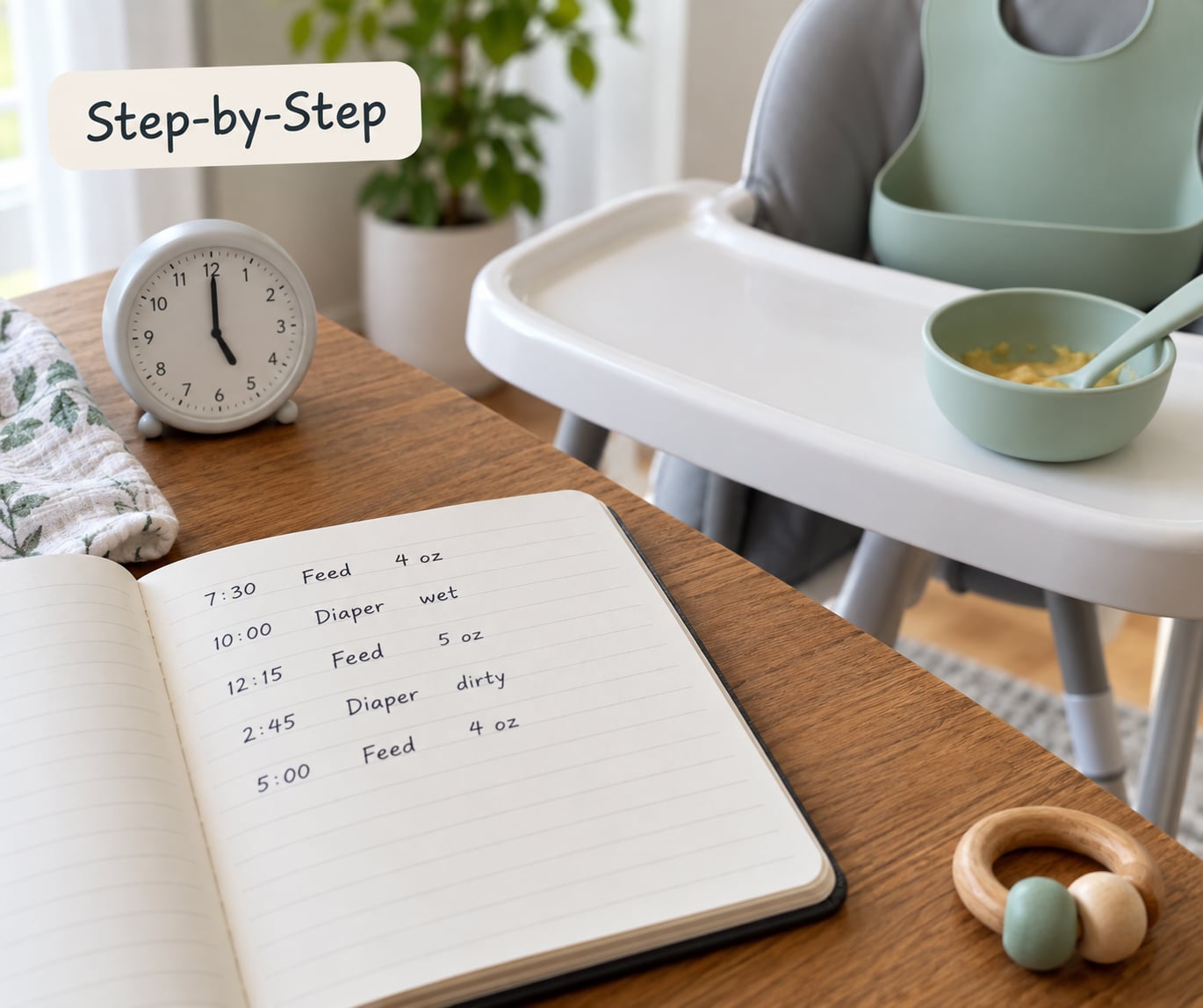
Seven steps cover it, and the order matters less than the speed of each one. Ten minutes setting up the log saves an hour of guessing at the two-week visit.
Step 1: Decide what to record before the first feed
Write down your four feed fields and three diaper fields and use them every single time. Consistency beats detail, because a short record that is complete can be read in seconds, while a detailed one that gets skipped halfway through is worthless.
| Event | Fields to log | Why it is there |
|---|---|---|
| Breastfeed | Start time, end time, minutes per side, side started, which side ended | Shows transfer and timing without any judgment |
| Bottle | Start time, type (breast milk or formula), ounces offered, ounces taken | Offered versus taken is the number clinicians ask for |
| Wet diaper | Time, wet, dirty, or both, color if anything looks unusual | Output is the clearest daily signal of how feeds are going |
| Pumping | Time, minutes, ounces expressed | Keeps pumping totals separate from feeds |
| Medication | Time, name, dose given by whom | Stops a dose being given twice by two people |
Leave sleep out at first. It is the first field parents add and the first one that turns a log into something that feeds anxiety instead of information.
Step 2: Build your template once
Draw the same grid you want on paper: one row per event, columns for time, type, and amount, and a blank margin column for notes. On a phone, set up the app’s categories so that logging a feed is a single tap rather than a form. Do this sitting down, not during a feed.
If you would rather have it printed than hand-drawn, search for a newborn feeding and diaper log template in your own region or language, print twelve copies, and stack them in a folder by the chair. Twelve days is more than most families need.
Step 3: Log in the moment, one-handed
Write the entry before you put the baby down, in under ten seconds. Reconstructing the night from memory is where gaps come from, and a gap is worse than a rough estimate because you cannot tell the difference later.
Make the common entries the easy ones. A feed that starts at the same button every time, a diaper preset that takes one tap, a timer that starts when the feed starts rather than when you remember to start it.
Step 4: Add context only when it changes the next hour
Notes earn their place when they describe something you would want to explain later: fussiness during the feed, repeated leaking on one side, a big spit-up, a stool color that surprised you, or a dose given by a visiting nurse. One short sentence in the margin is enough.
Skip everything else. A log full of guesses about whether a nap was long enough is work nobody asked for.
Step 5: Read the totals once a day, not constantly
At one point in the evening, add up the last 24 hours: number of feeds, number of wet diapers, number of dirty diapers. That is the whole review. Watching the numbers move in real time is what turns a useful record into a source of worry at 2am.
Typical ranges for the first twelve days look like this. Your discharge paperwork and your own clinician’s guidance come first, and babies who are feeding well often sit at the higher end.
| Day of life | Wet diapers per day | Stools per day | What the stool looks like |
|---|---|---|---|
| Day 1 | 1 to 2 | 1 or more | Thick, dark meconium |
| Day 2 | 2 to 3 | 2 or more | Meconium starting to thin |
| Day 3 | 3 to 4 | 3 or more | Transitional, greenish brown |
| Day 4 | 4 to 5 | 3 or more | Looser, mustard tones begin |
| Day 5 | 5 to 6 | 3 or more | Mustard or seedy if breastfed, paler paste if formula fed |
| Day 6 and beyond | 6 to 8 or more | 3 to 4 or more | Color shifts, less urgent to record |
Newborns commonly feed somewhere between 8 and 12 times across 24 hours, day and night, and that range shifts week to week. Cluster feeding, where feeds stack close together over several hours, is common in the early weeks and is not on its own a sign of a problem. Your clinician is the person who reads those numbers against your baby’s weight and history.
Step 6: Share one log with everyone
Two private logs are how double-feeding happens. Set up one shared record, add every caregiver to it, and agree on who writes what. With an app, that means invitations for your partner, your doula or night nurse, and any grandparent helping regularly. With paper, it means one chart in a fixed visible location rather than a notebook that travels between bedrooms.
Before anyone takes a shift, write the handoff on the log itself: last feed time, which side was started, any dose due, and what your clinician asked you to watch for. Thirty seconds of handoff beats an hour of reconstructing the shift afterward.
Step 7: Keep a fallback for missed entries
Some entries will not happen. The baby falls asleep mid-feed, your phone dies, a grandparent forgets the time. When that happens, write what you do know and mark the gap rather than backfilling a guess. A line reading “roughly 3am, bottle about 4 oz” is honest and still useful; a precise invented time is neither.
When a feed and a diaper change land at the same moment, record both on one line with a slash between them. Nobody reading your log later needs them as separate rows.
Common Mistakes
Almost every tracking system fails the same ways, and every one of them has a quick fix.
Recording too many fields
The classic mistake is choosing the app’s full feature set instead of your own five fields. Parents describe long forms getting abandoned mid-feed, which leaves you with a gap-filled record that helps no one. Cut back to time, type, and amount, and add detail only when your clinician asks for it.
Writing the entry later
Logging at the end of the shift feels efficient and produces fiction. The fix is mechanical: log before you move, and put the notebook or the phone where your hand already goes at the end of a feed. If a tool cannot be reached one-handed, it will not be used one-handed.
Reading your own log like a diagnosis
A log records. It does not interpret. A slow afternoon followed by three feeds does not mean a baby is not feeding, and a number below a range you read online does not mean something is wrong. Compare against your own baby’s recent pattern and your clinician’s guidance for your baby, not against an article’s average.
Forgetting day changes, time zones or travel
A log that runs across midnight without dates quietly corrupts every total you calculate. Mark the date at the top of each page, note the time zone if you travel or cross zones, and start a fresh column per day.
Running two records
A paper chart for the night shift and an app for the day shift produces conflicting totals and arguments nobody needs at week three. Pick one record. If you are mid-transition, keep the paper chart as the source of truth until every caregiver is in the app, then retire the paper.
Abandoning the log during a confusing week
The most common failure parents report is crash-logging week one and stopping in week two, which is exactly when clinicians adjust their guidance. Commit to the minimum instead: keep logging times and diaper counts even if you stop writing notes.
Tracking until it becomes the worry
Some families find that a tracker which helped in week one starts ruling the day by week four, and that is a real reason to taper. If opening the log makes your chest tight, that is information about the log, not about your baby. Move to totals only, or stop and tell your clinician you have stopped.
Frequently Asked Questions
Do I need to track every diaper when caring for a newborn?
For the first week or two, yes, counts are the fastest way to see whether feeds are going in and coming out. After that, log every wet diaper still, and dirty diapers daily rather than each time. If your baby is feeding well and regaining birth weight, ask your clinician when the detailed record can stop mattering. Many families settle for times and counts only after that point.
How long should I track newborn feeds and diapers?
Track in detail for the first two to six weeks, or for as long as your clinician wants the data. The point that matters is regaining birth weight, commonly checked around the two-week visit. Once weight gain is established and feeding feels predictable, most families taper to daily totals, then to nothing at all. Tracking far past that point tends to add anxiety rather than information.
Is a newborn tracking app necessary, or is a paper log enough?
A paper log is genuinely enough, especially for the first days, the hospital stay, and any caregiver without a smartphone. An app becomes useful when two or more people are logging and you want automatic totals and one shared record. Whichever you pick, the deciding factor is how few taps or the least writing an entry takes. Test that before you commit.
What should I record when my baby is fed breast milk or formula?
For breastfeeding, write the start and end time, minutes on each side, and which side you started and ended with. For bottles, record the type, ounces offered and ounces actually taken, since clinicians ask about the difference. Keep those fields identical every feed. Skip anything you would only be guessing at, such as estimating fullness by feel.
What if I forget the time of a feed or diaper change?
Write the entry as soon as you remember and label it as approximate, for example roughly 3am. Honest gaps are fine and your clinician can read them easily. What is not useful is backfilling a precise time you do not know, because it distorts the daily totals you will calculate later. A record with two approximate lines beats a perfect-looking one.
When should I ask a pediatric clinician about feeding or diaper concerns?
Contact your clinician the same day if wet diapers drop well below what your baby was producing, urine stays dark across the day, the mouth and lips look dry, crying brings no tears, there is blood in the stool, or the baby is hard to wake for a feed. A rectal temperature of 100.4 degrees Fahrenheit or higher in a baby under three months needs urgent medical attention. Tracking supports that conversation; it never replaces it.
A Simple Tracking Routine to Start Today
Choose one tool before tonight’s last feed, decide on five fields you will always fill in, and put the notebook or the phone within arm’s reach of wherever your baby usually feeds. That is the whole setup.
Log every feed and every wet diaper in the moment, mark anything you had to guess as approximate, and share the single record with everyone who touches your baby. Read the 24-hour totals once a day, not all night, and bring the averages to your next appointment instead of the raw rows.
Then taper on purpose. Drop the notes first, drop individual dirty diapers next, and stop entirely once your baby is gaining weight and your clinician is no longer asking for the numbers. If you want to know how to track newborn feeds and diapers for exactly one reason, it is this: it answers the questions before anyone has to ask them, and it does that best when it stays small.
Persistent worries about intake, output, color or behavior belong with your pediatric clinician or midwife. A log gives that conversation a starting point. It does not replace it.