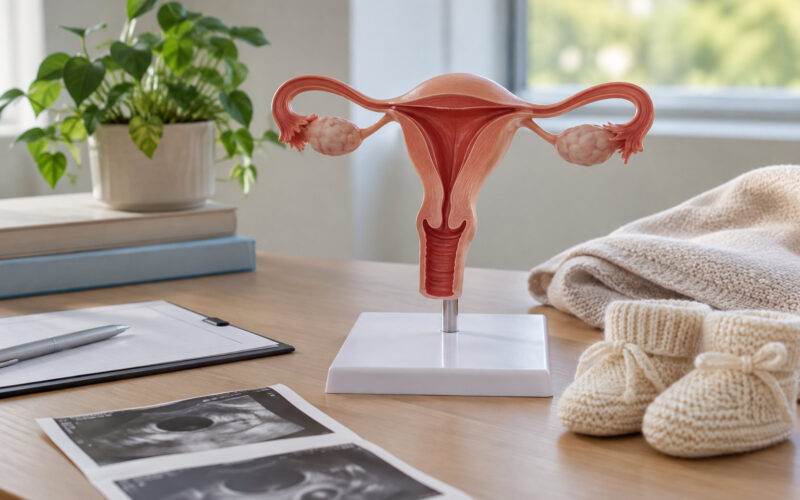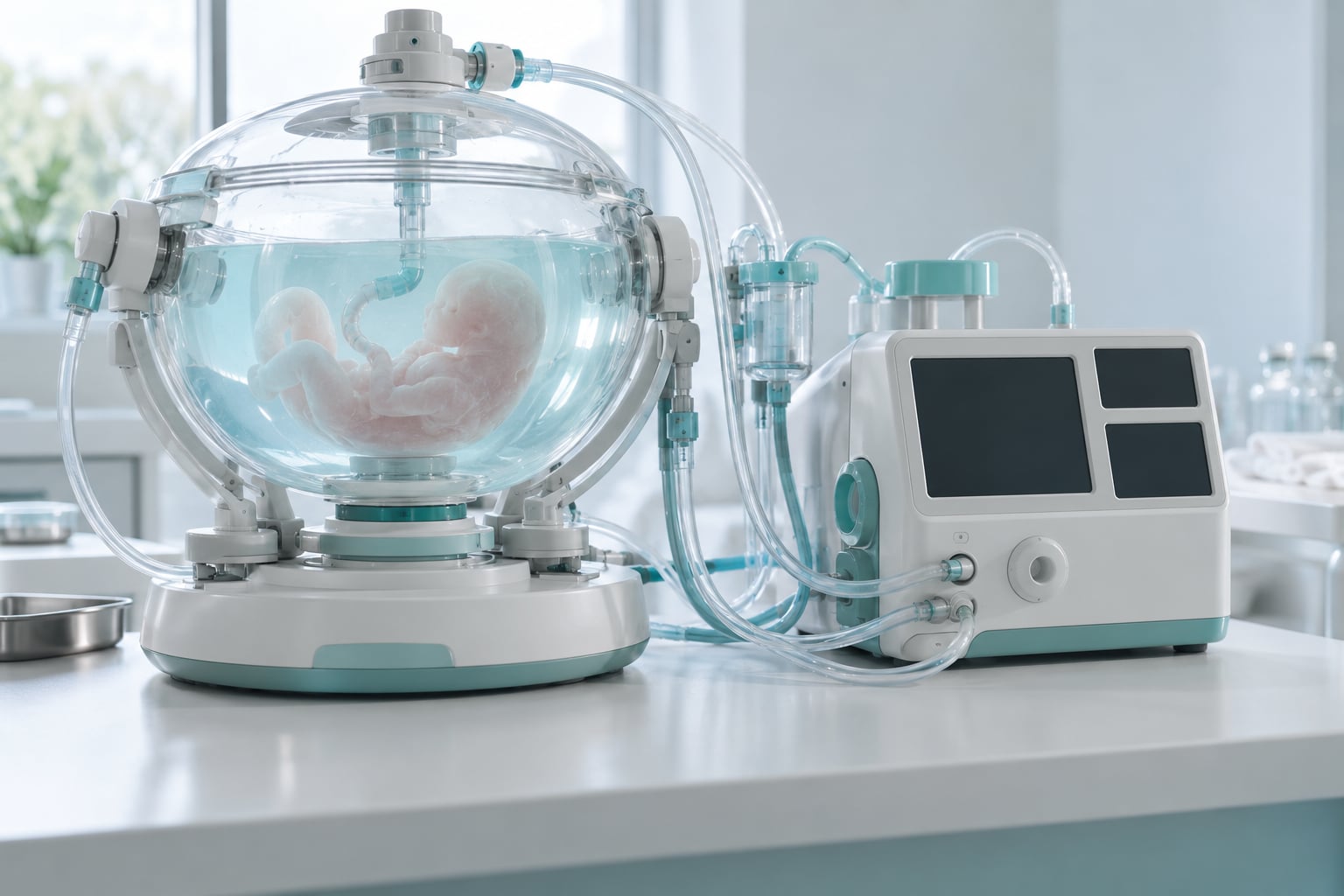
Artificial womb technology would let a fetus grow outside a human body, at least for part of pregnancy and possibly for all of it. That idea raises real questions about safety, consent, pregnancy and personhood. The short version of ectogenesis ethics explained for general readers: the technology is early-stage, the benefits are mostly hypothetical, and the disagreements are genuine rather than settled.
If you have read a headline about a “baby factory,” it is worth slowing down. No human fetus has been grown from conception to birth in an artificial womb. What exists today are experimental systems built for extremely premature lambs, and laboratory embryo models that are something else entirely. This guide separates what has actually happened from what people are imagining, then walks through the arguments on each side without telling you which conclusion to reach.
Last reviewed in 2026. This is general information about a technology and its ethical debate, not medical advice. For anything about your own pregnancy or treatment, talk with your obstetrician or a reproductive medicine specialist.
Table of Contents
- What Is Ectogenesis?
- How Would Artificial Womb Technology Work?
- Where the Science Actually Stands
- What Are the Main Ectogenesis Ethics Explained for General Readers?
- Is Ectogenesis Safe for a Human Fetus?
- Who Should Consent to Using an Artificial Womb?
- Would Ectogenesis Change the Meaning of Pregnancy?
- What Are the Social and Justice Concerns?
- Would Ectogenesis Eliminate Pregnancy or Surrogacy?
- What Laws and Medical Ethics Are Needed Before Ectogenesis?
- Frequently Asked Questions
- Does ectogenesis exist today?
- Is artificial womb technology the same as IVF?
- Could an artificial womb replace a uterus?
- Would a fetus in an artificial womb have legal rights?
- Would artificial wombs improve pregnancy outcomes?
- Should scientists be allowed to grow animals in artificial wombs?
- What Should Readers Take Away About Ectogenesis Ethics?
What Is Ectogenesis?
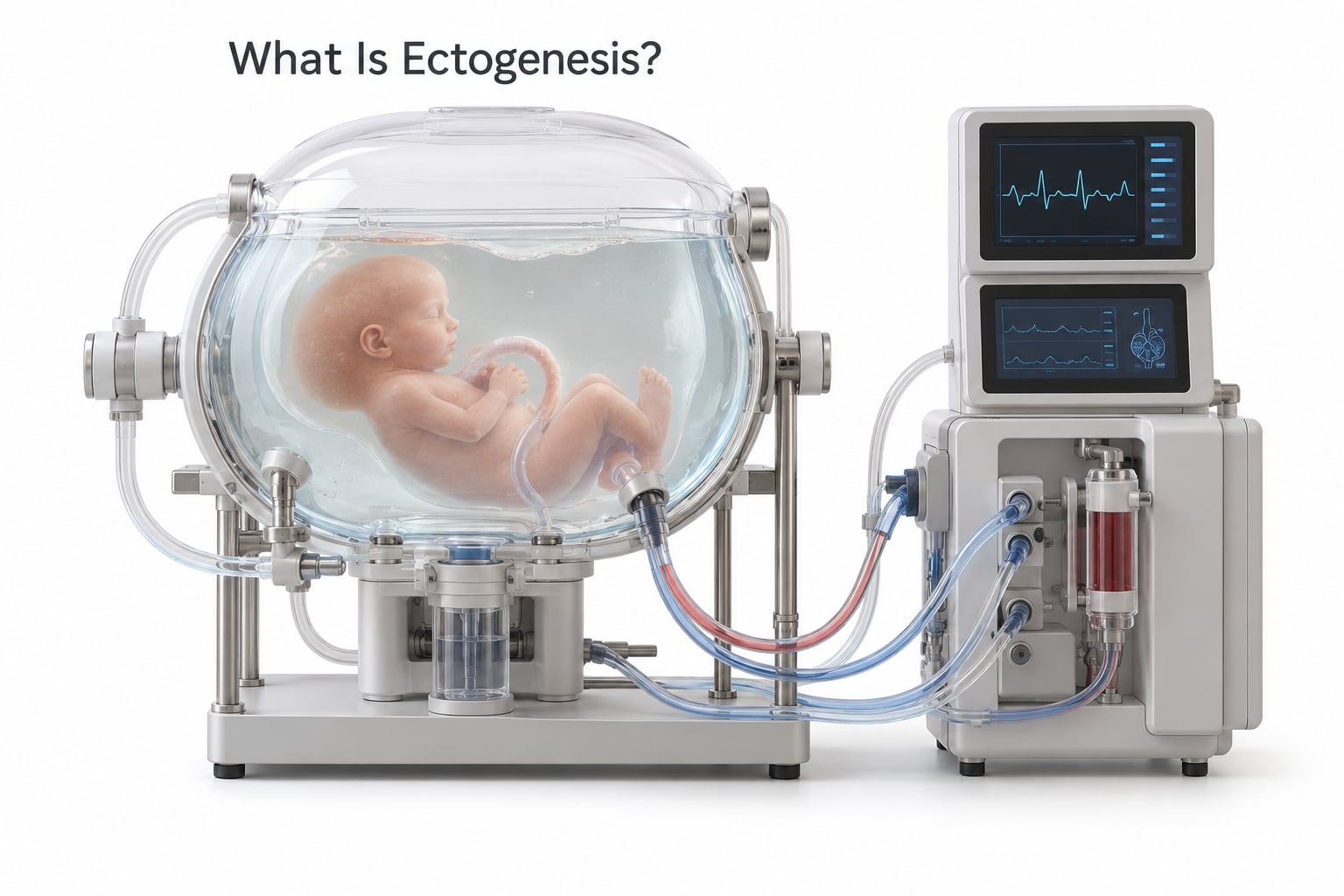
Ectogenesis is the growth of an embryo or fetus outside the body in which it would normally develop, inside a laboratory device that substitutes for a uterus. The word was coined by British scientist J.B.S. Haldane in 1924, from the Greek roots for “outside” and “origin.” When a fetus spends the whole pregnancy in such a device, that is full ectogenesis; when it spends only the final stretch, that is partial ectogenesis.
Several things get confused with it constantly, so it helps to separate them out. In vitro fertilization creates an embryo in a dish and returns it to a body, so there is no ectogenesis. A neonatal incubator supports a baby who has already been born, and the placenta has done its work, so that is not ectogenesis either. An ectopic pregnancy is a real medical condition in which a pregnancy implants outside the uterine cavity, and it has nothing to do with laboratories. And a synthetic embryo model, grown from stem cells in a dish, is not a fetus in a womb. It is a model of what an embryo looks like at an early stage.
| Approach | Where conception happens | Where development happens | Status today |
|---|---|---|---|
| Natural pregnancy | Body | Body, then an incubator if born early | Routine care |
| IVF with embryo transfer | Laboratory | Entirely inside a body | Routine care |
| Partial ectogenesis | Body or laboratory | Body, then an artificial womb after a set point | Experimental, animal testing only |
| Full ectogenesis | Laboratory | Entirely in an artificial womb | Conceptual, not clinical |
| Embryo model | Stem cells in a dish | Nowhere near a womb | Research tool, not a treatment |
One more term you will meet: ectogestation. People use it loosely as a synonym for artificial womb technology. Some researchers use it more narrowly, meaning only the second half of pregnancy, so it overlaps with partial ectogenesis.
How Would Artificial Womb Technology Work?
Everything described below is experimental. No clinic anywhere offers this as care today.
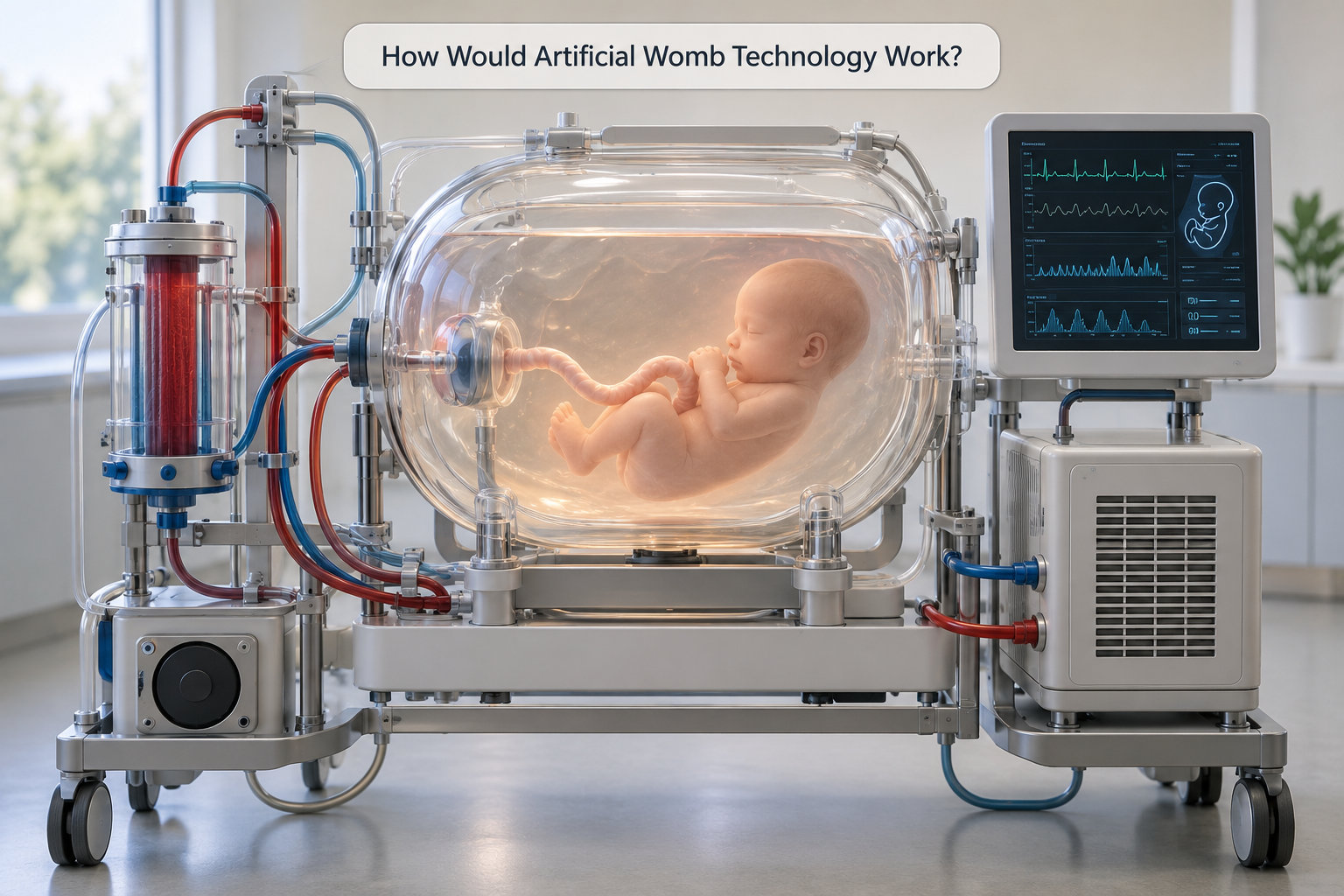
The design goal is deceptively simple: keep the fetus’s own heartbeat doing the work, and replace the placenta rather than the whole pregnancy. Researchers call the main device an ex utero support system, and the fluid-filled bag is usually called a biobag.
1. Preparation. A team would prepare a sterile chamber, fill it with artificial amniotic fluid warmed to body temperature, and remove the air. The fluid does more than cushioning. It lets the fetus move, keeps the skin and lungs in a familiar watery environment, and protects against sudden pressure changes.
2. Maintaining circulation. Two catheters, one for an artery and one for a vein, are placed in the umbilical vessels where the placenta was connected. Unlike a heart-lung machine used in surgery, these systems usually do not pump for the fetus. The idea is that the fetal heart keeps beating, the catheters carry blood out and back, and an external oxygenator adds oxygen and removes carbon dioxide.
3. Nutrition and waste. Nutrients and infection-fighting antibodies move into the blood through the venous line, and waste is filtered out. A mechanical pump handles the flow. Researchers describe this part as the least mature piece of the whole system.
4. Monitoring. Sensors track oxygen, carbon dioxide, pH, temperature, heart rate and movement, with results on screens beside the chamber. This continuous data is a real advantage over a body, where a fetus is much harder to watch.
5. Delivery. If everything holds, birth would be closer to a planned procedure than an emergency. In the proposed model, the fetal circulation is switched over gradually so the newborn’s own lungs take over, much as they do for a very premature baby today.
The honest limits matter more than the concept. Human skin, human lungs and a human brain are far harder to support than a lamb’s. The fetal lungs need fluid to stay open and cannot simply be ventilated with air, and the brain begins a burst of activity in the third trimester that may depend on signals the mother’s body provides. Long-term development cannot be assessed in an animal that will not live long enough to be assessed.
Where the Science Actually Stands
The field has real milestones behind it, which is a fair reason to take the ethics seriously rather than dismissing the topic as fantasy.
In 2017, researchers at Children’s Hospital Colorado reported keeping fetal lambs in an artificial womb for up to three weeks, with normal growth, active movement and a brain scan showing growth comparable to natural development. In 2019 the same group published work on an artificial placenta supporting lambs born extremely early. Researchers have also grown mouse embryos outside the uterus for several days, and in 2021 Jacob Hanna’s group at the Weizmann Institute reported building a system that held mouse embryos from day five to day eleven, well past the point where natural development stops.
Separately, teams including Hanna’s reported stem-cell-based embryo models in 2021 to 2023, structures that mimic early embryos for a few days. Those are the experiments most often reported as “growing a baby.” They are not fetuses, and they are not ectogenesis.
The gap between animal work and a human system is large enough that researchers themselves argue about timelines that vary by decades or that never arrive.
What Are the Main Ectogenesis Ethics Explained for General Readers?
Seven fault lines run through the debate. Safety and long-term outcomes come first. Then consent, given that a future child cannot weigh in. Then the moral status of a fetus, the effect on pregnancy and the definition of motherhood, the risk of commercialization, unequal access, and the possibility of misuse. The remaining sections take them one at a time.
Is Ectogenesis Safe for a Human Fetus?
Nobody knows, because no human fetus has been gestated in one. That is the whole answer, and it is a harder answer than headlines usually give.
Animal results are encouraging but not transferable in the way people hope. Lamb and mouse systems show that the basic principle can work for days or weeks. They cannot tell us how a human brain and nervous system develop over nine months outside a body, and no animal model can answer that. The third trimester is when human brain volume, synaptogenesis and lung maturation do much of their work, and those processes are the ones researchers can least replicate.
Any serious path forward would move in stages: laboratory work on tissue, then animal work, then trials with the smallest possible early transfers, with long-term follow-up into adulthood. A child born after ectogenesis would need to be monitored for decades before anyone could claim the technology is safe. Until then, claims of a proven, safe artificial womb are claims about something that does not exist yet.
Who Should Consent to Using an Artificial Womb?
Intended parents, donors, clinicians and independent ethics reviewers would all have roles, and the hard cases involve the fetus, who cannot consent to anything.
For routine fertility treatment, consent looks familiar. The people who created the embryo and the clinicians agree on its use. Artificial womb technology complicates that picture, because a transfer decision made at fourteen weeks is a decision about a twenty-week fetus with a nervous system, and at thirty weeks it is close to a decision about a child.
Elizabeth Chloe Romanis, who has written on partial ectogestation, argues that timing changes the ethics: the same procedure raises different questions depending on whether the fetus is at a point most doctors describe as non-viable or one that would survive outside the womb. Peter Singer and Deane Wells have argued in the opposite direction, that moving a fetus to an artificial environment could reduce the moral weight of abortion by lowering the point at which protection begins. Glenn Cohen, writing about artificial wombs and abortion rights, has raised a concern that cuts the other way: earlier protection could place pressure on a pregnant person to terminate and transfer rather than continue a wanted pregnancy.
Commercial arrangements add another layer. A paying customer is not the same as a clinician deciding what is best for a child, and if a company builds the device, the pressure to sell it is hard to ignore. Consent to ectogenesis ethics rules would need to be specific enough that a paying customer cannot quietly decide which risks a future child carries.
Would Ectogenesis Change the Meaning of Pregnancy?
It would not remove pregnancy, but it would change what people mean by it, and by motherhood.
Some readers treat this as liberation: a pregnancy that ends safely before it becomes dangerous, with the fetus finishing in a controlled environment. Others hear the same technology as a threat to the bodily autonomy that defines pregnancy at its most intense, because it creates a route out of a pregnancy that some people would use to pressure others. The technology itself is neutral on this. The legal and commercial context decides which way it cuts.
Bonding is a question people raise often, and there is no good evidence either way. Infants are routinely adopted, raised by relatives, or raised by men, and attachment grows in ordinary homes. A lack of a birth canal and a uterine wall does not obviously prevent a relationship. What nobody can dismiss is a child’s later discovery that the beginning of their life happened in a chamber, and what parents feel about discussing it.
Legal parentage is the most concrete change. A gestational mother is usually the legal mother because she carried the child. If a fetus never enters a body, that rule has nothing to attach to, and law would have to decide whether intended parents are automatically parents, or whether the order of events matters. Shulamith Firestone argued in 1970 that pregnancy and childbirth should be separable from women’s lives, partly so that no woman’s fate depends on her body. Dora Russell had pressed a similar view in 1925. Critics answer that a technology separating reproduction from women’s bodies is a tool for avoiding accountability, and that is a fair reading of how it could be used.
What Are the Social and Justice Concerns?
The benefits and the risks do not land on the same people, and a technology that helps one group can still harm another.
Who would plausibly benefit: people with no uterus or a damaged one, people facing a pregnancy dangerous to their health, people after a uterine transplant, trans men, same-sex male couples, people with repeated pregnancy loss, and possibly people who would otherwise turn to surrogacy. That is a real list, and for each group the technology offers something current care does not.
Who would carry the risk: whoever gestates first, and whoever buys the system first. If an early system works only well enough to produce babies with significant disability, the people using it are also the people who absorb the consequences. If the system costs what complex fertility care costs today, access will follow income, and the group with the least influence over how it is designed will be the group most likely to receive it.
| Potential benefit | Corresponding risk |
|---|---|
| A pregnancy that ends before it becomes dangerous | Pressure to end wanted pregnancies and transfer |
| An option for people without a uterus | Concentrated in clinics that few can reach or afford |
| Delivery of very premature infants at a chosen moment | Unproven long-term outcomes, discovered only after birth |
| Separating reproduction from a pregnant person’s body | Reduced autonomy, without a real route to refuse |
| Research tools that reduce embryo use in studies | Slippage toward goals nobody agreed to, including organ farming |
Racial and global inequality deserves a separate mention. Fertility care already divides along lines of race, income and geography. A technology that promises safety could be deployed first for well-resourced patients and arrive hardest on the people who were promised it least.
Would Ectogenesis Eliminate Pregnancy or Surrogacy?
No, and the most common misconception in search results is the claim that artificial wombs will end abortion. They would not, for a simple reason. People terminate pregnancies for reasons that have nothing to do with the risks of continuing: fetal anomaly, miscarriage, or a decision about whether a pregnancy is wanted at all. A system that begins at, say, twenty weeks does nothing for a decision made at eight.
Even a full ectogenesis system would leave miscarriage, infertility, and complicated pregnancies in place, because conception itself and the early weeks would still happen wherever they happen now. It would add an option. It would not replace standard prenatal care, and most births would still occur in bodies.
The widely repeated claim in forum discussions is that ectogenesis would not end abortion but would shift the debate, because it changes what viability means without telling anyone who decides it. That seems closer to right. Whether it reduces suffering or expands state control depends far more on law than on engineering.
What Laws and Medical Ethics Are Needed Before Ectogenesis?
The safeguards below are the ones researchers and bioethicists keep pointing to, and most jurisdictions have none of them today.
Laboratory standards would come first, covering culture systems, embryo models and how long experiments may run. Many countries follow a 14-day rule, a voluntary convention that many laboratories observe even where it is not law. Rules for embryo research, including what happens when a model shows signs of a primitive axis that would have become a nervous system, are still being argued.
Any human trial would need independent ethics review, stage-gated approval, and informed consent written for a decision a person is making on behalf of a future child. Somebody has to answer a question that consent forms rarely pose: at what point in development would we decline to transfer, and who is allowed to draw that line?
Then comes the register most people forget. Long-term outcome monitoring for decades. Parentage law that does not depend on a uterus. Privacy protections, because the data from a monitored pregnancy is unusually revealing. Advertising rules, so that a device is not sold as safe before it is. And export controls, because any restriction that applies in one country is meaningless if the hardware can simply be bought elsewhere.
Rules vary by country and change over time, so anyone giving advice on what is legal needs to check the specific jurisdiction rather than rely on a general statement.
Frequently Asked Questions
Does ectogenesis exist today?
No. No human fetus has been grown outside a body from conception to birth, and no clinic offers artificial womb technology as care. The closest work is experimental: fetal lambs supported for weeks in an artificial womb, mouse embryos grown outside the uterus for several days, and stem-cell-based embryo models used as research tools. Each is a real step, and none is a human artificial womb.
Is artificial womb technology the same as IVF?
No. In vitro fertilization creates an embryo in a laboratory dish and then returns it to a body, where all development happens as usual. Artificial womb technology would keep a fetus outside a body in a fluid-filled chamber, replacing the placenta with a mechanical system. Some researchers imagine the two combined, with an embryo created in vitro and moved straight into an artificial environment without entering a body at all.
Could an artificial womb replace a uterus?
It could replace the mechanical and medical functions of a uterus, but not the rest of what a body does. A uterus supplies hormones, immune protection, temperature control and a metabolic environment that a chamber would have to reproduce. Researchers argue about which of those functions matter for fetal development. Since a healthy uterus works reasonably well for nine months, the strongest case for the technology is not replacing it in routine pregnancy but ending one earlier and under more control.
Would a fetus in an artificial womb have legal rights?
That depends on how a given jurisdiction defines legal status, and there is no settled answer. Some systems grant rights from conception, others from birth, and many rely on a viability threshold, which artificial womb technology would move earlier and by choice rather than by accident. Lawmakers would also have to decide whether a fetus transferred out of a body is legally still pregnant. These are unresolved questions in most countries.
Would artificial wombs improve pregnancy outcomes?
Potentially, in a narrow and specific way. Partial ectogenesis could give extremely premature infants a controlled, monitored environment instead of the conditions of an early birth, and could end some dangerous pregnancies before they became emergencies. But it would not help pregnancies lost early, and it introduces new risks of its own, including long-term developmental questions that cannot be answered until children gestated this way reach adulthood. Nobody has this evidence yet.
Should scientists be allowed to grow animals in artificial wombs?
Animal research is the step that comes before any human work, and most bioethics review boards treat it as legitimate science rather than as a special moral case. Oversight still matters. Researchers have to follow the three Rs, minimize the number of animals used, and expect that some species will need to be tried and will fail. Forums like Reddit’s Futurology and transhumanism communities often follow this work closely, and their concern is usually about pace and oversight rather than about whether the research should happen at all.
What Should Readers Take Away About Ectogenesis Ethics?
The central tension is not benefit against harm in a simple sense. It is that a technology with plausible benefits for real people would also require society to make decisions about a fetus it cannot yet keep safe, for a child who cannot consent, under laws written for a world without it. That is why the ectogenesis ethics debate keeps returning to viability and autonomy: both are proxies for who holds power in a reproductive decision.
Three habits help when you read claims about this technology. Ask which stage the claim describes, since animal work, embryo models and a human system are three different things. Ask who carries the risk, because the person using the device and the person affected by it are rarely the same one. And ask what oversight exists, since a procedure run without independent review tells you very little about its safety.
Nothing here is settled, and reasonable people land in different places. The most productive position for a curious reader is to hold the promise and the unknowns at the same time, and to keep watching the research rather than the headlines. If you keep one line from ectogenesis ethics explained for general readers, make it this: the benefits are plausible and the unknowns are not small.