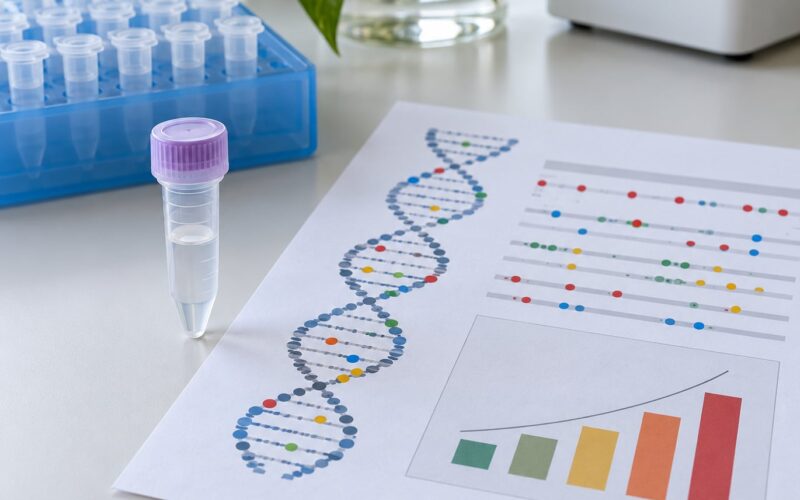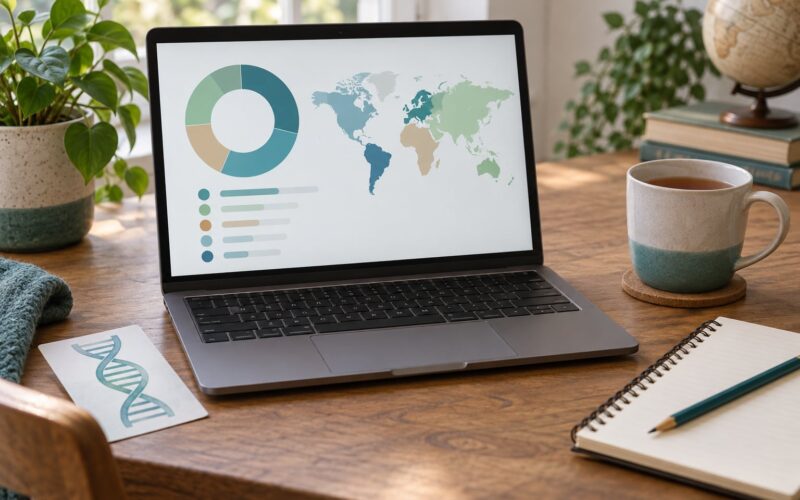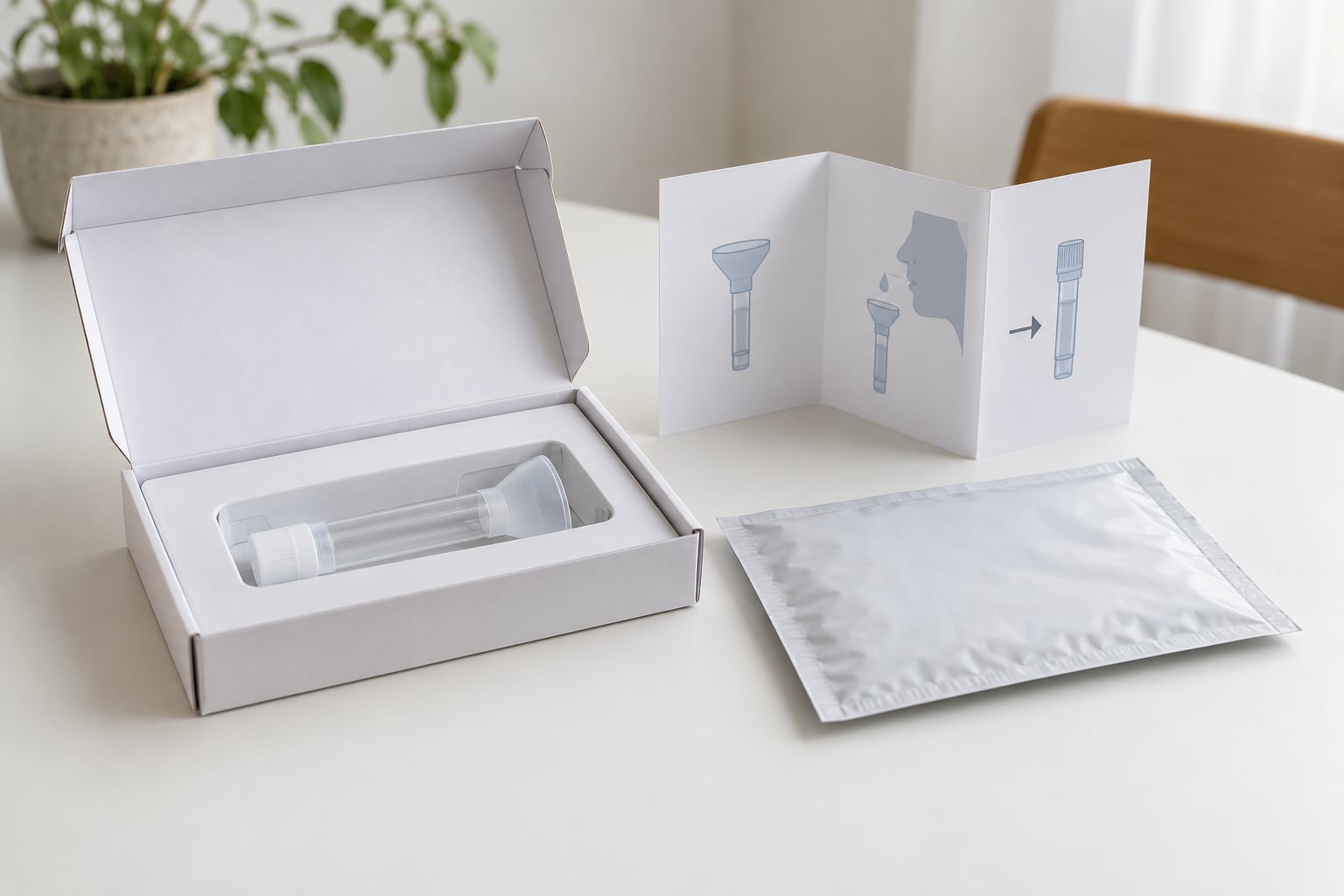
Direct-to-consumer DNA tests work by sending one of your cells to a lab and reading a few hundred thousand specific spots in your genome. You order a kit online, spit into a tube or rub a swab inside your cheek, mail it to a private laboratory, and weeks later you read estimates about your ancestry, lists of DNA matches, and optional health or trait reports in an app. No doctor orders it, no insurance is involved, and nobody interprets the findings for you unless you pay a genetic counselor to do it.
That last part is where most confusion comes from. Knowing the mechanics of how direct to consumer DNA tests work tells you which numbers are sturdy and which are soft. The lab chemistry is reliable. The ancestry percentages are estimates built on reference populations that are still growing. The health panels are closer to a weather forecast than a diagnosis.
This guide walks through the whole pipeline, from choosing a test to deleting your data years later. I have read the same peer-reviewed and government literature my readers are pointed to, and I will tell you plainly where the science is solid and where the marketing runs ahead of it.
Table of Contents
- How Direct to Consumer DNA Tests Work, Step by Step
- What Happens After You Submit Your DNA Sample?
- How Direct to Consumer DNA Tests Handle a Bad Sample
- What Do Direct-to-Consumer DNA Test Results Mean?
- How Accurate Are Direct-to-Consumer DNA Tests?
- Why Can Ancestry Results Change After You Take the Test?
- What Can a Home DNA Test Tell You About Your Health?
- What Should You Consider Before Ordering a Test?
- What Happens to Your DNA Data?
- Frequently Asked Questions
- Can a direct-to-consumer DNA test prove my identity?
- Can children take an at-home DNA test?
- Why are my DNA ancestry results different from my family’s?
- Can I delete my DNA sample and genetic data after testing?
- Can a home DNA test diagnose an inherited disease?
- What to Do First
How Direct to Consumer DNA Tests Work, Step by Step
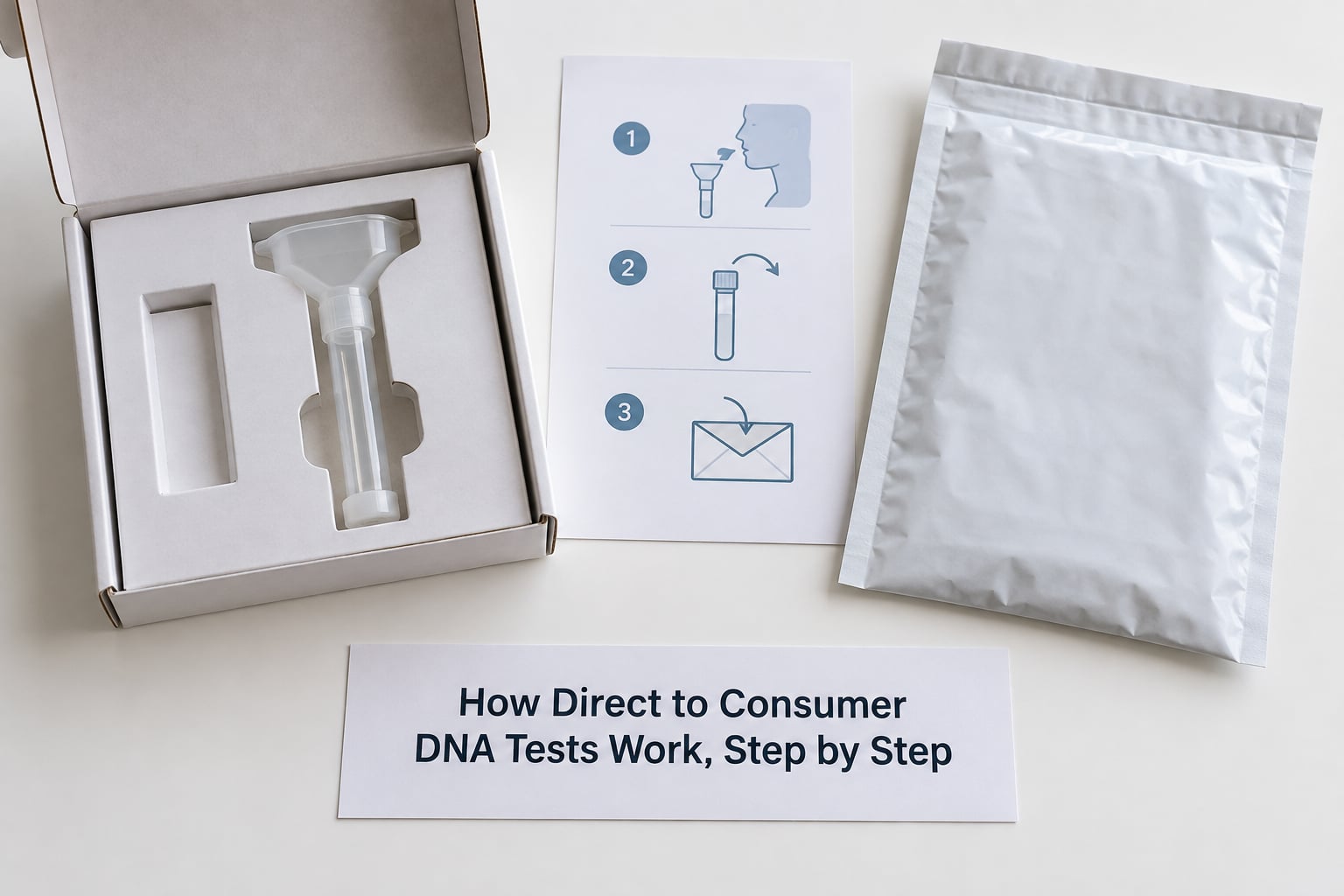
The process is the same for almost every company, and it takes seven steps. The whole thing, start to finish, usually runs four to eight weeks from the day you mail the tube.
- You order the test online. You pick a company, pay with a card, and a kit arrives at your home. Some companies also sell through pharmacies and clinics, but the company still does the testing.
- You check the consent terms. Before you spit, the paperwork asks whether you agree to research use of your sample, whether your stored DNA can be used to find relatives, and how long the company keeps the physical sample. This is the point where your data choices are actually made.
- You collect your own sample. Most tests want about 2 mL of saliva, spit into a sterile tube. Some kits use a cheek swab, a four-to-five minute rub inside the cheek to collect cells, and a few use a dried blood spot from a finger prick.
- You mail it back. The tube goes into a prepaid, biohazard-safe return mailer. Temperature and time matter; a sample that gets too hot or sits for weeks can be rejected.
- The lab extracts and reads your DNA. Cells are broken open, DNA is pulled out and purified, and a small aliquot is run on an automated genotyping platform that reads several hundred thousand markers at once.
- Software compares you to everyone else. Your markers are matched against a company reference panel of people with documented family histories, and an algorithm turns that comparison into ancestry percentages, a match list, and reports.
- Your report appears and changes over time. Results arrive in an app or online portal. When the company adds people to its reference panel or refines its algorithm, your existing numbers can be recalculated, and you get a notice.
Here is the same pipeline as a table, with what goes in, what the lab does, and what comes out at each stage.
| Stage | What goes in | What the lab does | What comes out |
|---|---|---|---|
| Ordering and consent | Your name, email, payment details | None. A database records your account and consent settings | A kit in the mail and a privacy agreement you set the terms on |
| Collection | Saliva, a cheek swab, or a dried blood spot | None. You do this part at home | A sealed tube containing cheek cells and a few milliliters of saliva |
| Shipping | The sealed sample | Receives and logs the tube under a unique identifier | A sample that has arrived and been checked against the kit barcode |
| Extraction | The sample | Breaks cells open, purifies DNA, runs a quality check on quantity and integrity | A usable volume of purified DNA, or a rejection notice |
| Genotyping | Purified DNA | Runs a genotyping array that reads a few hundred thousand specific marker positions | A genotype file: which version of each marker you carry |
| Analysis | The genotype file | Compares your markers to a reference panel and to other customers’ files | Ancestry estimates, a DNA match list, haplogroups, and any report you purchased |
| Delivery and updates | Your results | Recalculates estimates when the panel or algorithm changes | A report in an app or portal, revised as the database improves |
What Happens After You Submit Your DNA Sample?
After the tube arrives, the laboratory checks it over and then breaks the cells open to isolate the DNA. That extracted DNA gets a quality check for how much is there and whether it has degraded. A weak or damaged sample is rejected and the company asks for a new one, which is why people sometimes get a replacement kit weeks after ordering.
Most consumer tests then use a genotyping array, a chip that carries a few hundred thousand single nucleotide polymorphisms, or SNPs. A SNP is a single letter of the DNA code that commonly differs between people at that position. The chip reports which of the usual versions, called alleles, you carry at each of those positions. It does not read your entire genome letter by letter. It reads chosen positions, and leaves the rest out.
Whole genome sequencing, which reads the whole sequence, is a different and more expensive technology. A handful of consumer companies offer it, and it does catch more, including some structural differences a chip cannot see. More data is not automatically more useful, though, because a raw sequence without interpretation is just a very long list of letters.
The final stage is arithmetic. Your markers get compared against a reference panel, a set of people whose ancestry is well documented through records, or to other customers’ files. The distance between your profile and each reference population drives the percentage you see, and the amount of DNA you share with another person, measured in centimorgan, drives your match list. A centimorgan is a unit of shared DNA; the ranges people argue about online are just the intervals where a predicted relationship could be, not proof of one.
Two lab-stage mistakes cause most rejections. Eating, drinking, smoking, or brushing your teeth within about half an hour of spitting dilutes the sample. So does eating or drinking hot liquids right before collection, and a wet or touched swab. Follow the kit’s own timing instructions over anything you read online.
How Direct to Consumer DNA Tests Handle a Bad Sample
Read the insert before you open the tube, and set a timer. Spit away from the tube’s rim, cap it immediately, and follow the volume line. Cheek swabs want a firm scrub of the inside of both cheeks, not a lazy brush of the gums.
What Do Direct-to-Consumer DNA Test Results Mean?
Each part of the report answers a different question, and they differ enormously in how firm an answer you get. A DNA match is arithmetic. An ancestry percentage is a statistical estimate. A health finding is a risk statistic that needs context you probably do not have.
| Result | The question it answers | How firm is it |
|---|---|---|
| Ancestry estimate | Which reference populations does your DNA resemble most? | Estimate. Shifts when the reference panel changes, and under-represents some populations |
| DNA relative matches | Who shares enough DNA with me to be a relative? | Firm that a match exists; a range rather than a certainty for the exact relationship |
| Haplogroups (Y-DNA and mtDNA) | Which deep ancestral line do I sit on? | Relatively stable, but narrow: one paternal or maternal line only |
| Inherited traits | What tendencies show up in people with variants like mine? | Suggestive. A hair-color or caffeine result is a population average, not a personal fact |
| Health risk findings | Am I more likely than the reference group to develop certain conditions? | Varied. A single-gene finding can matter; a polygenic score is a weak statistical signal |
| Raw DNA data | What were my actual marker readings? | Firm. This is the underlying data, and you can take it to other tools |
Read that table as a ladder of certainty. Ancestry and traits sit near the top as soft, health sits in the middle and is hardest to interpret, and raw data at the bottom is just a file of marker readings with no interpretation attached at all.
Ancestry percentages are the most popular feature and the least precise. A result of 40% one region and 25% another does not mean a fixed slice of your body came from somewhere specific. It means your markers fit those reference populations better than any others, on the day the algorithm ran.
People often ask what a “3% match” means. It means you and that person share enough DNA to be placed in the same family network, most likely somewhere in the extended range, and the company’s range narrows as you add shared segments from other matches or a documented tree. It is a starting point, not a label.
How Accurate Are Direct-to-Consumer DNA Tests?
Accuracy splits into several parts, and they are not equally strong. The laboratory part is very strong. The interpretation part ranges from reasonable to weak, depending on what is being interpreted.
Laboratory quality is high. A test that reaches the lab and passes quality control produces accurate marker readings, because the genotyping chemistry is mature and repeatable. A technical error in the reading is unusual.
Reference populations are uneven. Ancestry estimates depend on who is in the panel. Panels have historically been drawn heavily from people of European ancestry, so a family line from a population with fewer reference participants gets estimated less well, or not at all. This is why Indigenous ancestry so often fails to appear, or appears at a fraction of a percent that could easily be noise.
Confidence ranges are wide on the edges. A large central estimate can be fairly stable. A small sliver, anything under about 2 percent, often sits inside the margin of error and should not carry weight.
Algorithms differ between companies. Each company chose different marker sets, different reference panels, and different ways of grouping populations. Two reputable companies working from the identical sample can and do return visibly different percentages. That is not proof that one is lying or that one is better. It means the question has more than one reasonable answer.
Finding a match is not the same as naming a relationship. Companies can reliably tell that a person is a genetic relative. The precise label, cousin twice removed versus half first cousin, comes with a range that only firms up as you add evidence. A predicted relationship is not a legal finding of kinship, parentage, or identity, and it is not proof of parentage on its own.
Health results are where accuracy claims are weakest. One small study, cited widely in secondary coverage, found that for some reported variants only about 60 percent of the flagged individuals actually carried the abnormal sequence, implying a high false positive rate in some consumer health reports. Sample sizes and panels have changed since then, which is precisely the problem: the underlying evidence base is still catching up to what companies are selling.
Why Can Ancestry Results Change After You Take the Test?
Ancestry results change because the reference panel and the algorithm change, not because your DNA changed. Your sample is what it was the day you spit into the tube.
Every time a company adds customers with well-documented family histories, the panel gets larger and more representative. That is genuinely good news for accuracy, and it is also why last year’s numbers are not this year’s numbers. When the panel is rebuilt, the software re-runs the comparison across every existing customer and issues revised estimates.
Research also improves. A published study that sharpens how certain regions map to certain marker patterns gets folded into the algorithm, which can move your percentages without any new sample. This is exactly the pattern people describe on forums, where the same raw data file uploaded to a different tool produces a different breakdown and everyone concludes that something is wrong.
Nothing is necessarily wrong. Your DNA is a fixed input; the questions being asked of it are the variable. A percentage that moves a few points on a panel update carries very little information, and a percentage that changes a lot usually says more about the panel than about you.
What Can a Home DNA Test Tell You About Your Health?
A home DNA test can tell you which genetic variants you carry and can give you statistical risk estimates for some conditions. It cannot tell you whether you have a disease, whether you will develop one, or what to do about it. Those are different questions with different evidence behind them.
Consumer health panels come in two very different flavors. A single-gene finding, such as a variant in BRCA1 or BRCA2 that is associated with hereditary breast and ovarian cancer, involves a specific well-characterized change. Those are the results where a clinical confirmation test, ordered by a doctor, is genuinely meaningful. The factor V Leiden and hemochromatosis findings people see in consumer reports sit in a similar category, with their own caveats.
Polygenic risk scores work differently. They combine many small variants, each contributing a fraction of a percent, into a single number. When people ask about BRCA1, BRCA2, or MTHFR results, or about a 3 percent increased risk of a condition, the math behind the number is much softer than the headline suggests, because the reference studies these scores are built on are large but still imbalanced and often not matched to the population reading the report.
Treat consumer health results as a reason to ask a question, not as an answer to one. A result is not a diagnosis, and a risk percentage is not a forecast of your future. If a report flags something that worries you, or you have a family history of a condition that runs in your family, or you are planning a pregnancy, take it to your doctor or a genetic counselor rather than acting on it alone. A counselor can order a properly validated clinical test, which is a genuinely different analysis, and put the result into your actual family history.
That matters especially for carriers. Some consumer panels include carrier screening, which tells you whether you carry one copy of a recessive variant. That can be useful before or during a pregnancy, when both partners’ carrier status shapes the plan, but a carrier result from a consumer test is a starting point for a conversation with your prenatal provider, not a substitute for clinical carrier screening done through a medical order.
What Should You Consider Before Ordering a Test?
Decide what question you actually have first, because a broad test will hand you dozens of answers you did not ask for. Curiosity about ancestry is a reasonable reason to test. A health decision is not.
Then work through these points in order.
- The question you want answered. Finding relatives, understanding a family line, checking carrier status before a pregnancy, and getting a disease risk number are four different needs, and no single consumer test does all four well.
- What is actually being tested. Check whether the health panel uses single-gene findings, polygenic scores, or both, and how many markers the array reads. A large number of markers is not the same as clinical-grade accuracy.
- Sample type and failure modes. Saliva is the most common and works for most people. Cheek swabs can fail in people with dry mouths or if the swab is wet. Dried blood spots are harder to collect but are used where a clinician needs blood-based testing.
- Whether the company and lab are regulated for the specific result. Ancestry results are not the same regulatory category as health results. The U.S. FDA required one major company to withdraw its health risk results in 2013 and again in 2015, and further action followed, because those reports were not backed to the standard the agency applies to other tests. That history tells you something important about which parts of a consumer report to trust.
- Cost structure and what a subscription changes. Many companies separate a one-time kit fee from a required membership that unlocks the deeper reports, or charge per relative match. A test that seems cheap can be a multi-year bill if you do not cancel.
- Refunds and re-testing. Samples can be rejected for low DNA quantity. A company that will send a free replacement matters more than a discount on the first kit.
- Update practices. Will your report be revised when the panel improves, and will the company tell you? AncestryDNA, 23andMe, MyHeritage, and FamilyTreeDNA all behave a little differently here.
- Raw data and third-party tools. Most companies will let you download a genotype file and upload it to tools like GEDmatch or Promethease. More data means more options, and also more places to misread it.
If a result does surprise you, follow a fixed order rather than reacting in the moment. Take a screenshot of the full report, including the confidence ranges, before the company revises it. Tell the other person if the finding involves them. Then make an appointment with a genetic counselor and ask for a clinical confirmation test if a health finding is involved. Do not reorganize your care, your medications, or your pregnancy plans off a consumer report alone.
What Happens to Your DNA Data?
Your sample and your data are two different assets, and they follow different paths. Most companies keep the physical sample for a set period and then destroy it, while the digital data stays in their system for as long as your account is active. Some keep the sample indefinitely for future testing, which you should check before you send it.
Your data typically has four uses. It powers the matching database, so new relatives can be found for you and for other customers. It may be used for research, if you consented, sometimes with identifiers stripped out and sometimes not. It can be requested by law enforcement, which is one reason researchers, clinicians, and privacy advocates repeatedly advise against uploading a full raw DNA file to a third-party site, because a sample there can be hard to remove. And it can raise questions about relatives you never met, since a match to you is a match to them too.
Federal law offers partial protection. The Genetic Information Nondiscrimination Act of 2008 bars health insurers and employers from using genetic information for coverage or hiring decisions. It does not cover life insurance, disability insurance, or long-term care insurance, and it does not reach many small employers. Read the current privacy, consent, retention, and deletion terms yourself before submitting, because policies change and they differ a lot between companies.
Deletion requests are worth understanding up front. What you can usually do is ask a company to delete your stored sample and data, and to close your account. What you often cannot do is remove information from research databases that already hold it, or from the profile another person built about the match between you and them. Decide that tradeoff before you upload, not after.
Frequently Asked Questions
Can a direct-to-consumer DNA test prove my identity?
No. A consumer test can show that your DNA matches another person’s sample, and it can place you in a range of predicted relationships. That is useful for genealogy, but it is not a legal determination of identity or parentage. Courts, insurers, and government agencies require documented chain-of-custody procedures, such as a test collected by an approved party, rather than a self-collected sample.
Can children take an at-home DNA test?
Technically, yes. Most kits work on a child’s saliva sample, though companies set their own age minimums and the instructions usually cover collection by a parent or guardian. Think carefully before testing a minor. A report can surface unexpected ancestry or unknown relatives, and the child cannot consent to how that information gets shared. Many people wait until adulthood for that reason.
Why are my DNA ancestry results different from my family’s?
Because each person inherited a different mix of DNA from their parents, and everyone also has some unshared ancestry that is not visible in a parent’s results. On top of that, every company estimates percentages a little differently based on its own reference panel. A parent showing almost no trace of a region is common even when the child shows a meaningful amount of it.
Can I delete my DNA sample and genetic data after testing?
Usually, yes, and most companies provide a deletion or account-closure process, often within their privacy settings. The limits are worth knowing. Data already shared with research partners or included in a study generally cannot be pulled back, and a match between you and another customer may remain in that person’s account. If keeping your data out of matching databases matters to you, say so before you order.
Can a home DNA test diagnose an inherited disease?
No. A consumer test reports that you carry a genetic variant or have an elevated statistical risk. A diagnosis requires clinical laboratory testing ordered by a doctor, interpretation in the context of your own symptoms and family history, and a treatment or monitoring plan. A consumer health result is a reason to schedule an appointment with your doctor or a genetic counselor, not a finding in itself.
What to Do First
Before you order anything, write down the single question you want answered. Ancestry and relative matching are the most reliable parts of a consumer test, and a question about a disease, a medication, or a pregnancy is one that belongs with a clinician from the start.
Then read the privacy and consent terms, not just the marketing page, because that is where you learn whether your sample is kept, who uses your data, and how to delete it later. Choose a service with a reasonably sized reference panel and a process for sending a new sample if yours is rejected.
Finally, decide in advance what you will do with a surprising result. Screenshot the report, talk it through with someone qualified, and if it touches your health or your family planning, book a genetic counselor. Understanding how direct to consumer DNA tests work is useful on its own. Knowing where the reliable part stops and the estimate begins is what makes the result worth trusting.