Mitochondrial donation explained in plain language: it is an IVF technique in which a mother’s nuclear DNA is moved into a donor egg that carries healthy mitochondria, so a baby is genetically related to the intended parents but is unlikely to inherit the mother’s mitochondrial disease. Almost none of the baby’s DNA comes from the donor, and none of it comes from the sperm donor in the sense that matters here.
It is worth separating what this procedure is designed to do from what it can promise. It substantially reduces the chance of passing on a disease-causing mitochondrial mutation. It does not remove every trace of affected mitochondria, and it is not available everywhere.
Below is a walkthrough written for someone who is weighing the decision rather than for a genetics exam. This is educational information, not medical advice. A clinical geneticist and a specialist mitochondrial disease team should be the ones to advise you on your specific situation.
Table of Contents
- What Is Mitochondrial Donation?
- Why Is Mitochondrial Donation Needed? The Problem of Mixed Mitochondria
- How Does Mitochondrial Donation Work? Step by Step
- Mitochondrial Donation vs. Egg Donation: What Actually Changes
- Who Might Be Eligible for Mitochondrial Donation?
- Can Embryo Testing Reduce the Risk? Partly, Not Completely
- What Are the Benefits, Limitations, and Health Risks?
- What Ethical Questions Does It Raise?
- What Else Should Patients Know Before Proceeding?
- Frequently Asked Questions
- Does mitochondrial donation use a donor egg?
- Will a child born through mitochondrial donation be unaffected?
- Is mitochondrial donation the same as embryo donation?
- Does mitochondrial donation guarantee that a child will not develop the disorder?
- Who approves and performs mitochondrial donation?
- Does mitochondrial donation always succeed on the first IVF cycle?
- What to Do First
What Is Mitochondrial Donation?
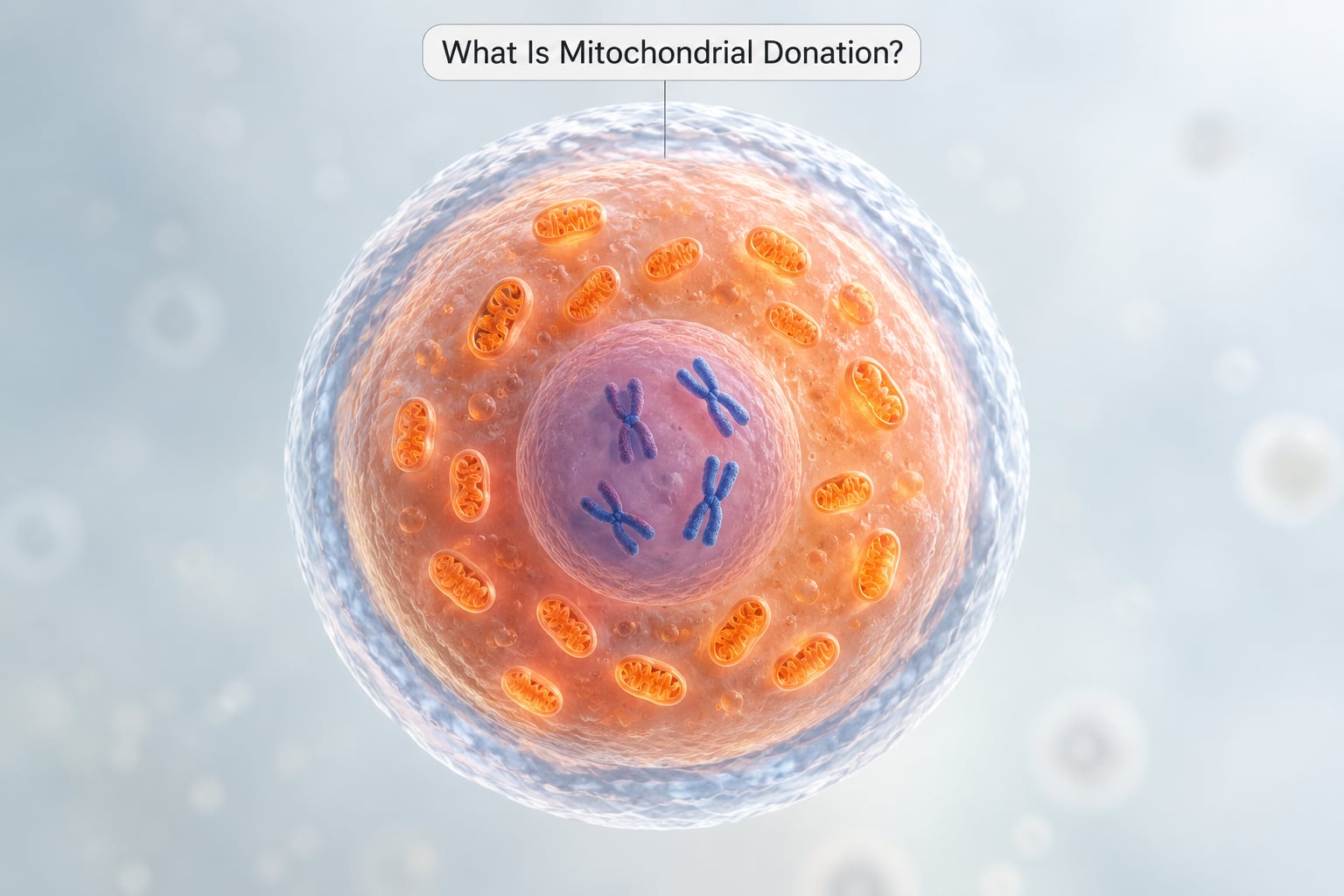
Mitochondrial donation is an IVF technique that lets a woman who carries a disease-causing change in her mitochondrial DNA have a biologically related child without passing that change on. It works by placing her nuclear DNA, the instructions held in the cell’s chromosomes, into a donor egg whose mitochondria are healthy.
The distinction that confuses most people is between two kinds of DNA. Mitochondrial DNA, usually written mtDNA, is a small separate set of instructions that lives inside the mitochondria and is copied by them. Nuclear DNA, written nDNA, is the much larger set of instructions in the cell’s chromosomes, and it holds almost everything else about a person.
From the donor comes the mitochondria, and with them mtDNA, which in published work has amounted to roughly 0.1 to 0.3 percent of the resulting child’s DNA. The intended mother still supplies the nDNA, and the father supplies roughly half of it as usual.
Read that again if it helps. A child conceived this way is not half donor and half mother. The donor contributes a small, specific biological component, and no legal parentage.
Why Is Mitochondrial Donation Needed? The Problem of Mixed Mitochondria
Most mitochondrial disorders are inherited from the mother, because the egg supplies the embryo with essentially all of its mitochondria. Fathers do not pass on mitochondrial DNA, and there is currently no comparable procedure for the small number of disorders linked to nuclear genes.
Here is the part that makes the risk hard to predict. A woman who carries a mutation usually has a mixture of healthy and affected mitochondria in her cells, a state described as heteroplasmy. As her eggs form, they can end up with very different mixtures, one embryo more affected than the next.
Because the proportion varies unpredictably from egg to egg, each pregnancy is a fresh roll of the dice rather than a repeat of the last one. Families who have already lost a child describe mitochondrial disease as varying widely in severity, and that unpredictability is precisely why reducing the risk matters so much to them.
Families affected by conditions such as Leigh syndrome, where a child’s mitochondria cannot keep up with their energy needs, often describe the fear of passing the condition on as a weight carried through every pregnancy decision.
How Does Mitochondrial Donation Work? Step by Step
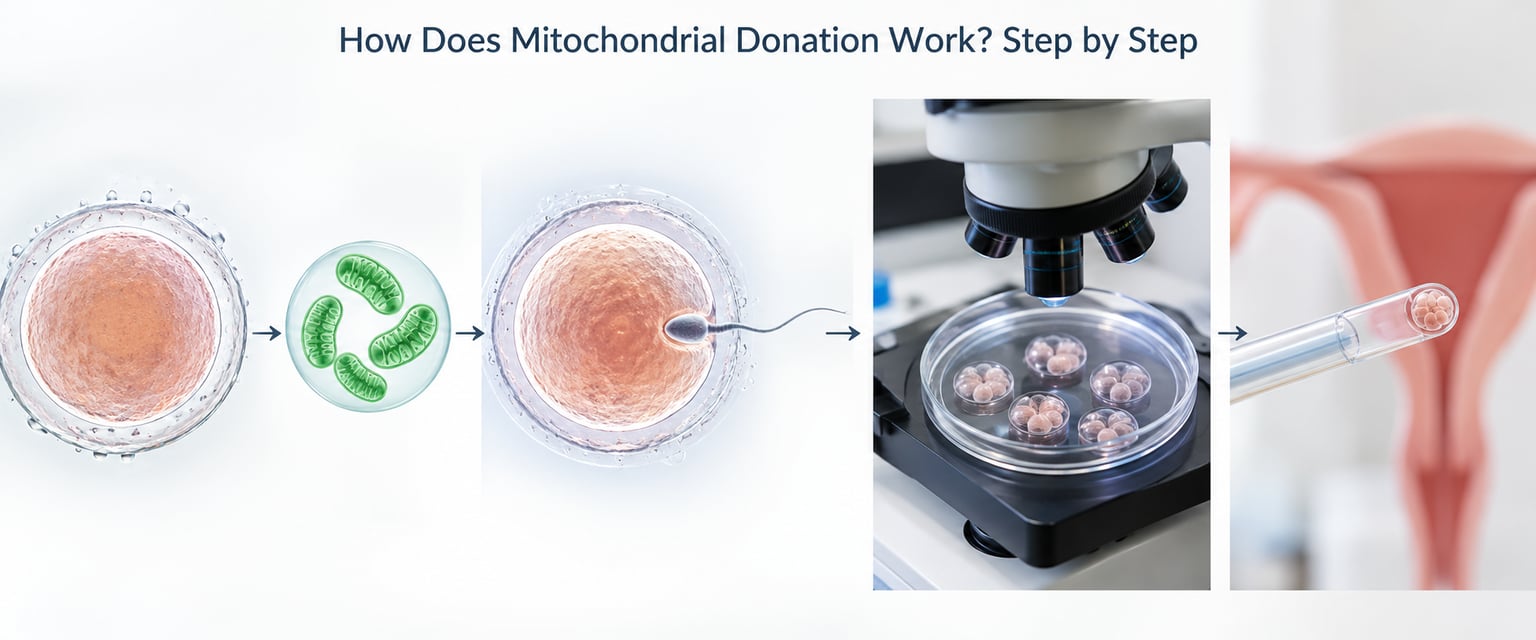
In every country’s programme, the sequence follows the same broad arc: stimulate the ovaries, collect eggs from two sources, use micromanipulation to move the intended parents’ nuclear DNA into a healthy cell, then test and transfer.
- Stimulation and assessment. Both the intended mother and the donor receive hormone injections to produce multiple eggs, and both are screened for infectious disease and general health.
- Egg collection and fertilisation. The intended mother’s eggs are fertilised with the partner’s sperm in the usual IVF way, alongside embryos created from the donor’s eggs with donor sperm.
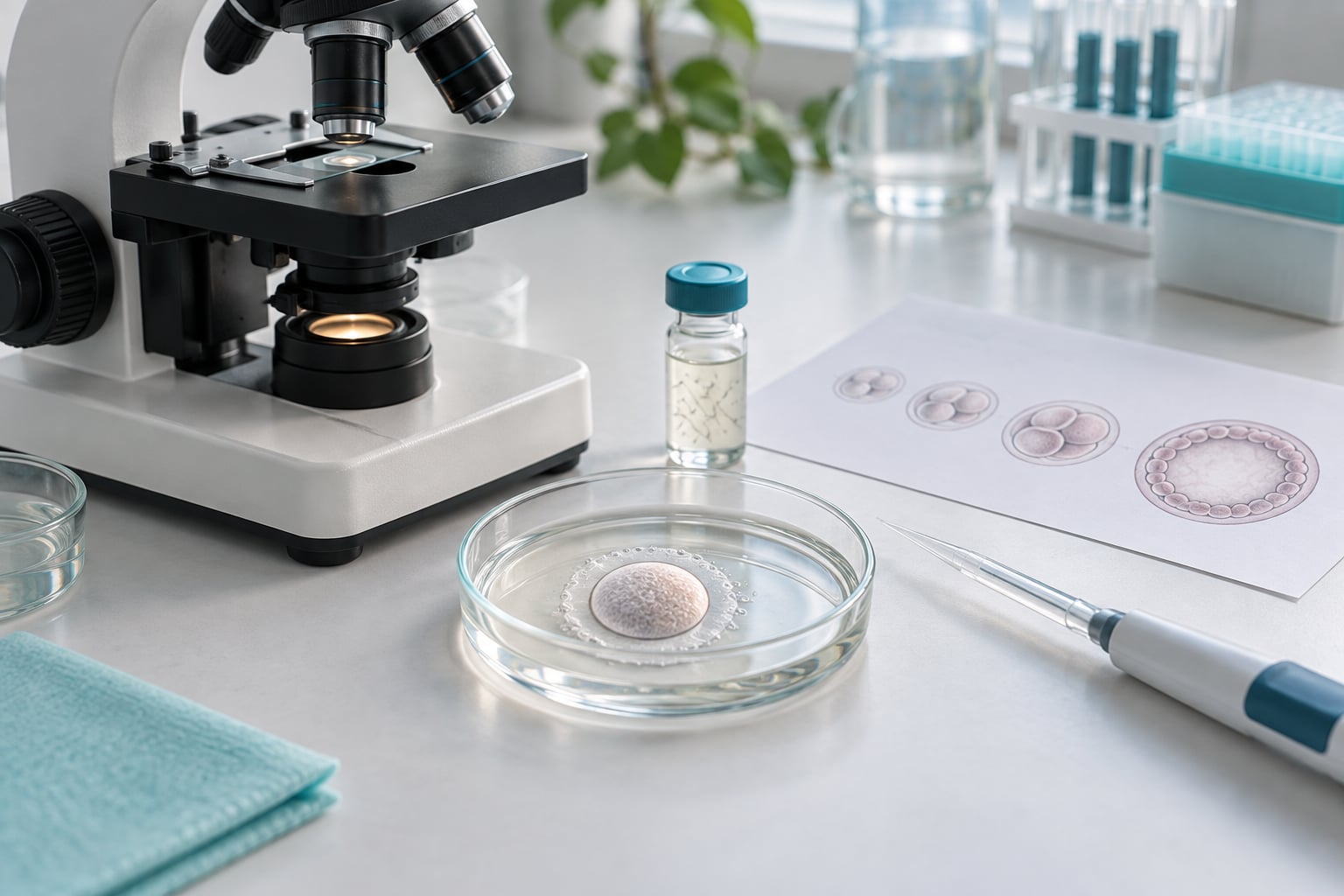
- Moving the nuclear DNA. Under a microscope, an embryologist removes the intended parents’ chromosomes and transfers them into the donor’s egg cytoplasm, which is rich in healthy mitochondria.
- Culture and testing. The resulting embryo is grown in the lab, and a small sample is tested for its own mtDNA and for the known family mutation.
- Embryo transfer. A suitable embryo is transferred into the intended mother’s uterus. If it implants and develops, the pregnancy proceeds as a normal high-risk pregnancy.
Two named techniques do the moving, and clinics may use either depending on the case and on regulatory approval.
| Stage | What it is for | Main limitation |
|---|---|---|
| Ovary stimulation | Produces enough eggs from the intended mother and the donor | Response varies with age and ovarian reserve |
| Fertilisation | Creates embryos that carry the intended parents’ nuclear DNA | Not every fertilised egg survives to blastocyst stage |
| Micromanipulation | Moves chromosomes into donor cytoplasm rich in healthy mitochondria | A small amount of the mother’s own mitochondria can stay behind |
| Genetic testing | Estimates how much affected mitochondrial DNA remains | Measurement is an estimate, not a guarantee |
| Embryo transfer | Establishes the pregnancy | IVF carries its own risks at every stage |
| Technique | What is moved | When it is used |
|---|---|---|
| Maternal spindle transfer | The chromosomes are removed before the egg has fully joined into one nucleus, while they are still attached to the spindle | The most common approach in current programmes, performed a few hours after collection |
| Pronuclear transfer | The two nuclei that form after fertilisation are moved into the donor’s embryo | Used less often, because the process requires more handling of the embryos |
Whichever route is used, some of the intended mother’s own mitochondria travel with her chromosomes. That leftover is the single most important open question in the field, and it gets its own section below.
Mitochondrial Donation vs. Egg Donation: What Actually Changes
Mitochondrial donation is not egg donation, and it is not embryo donation either. In egg donation, the whole egg is replaced, so the child is genetically related to the father and the egg donor. In mitochondrial donation, the intended parent’s egg and its nuclear DNA stay central to the procedure.
People on fertility forums describe the emotional difference in plain terms. The common thread in those conversations is that the child is overwhelmingly the parent’s own, and the real worry is less about the DNA amount and more about how donor rights and legal status are handled.
The donor also contributes no nDNA. She is not a legal parent, and a child conceived this way does not inherit her genes in the ordinary way. What passes forward is the mitochondrial machinery only, and because mitochondria are inherited maternally, it would be passed on by a daughter rather than a son.
Who Might Be Eligible for Mitochondrial Donation?
Eligibility usually starts with a confirmed or suspected mitochondrial disease in the woman who wants to carry a pregnancy, or a previously affected pregnancy or miscarriage. Most programmes require the diagnosis to come from a clinical geneticist rather than a routine screening result.
Other factors clinics weigh include the mutation level, sometimes called heteroplasmy, in her blood or other tissues, and whether preimplantation genetic testing could find an embryo that avoids the mutation without needing donation. Age, ovarian reserve and general reproductive health shape the practical plan, because the treatment is IVF and depends on how many usable eggs can be retrieved.
Beyond the medical picture, most clinics also review family history, the number of previous IVF cycles, and the long-term follow-up plan for the child. Community members ask for the same first step over and over: a specialist mitochondrial disease team plus a clinical geneticist, not a general fertility counsellor.
Access is where the picture changes most. Rules are set nationally, they differ sharply between countries, and they can be amended while a patient is in the middle of treatment. Any answer you get about eligibility needs to come from a clinic in the country where the treatment would physically take place.
Can Embryo Testing Reduce the Risk? Partly, Not Completely
Testing helps, and it helps more than it did even a few years ago, but it works by estimating rather than by guaranteeing. A small sample of cells is taken from the embryo and used to measure the level of affected mitochondrial DNA, usually reported as a mutation load or percentage.
Low measured levels are generally considered compatible with a healthy outcome, and clinics reject embryos whose results fall outside their accepted range. A low reading reduces uncertainty substantially, which matters a great deal to families comparing it with an unpredictable natural conception.
The limitation sits in the word measurement. The sample comes from a few cells at one moment, and laboratories use different assays, so results depend partly on the method used. The remaining risk cannot be reduced to zero, and no clinic presenting this treatment to you will claim otherwise.
Beyond the embryo, prenatal testing and newborn screening are part of the plan, and long-term follow-up of the child’s health is expected in regulated programmes.
What Are the Benefits, Limitations, and Health Risks?
The main benefit is straightforward: substantially reducing the chance of passing a serious, unpredictable mitochondrial disease to a child who would otherwise be at high risk. For some families there is no other way to have a biologically related child, which makes that reduction worth a great deal.
The burden is real. The procedure requires IVF, and IVF success is not guaranteed, so multiple cycles and their costs, waits, and emotional weight are part of the picture. The published experience is still small. The widely reported United Kingdom series, published in the New England Journal of Medicine, followed 22 women treated and reported 8 healthy children, with a proportion of the cycle outcomes not ending in a birth.
That number gets read as a one-in-three failure rate far more often than as what it is: a small early series that was largely about safety and feasibility, not a reliable forecast of anyone’s individual chance.
Other limits are harder to quantify. A small amount of the mother’s affected mitochondria can be carried over into the donor egg, and a process called mitochondrial reversion means that a child’s cells can sometimes shift back toward the mutation over time. Whether that ever causes harm is unknown, because the children reported so far have been followed for too short a time to answer it.
Pregnancy and birth carry the ordinary added risks of IVF pregnancies, which are higher-risk pregnancies and are monitored as such. On top of that sits the hardest part to describe, which is the possibility that a predicted risk or a clinical judgement about who counts as eligible will be disputed later.
What Ethical Questions Does It Raise?
The debate usually starts with consent and relatedness. If mitochondrial DNA is inherited, and if a daughter would pass on the donor’s mitochondria, what exactly has the donor agreed to, and does that agreement need to be revisited in a future generation?
Supporters argue that the intervention is comparatively modest. It is not gene editing, no nuclear gene is altered, and the intervention does not change the number of genetic contributors in any meaningful social sense. Critics raise germline modification, the commercialization of donor eggs, and what they see as a slide toward treating disability as something to be avoided at any cost.
Donor conditions are part of the same question. What screening does a donor undergo, what are they told about follow-up, and can a child later request information about the donor? Different jurisdictions answer these differently, and some of the answers are genuinely unclear.
Patient communities also worry about a subtler problem: being treated as a research opportunity rather than as a family. Being rushed toward a decision before the uncertainty has been explained properly is a complaint you will hear more than once.
What Else Should Patients Know Before Proceeding?
Ask for the treatment at a centre that handles mitochondrial disease, not only IVF. A specialist team can explain how your own mutation levels affect the options, and how your case compares with the small amount of published experience.
Bring your records. Genetic reports, previous IVF notes, and a family history written out are worth more at a first appointment than any amount of reading. Ask a genetic counsellor to walk you through the uncertainty in numbers, including what the testing can and cannot detect.
Check the regulatory status for the country you would travel to, at the time you would travel. Ask about funding routes, waiting times, what happens if the first cycle does not work, and what follow-up the child would have. Then take time to sit with the answer before you decide.
Whatever the decision, it belongs with your clinicians and your family. This page is a plain-language explanation, and it cannot tell you whether mitochondrial donation is right for you or whether the risks for your particular mutation are acceptable.
Frequently Asked Questions
Does mitochondrial donation use a donor egg?
Partly, and the difference matters. The intended mother’s egg supplies the nuclear DNA, while the cytoplasm, and therefore the mitochondria, comes from a donor egg. No nuclear DNA is taken from the donor, so she is not a genetic parent in the ordinary sense. The procedure is closer to IVF with a modified egg than to standard egg donation, where the whole egg and all its DNA come from the donor.
Will a child born through mitochondrial donation be unaffected?
Not guaranteed. The technique substantially reduces the risk of passing on the mother’s mitochondrial disease, and embryos with high measured levels of the affected mitochondrial DNA are usually not used. But a small amount of the mother’s own mitochondria can be carried over, and laboratories estimate levels rather than prove them. Any treating clinic should discuss the residual risk with you directly rather than describing the outcome as certain.
Is mitochondrial donation the same as embryo donation?
No. In embryo donation, an embryo created from two other people is transferred to the intended mother, so there is no genetic link to her at all. Mitochondrial donation keeps the intended parents’ nuclear DNA intact and replaces only the mitochondrial component. The future child is genetically related to both intended parents, with donor mitochondria making up a small fraction of the DNA.
Does mitochondrial donation guarantee that a child will not develop the disorder?
No guarantee exists. Published work estimates the donor contribution at roughly 0.1 to 0.3 percent of the child’s DNA, and the remaining uncertainty comes from carryover of the mother’s own mitochondria and from the limits of testing. A mitochondrial reversion process could also shift a child’s mitochondrial levels over time. The honest summary is that risk is greatly reduced, not eliminated.
Who approves and performs mitochondrial donation?
It depends entirely on the country. The United Kingdom licenses it through the HFEA on a case-by-case basis, and Australia and the United Kingdom run regulated programmes. In the United States, federal rules prohibit using federal funding for the technique, and patients generally cannot access it there. Always confirm the current position for the country where treatment would physically take place, since regulations do change.
Does mitochondrial donation always succeed on the first IVF cycle?
No. The treatment depends on ovarian response, egg quality, how many embryos are created, and whether any of them test acceptably and then implant. The widely reported United Kingdom series followed 22 women and reported 8 healthy children, which is better read as an early safety and feasibility series than as a personal forecast. A specialist team can estimate your own odds from your age, reserve, and previous cycle history.
What to Do First
Start with a clinical geneticist or a specialist mitochondrial disease team, not with a fertility clinic brochure. Bring your genetic reports, your IVF history, and a written family history, and ask for a plain explanation of the numbers that apply to your mutation rather than the general ones.
Then ask the two questions people most often forget: what is still unknown, and what happens if the answer changes. If you do that, you will be able to weigh mitochondrial donation against preimplantation genetic testing, donor eggs, and adoption on grounds that belong to your family.