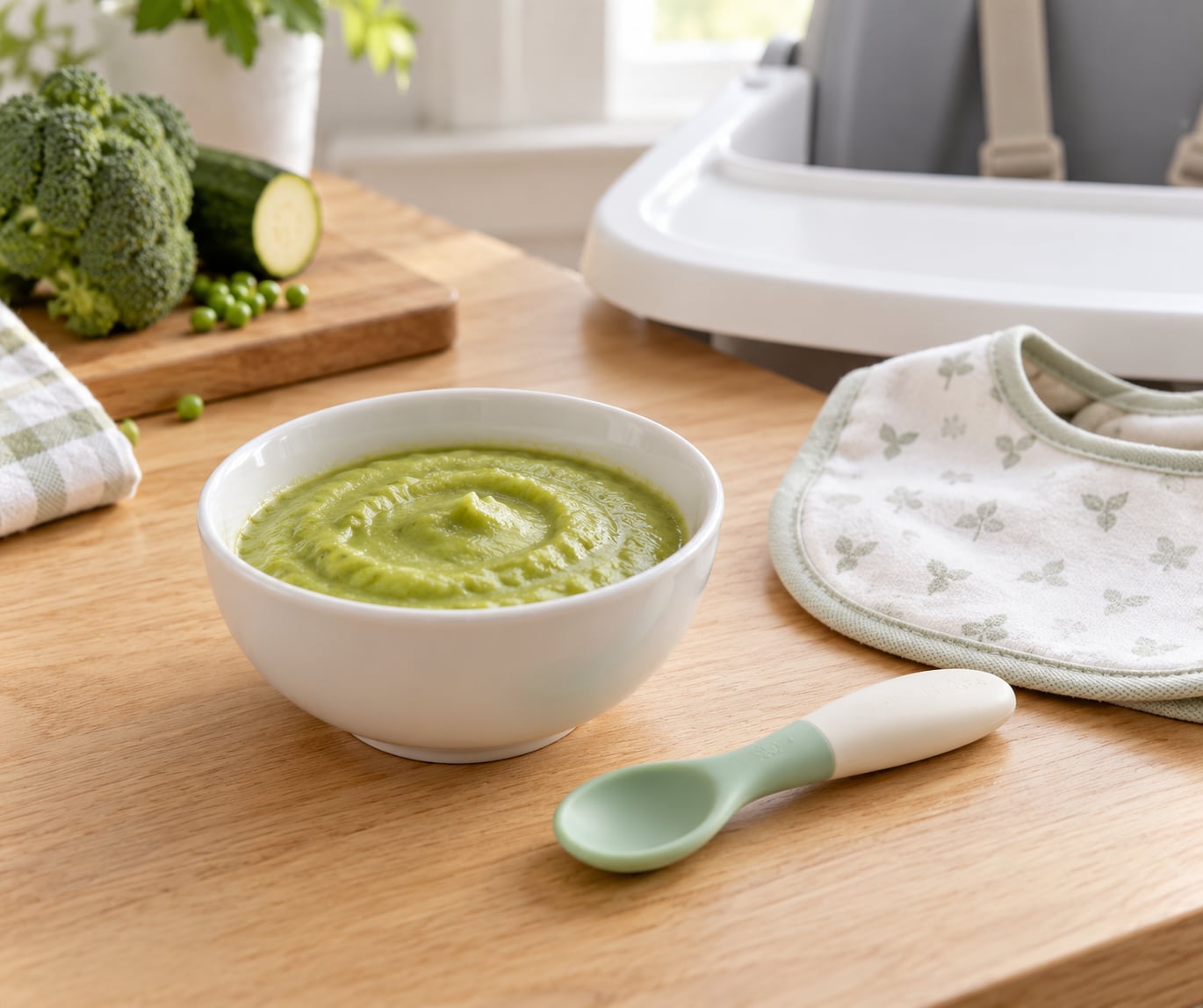
Most babies are ready for solid foods at about 6 months of age, and not before 4 months. The signs that matter are physical, not calendar-based: your baby can hold their head steady, sit upright with support, shows interest in what you are eating, and has lost the tongue-thrust reflex that pushes food back out. Learning how to introduce solid foods to a baby is less about nutrition than it is about practice. Breast milk or formula stays the main food for the whole first year.
This guide covers readiness, the mechanics of a first spoonful, a realistic first week, allergens, and how to tell gagging from choking. It is general guidance. Your baby’s pediatrician knows their history, and any question about your own baby belongs in that office, not in a comment section.
Table of Contents
- What You Need
- A high chair with a harness
- A soft infant spoon and a small bowl
- A bib and something under the chair
- A blender, masher, or potato ricer
- A clear, uncluttered prep space
- A conversation with the pediatrician
- Step-by-Step: How to Introduce Solid Foods to a Baby
- Step 1: Confirm the readiness signs
- Step 2: Pick a calm moment, not a hungry one
- Step 3: Prepare one simple food
- Step 4: Offer one spoonful and let your baby close the mouth
- Step 5: Watch for a reaction over the next two or three days
- Step 6: Build variety without pressure
- Your first week of solid foods, day by day
- How textures change from 6 to 12 months
- Common Mistakes
- Starting before the readiness signs are there
- Skipping or delaying allergens
- Making the 3-day rule into a 3-month rule
- Treating refusal as a feeding disorder
- Confusing gagging with choking
- Frequently Asked Questions
- When can babies start solid foods?
- What are the best first foods for a baby?
- How do I introduce allergens to my baby?
- Is gagging the same as choking?
- Can babies eat finger foods?
- A Calm Beginning
What You Need
You can start solids with very little equipment. What you cannot skip is a safe, upright place for your baby to sit.
A high chair with a harness
Upright sitting is the single biggest safety factor in feeding. A high chair that reclines or lets a baby slide down is not suitable for solid food. Buckle the crotch and shoulder harness every single time, and keep feet supported so your baby can push up rather than slump.
A soft infant spoon and a small bowl
A silicone spoon sized for a baby’s mouth is worth buying, because it is shallower than a kitchen teaspoon. A small bowl or cup with a wide base sits more stably on the tray than a deep plate.
A bib and something under the chair
The floor will not stay clean, and the sooner you accept that, the calmer everyone is. A washable floor mat or a rolled towel under the chair saves you from the tray entirely.
A blender, masher, or potato ricer
One of these turns cooked vegetables or soft fruit into a texture a brand-new mouth can manage. A fork works for very soft foods once your baby is past the smoothest stage.
A clear, uncluttered prep space
Cook, mash, and let the food cool to a comfortable temperature before it ever reaches the tray. Test it on your own wrist the way you would a bottle. No salt, no sugar, no honey, and no added spice in anything under 12 months.
A conversation with the pediatrician
Ask before you start if your baby was premature, has reflux, has a swallowing problem, or has an existing diagnosis. For a typical healthy baby, no special commercial food is required. Homemade, jarred, and packaged foods all work, and the packaged route is often easier during the exhausted early weeks.
Step-by-Step: How to Introduce Solid Foods to a Baby
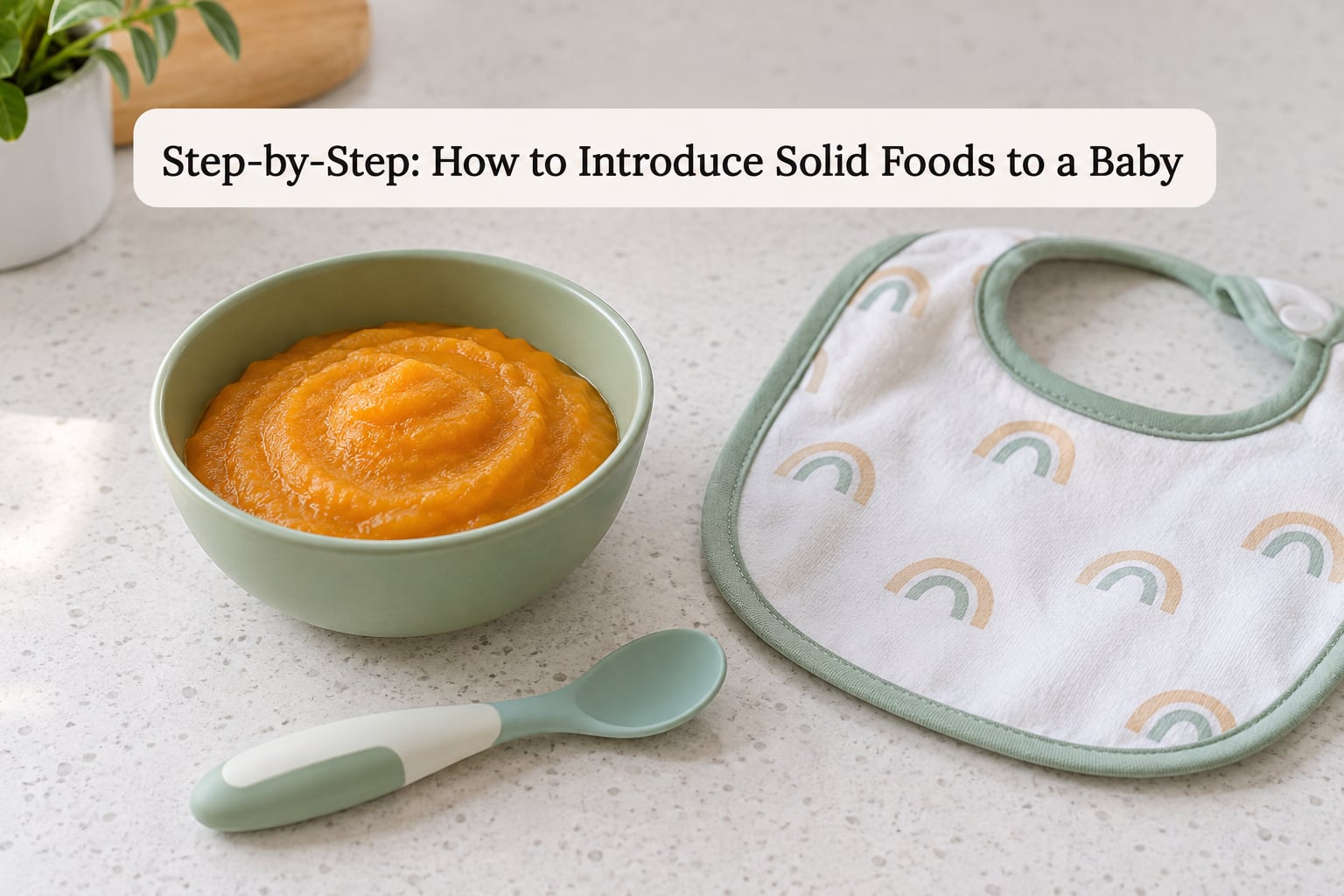
Each step below includes what it looks like when it is going well, so you know you are on track rather than guessing. Work through them in order when you introduce solid foods to a baby who has never tasted any of it.
Step 1: Confirm the readiness signs
Look for all four: steady head control with no wobble, the ability to sit upright in a high chair with support and lean forward without folding over, interest in adult meals, and the fading of the tongue-thrust reflex where food gets pushed back out automatically. Most babies show them together somewhere around 6 months.
What success looks like: your baby leans toward the spoon in other people’s meals and reaches for your plate. A baby who consistently spits food out with a strong forward tongue is not ready yet, and starting anyway is what makes the first weeks miserable for both of you.
Step 2: Pick a calm moment, not a hungry one
Offer the first meal when your baby is slightly hungry but not frantic, roughly an hour or so after a milk feed. Late morning usually works well because you have the rest of the day ahead of you to watch for reactions.
What success looks like: your baby is calm, mildly hungry, and not distracted. A screaming baby cannot be safely fed solids, and a full baby will simply refuse. Skip the meal and try again in an hour.
Step 3: Prepare one simple food
Start with something single-ingredient and smooth: iron-fortified single-grain cereal mixed to a thin consistency, or a well-cooked vegetable or fruit blended with breast milk or formula until it slides easily off the spoon. Iron matters here because a baby’s iron stores are dropping around this age while breast milk alone no longer keeps pace.
What success looks like: the food has no lumps, no strings, and no hard bits, and it is only slightly thicker than milk at first. Thicker textures come a few weeks later, once your baby handles the first stage well.
Step 4: Offer one spoonful and let your baby close the mouth
Set the spoon on the baby’s lower lip and let them pull it in. Wait for the mouth to close before you take the spoon back, and do not push the spoon in or twist it toward the roof of the mouth, which can trigger the gag reflex. When your baby turns away and closes their lips, the meal is over. That refusal is communication, not a fight.
What success looks like: a few swallows, some interest in the spoon, and more mess than food swallowed. Expect one or two teaspoons at the start. Forcing more is the fastest route to a baby who refuses food for weeks.
Step 5: Watch for a reaction over the next two or three days
Hives, swelling, a rash, repeated vomiting, or unusual lethargy after a new food mean you stop that food and contact your pediatrician. A mild rash on the cheeks that clears between feedings is common and different from hives. Keep a simple written note of what you fed, when, and what happened, because memory at 2 a.m. is unreliable.
What success looks like: nothing at all, which is the usual outcome. Two or three days per food is enough to notice a delayed reaction without spending a month on a single ingredient.
Step 6: Build variety without pressure
Once the first food is boring rather than alarming, add another single food the same way. Then two or three together in one spoon, which is how family meals actually work. Milk feeds continue on their own schedule and remain the main source of nutrition through the first year.
What success looks like: your baby eats a few different foods without a reaction and starts reaching for pieces, sitting a little more upright, and grabbing at the spoon. That last part is a developmental milestone, not a mess to correct.
Your first week of solid foods, day by day
Here is a simple calendar so you are not improvising at 5 p.m. after a short nap.
- Day 1: one iron-fortified cereal or pureed vegetable, one to two teaspoons, mid-morning. Nothing else new.
- Day 2: repeat the same food, same texture, same time of day.
- Day 3: repeat again, then watch for any reaction across the next 48 hours.
- Day 4: introduce a second food, a different single ingredient.
- Day 5: offer both foods, and try the second one at a slightly thicker texture.
- Day 6: add a third food, ideally a different vegetable or fruit.
- Day 7: combine two already-tested foods in one spoon and hand over a soft, safe finger food to hold.
How textures change from 6 to 12 months
| Age | Texture | Examples |
|---|---|---|
| 6 months | Smooth and thin | Iron-fortified cereal, pureed vegetables and fruits, yogurt |
| 7 to 8 months | Mashed with soft lumps | Mashed banana, oatmeal, soft lentils, mashed avocado |
| 8 to 9 months | Thick, soft lumps and early finger foods | Soft scrambled egg, flaked fish, soft steamed carrot sticks |
| 9 to 12 months | Small pieces and self-feeding | Mini omelet pieces, soft cubed vegetables, pasta, soft fruit slices |
Everything you offer should be soft enough to crush between your fingers and cut smaller than half an inch. Whole grapes must be quartered lengthwise. Hot dogs are cut into small pieces, never coin-shaped rounds. No raw carrots, no whole nuts, no popcorn, no sticky spoonfuls of peanut butter, and no honey before 12 months because of infant botulism risk.
Milk feeds stay in charge through all of this. By around 8 months most babies take three meals a day with milk still coming first, and by 12 months they eat about four times a day alongside roughly 20 to 24 ounces of milk. Do not replace milk with water or juice in volume.
Common Mistakes
Starting before the readiness signs are there
The pressure to start at 4 months is real, and the earlier timeline has been marketed hard. Sitting upright with head control is what makes swallowing safe, and no calendar overrides it. Waiting a few weeks past 6 months is not harmful; forcing a 4-month-old is.
Skipping or delaying allergens
Peanut, egg, milk, wheat, soy, sesame, fish, shellfish, and tree nuts are the big ones to introduce once solids begin, not later. Evidence from trials such as LEAP shows that giving peanut-containing foods early in life lowers the chance of peanut allergy, so delay driven by fear works against your baby. Introduce each one in a small amount in the morning, on its own, and watch for a reaction over the next two or three days. For peanut, a spoonful of smooth peanut butter thinned with warm water or breast milk works well; a spoonful straight from the jar is a choking hazard.
Making the 3-day rule into a 3-month rule
Two or three days of observation per new food is sensible for allergens. Applying it to every single vegetable is what leaves a baby eating five foods by eight months and refusing everything else. Once plain single foods are going well, offer several familiar foods a day and only isolate a brand-new allergen.
Treating refusal as a feeding disorder
Spitting food out, turning away, and gagging are normal phases, especially in the first six to eight weeks of solids. A baby who eats a small amount of something new and refuses it has still learned something. Genuine red flags are different: refusing nearly all solids past 9 months, gagging with no food in the mouth, coughing or choking during most feeds, or weight loss. Those warrant a pediatrician visit and possibly a feeding evaluation.
Confusing gagging with choking
A gag is loud, brief, and productive. Your baby pushes food forward or back, makes a noise, opens wide, and swallows again. It happens often and it means the gag reflex is working, which is a good thing.
Choking is silent or quiet, and the baby cannot make sound or cry. If that happens, stop feeding, put the baby face down across your thigh, and give up to five firm blows between the shoulder blades. If the food does not come out, call emergency services right away and start infant first aid and CPR instructions from the dispatcher. Any choking event needs a pediatrician the same day.
Prevention is the better plan: upright in a harness, never fed while lying down, walking or distracted, food cut smaller than half an inch, and no food in the car seat or on the sofa.
Frequently Asked Questions
When can babies start solid foods?
Most babies are ready around 6 months of age, and not before 4 months. Watch for four signs together: steady head control, the ability to sit upright with support, real interest in what adults are eating, and the loss of the tongue-thrust reflex. The calendar matters far less than those cues. Ask your own pediatrician before starting, particularly if your baby was premature or has reflux or a swallowing condition.
What are the best first foods for a baby?
Iron-rich single foods lead: iron-fortified single-grain cereal, well-cooked pureed meats, lentils, or soft egg. Plain vegetables such as sweet potato, carrot, and avocado are equally good early choices, as are soft fruits like banana and pear. Start with one ingredient, mixed thin enough to slide off the spoon, and skip salt, sugar, honey, and seasoning entirely before the first birthday. There is no required first food.
How do I introduce allergens to my baby?
Introduce the major allergens early, one at a time, once solids are underway. Peanut, egg, milk, soy, wheat, sesame, fish, shellfish, and tree nuts all count. Offer a small amount in the morning so you can watch your baby through the day, then wait two or three days before the next new allergen. Thin peanut butter with warm water or breast milk until it pours, and offer eggs fully cooked. Early exposure lowers allergy risk rather than raising it.
Is gagging the same as choking?
No, and telling them apart removes most of the fear. Gagging is noisy, brief, and protective: your baby pushes food out, opens wide, and carries on. It happens often and is a sign the reflex works. Choking is silent or quiet, and your baby cannot cry or make sound. If choking occurs, stop, place your baby face down across your thigh, give up to five back blows, and call emergency services if the food does not clear.
Can babies eat finger foods?
Yes, and they should. Most babies are ready for soft finger foods around 8 to 9 months, when they sit steadily, bring objects to their mouth, and show a developing pincer grasp. Pieces should be soft enough to crush between your fingers and smaller than half an inch. Good early options are soft steamed carrot, banana, cooked pasta, scrambled egg, and slow-cooked meat. Sit your baby upright in a harness and stay at the table for every meal.
A Calm Beginning
Start by watching your baby, not the calendar. When the readiness signs line up, pick a calm mid-morning moment, make one simple iron-rich food, and offer one spoonful at the pace your baby sets.
Treat the first weeks as practice rather than performance. Follow your baby’s cues, keep milk as the main food through the first year, introduce allergens early rather than late, and expect mess and gagging as part of a normal process.
Bring anything specific about your own baby to the pediatrician, especially prematurity, reflux, a swallowing problem, or any reaction you have seen. Updated for 2026.