Barbara Katz Rothman, CNM, reviewed this guide against current ACOG, Preeclampsia Foundation and NHS guidance. Last medically reviewed: October 2026. This is general education, not a diagnosis or a plan for your care. Only your own midwife, obstetrician or emergency team can assess you.
Preeclampsia is a pregnancy-related high blood pressure disorder that usually begins after 20 weeks, in which the blood vessels feeding the placenta do not develop or work normally, so blood pressure rises and organs such as the kidneys, liver, brain and eyes can be affected. It often causes no symptoms at all, which is why knowing what preeclampsia is and warning signs to know matters before you feel unwell.
Here is the honest version. Preeclampsia can start quietly, get worse in a day or two, and the first thing most families notice is a number on a cuff or a protein result on a dipstick. What you can control is knowing the warning signs in advance and knowing which ones justify a phone call tonight.
Table of Contents
- What Preeclampsia Is and Why It Matters
- Signs versus symptoms: why you cannot always feel it
- Preeclampsia Warning Signs and Symptoms
- Who Is at Higher Risk?
- How Preeclampsia Is Diagnosed and Monitored
- What To Do If You Notice a Warning Sign
- How Preeclampsia May Affect You and Your Baby
- Questions to Ask Your Care Team
- Frequently Asked Questions
- Can you have preeclampsia without noticeable symptoms?
- Does swelling in pregnancy mean you have preeclampsia?
- Can preeclampsia happen after the baby is born?
- What blood pressure reading is considered concerning during pregnancy?
- Does a headache during pregnancy always mean preeclampsia?
- What should I do if I have several preeclampsia warning signs at once?
- Conclusion: Know the Signs and Get Help Promptly
What Preeclampsia Is and Why It Matters
The medical name is pre-eclampsia, spelled with a hyphen in UK and ACOG guidance. You may also see the old name toxemia in older books and in family conversation. Toxemia is not a different condition; it is an outdated name for the same thing, and nothing about it is caused by toxins.
Here is what is actually happening in the body. In a typical pregnancy, the blood vessels that supply the placenta remodel early on, opening up wide and low-pressure so blood can reach your baby. In preeclampsia, those vessels fail to do that properly. The placenta sends signals into your bloodstream that narrow blood vessels across your whole body, and your blood pressure climbs to protect your brain.
That constriction is why the signs show up in so many organs. The filtering kidneys leak protein into urine. The liver and the small vessels in your brain, eyes and lungs can swell or misbehave. The placenta itself may not deliver blood to your baby efficiently enough. Everything that follows in this article is downstream of those two facts.
Signs versus symptoms: why you cannot always feel it
Here is the distinction that changes how you should think about this. A sign is something a clinician measures: a blood pressure of 140/90 or higher, protein in the urine, low platelets, raised liver enzymes. A symptom is something you feel: a headache that will not shift, flashing lights, pain under your ribs.
The most dangerous sign of preeclampsia, high blood pressure, produces no sensation at all. You can sit at a prenatal visit feeling completely well and leave with a plan to be monitored more closely. That is why the term silent gets used so often in this conversation, and why waiting to feel bad is not a reasonable strategy.
Preeclampsia Warning Signs and Symptoms
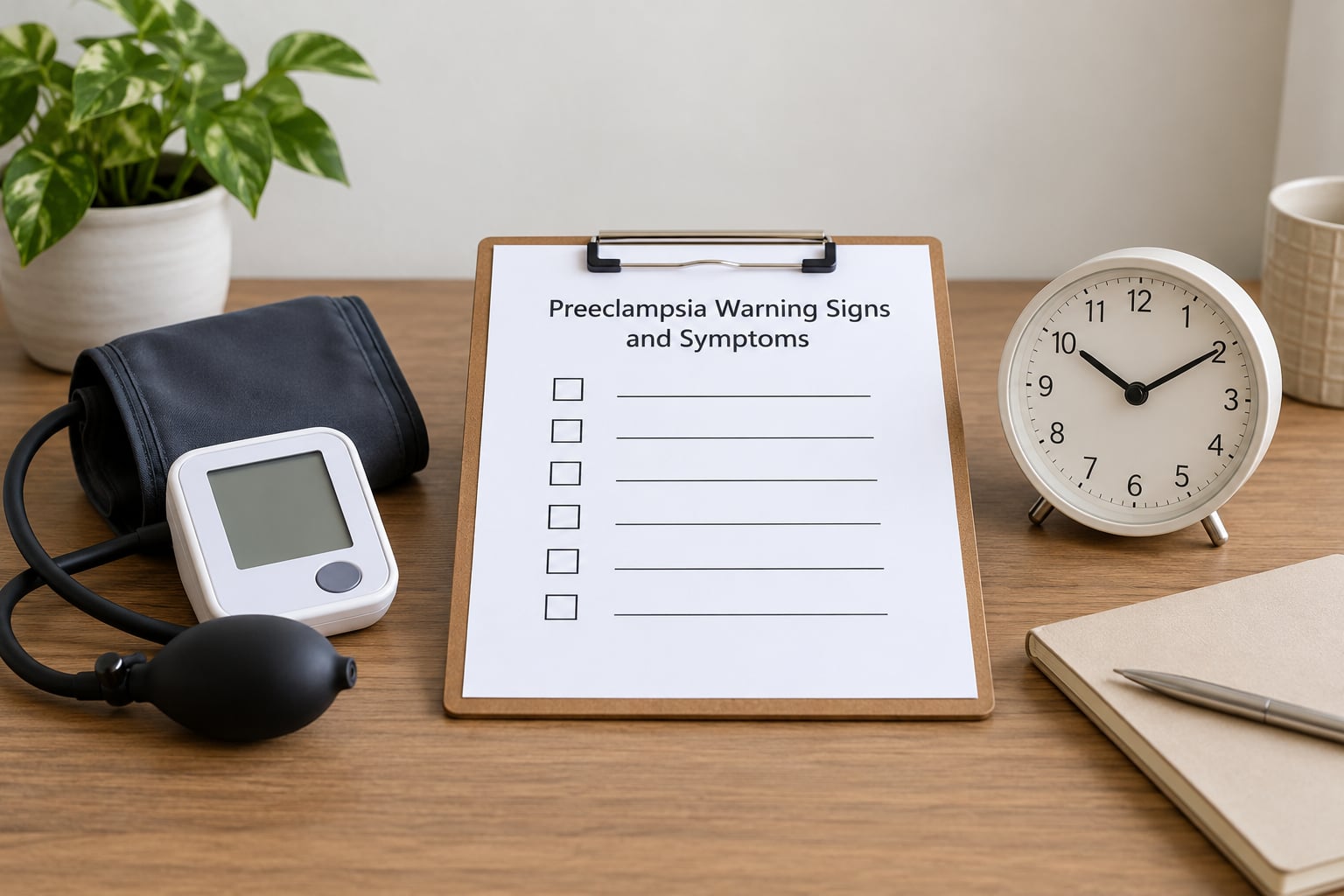
Warning signs of preeclampsia are easiest to act on when they are written as short phrases. If any of these appear, especially together or suddenly, contact your midwife, obstetrician or maternity unit the same day.
- Severe headache that does not go away
- Vision changes, blurred vision or flashing lights
- Pain below the ribs, usually on the right
- Sudden swelling of face, hands or feet
- Protein in your urine
- Blood pressure of 140/90 or higher
- Nausea and vomiting after the first trimester
- Shortness of breath
- Sudden weight gain over a day or two
- Feeling very unwell, with a sense of doom
Several of those are worth unpacking, because the wording matters when you are describing them to a clinician at 9pm.
Headache. The concern is a headache that is severe, persistent and does not ease with rest, water or usual painkillers. Early pregnancy headaches are usually short-lived and settle. A headache that has been building for hours and will not shift is a different thing.
Vision. Blurring, flashing lights, zigzag patterns, spots, or sudden sensitivity to light. All of these point to the same place, and all of them deserve a call rather than a wait for the next visit.
Rib pain. Pain under the ribs on the right, or a dull ache under the right shoulder blade, is often pain referred from the liver. Some people describe it as lower back pain instead, which is one reason it gets missed.
Swelling. Normal pregnancy swelling is heaviest in the feet by evening and improves overnight. What raises concern is swelling that appears suddenly, that does not improve with rest, or that shows up in your face and around your eyes, sometimes to the point that your rings or shoes feel different.
Nausea and vomiting. Morning sickness that starts or returns after the first trimester is not morning sickness. Persistent heartburn that will not settle with the usual measures is another version of the same warning.
Breathing, pulse and mood. Shortness of breath, a racing pulse, feeling confused, and a strong sense of impending doom can all be signs of fluid building up where it should not be. People describe this cluster as feeling like something is very wrong before they can name what.
Hyperreflexia. When a clinician taps the tendon below your kneecap, an exaggerated bounce can indicate the nervous system is irritated. You will not be able to check this yourself, and that is exactly the point: reflexes, platelet counts, liver enzymes and fetal growth are the parts of this condition you cannot monitor from home.
One word on numbers. Forum conversations often centre on a single reading, such as 138/88. What clinicians look at is the trend against your own baseline as well as the absolute number, and a rise of roughly 30 systolic or 15 diastolic over your usual reading is worth mentioning even if the total is not alarming on its own.
Who Is at Higher Risk?
Risk factors raise your chance; they do not predict your pregnancy. Plenty of people with several of these have an uneventful nine months, and plenty with none of them develop preeclampsia.
The higher-risk group most guidelines single out includes a previous pregnancy with preeclampsia, chronic high blood pressure that predates pregnancy, type 1 or type 2 diabetes, kidney disease or autoimmune conditions such as lupus or antiphospholipid syndrome, a pregnancy involving IVF, twins or other multiples, and a body mass index at or above 30.
A moderate-risk group includes a first pregnancy, being 35 or older at the estimated due date, a family history of preeclampsia on your mother’s or father’s side, being of Black or South Asian background, and having limited access to regular prenatal care. That last one is worth naming plainly. Differences in preeclampsia risk do not map neatly onto biology; they track with how often and how early you get your blood pressure checked, how easily you can reach a maternity unit, and how much chronic stress you are carrying.
Being told you are high risk usually means closer monitoring, not alarm. It means your blood pressure gets taken with attention at every visit, and your care team talks with you about what to watch for.
How Preeclampsia Is Diagnosed and Monitored
Diagnosis belongs to your clinical team, and it is built from several pieces rather than one test.
Blood pressure. This is the primary indicator. A reading of 140/90 or higher, confirmed on repeat measurement, is what clinicians look for, alongside persistent readings near that range and sustained rises over your baseline.
Urine and blood testing. Protein in your urine, quantified through a dipstick, a 24-hour collection or a protein-to-creatinine ratio, is one route. Blood tests look at platelet count and liver enzymes, because low platelets and raised enzymes point to a more severe form.
Symptom assessment. Your description of headache, vision, pain, breathing and swelling carries real diagnostic weight. Write down when a symptom started and whether it is constant or comes and goes.
Fetal monitoring. Ultrasound growth scans, fluid checks, and, when concerns rise, cardiotocography or a biophysical profile help your team judge how well the placenta is working.
Something useful to hold onto: preeclampsia can be diagnosed even when blood pressure is not high, and even when there is no protein in the urine, if organ involvement is shown through blood tests or symptoms. That is what atypical preeclampsia means in practice.
What To Do If You Notice a Warning Sign
If you are reading this at two in the morning because your head hurts and your feet are swollen, that is not overreacting. Calling is the correct response, and a clinician who has heard from you cannot mark you as a worrying patient.
| What you are noticing | What to do |
|---|---|
| Severe headache that will not settle, vision changes, pain under the ribs, sudden swelling, shortness of breath, vomiting after the first trimester | Call your midwife, obstetrician or maternity unit now. If you cannot reach them, go to urgent or emergency care. |
| Seizure, chest pain, severe difficulty breathing, fainting, sudden loss of vision, confusion, or feeling you are about to pass out | Emergency care now. Do not drive yourself if you feel this unwell. |
| A home blood pressure reading of 140/90 or higher, a dipstick showing protein, or a steady unexplained weight gain | Contact your care team the same day, repeat the reading after sitting quietly for five minutes, and report both numbers. |
| Mild swelling in the feet by evening, an occasional headache that eases with rest, an episode of heartburn | Usually normal for pregnancy. Mention it at your next visit and keep watching for change. |
When you call, a short script does the work: I have had a severe headache and blurred vision since this morning, and my home blood pressure was 148/96. Can you check me and test my urine today? Naming the symptom, the timing and the number gets you triaged properly.
If you do take a reading at home, sit quietly for five minutes first, feet flat and back supported, arm at heart level with nothing tight on the upper arm, and use a cuff of the right size. Take two readings a minute apart and write both down, with the time. Log the number, the symptom and anything you ate or did beforehand, so a pattern becomes visible.
If you have had preeclampsia before and feel dismissed, it is reasonable to ask directly: I would like my blood pressure checked and my urine tested for protein before I leave. Can we do that? That request is ordinary, and it is the one that works.
How Preeclampsia May Affect You and Your Baby
Preeclampsia affects a placenta working properly rather than a body that is simply failing, which is why the management conversation usually turns to timing and monitoring rather than a cure.
For you, the range runs from extra monitoring through blood pressure medication and magnesium sulfate, which is used to reduce seizure risk, to earlier delivery. Clinicians balance the risk of continuing the pregnancy against the risk of delivering, and that is a conversation to have with your team rather than a rule anyone can read off a website.
HELLP syndrome is a severe form involving haemolysis, raised liver enzymes and low platelets. Eclampsia means seizures. Rarely, a placental abruption, where the placenta separates early, or a stroke can occur. Each of these is a reason for the urgency you will feel from your team, and each is why early recognition matters.
For your baby, the concern is blood flow. Preeclampsia can lead to fetal growth restriction, a lowered amount of amniotic fluid, or a need for early delivery because the placenta can no longer support growth comfortably. That is why growth scans and monitoring become more frequent once preeclampsia is diagnosed.
Two things people are often surprised by. First, birth does not end the risk. Postpartum preeclampsia can begin days after delivery, most often in the first week and within six weeks overall, and it is the reason your blood pressure gets rechecked after you go home. Second, a pregnancy complicated by preeclampsia is associated with higher cardiovascular risk later in life, which is why a follow-up blood pressure check and a note in your records are worth having.
Questions to Ask Your Care Team
Asking these at a prenatal visit is far more comfortable than asking them in an urgent clinic at midnight.
- What is my blood pressure baseline, and what number would mean you want to see me sooner?
- Am I in a higher-risk group, and does that change how often you check my blood pressure and urine?
- Which symptoms should make me call today, and which should send me straight to emergency care?
- Do any of my current medications or conditions affect my risk?
- Should low-dose aspirin be considered for me, and if so, when would it start?
- How will you monitor my baby’s growth if preeclampsia develops?
- Who do I call after hours, and what is the direct number for the maternity unit?
- What happens after birth if my blood pressure is still high?
- When should I have a blood pressure check after delivery, and when do I follow up about long-term heart health?
Frequently Asked Questions
Can you have preeclampsia without noticeable symptoms?
Yes, and this is one of the most important things to understand about it. High blood pressure and protein in the urine raise no alarm in your body, so many people are diagnosed at a routine visit while feeling completely well. Some people notice only mild signals, like tired legs or a headache that passes. That is why care teams rely on blood pressure checks, urine tests and blood tests rather than on how you feel. Feeling fine is not evidence that your blood pressure is fine.
Does swelling in pregnancy mean you have preeclampsia?
Not on its own. Swollen feet and ankles by the end of the day is extremely common in pregnancy and usually improves overnight with elevation and rest. The swelling that warrants a call is different: it appears suddenly, it does not settle with rest, or it shows up in your face, around your eyes or in your hands quickly enough to notice. Swelling on its own is not preeclampsia, but sudden swelling alongside a headache, vision change or a high reading should be reported the same day.
Can preeclampsia happen after the baby is born?
Yes. Postpartum preeclampsia usually begins in the first week after delivery, though it can start any time within six weeks, and it can happen even after a pregnancy with normal blood pressure throughout. The warning signs are the same list as during pregnancy: severe headache, vision changes, pain under the ribs, swelling, shortness of breath and high readings. This is why blood pressure is rechecked after discharge and at your follow-up visit, and why feeling unwell in the early weeks deserves a call rather than an assumption that it is normal recovery.
What blood pressure reading is considered concerning during pregnancy?
A reading of 140/90 or higher is the usual threshold clinicians look for, which is why hypertension is defined at that level or above during pregnancy. Readings close to it, or a clear rise over your own usual numbers, also matter. Sustained readings at 160/110 or higher are treated as a severe feature and prompt urgent assessment. Home readings vary with position, cuff size and nerves, so sit quietly for five minutes, take two readings a minute apart, and report the numbers rather than a single figure.
Does a headache during pregnancy always mean preeclampsia?
No, and most pregnancy headaches are ordinary, especially in the first trimester. The headache that concerns care teams is severe, persistent and does not ease with rest, fluids or ordinary painkillers, particularly alongside high blood pressure, vision changes or swelling. If a headache clears after a glass of water and a lie down, that is reassuring. If it builds over hours and will not shift, or if you also notice swelling or visual changes, call your midwife or maternity unit the same day and let them decide.
What should I do if I have several preeclampsia warning signs at once?
Treat the combination as the serious signal it is. Several signs appearing together, or appearing suddenly, are more concerning than any single one, and you do not need to wait to see whether a second one follows. Call your midwife, obstetrician or maternity unit now, describe the signs and when each started, and go to urgent or emergency care if you cannot reach anyone or if you have chest pain, a seizure, severe difficulty breathing, fainting or sudden vision loss. Calling early is the right call even if it turns out to be nothing.
Conclusion: Know the Signs and Get Help Promptly
The first thing to do is learn the warning signs and say them out loud to someone who lives with you, so they can make the call if you are the one with the headache. Keep your prenatal appointments, where your blood pressure and urine get checked even when you feel completely well.
Then act on the pattern. Severe headache, vision changes, pain under the ribs, sudden swelling, shortness of breath, vomiting after the first trimester, or a reading of 140/90 or higher means contact your midwife, obstetrician or maternity unit the same day. Chest pain, a seizure, severe difficulty breathing, fainting or sudden vision loss means emergency care now. And in the first six weeks after birth, remember that the same signs still count.