A membrane sweep is a quick, drug-free procedure where a midwife or doctor puts one or two gloved fingers through your cervix and sweeps them in a circle to gently separate the amniotic sac from the wall of the uterus. It may help labor start sooner, but it is not a guaranteed induction. The short answer to what is a membrane sweep and does it work: it nudges your body toward labor, and about half of people who have one are in labor within seven days, with the timing impossible to predict in advance.
Here is the shape of it in a few lines before we go into detail.
- It takes a few minutes and is usually done during a routine antenatal visit or a hospital appointment.
- No medication is involved, so it is often offered as a gentler first step before a medical induction.
- It works best on a cervix that is already moving – soft, thinned, and open about 1 to 2 cm.
- Cramping and spotting are common in the hours afterward, and sometimes your waters break.
- It is optional. It is a medical procedure, not part of a normal check-up, and you can say no at any point.
This article is general information, not medical advice. Everything below describes what published guidance and parent communities say, so you can walk into your next appointment with better questions.
Table of Contents
- What Is a Membrane Sweep?
- How Does a Membrane Sweep Work?
- What Happens During the Procedure?
- How painful is a membrane sweep?
- How Effective Is a Membrane Sweep at Inducing Labor?
- How Long Does a Membrane Sweep Take to Work?
- What Are the Benefits, Risks, and Alternatives?
- Membrane sweep, medical induction, or waiting
- Who Should Ask About a Membrane Sweep?
- Questions to Ask Before a Membrane Sweep
- Frequently Asked Questions
- Is a membrane sweep painful?
- Can a membrane sweep break my water?
- How soon after a membrane sweep will labor start?
- Can I have a membrane sweep at home?
- What should I do if I feel cramps or bleeding afterward?
- Conclusion
What Is a Membrane Sweep?
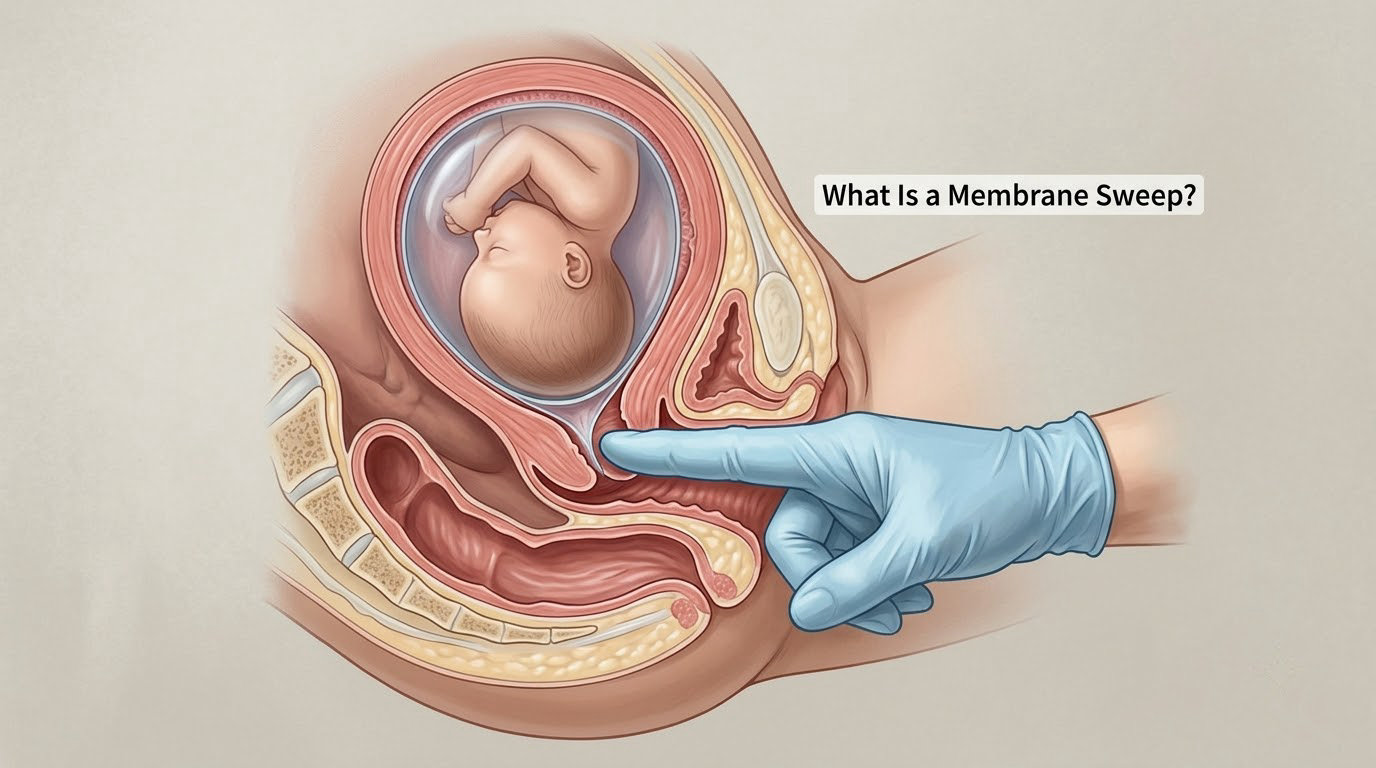
A membrane sweep is an internal examination where a midwife, doctor, or nurse inserts one or two fingers through the cervix and uses a continuous circular motion to separate the amniotic membranes from the lower part of the uterus. The aim is to irritate the cervix and encourage your body to release prostaglandins, the hormones that soften the cervix and start contractions.
The same procedure goes by several names, and knowing them makes searching much less confusing. You will see membrane stripping, stripping the membranes, stretch and sweep, and cervical sweep used interchangeably in UK, US, and Australian maternity care. A stretch and sweep may also refer to a digital cervical examination performed at the same time, which measures dilation and effacement rather than separating the membranes.
What it is not: it is not an induction of labor in the medical sense, it does not break your waters on purpose, and it is not a routine part of a check-up. It is a mechanical step, offered most often between 37 and 42 weeks in low-risk pregnancies, and it is usually a separate decision that deserves its own consent.
How Does a Membrane Sweep Work?
Two things happen, and both matter. Mechanically, the finger separates the membranes from the uterine wall, which is thought to reduce the support holding the baby up and to increase pressure on the cervix. Biochemically, that irritation prompts the release of natural prostaglandins, which ripen the cervix and can bring on contractions.
Prostaglandins are the same class of hormone used in some medical induction methods, which is why a sweep is often described as a mechanical version of that step. It just uses your own supply instead of a synthetic one, so the effect is gentler and slower.
Whether it does anything meaningful comes down to the cervix you have that day. Obstetricians describe a cervix as favourable when it is soft, thinned out (effaced), and dilated about 1 to 2 cm, and a score built from those features, called Bishop’s score, is often used to predict how well induction will work. An unfavourable cervix is firm, long, and closed, and a sweep on that cervix often accomplishes very little, or cannot be performed at all because the cervix sits too high or too far back to reach comfortably.
This is the single most useful thing to ask about before you consent: how favourable is my cervix, and do you expect this to change it? A sweep performed on a favourable cervix is a genuinely different intervention from the same words spoken on a closed one.
What Happens During the Procedure?
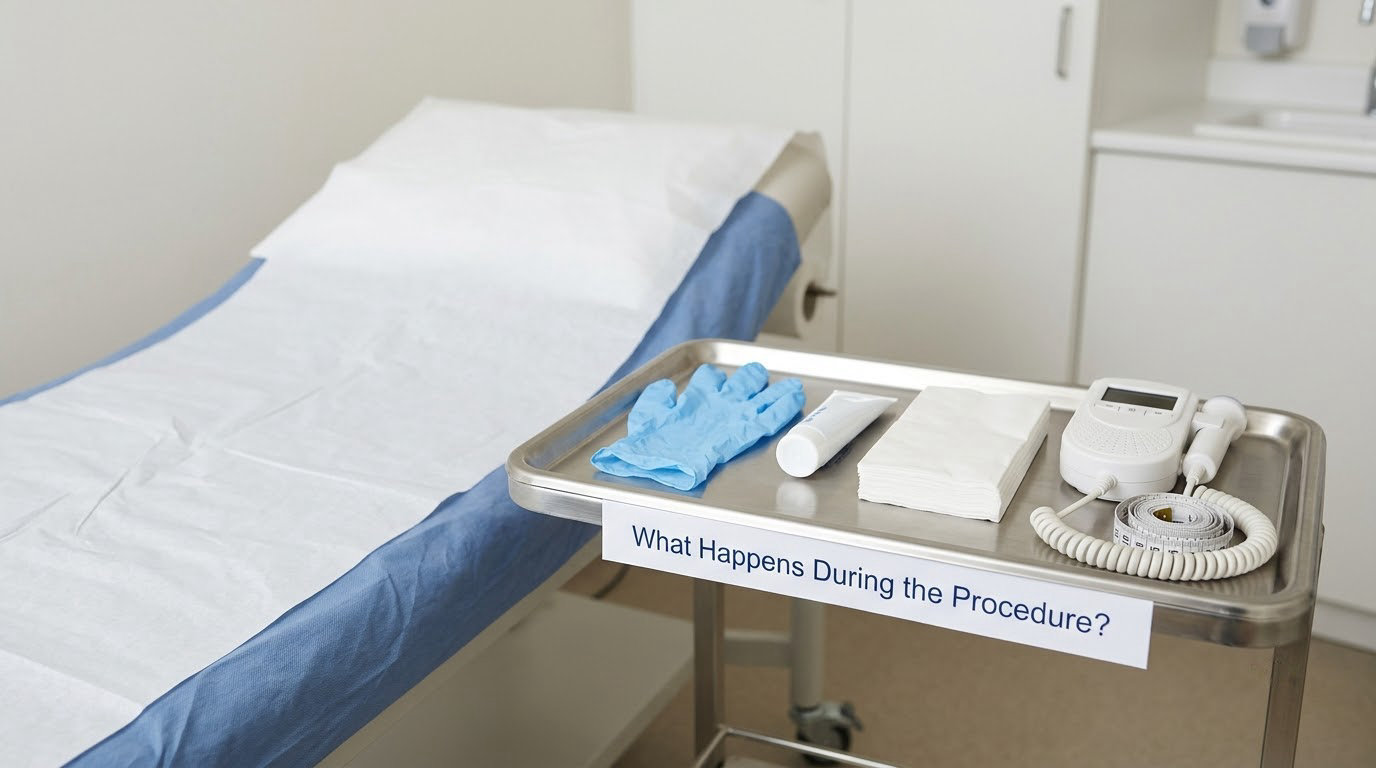
It is a short appointment, and most of it is waiting and undressing rather than the sweep itself. Here is the usual sequence.
- You are asked what you consent to. Some appointments cover both a cervical check and a sweep in one conversation. You can hear the word sweep, ask questions, and agree or decline before anything happens.
- You lie back on a covered exam couch with your legs supported, usually in a similar position to a routine cervical check at your booking appointment.
- Your cervix is checked first for dilation, effacement, and position. If it is closed and high, the practitioner may stop and offer something else, or nothing at all.
- A gloved, lubricated finger is inserted and swept in a circle around the lower part of the uterus, separating the membranes from the wall. This lasts a minute or two at most.
- You are given time to sit, get dressed, and ask questions. You can go home; no monitoring is usually needed afterwards unless your provider says otherwise.
How painful is a membrane sweep?
More intense than a routine cervical check, and much shorter than early labor. In the one trial that formally measured pain, 31% said it was not painful, 51% said somewhat painful, and 17% said painful or very painful. Of those who rated it painful, 88% said they would have it again in a future pregnancy.
Parents describe it in blunt terms: a rough internal exam, a deep cramp, or a bit like a smear that goes on longer than expected. For people with a history of painful exams or sexual trauma, that number can sit very differently, and asking for a support person, a slower pace, or stopping at any point is entirely reasonable.
How Effective Is a Membrane Sweep at Inducing Labor?
It is effective at nudging timing, and it is not effective at guaranteeing labor. The clearest summary comes from the 2020 Cochrane review of membrane sweeping by Finucane and colleagues, which pooled 44 randomised trials.
| Outcome | What the research shows | How certain is the evidence? |
|---|---|---|
| Spontaneous labor | More likely after a sweep than without one, especially within the first few days | Low certainty |
| Formal hospital induction | Less likely after a sweep than without one, most noticeably within 48 hours | Low certainty |
| Caesarean delivery | No clear difference between groups | Low certainty |
| Forceps or vacuum delivery | No clear difference between groups | Low certainty |
| Serious maternal illness | No clear difference between groups | Very low certainty |
| Water breaking before labor | In one randomised trial, 9% with sweeping compared with 0% with no treatment | Very low certainty |
Three things about that table are worth holding onto. None of the trials were masked, which means women usually knew they had had a sweep, and that alone can shape how they report pain and how they interpret early cramping. The reduction in formal induction is the finding people care about most, and it is also the one carrying the weakest confidence rating.
Cleveland Clinic’s patient education puts a simple number on it: roughly half of women are in labor within seven days of a sweep. That is the figure most people meet first, and it is a fair description. What it cannot do is promise you are in the half.
How Long Does a Membrane Sweep Take to Work?
It is often described as a 48-hour method, and sometimes as a seven-day one. Both are accurate, which is why the two numbers seem to contradict each other. The best of the available evidence points to a greater effect within 24 to 48 hours, with a smaller additional bump over the following several days, up to about a week.
So if your provider says the aim is 48 hours, they mean the point at which the effect is most likely to show. If a source says seven days, they mean the full window in which around half of people have started labor. Neither is a countdown you can rely on.
Signs that something is shifting usually arrive in this order: irregular cramping in the hours after the sweep, then a change in cervical mucus, a bloody show, or a loosening of the mucus plug, then contractions that come closer together and get stronger. Not everyone gets past the first stage.
Follow up with your maternity care team if contractions become regular and strong, if you pass blood heavier than a small streak, if you feel your waters have broken, or if you simply reach a point where you want to discuss options rather than continue waiting. The most common question in parent communities is how long to keep waiting, and the honest answer is that it depends on how far past your due date you are and how your pregnancy is going. That is a conversation with your provider, not a number on a page.
What Are the Benefits, Risks, and Alternatives?
Being honest about both sides is more useful than a sales pitch, so here they are side by side.
Reasons people accept one: no medication is involved, it can be done in a few minutes at a routine visit, it may reduce the chance of needing a more managed hospital induction, it can be repeated or combined with other methods, and it keeps the start of labor in your body’s hands rather than a drip.
Reasons people decline one: the evidence of benefit is real but modest and low certainty, there is no way to predict whether it will work for you, cramping afterward can be genuinely uncomfortable, there is a small chance your waters break before you are ready for a hospital, and you may still need medical induction regardless.
Membrane sweep, medical induction, or waiting
| Option | What it involves | How well it works | Can you decline it? |
|---|---|---|---|
| Membrane sweep | A few minutes of internal examination, no medication | Modest increase in spontaneous labor, most effect within 48 hours | Yes, entirely |
| Waiting for labor to start on its own | No procedure, monitoring and check-ups | Many labors begin on their own, timing unpredictable | Not a procedure; the decision is yours about how long to wait |
| Cervical massage | External and internal massage of the cervix, sometimes offered when the cervix is closed | Less studied than sweeping, generally gentler | Yes |
| Balloon catheter | A soft balloon placed inside the cervix to apply steady pressure | Used as a ripening method before induction | Yes |
| Artificial rupture of membranes | A clinician breaks the waters in hospital | Reliable, but usually paired with other induction methods | Yes |
| Medical induction | Prostaglandins, a hormone drip, or both, usually in hospital | Effective, managed, and more intervention than a sweep | Yes, though clinicians recommend strongly once indications are met |
These are not competing in the sense that one is right and the rest are wrong. Most people meet a sweep first, then a balloon or prostaglandin, then a drip if labor still has not started. Knowing the order of the steps helps when you are deciding whether this one feels like the right step for today.
Who Should Ask About a Membrane Sweep?
The most common situation is a full-term, low-risk pregnancy where someone would like to encourage labor to begin without medication. In UK guidance, NICE NG207 discusses offering sweeps at term for a first-time parent and around 41 weeks for someone who has given birth before, reflecting the different patterns of labor progress. In the US and Australia, sweeps are commonly offered from 39 weeks, and some providers offer them earlier.
Two questions narrow the answer fast: how favourable is the cervix, and what is your medical history.
A previous caesarean birth is the question parents in VBAC communities ask most often, and it is one most websites dodge. The honest position is that the evidence base for sweeps after a caesarean is thin, and the main concern is scar pain rather than a clear effect on your chances of another caesarean. This needs an individual conversation with your obstetrician, who can weigh your specific history.
Group B strep positive status also comes up, because a sweep can sometimes break the membranes. Group B strep is a common bacterium that many pregnant people carry without symptoms, and standard care is to give antibiotics in labor if the baby may be exposed. A sweep may be offered with that plan in place, so ask your team how they plan to handle it.
Sweeps are generally not the plan for high-risk pregnancies, for anyone whose labor signs point toward a caesarean, or for a cervix that cannot be reached. If you are in any of those categories, your provider’s judgment is the deciding factor, not a general article.
Questions to Ask Before a Membrane Sweep
Walking in with six specific questions tends to get better answers than a general should I do this?, because it gives concrete information to work with.
- How favourable is my cervix right now? Ask for the dilation in centimeters and how effaced it is, and what that predicts for success.
- What success rate do you see with your patients? Providers’ own numbers are more useful than the population average.
- What are the realistic side effects for me? Cramping, spotting, waters breaking, and how long you would expect to wait afterwards.
- Would you offer this again if it does not work? And how would that change the plan next time.
- What are my other options right now? Waiting, cervical massage, a balloon, or going straight to induction.
- Who do I call if I need you afterward? After-hours numbers, and which symptoms should not wait for the morning.
And if you would rather not have one, say so in plain words before the exam starts. Something like I would like a cervical check today, but I am not consenting to a membrane sweep does the job, because a check and a sweep are two separate procedures. If a sweep is offered mid-exam without being named, you can simply say please stop, I did not consent to that. You can also decline vaginal examinations in the final weeks of pregnancy, and you can ask for that to be recorded in your notes so it is not re-offered as a surprise each visit.
Frequently Asked Questions
Is a membrane sweep painful?
Most people rate it as more intense than a routine cervical check and much shorter than early labor. In the one trial that measured pain formally, 31% said it was not painful, 51% said somewhat painful, and 17% said painful or very painful. Among those who found it painful, 88% said they would have it again. You can ask to stop at any point.
Can a membrane sweep break my water?
It can, and that is one of the real downsides. Separating the membranes does not usually break them, but in one randomised trial, 9% of women who had a sweep had their waters break before labor compared with 0% who had no treatment. If that happens, you should contact your maternity care team straight away so they can plan next steps with you.
How soon after a membrane sweep will labor start?
The effect is strongest within 24 to 48 hours, and about half of people are in labor within seven days. Some report cramping within a few hours, others several days, and some notice nothing at all. The evidence certainty is low, so treat any timeline as a general pattern rather than a prediction. Ask your provider how they would time follow-up for your situation.
Can I have a membrane sweep at home?
Rarely. It is a clinical procedure that needs a trained practitioner, sterile equipment, and a way to assess your cervix safely, so it is normally done in a clinic, birth center, or hospital outpatient setting. A home visit would not usually be offered, and a home vaginal exam carries risks that a clinical setting does not. If home birth is part of your plan, ask your own team how they handle sweeps.
What should I do if I feel cramps or bleeding afterward?
Mild cramping, irregular contractions, and a small amount of spotting are common in the hours after a sweep and usually settle on their own. Call your maternity care team if the bleeding soaks a pad, if the pain is severe or persistent, if you have a fever, if your waters seem to have broken, or if you notice reduced fetal movement. Do not wait for regular contractions before calling if something feels wrong.
Conclusion
So, does it work? A membrane sweep modestly increases the chance that labor begins soon and may reduce your need for a formal hospital induction, and it does nothing guaranteed. About half of people are in labor within a week, the strongest effect lands in the first 48 hours, and the certainty of that evidence is low.
What to do first: ask how favourable your cervix is, ask what your provider sees as the success rate with their own patients, and ask what the alternative of waiting looks like for you specifically. If the answer does not feel clear, or if you simply do not want it today, that is a complete answer. Take it to your obstetrician, midwife, or maternity care team, who can weigh your circumstances, your history, and your local protocols far better than any article can.
Sources: Cochrane systematic review, Finucane and colleagues, 2020, membrane sweeping for induction of labor; NICE guideline NG207, Inducing labour; NHS, Inducing labour; Cleveland Clinic; Tommy’s; Evidence Based Birth. This article is for general information and is not a substitute for individual medical advice from your clinician.