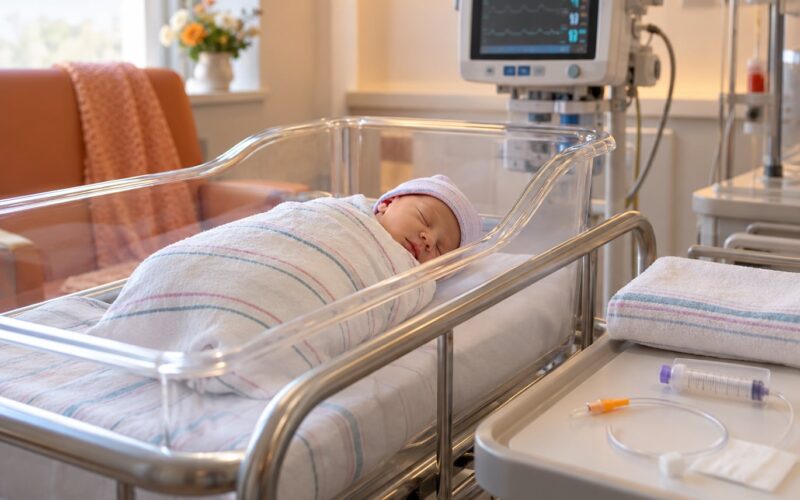
Birth in the United States was a home event attended by a midwife, and it became a hospital event managed by an obstetrician with monitors, IVs, induction and a scheduling system. That shift took about 150 years and it happened for reasons that had as much to do with law, insurance money and liability as with medical progress.
So how medicalized birth became the norm in the US is a story about institutions, not a story about a single invention. Antibiotics and blood transfusion genuinely saved lives. So did the hospital building, the residency system and the liability regime that made it very hard to practice outside one. Holding both of those at once is the whole difficulty of the topic.
More than 98 percent of births in the United States now happen in hospitals, and roughly a quarter arrive by cesarean. Understanding how we got here tells you which parts of the system are load-bearing and which parts are habit.
Table of Contents
- What Does Medicalized Birth Mean?
- How Did Childbirth Move From Homes to Hospitals?
- Why birth was genuinely dangerous before modern medicine
- How medicalized birth became the norm in the US, step by step
- How Medicalized Birth Became the Norm in the US
- How medicalized birth became the norm in the US, and why it stuck
- Why Did Routine Interventions Expand?
- How Did Doctors, Hospitals, and Technology Gain Authority?
- What Social Forces Encouraged Hospital Birth?
- How Does Medicalization Affect Pregnant People and Families?
- What Is the Difference Between Medicalization and Necessary Medical Care?
- What Trends Are Shaping US Birth Care Now?
- Frequently Asked Questions
- Is hospital birth safer than home or birth center birth?
- What is traumatic birth?
- Is it true that most maternal deaths are preventable?
- Can a hospital override my refusal of an intervention?
- How does US maternity care compare to other countries?
- Do hospitals still shave pubic hair before delivery?
- Conclusion
What Does Medicalized Birth Mean?
Medicalized birth means treating pregnancy, labor, delivery and the postpartum period as a medical condition requiring clinical management, monitoring and institutional oversight, rather than as a physiological process that a capable person can navigate with support. It is a description of systems and expectations, not a judgment about any individual birth.
The useful test is not whether a person received care. Plenty of medically necessary care has nothing to do with medicalization. The test is whether the intervention, the setting or the surveillance became the default, and whether a person could decline it without needing to argue their way out of it.
A medicalized birth tends to have a recognizable set of features:
- Technology treated as the definition of safety, rather than one tool among several
- Monitoring and surveillance applied routinely, whether or not risk is elevated
- The laboring person admitted to a facility designed for sick patients, on the assumption that birth is a medical event
- Care fragmented across shifts, with a new decision-maker every few hours
- Family presence regulated or limited, partners treated as visitors
- Separation of the mother and baby immediately after delivery, rather than skin-to-skin contact
- Institutional pace: inductions, scheduled cesareans and shift-friendly timing
Public health researchers often pair this with a second idea from Antonovsky’s salutogenesis, which asks what keeps people well rather than what makes them sick. Pathological care hunts for risk. Salutogenic care asks what conditions let a person do the work of their own labor. Most hospital labor and delivery units do some of each.
How Did Childbirth Move From Homes to Hospitals?
Hospital birth became the normal way to give birth in the United States over roughly three decades, from the 1920s through the 1950s. By the 1930s about half of births were in hospitals. By 1960 the shift was essentially complete, and by the early 1980s the figure is usually reported as far below the 100 percent mark only because of home and birth center births, which were well under two percent combined.
Before that shift, somewhere around 95 percent of American births happened at home. They were attended by women who had learned their craft by apprenticeship, often over years, often under a physician who supplied the forceps if a labor stalled.
Midwifery in the American South was dominated by Black practitioners, some of them enslaved and some of them free, and their knowledge was often the only obstetric knowledge available to a rural Black woman. That is not a sentimental footnote. It is a fact about who held clinical authority before physicians took it.
Why birth was genuinely dangerous before modern medicine
Between roughly 500 and 1,000 maternal deaths per 100,000 live births occurred in the United States around the start of the twentieth century. Anyone who tells you the old system was better is describing a system where a significant fraction of deliveries were fatal, and where many survivors suffered permanent injury.
Four causes accounted for most of it:
- Puerperal fever. A streptococcal infection of the birthing parent after delivery, often fatal, frequently transmitted by unwashed hands and unwashed instruments. Ignaz Semmelweis showed in 1847 that physician handwashing cut the death rate dramatically in his Vienna clinic. The medical establishment rejected the idea for roughly a decade, and handwashing did not become standard until germ theory was accepted later in the century.
- Postpartum hemorrhage. The uterus failing to contract after delivery. Without a uterotonic, a blood bank or a surgeon, a hemorrhage that started often did not stop.
- Obstructed labor. A fetus too large, malpositioned or simply too long in the channel. Before cesarean was a planned procedure, a stuck labor meant a long night with forceps, and often a dead fetus and a dead mother.
- Hypertensive disorders. Preeclampsia and eclampsia, which caused seizures, stroke and death, and were frequently misdiagnosed because blood pressure measurement was not part of routine antenatal care.
That is the counterweight to every critique of medicalization. The pre-hospital system was not a free birth movement. It was a high-mortality system that happened to be located in people’s houses.
How medicalized birth became the norm in the US, step by step
| Year | Event | Effect on how birth was managed |
|---|---|---|
| 1847 | Semmelweis demonstrates antisepsis in Vienna | Sets up a century-long fight over whether clinicians cause the infections they treat |
| Late 1800s | Forceps practice spreads; physicians begin attending more births | Obstetrics becomes a physician specialty with its own apparatus |
| 1900 | Physicians attend roughly half of American births | Many attending physicians have had little or no formal obstetric training |
| 1910 | Flexner Report | Recommends hospital-based training and effectively sidelines midwifery education |
| 1914 | Twilight sleep introduced in the United States | Laboring people are drugged and the birth becomes an institutional procedure |
| 1915 | Joseph DeLee argues pregnancy and childbirth are dangerous and evil | Gives the medical model its most quoted ideological statement |
| 1921 | Sheppard-Towner Infancy Protection Act | Triggers state licensure laws that restrict lay midwives sharply |
| 1925 | Frontier Nursing Service founded in rural Kentucky | Creates nurse-midwifery as a credentialed profession, and simultaneously professionalizes away the apprentice |
| 1930s | Roughly half of births occur in hospitals | Hospital birth becomes the majority experience |
| 1930s-50s | Hospital standardization, blood banks, antibiotics, prenatal care expand | Maternal mortality falls sharply, and it falls mostly because of these, not because of the building |
| 1960s-70s | Neonatal intensive care, Lamaze, Bradley, birth centers, Ina May Gaskin and the natural childbirth movement | Family presence and unmedicated birth become legitimate asks rather than fringe positions |
| 1980 | Midwives attend 1.1 percent of US births | The near-extremity point of American midwifery |
| 1990s-2000s | Routine episiotomy declines, delayed cord clamping and skin-to-skin become standard | Evidence-based practice begins to unwind practices that were never justified |
| 2020 | Midwives attend about 12 percent of US births | Midwifery returns without ever approaching the share it holds in most of Europe and Japan |
Note what that table contains and what it does not. It does not contain the year the hospital was invented, because the hospital was not the causal thing. The building arrived and, for a while, birth care in it was not reliably safer than the care it replaced.
How Medicalized Birth Became the Norm in the US
The answer is that six forces reinforced each other until hospital, physician-led, technology-monitored birth was easier to deliver, easier to bill and easier to defend than any alternative. Remove any one of them and the system is more fragile than it looks.
How medicalized birth became the norm in the US, and why it stuck
- Technology. Forceps, then anesthesia, then ultrasound, then electronic fetal monitoring, then neonatal intensive care. Each did real work, and each made the last one seem reasonable. A labor monitored by a machine can be managed by schedule, which is the thing schedules are for.
- Professionalization. Residency training, board certification and hospital privileging replaced apprenticeship. This produced far more consistent training, which is not a small benefit, and it also produced a single gatekeeper who can set the rules of a labor.
- Regulation. State licensure and the Flexner Report’s restructuring of medical education removed the lay midwife from the formal system. Once a service is unlicensed, it is easy to describe as unregulated rather than as a competitor with a different evidence base.
- Liability. Malpractice exposure is the driver almost nobody writes about. A physician or nurse-midwife who attends a home or birth-center birth carries risk that hospital-based practice absorbs, because the hospital has the monitoring, the blood bank, the OR and the resuscitation team down the hall. In the 1970s and 1980s, insurers and employers moved toward the hospital for exactly this reason.
- Payment. Reimbursement follows the facility. A hospital birth generates facility fees, anesthesia and newborn care billed separately, and out-of-network newborn services can land on a family as a surprise. Birth centers and home birth have historically been harder to cover, and where coverage is thin, so is the choice.
- Cultural shift. Over the twentieth century, safety came to mean equipment. A home birth stopped reading as intimacy and started reading as risk, largely because that is how the media, the courts and the insurance tables described it.
There is also a category error worth naming. Hospitals are built for sick people. Infection control, controlled access, continuous observation and regimented medication administration are the design logic of a facility treating illness. A laboring person is not ill. Admitting a physiologic event to an illness facility imports that facility’s assumptions, and the assumptions are not neutral.
Why Did Routine Interventions Expand?
Interventions expanded less because clinicians wanted to intervene than because institutions need predictability. A monitored labor is legible to a nurse managing four patients. An unmonitored labor requires a person whose entire job is watching. Both are reasonable; only one scales the way a unit needs to scale.
Induction is the clearest example. It is now standard for pregnancies that reach a certain point, and it converts a spontaneous event into a scheduled one with a predictable start time, a predictable length and a predictable staffing requirement. A scheduled start also fits a shift, a billing cycle and a childcare plan.
The same logic applies to continuous electronic fetal monitoring, which cannot tell a clinician whether to act sooner than intermittent auscultation in the large majority of labors, but gives a continuous record that can be reviewed, printed and relied on later. It became standard in the 1980s and remained standard after the evidence for most routine use came back equivocal.
The cesarean rate tells the story of the whole system. It sat near 5 percent in 1970. It passed 30 percent in the 1990s and has stayed in that neighborhood since. Not all of that increase is inappropriate. A cesarean that replaces a death is a good trade. But the growth also reflects repeated operative delivery making the next delivery operative, which is a cascade with a real cost in surgical adhesions, blood loss and recovery time.
| Indicator | United States | Comparison point |
|---|---|---|
| Births occurring in hospitals | More than 98 percent | Near universal in most high-income countries |
| Births attended by midwives, 2020 | About 12 percent | Close to 75 percent in Sweden, France and Japan |
| Births attended by midwives, 1980 | 1.1 percent | The near-extinction point |
| Cesarean delivery | Over 30 percent | Around 20 percent or lower in many European countries |
| Maternal mortality | Roughly 20 to 25 deaths per 100,000 live births, and higher for Black birthing people by two to three times | Higher than in most comparable wealthy countries |
Against that, some of the same countries that have low intervention rates also have excellent outcomes, and Sweden in particular has shown that a highly standardized, midwife-run system with consultant backup can produce both low intervention rates and low mortality. The argument for hospitals was never that hospitals are bad. It was that they are necessary. The problem is that necessity came to be read as sufficiency.
How Did Doctors, Hospitals, and Technology Gain Authority?
Authority did not arrive in one decree. It accumulated through training, documentation, money and risk, and each layer made the next one harder to argue with.
The chart. Once the hospital held the record, the hospital’s version of a labor was the version that counted. If a person says she felt pressured and the chart says she consented, the chart is what a lawyer, a licensing board and a hospital committee will read. Paperwork is not neutral about power.
The training pipeline. The Flexner Report restructured medical education around universities and hospitals, and the midwifery schools that remained inside that system trained nurse-midwives, a credential that is different in kind from apprenticeship. A formally credentialed profession can be measured, and once a profession can be measured, its members can also be ranked, sanctioned and excluded. Alabama illustrates how fast: when the Sheppard-Towner Act pushed the state to license midwives in 1923, roughly 150 granny midwives were deregistered within days.
The liability shift. This is the mechanism I would put at the top of the list for explaining why hospital birth became the default, and almost no explainer mentions it. A provider who delivers outside a hospital cannot call for a surgeon in ninety seconds. Insurers priced that. Hospitals did not have to argue that they were better; they only had to be insurable, and by the 1980s the system of coverage had done most of the arguing for them.
The money. A hospital birth is a facility event and it is paid for as one. Out-of-hospital birth has historically been reimbursed less reliably, which means that in areas where insurers decline to cover it, choosing a birth center can mean choosing to pay a great deal yourself. That is a payment design decision, not a clinical one, and it lands on families unevenly by income.
What Social Forces Encouraged Hospital Birth?
Race and class are not a subplot here. They are load-bearing.
The Flexner Report of 1910 recommended restructuring medical education and is now read as explicitly committed to a racially and ethnically narrowed conception of who was fit to practice. Its effect on midwifery education was to funnel the field toward hospital-based nursing programs. The Sheppard-Towner Infancy Protection Act of 1921 pushed states toward midwife licensure, and states that did it used licensure to shrink the practicing pool rather than to expand it.
The federal government did the same thing to Native American birth. Birth on reservations was required to happen in Indian Affairs hospitals, which removed a long-standing tradition of attending relatives and produced documented harm. People who were already least able to choose their care had it chosen for them.
Class ran through all of it. Hospital care is free at the point of use in a way home birth never was, and a 1915 argument by Joseph DeLee that pregnancy and childbirth were dangerous and evil did a great deal of work in the formation of that preference. Once the public could be told that birth was dangerous, demand for a facility rose, and demand for a facility made the facility the reasonable choice.
The consequences are measurable now. Black birthing people in the United States experience maternal mortality at two to three times the rate of white birthing people, and the gap is widest in the highest-causes categories, which are the ones where a delayed or ignored symptom does the most damage. The line between the 1920s deregistrations and a contemporary labor room where a patient is not believed runs through a very thin set of institutional choices.
Family planning policy belongs here too. Access to contraception and sterilization determined who was pregnant, how often, and under what circumstances, and it was distributed by class and by race in ways that still structure who the labor wards serve.
How Does Medicalization Affect Pregnant People and Families?
The clearest effects are on autonomy and on memory. People who have given birth in a US hospital describe the same pattern fairly consistently: the labor was managed around the institution’s needs, and they were not in the room where those decisions were made.
In r/beyondthebump, one person wrote that a labor lasting under two hours still left her with psychological trauma, and that she had not been prepared for that. Another described requesting a cesarean after three hours of pushing and being denied. In r/unmedicatedbirth, the question that recurs most is legal: can a hospital do this to me if I say no? The short answer is that a competent adult generally cannot be forced to submit to a non-emergency procedure, with the exception of a court order or a finding of incapacity, which is rare and hard to obtain.
What people describe more often than force is pressure. Induction scheduled because the unit is full, a birth plan acknowledged at registration and then not retrieved during labor, a partner asked to step out so a monitor can be repositioned. None of that is assault, and all of it is the medicalized structure doing its job.
One fairness point deserves its own note, because the internet tends to skip it. Parents on r/beyondthebump have organized hard against the idea that choosing an epidural makes you less of a parent, and unmedicated-birth communities have organized against the assumption that refusing induction makes you irresponsible. The history in this article does not point in either direction. The point is that the person giving birth owns the risk decisions on their own body, informed by a clinician who owes them accurate information.
One more caution. The idea of a cascade of interventions, where one intervention makes the next more likely, is a real and useful description for some families, and it is also contested in the research literature as a general claim. Treat it as a pattern worth discussing with your provider, not as a rule.
What Is the Difference Between Medicalization and Necessary Medical Care?
The line is straightforward to state and genuinely hard to hold. Necessary medical care is an intervention where the expected benefit exceeds the expected harm for this patient in this situation. Medicalized care is an intervention applied by default because the institution expects it, because it is convenient, or because it has been assumed safer than watchful waiting without being tested.
Standardization is not the villain. Everyone on a unit knowing the postpartum hemorrhage protocol, everyone able to read a fetal heart tracing competently, everyone able to get a baby to a NICU in minutes: that is standardization, and it is the reason birth in a hospital today is far safer than birth in a hospital in 1930. The problem is a different kind of standardization, where the same intervention is applied to everyone regardless of whether that particular person needed it.
The list of advances that genuinely reduced maternal mortality is short and unglamorous. Antisepsis and antibiotics. Blood transfusion. Uterotonics such as Pitocin. Prenatal care that catches hypertension, infection and Rh incompatibility. Safer cesarean and emergency surgery. Anesthesia. Neonatal intensive care. Those, plus the buildings and teams that made them usable, are why a US birth today is not remotely as dangerous as a US birth in 1900.
None of them require a routine episiotomy, a scheduled induction at a particular date, or continuous monitoring for a low-risk labor. A tool existing is not the same as everyone needing it, and holding both of those ideas at once is what most birth-preparation classes try to teach.
What Trends Are Shaping US Birth Care Now?
The direction of travel is genuinely mixed, and both of these are happening at the same time.
Rural obstetric units continue to close. The pattern is predictable: a small labor and delivery unit cannot cover anesthesia, transfusion and a cesarean around the clock on the volume it sees, so it closes, and the distance to the next unit goes up. That produces maternity care deserts concentrated exactly where the population is already underserved.
At the same time, midwifery is being integrated rather than replaced. Certified nurse-midwives now attend roughly 12 percent of US births, up from 1.1 percent in 1980, and most of that growth is in hospital-based programs where midwives work alongside obstetricians. Birth center and home birth are also growing, though still a small share.
Telehealth and remote monitoring have moved into prenatal care, and with them the possibility of more prenatal contact and less in-person contact, which changes who gets screened and when. Quality review bodies, respectful maternity care initiatives and the push to measure experience alongside outcomes are also real, and they are changing hospital behavior in ways that did not exist twenty years ago.
| Place of birth | Typical provider | Typical intervention profile | Transfer time if something goes wrong |
|---|---|---|---|
| Hospital labor and delivery | Obstetrician or nurse-midwife with resident and nursing team | Full monitoring, induction, anesthesia, operative delivery available | Minutes; OR and NICU on site or adjacent |
| Freestanding birth center | Nurse-midwife, sometimes with a nurse | No episiotomy, no routine induction, no cesarean on site | Ranging from minutes to over an hour depending on location and weather |
| Home birth | Nurse-midwife or licensed midwife | Low intervention, continuous labor support, planned and prepared for transfer | Longest; this is the central tradeoff to weigh |
Eligibility is not equal across the three. Birth centers and home birth generally require a pregnancy that is term and low risk, and a provider willing to transfer. High-risk pregnancies, and some Medicaid coverage, push people toward the hospital whether or not that is where they would have chosen to be.
Frequently Asked Questions
Is hospital birth safer than home or birth center birth?
For a high-risk pregnancy, yes, and not marginally. For a term, low-risk pregnancy in a well-run birth center with a clear transfer protocol, research has not shown a clear difference in outcomes, and midwifery continuity of care is associated with fewer interventions. What changes the picture is transfer distance, the availability of blood and anesthesia, and whether the setting can manage a postpartum hemorrhage. Ask any provider how long a transfer would actually take at 3 a.m. in February.
What is traumatic birth?
Birth trauma is a psychological response to a labor or delivery, not a synonym for a medical complication. It is commonly described after an induction a person did not consent to, an operative delivery, a birth plan that was ignored, being left alone, or losing control of decisions about their own body. People also describe a short labor as traumatic, which surprises them. A baby and a mother can both be healthy and the experience can still be hard.
Is it true that most maternal deaths are preventable?
A large share are, according to reviews by state maternal mortality review committees, which routinely find that a meaningful number of deaths involved a missed or delayed diagnosis, a delayed response to bleeding or severe hypertension, or a lack of timely access to an operating room and blood. Treat that as a reason to know the warning signs of postpartum hemorrhage and severe headache and preeclampsia, and to insist on timely escalation, rather than as a reason to distrust the hospital.
Can a hospital override my refusal of an intervention?
Generally, no. A competent adult cannot be forced to undergo a non-emergency procedure without consent, and you can refuse induction, continuous monitoring, an epidural, an episiotomy, or a cesarean. In an emergency where delay would be dangerous, clinicians can act on implied consent, and a court order or a finding that you cannot consent are the rare exceptions. You can ask to sign a refusal of a specific intervention and get a copy for your records.
How does US maternity care compare to other countries?
In Sweden, France and Japan, midwives attend close to 75 percent of births, and cesarean rates run lower. The US is close to universal for hospital birth, uses midwives for about 12 percent of births, and has a cesarean rate over 30 percent. That is not an argument that the US system does nothing right. The standardized midwifery systems those countries run are admired partly because the United States spent fifty years failing to build one.
Do hospitals still shave pubic hair before delivery?
Routine shaving has declined a lot in recent years, largely because studies found it does not reduce infection and can actually irritate the skin. Some clinicians still shave or clip the area for a specific procedure, usually a planned cesarean, and it is a legitimate question to ask in advance. Ask what the policy is, when it would apply to you, and whether it happens before you are admitted or on arrival.
Conclusion
How medicalized birth became the norm in the US comes down to a handful of durable things: hospitals were more insurable, physicians were more credentialed, lay midwives were deregistered, and payment followed the facility. The tools that came with all of that are why birth is safer now than it was in 1900, and they are worth keeping.
What is worth questioning is the part where a tool stops being a tool and becomes a requirement. There is a practical way to hold both: ask how each intervention is indicated, what the benefit is for you specifically, and what happens if you wait. Ask which parts of your plan the hospital has in writing, and get a copy. Ask how long a transfer to a higher level of care would take from where you are choosing to give birth.
Then pick a setting and a team that fit your circumstances, and stop there. A birth that ends with a healthy baby and a person who felt respected is not a compromise outcome. It is the whole thing.