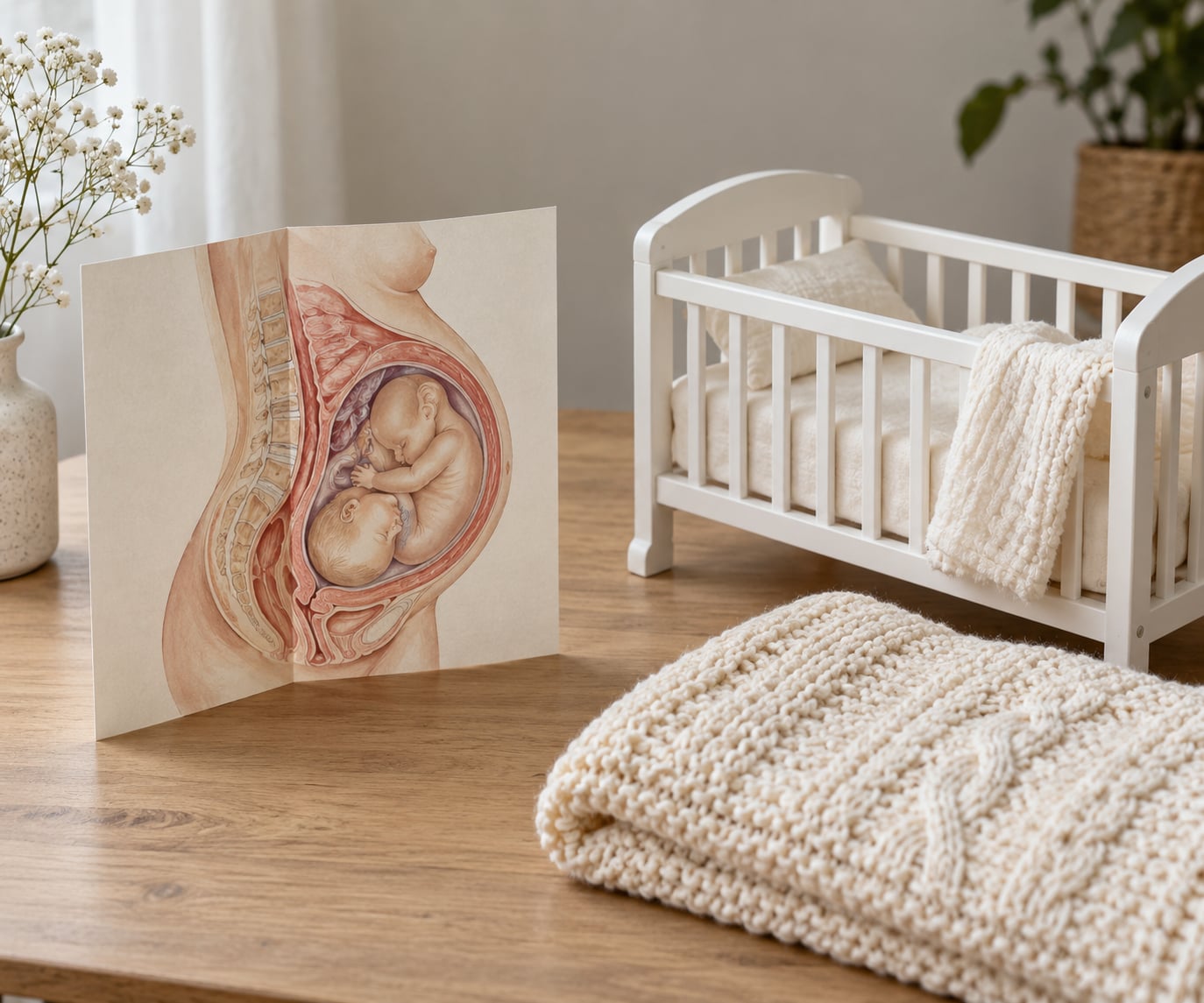
If your child asks where babies come from, answer plainly: a baby grows inside a woman’s uterus, is fed through the umbilical cord, and is born through the vagina or delivered by a doctor through a C-section. Say what your child actually asked, in words they will recognise, then get on with the day. Small true answers beat one long lecture every time.
Most parents who dread this conversation are not worried about the biology. They are worried about their own reaction, the tone of their voice, and whether they will overshoot. That is normal, and it is also the thing you can practise.
I have sat with families through this talk many times, and the pattern is consistent: children handle the true answer easily. It is the vague answer that causes trouble, because a vague answer invites them to build a worse one from things they have heard at school.
Learning how to talk to your kids about where babies come from is mostly a matter of three habits. Answer the question that was asked, use the correct name for the body part, and stop while you are still ahead. Here is how that looks at each age.
Table of Contents
- What You Need Before the Question Arrives
- Step-by-Step: How to Answer in the Moment
- Start With the Question Your Child Is Asking
- Use Simple Words for Bodies and Conception
- Explain Pregnancy, Birth, and the Baby’s Development
- Answer Questions About Sex Without Making It Secret
- Connect the Explanation to Safety and Trust
- Invite Questions and Revisit the Topic
- Common Mistakes and What to Say Instead
- Frequently Asked Questions
- At what age should I tell my child how babies are made?
- How do I explain where babies come from without saying too much?
- What words should parents use for sperm, egg, vagina, and penis?
- How do I answer if my child asks whether sex is fun?
- How should I explain that a baby was adopted or came from a donor?
- What if my child asks a sexualized question I am not ready to answer?
- How to Talk to Your Kids About Where Babies Come From: Start Small and Keep the Door Open
What You Need Before the Question Arrives
You need five minutes of calm, one sentence you have practised out loud, and agreement with the other adults in your child’s life. That is genuinely all of it. Everything else — books, diagrams, a good vocabulary — is helpful but optional.
One true sentence to fall back on. Before the conversation happens, write down one sentence in your own words that answers the broad question. Mine is: “Babies grow inside a woman’s body, in a place called the uterus, and then they are born.” Say it once, clearly, and let it be enough for today. You will add to it later rather than replace it.
The right words for body parts. Uterus, vagina, vulva, penis, anus, scrotum, testicles. If you can say them without flinching, you can teach them. The moment this pays off is easy to spot: a four-year-old correctly describing her own body using the word she learned from you.
Agreement with other adults. Grandparents, babysitters and co-parents are the usual source of the stork story resurfacing. The regret parents describe most often is not their own answer but an uncle’s answer three weeks later. One short conversation with the adults who see your child regularly is worth more than any leaflet.
A way to say “I need to look that up.” Children ask about things you genuinely do not know. Saying “I do not know, let me find out and tell you tomorrow” builds more trust than a confident guess, and it is the phrase many parents wish they had reached for sooner.
A time and place. Not at bedtime, not while you are cooking, not in the car when you cannot make eye contact. Questions that appear completely at random in the kitchen are usually children testing you rather than genuinely curious — answer briefly and revisit it when you are both sitting down.
None of this needs to happen today. It needs to be in place before the question does, because the question will arrive at a supermarket checkout.
Step-by-Step: How to Answer in the Moment
Start With the Question Your Child Is Asking
Children do not ask “explain reproduction”. They ask one specific thing, and the best answer is the one that matches that specific thing. Two questions sound similar and need completely different replies: “How do babies get in the tummy?” is about a mechanism, while “Did you and Dad do it to make me?” is about you.
Before you answer, ask what they already think. “What have you heard so far?” This is the single most useful tactic parents describe, and it does two jobs at once: it calms you, because you are no longer improvising, and it tells you exactly how much detail is needed.
| Age | What they usually ask | Words you can say |
|---|---|---|
| 1 to 3 years | “Where does the baby sleep?” | “Inside mummy’s tummy, in a soft place called the uterus, until the baby is big enough to come out.” |
| 3 to 5 years | “How did the baby get in there?” | “A seed from daddy’s body joined an egg in mummy’s body, and it grew into a baby in the uterus.” |
| 5 to 7 years | “How does the sperm get in?” | “The sperm travels up inside the penis and into the vagina, then it finds the egg. That is called fertilising.” |
| 8 to 11 years | “What exactly happens?” and “how does it come out?” | Fuller description of sperm, egg, fertilisation, the uterus growing, the umbilical cord, and birth through the vagina or a C-section cut. |
| 12 and up | “How do people choose to have a baby?” | Add conception as a choice, the fact that it does not always work, IVF, donor eggs or sperm, surrogacy and adoption. |
There is no single “right age”, but the curve is well documented: many children start around four, and the peak window is six to seven, when peer conversation fills the gaps you left. If you are reading this in 2026 with a child in that window, start this week rather than waiting for the right moment.
Use Simple Words for Bodies and Conception
The words do the work here, not the explanation. Say sperm, egg, uterus, vagina and penis. Children can handle every one of those words. What they cannot handle is the adult’s discomfort leaking into the room.
The one word to be precise about is tummy. A child’s tummy is where food is digested. Saying “the baby grows in your tummy” teaches them the wrong organ, and you will be correcting it years later when it matters. Say uterus, then add “the place in your body where the baby grows” as the gloss.
Pet names are the risk I would flag hardest as a midwife. “The private area”, “the flower”, “thewee” — these sound gentle and they are not. If a child has only ever heard a cute name for their genitals, they cannot describe what is happening to them to another adult. That is the entire point of using the clinical word: it is a safety tool, and paediatric bodies consistently recommend it.
Keep the sentence short. “A sperm from a man’s body joined an egg inside a woman’s body, and that started a baby growing in the uterus.” Twenty-two words, accurate, done.
Explain Pregnancy, Birth, and the Baby’s Development
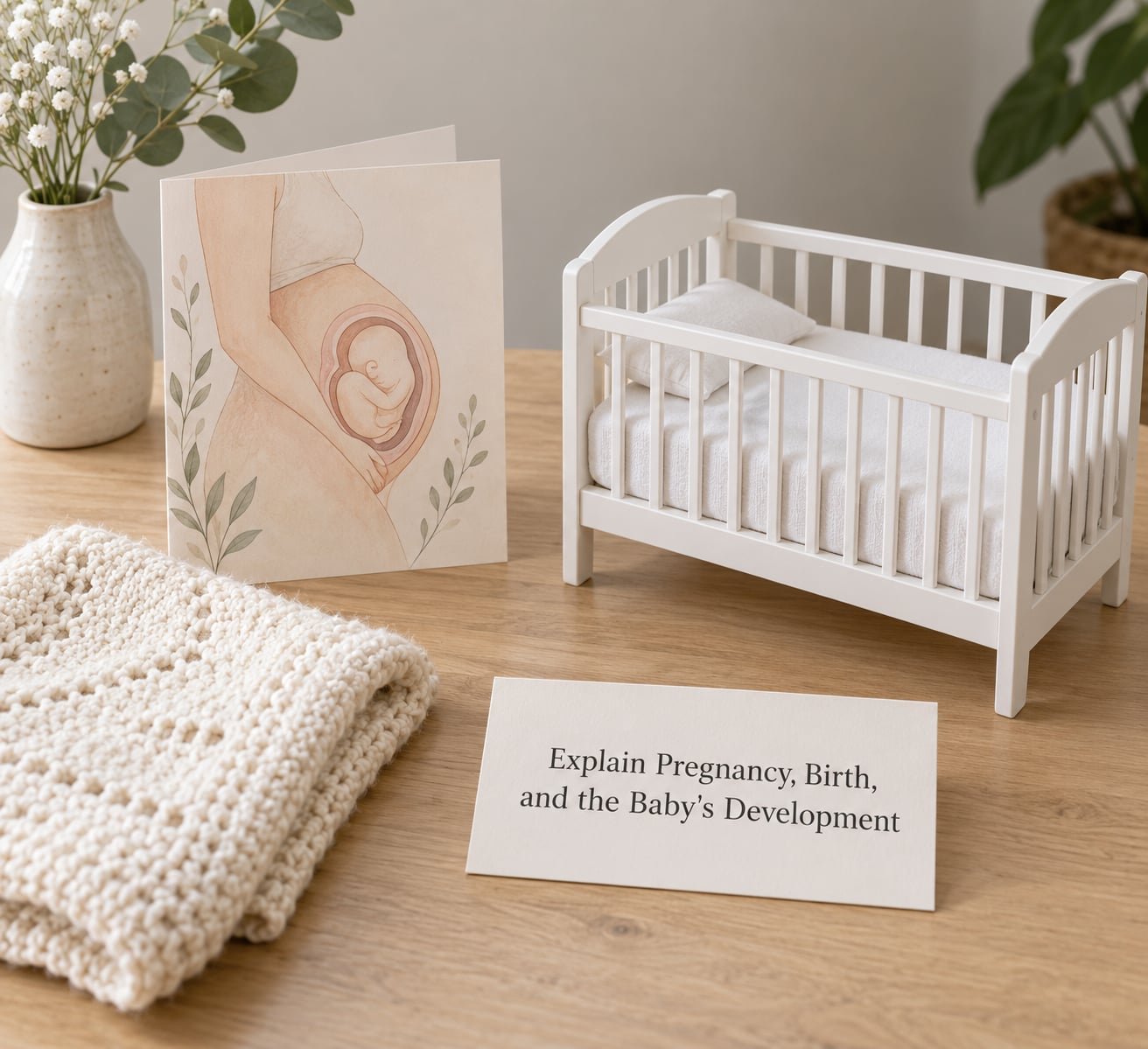
Once a child knows where the baby lives, they want to know what happens next. The short version is: the baby grows for about nine months, gets food and oxygen through the umbilical cord, and then birth happens because a baby gets too big to stay comfortably inside.
Explain birth without drama, because children imagine worse things than reality. Most babies come out through the birth canal, which is the vagina. Some are lifted out by a doctor through a cut in the mother’s tummy, and that is a C-section. Both are normal ways babies arrive.
Be honest about what you saw. If you were in the room, describe it plainly — “you were born early and the team took you out so you could breathe” is better than a softened version. Children who were born by emergency C-section often ask later, and hearing it from you beats hearing it from a relative.
If your child has seen a birth video or a documentary, that is now the source you are competing with. Rather than pretending it did not happen, ask what they noticed and correct what is inaccurate. Online anatomy videos are frequently sped up and edited to look alarming, which is worth saying out loud.
Answer Questions About Sex Without Making It Secret
Some families answer sex questions in a birth context only. That tends to backfire, because it teaches children that sex is relevant exactly when a baby is involved and never relevant otherwise. A short factual frame keeps it ordinary: sex is something some adults do with their bodies, it is how most babies are conceived, and it is private.
Conception comes in more than one version, and families should say which one is theirs. For IVF: “A doctor helped us by putting a sperm and an egg together in a dish, and then that baby grew in mummy’s uterus.” For donor eggs: “The egg that started you came from another woman, and you grew inside mummy.” For surrogacy: “Another woman carried you, and you were born into our family.” For adoption: “You grew in another woman’s body before she became your mum.”
Stepchildren and non-biological parents can answer every one of these. Stepparents describe the relief of hearing someone say “I wasn’t there for that part, but here’s how it worked” — accurate, unembarrassed, and no more complicated than that.
Connect the Explanation to Safety and Trust
This is the part most guides skip, and it is the part that protects children. Alongside biology, say three things clearly: the parts of the body covered by a swimsuit are private, private means private with everyone except a doctor or a parent if you are hurt, and you can always ask any grown-up you trust, and they will take it seriously.
Correct body-part names are what make those rules usable. A child who only knows a pet name for their genitals has no vocabulary to say that someone touched them there. Give them the real word and the rule in the same breath, every time, so it does not feel like a warning aimed at them.
Then tell them who else they can ask. Naming two or three adults — a co-parent, a grandparent, a teacher, a school counsellor — matters more than you would expect, because it means they are not dependent on you being available.
For anything medical, bring in their paediatrician. Development questions, worries about bodies and anything involving pain or bleeding are exactly what that appointment is for.
Invite Questions and Revisit the Topic
Do not quiz afterwards. The second question is usually “Can I have ice cream?”, and if you treat the answer as an exam you will train them to stop asking.
Normalise the follow-up instead: “You will probably have more questions, and I will answer them.” Then use the next natural opening. A new pregnancy, an ultrasound, a sibling arriving, or a book they pick up themselves all give you somewhere to return to without it feeling like a scheduled lesson.
Expect the vocabulary to grow twice, usually around ages six to eight and again at puberty. Each time you upgrade the answer, say why: “You are older now, so here is the fuller version.” Children accept that easily.
Common Mistakes and What to Say Instead
Using the stork, cabbage patch or seed story. These feel kind, and they fail for a specific reason: children are literal, and by three or four they can tell a story does not survive the follow-up questions. A toddler who was told a stork delivered a baby will ask where the stork keeps its babies. Fixing it later costs more than telling it straight now.
Giving a worse explanation when a child asks a pointed one. “Well, you know how mummy and daddy love each other…” introduces intercourse without explaining anything and lands like a warning. Either answer the actual question or say you are not going to answer it yet — but do not replace the question with a bigger, vaguer one.
Pet names for genitals. Save them for teaching body-part names early and consistently, and pair them with the private-body rules. Otherwise use the clinical words only.
Over-answering. The most common version is a five-year-old asking about the tummy getting bigger and receiving a full description of conception. Answer the tummy question, then stop. Parents report that the short version almost always leads to a second question, and the second question is where you earn the right to give more.
Treating your own embarrassment as a reason to shut it down. “Don’t ask me that” teaches your child that the topic is shameful, which is the opposite of what body safety requires. You can be uncomfortable and still answer. A visible effort is fine; a refusal is not.
Correcting harshly when a child repeats a myth. “That’s silly, that’s not true” is unhelpful. “That is a common story, and here is what actually happens” is far better, because it normalises the myth instead of shaming the child who believed it.
Walking back a story you already told. If you used the seed or stork answer, say so directly and without drama: “When you were little I told you a made-up story about how babies arrive, and I should have told you the real one. Here is how it actually works.” Then give the accurate version once and move on. Parents who did this report the whole thing took under two minutes and nobody mentioned it again — which is usually exactly what happens.
Letting the adults in your child’s life tell a different story. Tell your co-parent, your own parents and your sitter what language you are using. One group message does it. Then if your child does repeat a myth, back your own version up rather than dismissing theirs.
Frequently Asked Questions
At what age should I tell my child how babies are made?
Start before you think you need to. From around three, answer simply that a baby grows in the uterus and is born. Between six and eight most children start asking specific questions about sperm and how a baby gets in and out, which is the peak window. Add detail in layers at each age rather than giving one full explanation early. You do not need a set script, only one accurate sentence you can say calmly.
How do I explain where babies come from without saying too much?
Answer only the question that was asked, using the words your child used, then stop. If they ask how the baby got in the tummy, give one sentence about a sperm and an egg joining in the uterus. Do not add birth, or sex, or anything they did not ask about. If they want more, they will ask, and that second question is where you can offer a little more detail.
What words should parents use for sperm, egg, vagina, and penis?
Use the clinical words: sperm, egg, uterus, vagina, vulva, penis, anus. They are not obscene, they are short, and they are the words a child needs in order to describe their own body to a doctor or a trusted adult. Avoid private area and similar pet names, because a child who has no accurate vocabulary cannot report what has happened to them. Say the words early and use them often.
How do I answer if my child asks whether sex is fun?
Answer truthfully and briefly. You can say that sex is something some adults do with their bodies, that it can feel good for some people, and that it is private. Do not describe what it looks like unless your child asks, and do not use it as a warning about being caught. Framing sex as ordinary and private, rather than shameful or forbidden, is what keeps children willing to raise concerns with you.
How should I explain that a baby was adopted or came from a donor?
Use the plain version of your child’s own story. For adoption: you grew inside another woman before you came to live with us. For donor eggs: the egg that started you came from a woman you may meet one day. For surrogacy: a woman carried you and then you came home to us. Keep birth stories separate from conception stories so the child knows where they began and who raised them.
What if my child asks a sexualized question I am not ready to answer?
It is fine to say not now, and it is not fine to shame them for asking. You can say that you will answer it a bit later, then actually do so, because breaking that promise teaches them not to ask next time. If you need help, tell their paediatrician or a child psychologist that you are unsure how much to explain. They can tell you what is age-appropriate and support you in saying it.
How to Talk to Your Kids About Where Babies Come From: Start Small and Keep the Door Open
Answer the exact question that was asked. Use the correct name for the body part. Give one sentence, then stop and carry on with your day. That is the whole method, and it works far better than a planned speech.
Do it today rather than at some mythical perfect moment, because the window opens around four and stays open for years. If you already told a story you have since regretted, say plainly that it was a made-up story and give the real version now.
Do it calmly, even when you are not, and ask your child’s paediatrician if you want a second opinion on how much to cover at their age.