To split household labor fairly with a partner, write down every recurring job, name the planning behind each one, and give each job a single owner who is also responsible for remembering it, scheduling it, and deciding when it is done. Then review the split on a fixed date. Equal task counts are not the goal. Comparable free time and a share of the thinking are.
The thinking is what most couples miss. The mental load is the cognitive and emotional work of planning, remembering, anticipating, and organizing a household, and it rarely leaves a visible mark. Washing the dishes leaves dishes in the rack. Noticing the dishwasher is out of detergent, buying it, and remembering to buy it next week leaves nothing at all. A split can look even on paper and still tip heavily toward whoever is holding all of that.
Researchers have tied an unequal division of household labor to marital dissatisfaction, arguments about money, reduced sexual desire, and irritability that lands on the person doing the coordination. The Harvard Business School study on couples who stayed married fifteen years or longer put disagreement about chores in the top three marital trouble spots. The Pew Research Center has documented the same gap over time: the share of women doing the majority of daily housework fell, but the share of women reporting that family members divide chores fairly has not moved nearly as much. Perception drifts slower than behavior.
What follows is a system, not a pep talk. It works for dual-career couples, stay-at-home parents, new parents, and people who have been quietly over-functioning for years. It takes about an hour to build and about twenty minutes a week to keep alive.
Table of Contents
- What You Need
- How to Split Household Labor Fairly With a Partner
- 1. List every recurring household task, including the invisible ones
- 2. Define what fairness means to both of you before assigning anything
- 3. Audit the current workload together
- 4. Assign ownership and a backup plan for every job
- 5. Build a weekly check-in into the week
- 6. Make invisible work visible and divide the planning layer
- 7. Review and revise the plan on a schedule
- Common Mistakes
- Frequently Asked Questions
- Should housework be split 50/50?
- What is a good chore chart for couples?
- What is the mental load in a relationship?
- How do I get my partner to do more housework without arguing?
- How do couples divide chores fairly when one partner earns more?
- How often should we reassess our chore split?
- Conclusion
What You Need
You need three things before the conversation, and none of them is a spreadsheet program.
A real inventory. A shared list of every job the household actually runs, not the ones that sound reasonable. Empty the dishwasher and note everything you touched to get it open. Check the fridge, the pantry, the bathroom, the car, the mailbox, the calendar. Most people discover six to ten jobs nobody has ever named out loud.
A rough time estimate per job. Minutes per week or per month is enough, and your first numbers will be wrong in both directions. Precision is not the point. The point is that “I do the laundry” and “I do the laundry plus the shopping list plus noticing we are out of shampoo plus the errand” are not the same job, and the estimate makes that visible without anyone having to accuse anyone of anything.
A shared definition of fairness. Ask each other what a good week at home looks like in free time. Most people assume their own answer is the neutral one, so say yours out loud before you hear theirs. If your answers are wildly different, that is the most useful thing you will learn all evening.
A place to keep the list. A paper chart on the fridge or a shared note on your phone. Visible beats private. A private list lives in the head of the person who made it, which is exactly the problem you are trying to solve.
How to Split Household Labor Fairly With a Partner
Work through these seven steps in order. The first three are about seeing clearly, and skipping them is why so many splits collapse after a month.
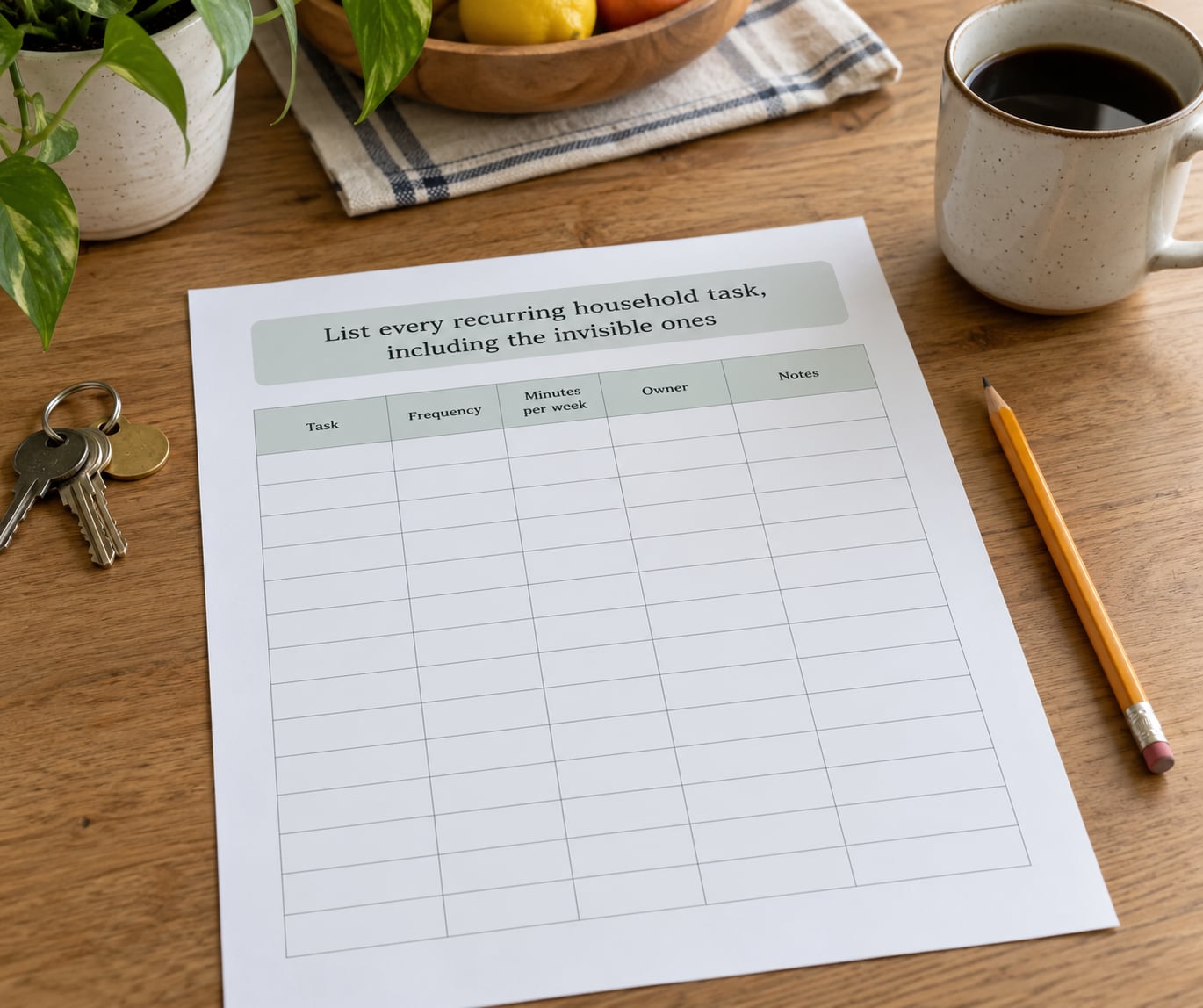
1. List every recurring household task, including the invisible ones
Take ten minutes and write down what happens in your home in a typical week. Then take another ten and add what never happens but should.
Split the list into two columns. Visible tasks produce an output: dishes, laundry, vacuuming, mopping, taking out trash, changing bed linens, cooking dinner, grocery shopping, cleaning the bathroom, washing the car, walking the dog, managing the recycling. Invisible tasks produce no output: noticing the toilet paper is running out, remembering the pediatrician appointment, tracking which kid needs new shoes, keeping track of whose turn it is for the school thing, planning meals so the fridge isn’t empty on Thursday, noticing the car registration is due, and managing the emotional temperature of the house when someone is struggling.
That second column is usually twice as long as the first, and it is almost always held by one person. Write it down anyway. A job you cannot name is a job you cannot hand over.
2. Define what fairness means to both of you before assigning anything
Fairness is not a single number, and couples who skip this step end up arguing past each other. Four dimensions usually matter: task count, time, mental load, and flexibility. Two people can match on every one of them and still feel wrong, and they can look unequal on paper and feel completely fine.
Say which of the four is least important to you right now, and why. If you are exhausted rather than exploited, flexibility may matter more to you than symmetry. If you are the one planning every trip, mental load is the one to protect. Naming it ends a lot of arguments before they start.
There are four well-known ways to structure the arrangement, and they suit different households.
| Framework | Core idea | Works best for | Watch out for |
|---|---|---|---|
| Strict 50/50 | Every job split down the middle, often by rotating pairs | Two people with similar hours, similar energy, no young kids | Maximizes handoffs. You finish the laundry and hand it to the other person to fold, and both of you now manage one more thing. |
| The 80/80 method | Each person aims to do 80% of their share, leaving slack for bad weeks | Couples with kids, illness, or shift work where exact parity is unrealistic | Feels vague. Agree in advance what the 20% looks like so it does not read as one person always getting a pass. |
| Strengths and preferences | Jobs are assigned to whoever does them well or enjoys them | Couples with genuinely different skills, or a stay-at-home parent with strong preferences | Explaining the assignment is work. Say it out loud, or the person left with the lamp repair will feel dumped rather than trusted. |
| Fair Play cards | Domains of responsibility, each with one owner, modeled on Eve Rodsky’s system | Homes where nothing has ever been written down | Big. It works, but the card set assumes two adults and a house, so families with infants will need to adapt it. |
There is no universally fairest column. What matters is that you pick a structure, write it down, and stop renegotiating it in the moment.
3. Audit the current workload together
Now mark up the list with what actually happens, not what you think happens. Do this in the same room, at the same time, within the same week. Argue about chores from separate weeks and you are arguing from memory, which is exactly how a 50/50 list survives for years next to a household that runs on one person noticing things.
Two columns, two weeks. Mark who did it and how long it took, using your estimates rather than a stopwatch. Be honest about the week you were slammed at work and the week your partner was. One week of data will not tell you much, and it is still better than the argument you are currently having.
The audit usually surfaces three things. A cluster of jobs concentrated in one person. A handful of jobs that quietly stop happening, because nobody sees them until they stop. And a few jobs where the “owner” is really whoever noticed it, which is not the same as who did it.
4. Assign ownership and a backup plan for every job
Give every recurring job one primary owner and one backup. Shared ownership with no default is how jobs disappear, because each of you is waiting for the other to do it.
Assign by preference and available time, with strength as a tiebreaker. Someone who cooks well and enjoys it should cook. Someone who is out of the house on Wednesdays should not own the Wednesday errand. Do not assign by default history, either. The person who has always done the bins did not choose that, and inheriting it is not the same as owning it.
Then build your chart. Six columns, no cleverness required.
| Job | Owner | Backup | How often | Standard of done | Who plans it |
|---|---|---|---|---|---|
| Grocery shopping | Weekly | Fridge stocked for seven days | |||
| Meal planning and prep | Weekly | Five dinners planned by Sunday | |||
| Dishes | Nightly | Loaded and running | |||
| Laundry | Weekly | Clean and put away | |||
| Bathrooms | Weekly | Sinks wiped, toilet brushed | |||
| Vacuum and mop | Weekly | Main rooms and hallway | |||
| Trash and recycling | Weekly | Out to the curb | |||
| Appointments and school | As scheduled | On the shared calendar | |||
| Repairs and maintenance | As needed | Fixed or on the list | |||
| Restocking and supplies | Monthly | Nothing below half |
Two columns carry most of the weight. “Standard of done” is where a surprising amount of conflict lives, because one partner’s clean is the other’s scrubbing. Write a concrete line. Sinks wiped out, not sanitized. Vacuumed in the main rooms and hallway, not under every piece of furniture. The standard belongs to the job, not to the person who set it before you were in the room.
“Who plans it” is the column that separates a task split from a fair one. The owner of meal planning decides what to buy. The owner of the calendar sees the appointment. The planning is not a favor either person performs for the other; it is part of the job.
Keep a separate short list for the jobs you both hate. Put them on a monthly rotation, or alternate week by week, so neither of you becomes the permanent holder of the litter box. And write down the jobs you are both fine dropping. An iron nobody uses is not a household responsibility, and deleting it is a free win.
5. Build a weekly check-in into the week
Twenty minutes, same time, same place. Pick a time neither of you is leaving the house or coming back from a hard shift, and put it in the shared calendar like any other appointment, because a check-in nobody sees will not happen.
Five questions, in this order. What did not get done this week? What ran out, expired, or needs a decision? Did anything change with work, kids, health, or family? Which job felt heavier than it should, or felt like it belonged to someone else? What moves do we want to try next week?
Say the last one out loud. A check-in where nothing changes becomes a complaint session, and a complaint session is how a twenty-minute ritual turns into an avoidance pattern within two months.
Monthly, do the same thing at a larger scale: look at last month’s minutes per week, compare them, and move one or two jobs. One move is enough. Churn produces a system nobody trusts.

6. Make invisible work visible and divide the planning layer
Most broken splits share one cause. One partner does roughly half the visible tasks and all of the invisible ones, and the visible half looks balanced to anyone counting.
Invisible work has a predictable shape: noticing, remembering, anticipating, coordinating, and managing feelings. Somebody tracks that the toddler’s inhaler refills at a certain date. Somebody decides the birthday party needs a cake on Saturday. Somebody notices the marriage is running on fumes and books the reservation. None of it shows up on a chart, so none of it gets discussed, and it accumulates on whoever was already doing more.
Pull the last two weeks out of your own head and write down every instance of that. Then assign those sub-steps to the same person who owns the visible job, wherever possible. Cleaner to own means the owner also restocks the soap, notices the vacuum bag, and knows the filter needs changing. The planning never becomes a separate favor, because it was never a separate job.
Emotional labor goes in the chart too, even though it looks like nothing. Managing a child’s anxiety before a school day, keeping a friendship with a difficult in-law, and being the person who remembers someone’s birthday are real work. Two couples with identical task counts can have very different workloads depending on who is doing this.
Finally, name the category exceptions out loud. A repair is not automatically a man’s job, and a budget is not automatically a shared-decision job. Ask what the rule has been, whether it was ever deliberately agreed, and what happens if it is retired for a month. Usually the answer is that nobody decided. Usually the test passes.
7. Review and revise the plan on a schedule
Any division of labor in marriage is a snapshot of two busy people on one particular month, and the month changes. Put a review on the calendar twice a year, and let the weekly check-ins catch the small drifts before they become a fight.
Two periods break almost every working system, so plan for them in advance rather than in the middle. The first is a newborn. Nothing about the arrangement survives unchanged, and the partner whose hours stayed the same is often the one whose workload tripled. Agree before the birth on a temporary list and a review date, because this is a bad conversation to have at three in the morning. The second is a career change, a job loss, a move, an illness, or a new school year, where one person’s hours change and the other absorbs the difference by default.
It is also worth revisiting if one of you has been over-functioning for years. A household that quietly assigned everything to one person is not balanced just because both people are used to it. Treat that as a fresh start rather than a correction, and expect the first two weeks to be awkward. That is normal and it passes.
When a partner will not engage at all, the conversation stalls before the list ever comes out. Then stop solving the chore problem and solve the conversation problem. Try a description instead of a criticism: instead of “you never do the dishes,” try “the dishwasher has been sitting full since Thursday, and today was a twenty-hour day.” Say the feeling, say the need, and make a specific request that is answerable.
Watch for the two scripts that end it every time. “I told you to do it” makes invisible work into a trap, because the whole point is that nobody could tell you. “Just tell me what to do” means the explaining costs more than the doing, so the task stays where it is. If you hear yourself saying either one, the system is failing, and no chart fixes that on its own.
Common Mistakes
Counting tasks instead of time. Ten jobs and ten jobs are not equal if one set takes three hours and the other takes one. Track minutes per week, at least for the first two weeks, and let that drive the adjustment.
Using appreciation as the system. Thanking someone for doing the dishes is lovely and does nothing to change who remembers the dishwasher tablets. Structure is what does the work; gratitude is what keeps the structure pleasant.
Making a list without making decisions. A list of grievances is not a list of responsibilities. If a job has no owner and no backup, it does not exist, and writing it down changes nothing except the argument.
Leaving the planning with one person. This is the single most common failure. The person with a clean chart still runs the household in their head, which is a second unpaid job.
Keeping category exceptions. Even a genuinely equal visible split feels unequal when one set of jobs is quietly off-limits by long-standing habit. Ask where the exception came from, then run a one-month trial.
Demanding one standard from the doer. Perfectionism on the receiving end turns a fair split into a service arrangement. If you are not willing to have the job done to your standard, you are asking for help, not dividing work, and it is worth saying which one you mean.
Adding jobs without acknowledging the load. “Can you add the gutters?” lands as a verdict if the person already feels stretched. Add a job and something comes off, or name that the total load is going up.
Treating the first arrangement as permanent. Any list you wrote two years ago is a historical document. If nobody has reread it since, you are not running a system, you are running a leftover.
Two habits fix most of the above. Write the standard of done for every job, so nothing gets re-done in silence. And let one of the unpopular jobs rotate on a schedule, so there is always a visible mechanism preventing permanent assignment.
Frequently Asked Questions
Should housework be split 50/50?
Not necessarily. A 50/50 task count is a useful starting measurement, not a definition of fair, because it ignores time, mental load, and how well a job gets done. Couples who both work similar hours with no young kids can often hit a true split. Families with babies, shift work, or unequal hours usually do better with 80/80, which leaves slack for bad weeks. Measure minutes and planning for a few weeks first, then decide which structure your household can actually sustain.
What is a good chore chart for couples?
A good chore chart for couples has six columns: job, owner, backup, how often, standard of done, and who plans it. The first two make responsibility unambiguous, the fifth stops rework and arguments about clean, and the sixth is what keeps the split from being 50/50 on paper and lopsided in practice. Keep it visible, on the fridge or a shared note, and revisit it monthly rather than daily.
What is the mental load in a relationship?
The mental load is the planning, remembering, anticipating, and coordinating behind a running household, such as tracking refills, appointments, and who needs what when. It produces no visible output, so it is easy to miss. A 50/50 task split can still leave one person carrying all of it, which is why the mental load has to be written down and assigned, not just felt. Ask each of you to list every instance from the past two weeks.
How do I get my partner to do more housework without arguing?
Start with a joint inventory rather than a request, since accusations produce defenses and a list produces problem-solving. Then make the ask specific, immediate, and answerable: not you never help, but the dishwasher has been full since Thursday. Say why it matters to you in one sentence. Keep a visible chart so follow-through is a matter of fact rather than character. If the conversation keeps collapsing, couples counselors are trained for exactly this and it is not a failure.
How do couples divide chores fairly when one partner earns more?
Income is not a household currency, and the partner who earns more does not thereby buy fewer dishes. Value both contributions, then use time, energy, and health as the real inputs. A higher earner working long hours may have less capacity, which is a legitimate reason to assign them fewer jobs, and the lower earner can put more into the home. If one partner is not earning at all, their workload has to be itemized and acknowledged rather than assumed to be everything.
How often should we reassess our chore split?
Fifteen to twenty minutes weekly, and a fuller review twice a year. The weekly check-in covers what slipped, what ran out, and what changed, and it should end with at least one decision. The twice-yearly review looks at minutes per week and moves one or two jobs. Change the split sooner after a baby, a job change, a move, an illness, or a new school year, since those are the moments a working system usually breaks.
Conclusion
Start with the list, not the argument. Write down every job your household runs, including the planning behind it, and compare actual minutes over two weeks. The list alone tends to move the conversation from who is failing to what should change, which is the only version of this conversation that has ever worked for anyone.
Then book twenty minutes, put the chart where you both can see it, and agree on a review date before you leave the table. The system does not need to be perfect in 2026 or any year after it. It needs to be written down, revisable, and shared, and everything else follows from that.