If you want to know how to track your cycle to understand fertility, the short answer is this: record a small set of daily signals — the first day of your period, cervical mucus, and your basal body temperature — and read them together across three or more cycles. Add urine ovulation tests if you want more confidence. What emerges is your own fertile window, not a generic prediction printed by an app.
This takes about two minutes a morning and a little patience. Most people are surprised by how little data they need before a pattern shows up, and equally surprised by how much the pattern shifts month to month.
One idea organizes everything else: some signs tell you ovulation is coming, and some tell you it already happened. Cervical mucus and hormone tests are predictive. Basal body temperature is retrospective — it confirms the shift after the fact, which is why beginners often feel the temperature chart is useless in the moment. It is not; it is just answering a different question.
What follows is a six-step process, the tools you need, the mistakes that quietly ruin most charts, and a clear list of signs worth raising with a clinician. This is general information about how bodies work, not medical advice, and it cannot diagnose or rule out any condition.
Table of Contents
- What You Need
- Step-by-Step
- Step 1: Record the Start and Length of Your Period
- Step 2: Observe Cervical Mucus Throughout the Cycle
- Step 3: Take Your Basal Body Temperature Each Morning
- Step 4: Use Ovulation Tests When More Confirmation Helps
- Step 5: Compare Patterns Across Several Cycles
- How each tracking method compares
- What a completed 28-day cycle looks like
- Step 6: Know When to Ask a Clinician for Help
- Your daily two-minute checklist
- What to do when your cycle is not regular
- Common Mistakes
- Relying on a single method
- Confusing ovulation with the fertile window
- Taking temperature too late
- Counting spotting as a period
- Using first-morning urine for ovulation tests
- Testing once a day near the surge
- Expecting the textbook pattern every cycle
- Missing context notes
- Treating app predictions as facts
- What Your Chart Cannot Tell You
- Frequently Asked Questions
- What is the most reliable way to track my cycle to understand fertility?
- Can basal body temperature alone tell me when I am fertile?
- How long should I track my cycle before seeing a pattern?
- What cervical mucus is most likely to happen near ovulation?
- Can I use ovulation tests and basal body temperature together?
- What cycle changes should prompt me to contact a doctor?
- Conclusion
What You Need
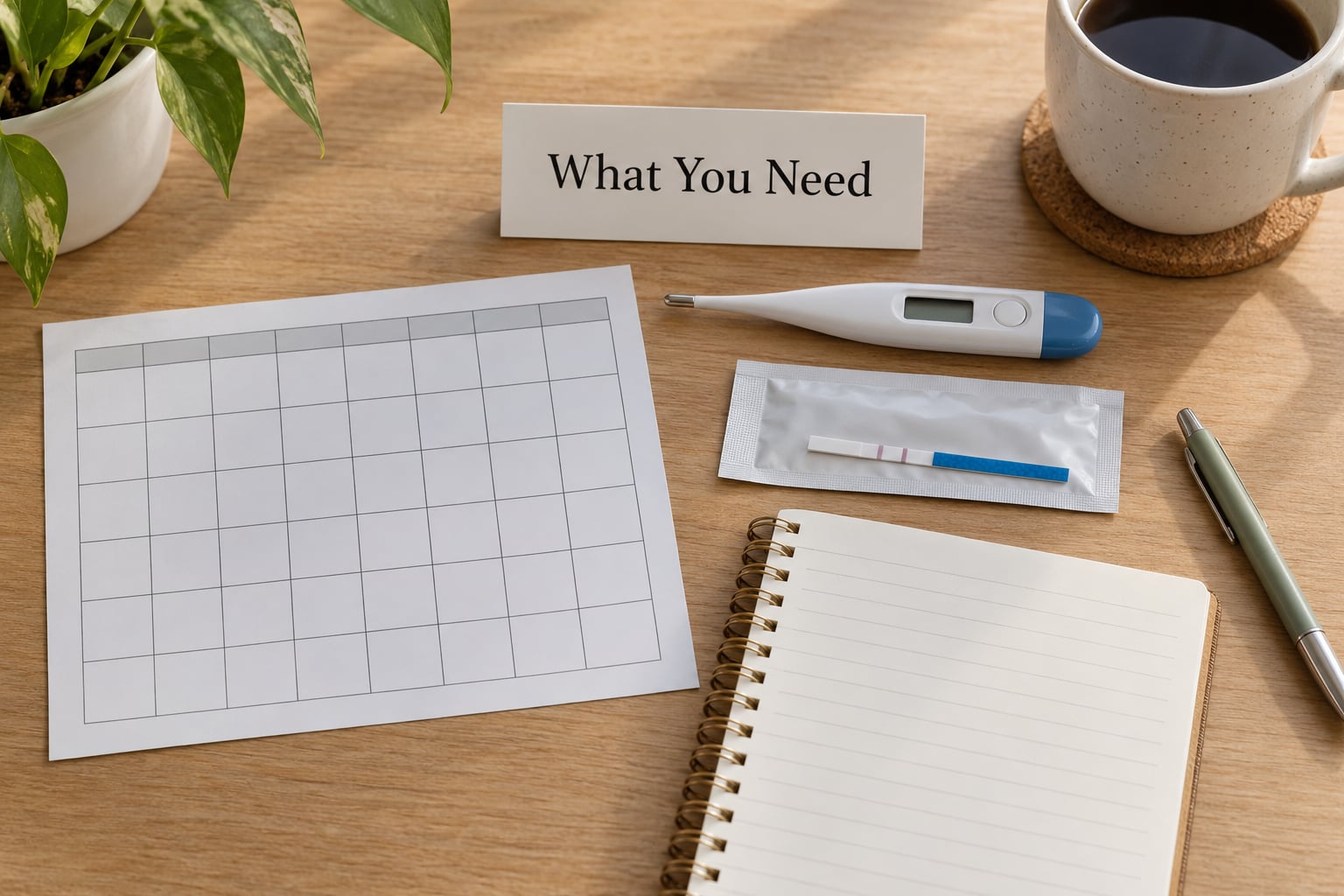
You need very little to start, and most of it you may already own. A calendar or a dedicated cycle tracking app handles the dates, a two-decimal basal body temperature thermometer handles temperature, and about thirty seconds of attention handles mucus. The rest is optional.
A reliable calendar or a dedicated app. Any app that lets you log a period start, daily mucus, and daily temperature works; some let you attach notes, which matters more than you would expect on months when something unusual happens.
A two-decimal basal body temperature thermometer. These resolve to a tenth of a degree, unlike a standard digital thermometer. The difference is not cosmetic: the temperature shift you are looking for is small, and a single-decimal thermometer rounds it away.
A consistent place to check cervical mucus. Most people do this during a shower or after using the bathroom, which is exactly the point — the check only works if it happens at roughly the same time, every day, including days when nothing seems to be happening.
Ovulation predictor kits, if you want a stronger signal. Optional, and most useful in the cycle where you are trying to conceive and want less guesswork. They detect a luteinizing hormone surge in urine, which precedes ovulation by roughly a day.
A note column for context. Illness, fever, alcohol, travel across time zones, medication, poor sleep and waking at an unusual hour all affect readings. Without a note you will spend months wondering why a particular week looks wrong.
Privacy matters here, more than most health apps suggest. Your cycle data is intimate reproductive health information, and many free apps are funded by sharing or anonymizing it. Read the privacy policy, use a strong unique password, and keep a paper backup if that matters to you.
Step-by-Step
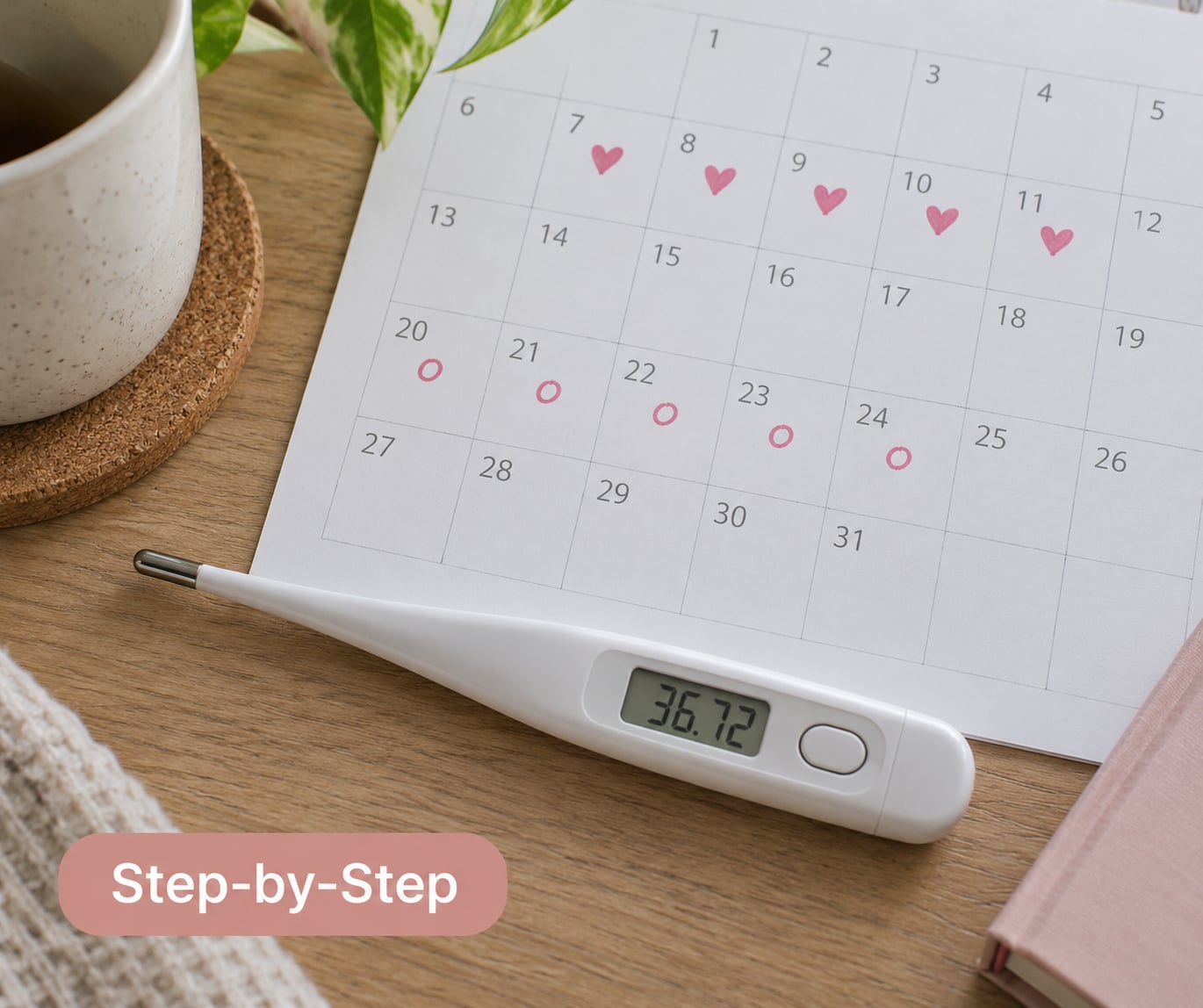
Step 1: Record the Start and Length of Your Period
Log the first day of full menstrual bleeding as day 1. Not a brown smear the day before, not light spotting that lasts an hour — day 1 is the day you would need a tampon or pad and it is genuinely red.
Cycle length is the count from that day to the day before the next one. A 28-day cycle means the first day of one period falls 28 days before the first day of the next.
Then subtract 14 to get a rough ovulation estimate. For a 28-day cycle that lands around day 14; for a 35-day cycle, around day 21.
It is worth knowing what that estimate is worth. The luteal phase, the stretch between ovulation and your next period, is far more consistent than the follicular phase before it, which is why the “minus 14” shortcut exists. It is a starting point for when to begin testing, not a prediction of the day you ovulate. On a 28-day cycle, real ovulation commonly lands somewhere between days 11 and 17.
So is day 17 too late to ovulate? No. Day 17 is late enough to miss a calendar estimate and entirely normal. If your period is due in early August, an ovulation around July 17 to 19 is unremarkable.
Track at least three cycles before you treat any estimate as useful. Longer cycles make the estimate worse, because variability scales with length — a 40-day cycle could easily put ovulation anywhere from day 20 to day 30.
What does not count as a period: spotting between periods, the brown discharge that ends a period, and bleeding triggered by hormonal contraception or a pregnancy test. Recording those as day 1 will corrupt every downstream calculation.
If you are on hormonal contraception, the picture changes. Combined pills, implants, injections and hormonal IUDs suppress or alter ovulation, so calendar estimates and mucus patterns will look different and often far less distinct. A cervical mucus and temperature chart under hormonal contraception is not reading your natural cycle. Ask your clinician how you would like to handle tracking while you use it.
Step 2: Observe Cervical Mucus Throughout the Cycle
Cervical mucus changes through the cycle because rising estrogen changes what the glands in the cervix produce. Early in the cycle, right after a period, there is often little at all. As estrogen climbs, mucus becomes thicker, then cloudy, then slippery, clear and stretchy near ovulation. After ovulation, progesterone thickens it again.
Check once a day at a similar time, gently, and describe what you find rather than judging it. Many people never notice a clear egg-white stage and assume something is wrong with them. It is common, and it does not mean you are not ovulating.
To check, wash your hands, then insert clean fingers about an inch into the vagina and touch the cervix, or use the tissue-like material at the opening. Note consistency, color and stretchiness. If you stretch the mucus between your fingers, slippery, clear, elastic mucus that resembles raw egg white suggests ovulation may be approaching.
Some people also track cervical position, which typically shifts higher, softer and slightly open near ovulation and drops lower, firmer and closed afterward. It is a primary sign, and it is the method most sensitive to good technique, so treat it as supporting evidence rather than a verdict on its own.
Hold onto one honest limitation. Mucus observations are a sign that ovulation may be near, not proof that it will happen this cycle. Anything that suppresses or shifts hormones — illness, stress, thyroid problems, PCOS, hormonal medication — can flatten the pattern. A chart without a distinct egg-white stage is information, not a verdict on your fertility.
Step 3: Take Your Basal Body Temperature Each Morning
Basal body temperature is your lowest temperature in a defined resting state, taken immediately on waking before anything else. Take it right after you open your eyes, before you eat, drink, get up to use the bathroom, exercise, or talk much.
Basal body temperature is your body’s resting temperature, and progesterone released after ovulation raises it by roughly 0.2 to 0.5 degrees Celsius. That rise is the shift you are charting. How many days of elevated temperature confirm ovulation? The shift itself is confirmation; the days after it are the luteal phase.
You need a sustained rise, conventionally two or three consecutive days, rather than a single spike. A one-day bump is usually noise, not a phase change.
Several things invalidate a reading or distort the curve: a night of interrupted sleep, alcohol the evening before, illness with or without fever, a late night, waking at a very different time, and travel across time zones. Note the exception in your log rather than discarding the number. Dropping data points leaves you with a chart full of gaps and teaches you nothing.
Sleep deserves a specific mention. Getting up to use the bathroom in the middle of the night, or feeding a baby, ruins that morning’s reading in a way that cannot be fixed afterward. If that describes your nights, decide in advance that those days get marked rather than measured, and do not read the resulting pattern as a problem with your body.
This is where wearables come up, and where many readers get an unwelcome surprise. Most consumer rings and wristbands measure skin temperature, which is not the same measurement as basal body temperature. Skin temperature is convenient and can still be interesting trend data. It is not the same input, so it does not substitute cleanly for symptothermal charting. Check what a device actually measures before you build a method on it.
Temperatures taken inconsistently cannot be compared against each other. Six months of readings at wildly varying times is a worse chart than one month of clean ones, because the errors are invisible once they are plotted.
Step 4: Use Ovulation Tests When More Confirmation Helps
Ovulation predictor kits detect a surge in luteinizing hormone in your urine. The surge is the pituitary’s signal to the ovary to release an egg, and it typically occurs about 24 to 36 hours before ovulation. That makes these tests predictive — they tell you ovulation is imminent, not that it happened.
Start testing based on your cycle length, following the instructions in the box. For cycles of 26 to 30 days, many people begin around day 10 to 12. Shorter cycles may need an earlier start, longer cycles a later one. The manufacturer’s chart exists for a reason; use it rather than a generic rule.
Test timing is where most people get a false negative. LH is concentrated in urine that has been sitting, so first-morning urine is the wrong sample. Testing between late morning and early evening, and avoiding drinking large amounts of fluid for a couple of hours beforehand, gives many kits the concentration they need.
Test at roughly the same time each day, and test more than once a day once you are close to a positive. LH surges are brief, and a single daily test can miss the peak entirely, which is a common reason people conclude their ovulation is invisible.
A faint line is usually negative, not borderline. A positive result means a surge was detected. It does not prove an egg was released, because a surge can occur without ovulation, and a read can also come back positive when you are perimenopausal or on certain fertility medications. Combine it with mucus and temperature rather than treating it as a verdict.
Expect the wait. The days between a positive test and a confirmed temperature shift are the hardest part of charting, because the tests told you something is coming and the confirmation has not happened yet. Most people use mucus and ovulation tests prospectively, then let temperature answer the question afterward. Experienced trackers in community forums describe exactly this split, and it resolves most of the beginner frustration that a temperature chart feels useless in the moment.
Step 5: Compare Patterns Across Several Cycles
A single cycle is an anecdote. Patterns emerge when you overlay three to six cycles and look at what repeats: roughly when mucus turns slippery, how long your period runs, whether your temperature shift lands about 12 to 14 days before the next period, and how much your cycle length moves.
Start by marking the primary and secondary signs on your chart, because they answer different questions.
- Predictive signs tell you ovulation is approaching: cervical mucus changes, cervical position, and a positive ovulation test.
- Retrospective signs confirm that ovulation happened: the sustained basal body temperature shift, and period onset as the closing marker of the luteal phase.
Community trackers widely described this as the core mental shift: use the predictive signs to plan, and use the retrospective ones to score the cycle afterward. If you only learn one thing from this guide, learn that.
How each tracking method compares
| Method | What it measures | Best for | Main limitation |
|---|---|---|---|
| Calendar method | Period dates and cycle length | Establishing a baseline | Estimates only, and less accurate on long or irregular cycles |
| Cervical mucus | Consistency, color and stretch of cervical mucus | A daily, free predictive sign | Requires daily technique; can be muted by hormones or illness |
| Basal body temperature | Resting temperature on waking | Confirming that ovulation happened | Retrospective, and easily spoiled by sleep, alcohol or travel |
| Ovulation predictor kits | Luteinizing hormone surge in urine | Narrowing the fertile window with confidence | Predictive only; prone to false negatives from timing and dilution |
| Cervical position | Height, firmness and openness of the cervix | Supporting evidence alongside mucus | Subjective and sensitive to technique |
| Cycle tracking apps | Whatever you enter | Storing, charting and reviewing history | Predicts from averages; cannot confirm anything you did not log |
Two methods combined are stronger than either alone, because they fail in different ways. Temperature confirms retrospectively, mucus predicts prospectively, and an ovulation test fills the gap between them. The combined approach is often called the symptothermal method, and named methods such as the standard days method and the Billings method are specific, rule-based versions of the same underlying observations.
What a completed 28-day cycle looks like
A typical 28-day chart read to a few illustrative figures looks like this: period from day 1 to day 5, scant or absent mucus through roughly day 7, thicker and cloudy mucus through day 10, slippery clear mucus on days 11 to 13, a positive ovulation test on day 12, a temperature shift of a few tenths of a degree starting day 13 or 14, a luteal phase of about two weeks with a small dip before the period, and the next period on day 29.
Notice what the chart actually established. Ovulation happened somewhere around day 11 to 13, confirmed by the shift, which makes the fertile window roughly days 6 to 12. The most fertile stretch is closer to the middle of that range.
Here is the biology behind those six days. Sperm can survive in the female reproductive tract for up to about five days under favorable cervical mucus, while an egg survives roughly 12 to 24 hours after release. So intercourse several days before ovulation can still result in conception, while the day after ovulation generally cannot. That gap is why the fertile window is wider than the ovulation day, and why the egg-white mucus that precedes ovulation matters so much.
If your chart shows ovulation around day 19 instead, your luteal phase is still about two weeks and your cycle is 33 days. Nothing is wrong. The chart did its job, which is to replace a generic rule with your own numbers.
With irregular cycles, day-count rules break down. Subtracting 14 and starting ovulation tests on day 12 is unreliable when cycle length varies widely, and this is the situation described constantly in PCOS communities, where the standard formulas assume more regularity than exists. A better approach for irregular cycles is to drop calendar prediction, test with ovulation predictor kits more frequently across a longer window, record mucus and temperature consistently, and let several cycles of data define the range rather than a single predicted day.
Step 6: Know When to Ask a Clinician for Help
Tracking is useful precisely because it turns vague worry into specific information. These are the findings worth bringing to a doctor or a fertility specialist.
- Cycle length consistently under about 21 days or over about 35 days
- Periods that stop for several months, or that become very irregular, after years of regularity
- No temperature shift across several consecutive cycles, which can point to anovulation
- Very heavy bleeding, bleeding that soaks through protection hourly, or bleeding with pain that does not settle
- Bleeding or pain between periods, or after intercourse
- Unusual discharge with odor, itching or pelvic pain
- Breast changes, acne, or excess hair alongside cycle changes, which can accompany PCOS or thyroid conditions
- Pelvic pain that is severe or one-sided
- Breastfeeding, postpartum bleeding, perimenopause, or a long gap without menstruation, since all of these change the chart and mean you have no usable baseline yet
Timeframes matter too, and they are context rather than rules. Guidance generally advises seeking evaluation after about a year of trying under age 35, and after six months at 35 or older, with earlier evaluation for known conditions such as PCOS, endometriosis, prior pelvic surgery, or a history of irregular cycles. Your clinician can adjust that based on your situation, and that is a good question to ask at a routine visit before you are in a hurry.
Take your chart to that appointment. A printed or on-screen record showing several cycles of period dates, mucus, temperature and test results is more useful than any single measurement, and it saves a round of questions. Bring the note column too, since medication, illness and travel patterns often explain the gaps a clinician is puzzling over.
Tracking can also be contraception, though with a significant caveat. Fertility awareness methods used as contraception have a typical-use effectiveness well below perfect adherence figures, because people misread signs, and signs vary. If avoiding pregnancy is the goal, do not rely on a chart alone without discussing reliable contraception with a clinician.
Your daily two-minute checklist
Tracking works when it is small enough to keep doing. One routine, at the same point in the day, covers everything:
- Take your temperature immediately on waking, before any movement, and record the number. If the night was disrupted, mark the day as invalid instead of forcing a reading.
- Check cervical mucus, once, and describe it in a word or two — none, thick, cloudy, slippery.
- Note anything unusual: illness, alcohol, medication, poor sleep, a late night, travel.
- Test for ovulation on the days your instructions call for, and never with first-morning urine.
- On the first day of full bleeding, mark day 1. That is the only entry that changes every other date on the chart.
That is the whole habit. Everything else in this guide is interpretation, and interpretation can wait until the record exists.
What to do when your cycle is not regular
Irregular cycles break day-count rules in a specific way: the rule assumes a consistent luteal phase, and when cycle length swings, the estimate is wrong by exactly the amount of the swing.
Track ovulation with signals from the current cycle rather than from a calendar. Run ovulation predictor tests across a longer window, test twice daily once you see a faint line developing, and keep logging mucus and temperature daily without expecting a textbook shape.
Give it more cycles, not fewer. With wider variation, three cycles can show a range of 15 days, and it takes longer for that range to narrow. Mention the variability itself in your notes, since it is one of the most clinically useful things on the chart.
Two things that flatly reset tracking rather than complicate it: starting or stopping hormonal contraception, and the postpartum or perimenopause transition. In both cases you have no usable baseline, so expect to start again from day one rather than treat your old chart as a comparison point.
Common Mistakes
Relying on a single method
One signal on its own gives you one data point with one failure mode. Temperature alone confirms too late to plan with. Mucus alone is subtle on some cycles. Ovulation tests alone miss surges that come and go between tests. Combine at least one predictive sign with one confirmatory sign, and the chart stops being guesswork.
Confusing ovulation with the fertile window
This is the most common misreading. Ovulation is a single moment. The fertile window is the several days before it, when sperm are still alive and the egg has not been released yet. Most conceptions happen from intercourse in the days leading up to ovulation, not on the day itself.
Taking temperature too late
Getting up, using the bathroom, making coffee, and then measuring gives you a warmed-up reading that is too high and can mask the shift entirely. A reading taken more than an hour after waking is generally treated as invalid. Set the thermometer somewhere you cannot miss it.
Counting spotting as a period
Brown discharge or a short bleed is not day 1. Logging it as one shifts every calculated date and quietly corrupts the whole chart. If you are unsure, note it in the notes column rather than the period field.
Using first-morning urine for ovulation tests
Luteinizing hormone concentrates in urine over time, so the most concentrated sample is the weakest one for this particular test. Testing between late morning and early evening, with less fluid beforehand, is the difference between a clear positive and a frustrating run of negatives.
Testing once a day near the surge
A surge can rise and fall within a day. When you are close, testing twice a day catches peaks that a single daily test walks straight past.
Expecting the textbook pattern every cycle
A textbook chart is an example, not a template. Your mucus may be subtle, your temperature shift smaller, your ovulation a few days from the estimate. The job of tracking is to learn your pattern, not to be measured against someone else’s.
Missing context notes
A week that makes no sense usually has a reason: illness, alcohol, a bad night’s sleep, a trip, medication. Two words in the notes column save hours of puzzling later.
Treating app predictions as facts
Apps calculate from averages of the data you enter. They can be wrong, sometimes meaningfully, and they cannot observe anything you did not log. A predicted ovulation day is a hypothesis to check against your own signs, and reading it as a verdict creates either false confidence or needless dread, both of which show up repeatedly in tracking communities. Read the prediction as a prompt to pay attention, and never as a diagnosis.
What Your Chart Cannot Tell You
Charts describe patterns. They do not diagnose PCOS, endometriosis, thyroid conditions or diminished ovarian reserve, and no amount of logging substitutes for hormone blood tests, ultrasound or a semen analysis when those are indicated.
Two beliefs are worth releasing early. First, regular periods do not prove you ovulate. A cycle can look textbook on a calendar while ovulation is inconsistent, which is one reason temperature and mucus add so much. Second, irregular periods do not automatically mean infertility. Many people with irregular cycles conceive without intervention, and the irregularity itself is a finding worth discussing rather than a verdict.
Regular, predictable cycles make day-count methods work better. That is a practical fact about the method, not a measure of your fertility. The methods at the top of the comparison table work hardest for exactly that reason: mucus, temperature and hormone tests read the current cycle instead of extrapolating from its length.
It is also reasonable to step back. Hyperfocus on daily data can turn into burnout, especially when the goal is conception and each month carries weight. Tracking is information, not a scorecard, and taking a break month does not erase a year of data you have already built.
Frequently Asked Questions
What is the most reliable way to track my cycle to understand fertility?
The most reliable approach combines at least one predictive sign with one confirmatory sign. Track cervical mucus daily to spot the slippery, clear, stretchy stage, and take your basal body temperature immediately on waking to confirm ovulation afterward. Ovulation predictor kits are a useful addition because they detect the luteinizing hormone surge about a day before ovulation. Read three to six cycles together before trusting any pattern.
Can basal body temperature alone tell me when I am fertile?
Not really. Basal body temperature is retrospective: it confirms that ovulation happened, roughly half a day after the fact, by showing a sustained rise of about 0.2 to 0.5 degrees Celsius. It cannot tell you your fertile window in advance. For planning, pair it with cervical mucus observations or ovulation predictor kits, which are predictive, and use temperature to confirm what those signs suggested.
How long should I track my cycle before seeing a pattern?
Plan on three to six cycles. Experienced trackers consistently describe the first one or two as exploratory, since you are still learning what your own mucus and temperature actually look like. Longer or irregular cycles take longer still, because the variability is larger. Judging your chart after a single cycle leads to false conclusions in both directions, so give the record time before drawing conclusions from it.
What cervical mucus is most likely to happen near ovulation?
Clear, slippery, and stretchy mucus that resembles raw egg white is the classic sign that ovulation may be approaching. It typically appears as estrogen reaches its peak, often a day or two before the ovulation event, and the stretch between your fingers increases. Not everyone notices a distinct egg-white stage, and a muted pattern does not mean you are not ovulating, since illness, stress, thyroid conditions, PCOS, or hormonal medication can all flatten it.
Can I use ovulation tests and basal body temperature together?
Yes, and this pairing is the most useful combination for most people. The ovulation test is predictive, giving you a positive result around 24 to 36 hours before ovulation, while basal body temperature is confirmatory, showing the shift afterward. Used together they cover the gap that makes either method frustrating alone. Test between late morning and early evening rather than with first-morning urine, since the hormone concentrates in urine over time.
What cycle changes should prompt me to contact a doctor?
Reach out if cycles are consistently shorter than about 21 days or longer than about 35, if periods stop for several months, or if you see no temperature shift across several cycles, which can point to anovulation. Also raise heavy bleeding, bleeding with persistent pain, bleeding between periods, or unusual discharge with pelvic pain. If you are over 35, or have PCOS, endometriosis, or a history of irregular cycles, ask about earlier evaluation rather than waiting.
Conclusion
Start today, not on Monday. Note the first day of your period if it is within the last few days, otherwise mark the day you begin. Pick one predictive method, one confirmatory method, and a place to write it down. Then keep the notes column honest, because context turns an unexplained week into a solvable puzzle.
Give it three cycles before you draw conclusions, and read the chart as a conversation rather than a verdict. When something looks off — consistently very short or very long cycles, no temperature shift, bleeding that worries you — bring the record to a clinician. That is what the data is for.
Tracking is a way of paying attention to your own body. Used that way, it tends to replace guesswork with information, and information is what makes a useful appointment possible.