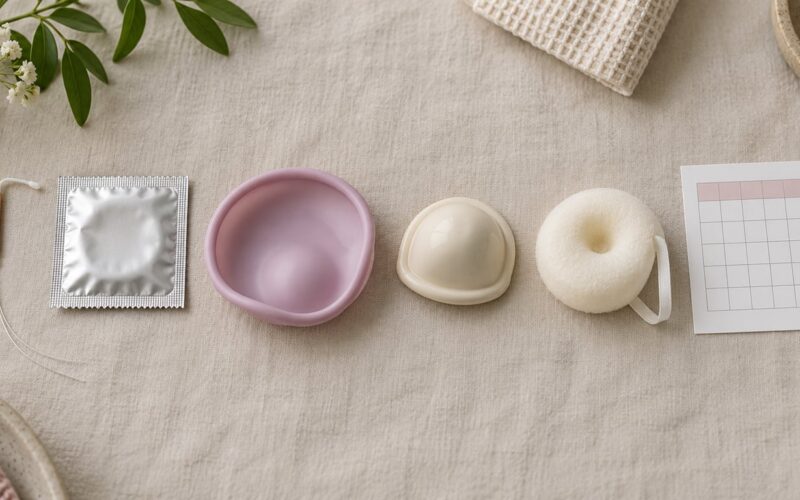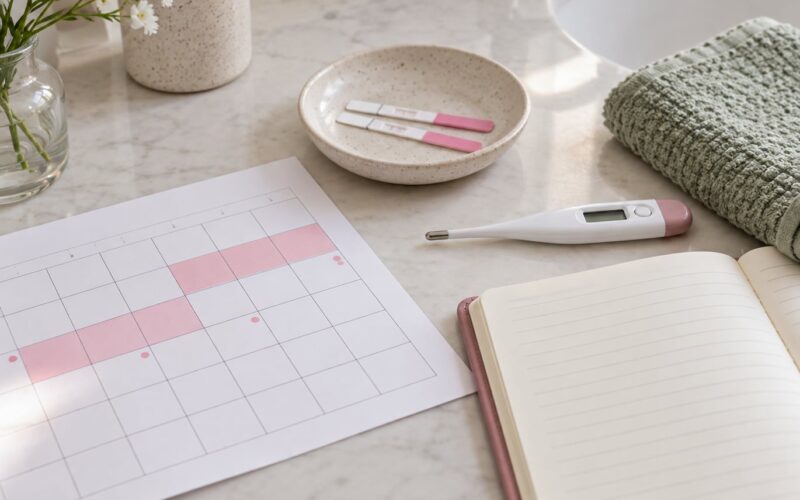
Long-term contraception costs vary enormously by method, and the sticker price is the least useful number to compare. A generic pill runs a few tens of dollars a month, which adds up to hundreds or thousands over a decade, while an IUD or implant costs several hundred dollars once and then keeps working for three to ten years. The cheapest method on a receipt is often the most expensive one by year five.
The figures below are typical US cash ranges as of 2026, not quotes. They shift with insurance, state, pharmacy, and clinic, and they assume you stay on the same method for the whole period without side effects that force a switch. Consider them a starting point for your own arithmetic rather than a price list.
Long-term cost has four parts, and most comparisons only count the first one:
- Upfront cost — the device, the procedure, or the first fill
- Recurring cost — refills, repeat injections, new packs each cycle
- Medical cost — office visits for insertion, removal, and follow-up, plus any treatment for side effects
- Time and opportunity cost — appointments, travel, and the risk that a method fails and leaves you managing an unintended pregnancy
One last framing note. This is general cost information for adults in the US, not medical advice. A midwife, clinician, or pharmacist can tell you which methods fit your health history, your plans, and your coverage, and the last section covers how to get accurate numbers for your own situation before you commit.
Table of Contents
- Long-Term Costs of Different Contraception Methods by Type
- Condoms and fertility awareness: low per use, hard to scale
- Pills, patches, and rings: the monthly drip
- The shot, implant, and IUDs: paying once, then forgetting
- Permanent methods: the highest upfront, the flattest curve
- Emergency contraception: occasional, unpredictable
- When does a device actually get cheaper than the pill?
- What Affects the Price
- Why a covered method still produces a bill
- Brand versus generic, clinic versus cash price
- The visits and side effects nobody budgets for
- Ways to Save
- Frequently Asked Questions
- What is the cheapest contraception method over five years?
- How much does contraception cost with insurance in the US?
- Are IUDs and implants cheaper than birth control pills over time?
- How much does emergency contraception cost when it is needed?
- Should I choose contraception based only on the lowest price?
- Conclusion
Long-Term Costs of Different Contraception Methods by Type
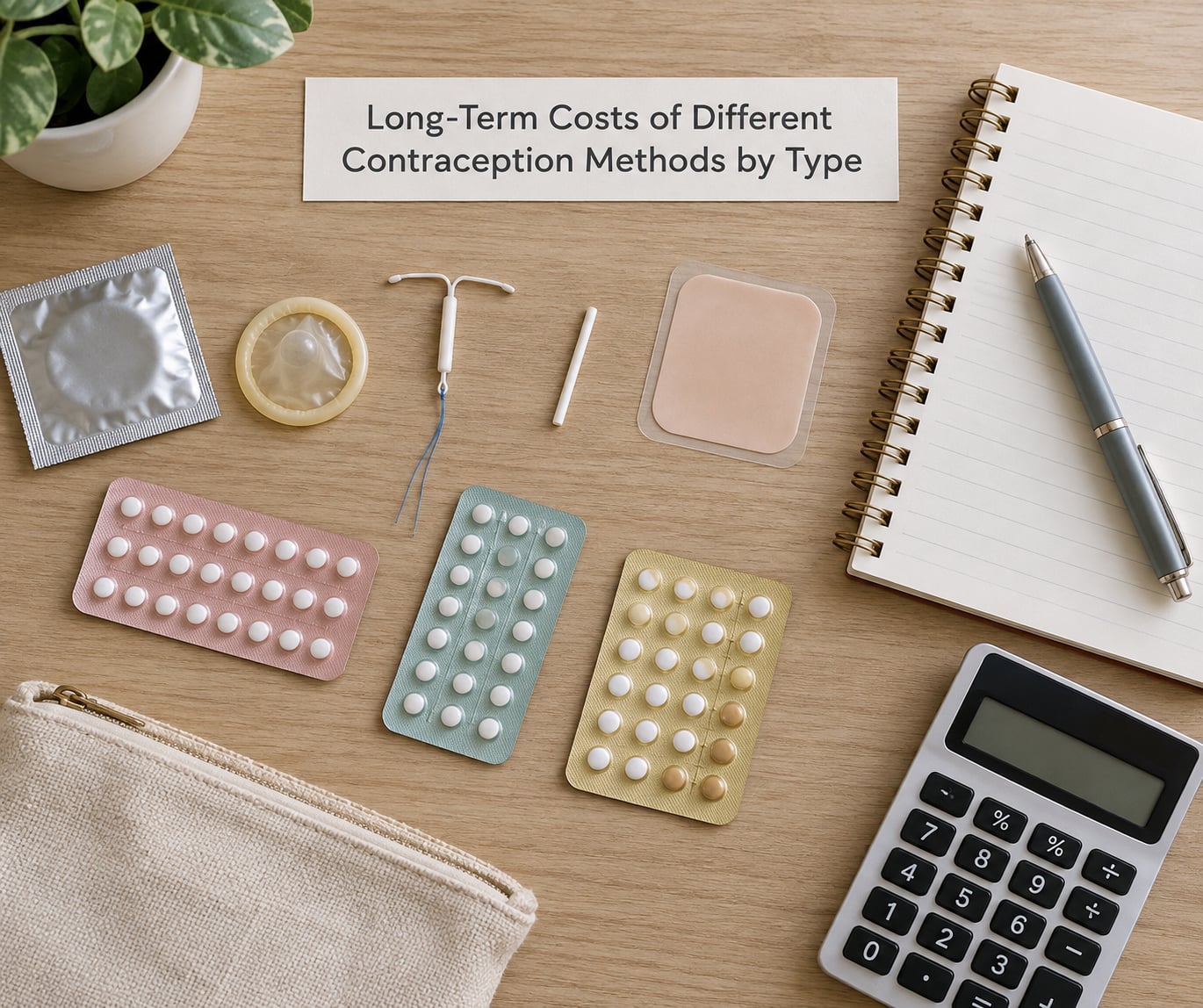
Here is the long-term cost of birth control by method, with typical upfront cost, how long the method works, and what five and ten years of use add up to. All figures are in typical US dollars and reflect what you would pay without insurance, before any discount or assistance program.
| Method | Upfront cost | Ongoing cost | Lasts | 5-year total | 10-year total |
|---|---|---|---|---|---|
| Fertility awareness | Free to about 50 for an app | 0 | Indefinite | 0-50 | 0-50 |
| Condoms | 5-15 per pack | Same per use | One use | 300-900 | 600-1800 |
| Generic pill | 10-30 first month | 10-30 per month | Requires daily use | 600-1800 | 1200-3600 |
| Brand-name pill | 40-90 first month | 40-90 per month | Requires daily use | 2400-5400 | 4800-10800 |
| Contraceptive patch | 30-60 per pack | 30-60 per month | Weekly change | 1800-3600 | 3600-7200 |
| Vaginal ring | 30-60 per ring | 30-60 per cycle | Monthly change | 1800-3600 | 3600-7200 |
| Depo-Provera shot | 50-150 per injection | 4-6 visits per year | 12 weeks | 1200-4500 | 2400-9000 |
| Implant (Nexplanon) | 300-700 including insertion | None | 3-5 years | 300-700 | 600-1400 |
| Hormonal IUD | 350-800 including insertion | None | 3-5 years | 350-800 | 700-1600 |
| Copper IUD | 400-900 including insertion | None | Up to 10 years | 400-900 | 400-900 |
| Vasectomy | 500-1500 one-time | None | Permanent | 500-1500 | 500-1500 |
| Tubal ligation | 1000-3000 one-time | None | Permanent | 1000-3000 | 1000-3000 |
| Emergency contraception | 10-60 per dose | Only when needed | One occasion | 0-120 | 0-240 |
Condoms and fertility awareness: low per use, hard to scale
Condoms cost the least to start and are the only option that also reduces STI transmission. They are the hardest method to budget over a decade, because the bill never goes away and rises with any increase in frequency.
Fertility awareness methods sit at the other extreme. Body temperature and cervical mucus tracking cost nothing beyond a cheap app, and a decade of use can genuinely be near zero. What you give up is spontaneity and a margin for error, and the method gets harder to use as cycles get less predictable.
Pills, patches, and rings: the monthly drip
Pill costs split hard by brand. A generic pill typically runs 10 to 30 dollars a month, while name-brand versions can run 40 to 90, so five years of the same brand can differ by more than three thousand dollars. Patches and rings land in a similar middle band, usually 30 to 60 per month, and both need a new supply every cycle.
Every one of these methods has an ongoing cost that never stops, which is the whole problem. A person taking a brand-name pill pays more in year ten than an IUD costs in total, and they pay it again in year eleven.
The shot, implant, and IUDs: paying once, then forgetting
The injection is the most expensive short-acting method over time, because you pay a visit 4 to 6 times a year forever, which reaches into the thousands over a decade. The implant flips that: roughly 300 to 700 including placement, then nothing for three to five years.
Both IUDs work the same way financially. The device itself is often low cost or no cost, but insertion, and later removal, is a separate bill, which is where most of the sticker price actually lives. A hormonal IUD runs 350 to 800 including placement, and a copper IUD 400 to 900, and because the copper one can stay in for up to a decade, it is the one method whose 5-year and 10-year totals are identical.
Permanent methods: the highest upfront, the flattest curve
Vasectomy and tubal ligation cost the most on day one, generally 500 to 1500 and 1000 to 3000. After that they cost nothing to maintain, and if you are certain about not having children, they win on any timeline longer than about four years.
The catch is reversibility. Reversal procedures are expensive, sometimes costing as much as the original surgery, and money is only one part of that decision. Talk it through with a clinician before ruling it in or out.
Emergency contraception: occasional, unpredictable
Emergency contraception is 10 to 60 per dose, and it is bought when it is needed rather than scheduled. Budgeting for it is hard because you are not really budgeting for a method, you are budgeting for a backup, and many insurance plans cover it fully with a prescription.
When does a device actually get cheaper than the pill?
Work it out with your own real monthly price. Take a generic pill at 20 dollars a month, which is 240 a year and about 1200 over five years. A hormonal IUD at 500 all-in is ahead after roughly two years, and a copper IUD at 600 breaks even at about two and a half years. The implant at 450 gets ahead in under two years.
The shot looks different because it costs 100 a visit and you need twelve visits a year, so 1200 a year, which is more than the entire lifetime cost of a copper IUD after two years of shots. Brand-name pills and patches cross the break-even line earlier still. With an uninsured cost of 900 for an IUD, one poster on r/TwoXChromosomes compared it to insurer-paid pregnancy and birth costs in the region of 19,000, and the gap was not close.
What Affects the Price
Why a covered method still produces a bill
Most US plans cover contraception under the Affordable Care Act, and that is genuinely useful. Coverage is not the same as free, though. Your plan may only cover a generic, a specific brand, or a device from a particular manufacturer, and anything outside that list is fair game for a bill. Deductibles, coinsurance, and out-of-network status all apply on top.
The most common shock is a device covered at one rate and the insertion billed separately. Forum threads on r/birthcontrol and r/TwoXChromosomes are full of people who did not know an IUD insertion generates its own charge until it arrived, including one user who reported 1200 out of pocket while holding employer insurance.
Where the plan is generous, the difference is startling. One poster on a PPO plan reported roughly 20 dollars total for pregnancy, delivery, recovery, and an IUD combined once the deductible was met, which is the clearest argument for checking your own deductible before assuming the worst.
Brand versus generic, clinic versus cash price
Most pills have a generic equivalent, and the gap between them is routinely 60 to 80 percent, so ask a pharmacist directly whether your specific pill is available generically. The same is true of the ring and the shot, and it is the single largest saving available to most pill users.
Clinic and hospital pricing is a different story from pharmacy pricing, and a private practice quote can run several times what a community health center or a Title X clinic charges for the same device. Uninsured totals reported in forums routinely land three or four times higher than insured ones.
The visits and side effects nobody budgets for
Insertion, removal, follow-up ultrasounds, and check-up appointments are all separate line items, and a device you insert once and leave for five years still has a removal visit waiting at the end. Add replacement cycles when a pack gets lost, and clinic visits after a missed dose, and the real running cost is higher than the table suggests.
Side effects add a second stream. Heavy bleeding or cramping, acne, mood changes, and headaches all lead to appointments and sometimes extra treatment, and the injection carries a bone density consideration over long-term use. If a method costs 200 a year in product and produces 400 a year in visits, the product price is not what decided your long-term cost.
Ways to Save

None of these are medical decisions, they are payment decisions. Take them in whatever order fits your situation.
- Ask for the generic. It is the highest-return move on this list for anyone paying cash for a branded pill, ring, or injection.
- Compare three cash prices for the same prescription using an app or a discount card, since retail and cash prices can differ a lot at the same store.
- Time a refill to your deductible year. If a brand is only fully covered after the deductible resets, buying around that date saves more than any coupon.
- Ask about manufacturer assistance. Many brands run patient assistance programs that reduce or eliminate the cost, and the clinic can usually start the paperwork at your visit.
- Get the device cost and the insertion cost in writing before the appointment, separately, so a surprise bill can be queried while it is still small.
- Check whether your plan covers a different brand or model of the same method, because a request for an out-of-network device is a frequent cause of large bills.
- Use a low-cost clinic rather than a private practice for the device itself. Planned Parenthood and community health centers use sliding-scale fees based on income, and they are the resource uninsured users in forums recommend most often.
- Request 12-month pill supplies where your plan allows, which cuts both the dispensing fee and the number of trips.
- Count visits, not just products, when comparing methods. One insertion appointment often replaces twelve pharmacy runs a year.
One caveat to hold onto. The cheapest method is a question of arithmetic, and the best method is a question of health, effectiveness, side effects, reversibility, and what your plans actually look like. Those two answers often differ, and cost should not be the deciding factor on its own. A clinician or pharmacist can work through the trade-offs with you, and a qualified insurance professional can tell you exactly what your plan will and will not cover before you commit to anything.
Frequently Asked Questions
What is the cheapest contraception method over five years?
Fertility awareness methods are the lowest cost over five years, often near zero, and condoms stay in the low hundreds to under a thousand depending on use. A generic pill totals roughly 600 to 1800 over the same period, while an implant or IUD totals around 350 to 900 including placement. The cheapest option depends heavily on how consistently you can use the method, and a method you use imperfectly can cost more than it saves.
How much does contraception cost with insurance in the US?
Under most Affordable Care Act plans, contraception is covered with no out-of-pocket cost when you stay inside your formulary and your deductible is met. The typical surprise is a device covered at one rate with insertion or removal billed separately, or a brand your plan does not carry. High-deductible and out-of-network situations can leave you paying full cost. Ask your insurer specifically which brands, devices, and visit types are covered before your appointment.
Are IUDs and implants cheaper than birth control pills over time?
Yes, over most multi-year timelines. A generic pill runs 10 to 30 dollars a month, so 600 to 1800 over five years. An IUD or implant is roughly 350 to 900 including insertion, then nothing until replacement. The break-even point usually falls between one and three years depending on the method and the pill you were taking. With insurance covering the pill, that comparison changes completely, so run the numbers for your own coverage.
How much does emergency contraception cost when it is needed?
Over the counter oral emergency contraception typically costs 10 to 60 per dose, while the copper IUD, which is the most effective form, is a device and insertion cost instead. Many insurance plans cover emergency contraception fully when a pharmacist or clinician provides a prescription, and the price differs sharply by brand. A pharmacist can confirm both the price and the coverage for your specific plan, and timing matters for how well it works.
Should I choose contraception based only on the lowest price?
No, and most clinicians would not advise it. Cost is one factor alongside effectiveness in typical use, side effects, reversibility, and how consistently you will be able to use the method. A lower-cost method that does not fit your life is more expensive than a higher-cost one you actually use correctly. A clinician or midwife can weigh those factors with you, and a pharmacist can give you accurate current prices and coverage details.
Conclusion
Long-term cost of birth control is the sum of the product, the visits, the side effects, and the risk of a method failing, and the cheapest entry price is rarely the cheapest total. Anything that bills you monthly keeps billing you; anything that bills you once and lasts five years usually wins on any timeline past two or three years.
Here is what to do first. Write down every method you are actually considering and its real recurring or one-time price, including the insertion visit. Then check current pharmacy and clinic prices, ask your insurer which brands, devices, and visit types your plan covers, and confirm the deductible timing. A pharmacist can answer the price question and a clinician or midwife the fit question, and both conversations are quick compared with a bill you did not see coming.