
The history of the midwifery debate in American medicine is a long argument about who should attend births, where births should happen, and what counts as legitimate expertise. Organized physicians used licensing law, abortion regulation and hospital access to push midwives out of practice, and midwives and their supporters eventually pushed back and rebuilt the profession.
Understanding the history of midwifery in America explains why birth in this country looks the way it does — why most births happen in hospitals, why midwife-attended birth is harder to arrange here than in most other wealthy countries, and why questions about who is qualified to help a woman give birth still generate heat. This is general historical and educational information, not medical advice; for your own care, talk with your obstetric provider or midwife directly.
Table of Contents
- What Was the History of the Midwifery Debate in American Medicine?
- How Did Midwifery Function in Early American Communities?
- Why Did Physicians Gain Authority Over Childbirth?
- How Did Regulation Shape the Midwifery Debate?
- What Happened to Midwifery in the Twentieth Century?
- Why Did the Home Birth Movement Resurrect Midwifery?
- How Do Doctors and Midwives View the Debate Today?
- What Evidence Shapes the Modern Midwifery Debate?
- What Should Readers Take Away From the Historical Debate?
- Frequently Asked Questions
- When did the debate over midwifery begin in American medicine?
- Were midwives common in the United States before hospitals?
- Why were midwives pushed out of American childbirth?
- How did nurse-midwives and certified midwives become recognized professions?
- Is midwifery safer or more effective than physician-led maternity care?
- Can a midwife transfer a patient to a hospital when needed?
- Conclusion
What Was the History of the Midwifery Debate in American Medicine?
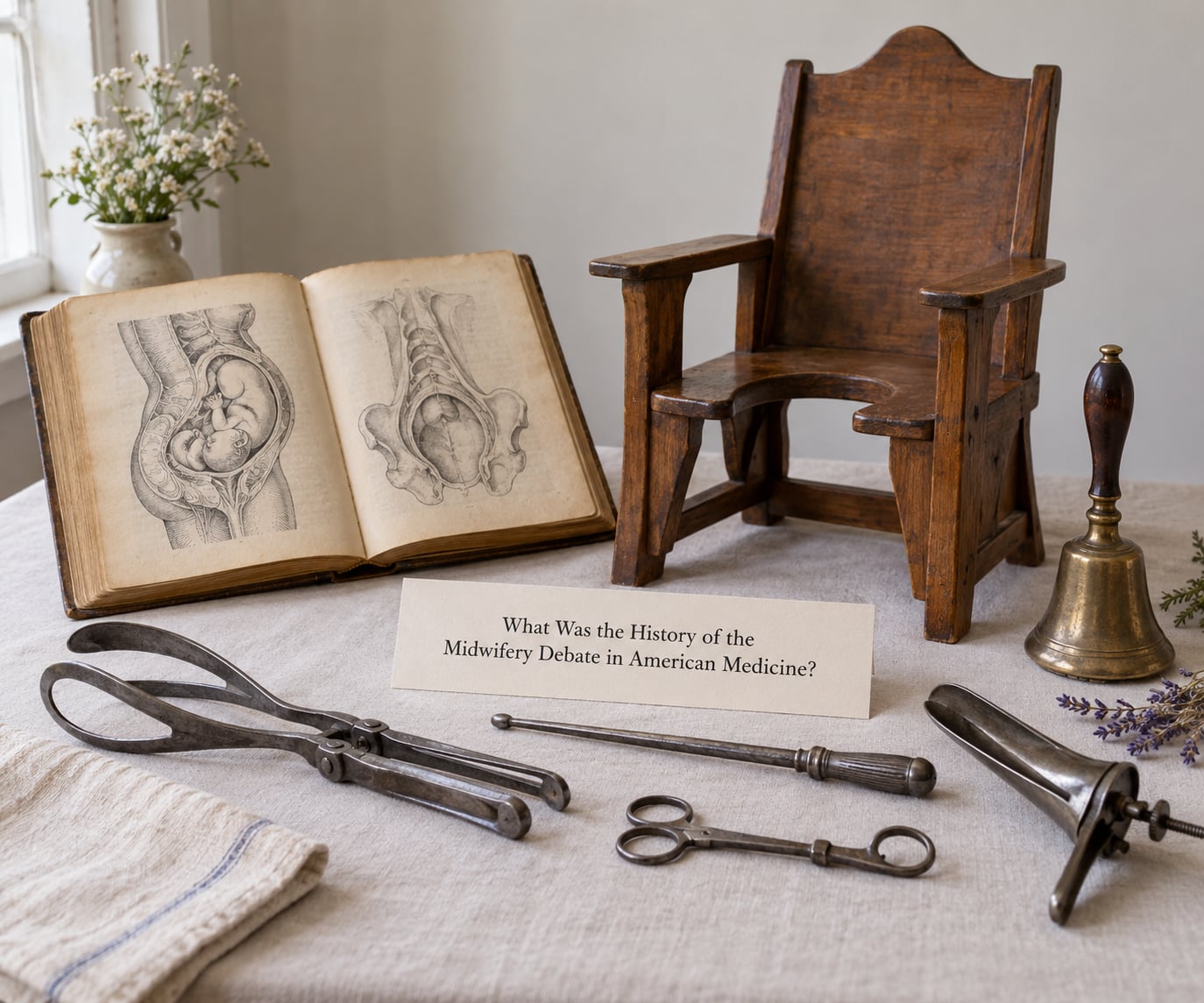
The midwifery debate in American medicine is the recurring conflict over who should attend births, where births should occur, what qualifications providers must hold, and how much independent authority a midwife should have. It unfolded across several overlapping eras — professionalization, regulation, the move to hospital birth, and revival — rather than beginning with any single event.
There is no single moment when the argument started, and no single moment when it ended. It is better understood as one long dispute with different terms in each decade: who may practice, who may be paid, whose knowledge counts as medical, and what a safe place to give birth looks like.
Historians disagree sharply about the motives behind it. Frances E. Kobrin’s 1966 article in the Bulletin of the History of Medicine, “The American Midwife Controversy: A Crisis of Professionalization,” argued that the displacement of midwives was about medical market share and professional status rather than clinical superiority. Kira Beckett, writing in 2005, framed it as a cultural and political struggle fought state law by state law. Both of those readings are contested, and serious scholars who argue that technology and falling mortality genuinely justified the shift still exist. The honest answer is that both things happened, unevenly and in different places.
How Did Midwifery Function in Early American Communities?
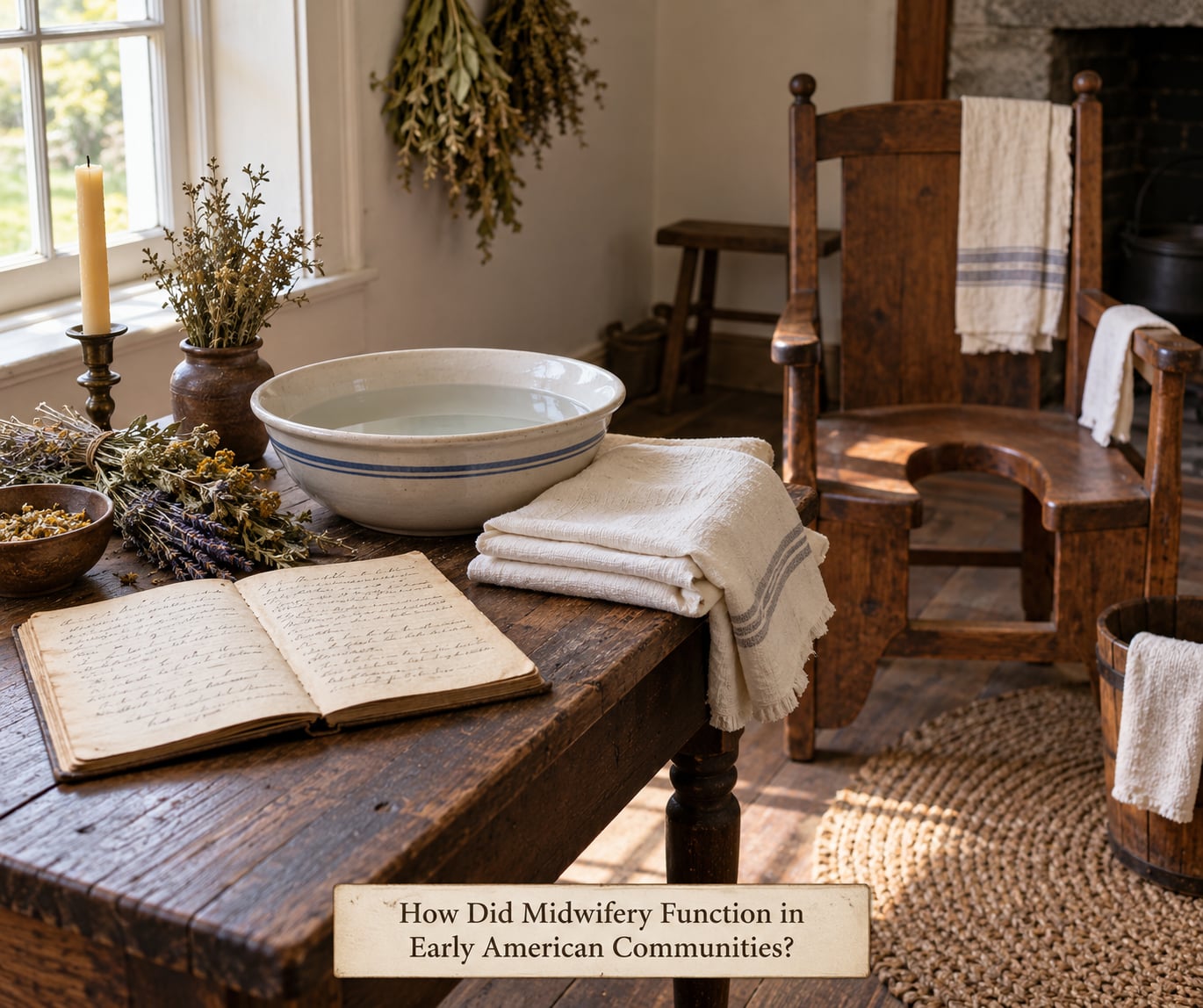
Before hospitals, in most American communities the midwife was not an alternative provider. She was the provider.
Colonial and early national households relied on female lay practitioners whose knowledge passed through families, apprenticeships and community networks rather than through medical schools. The work included catching infants, cutting the cord, managing the placenta, feeding the newborn and, in the harder cases, deciding when a birth could not proceed at home. Midwives also carried the accumulated practical knowledge of women’s reproductive health, including which herbs and remedies had been used to bring on or end a pregnancy.
Their own records show the reality was mixed. Martha Ballard, a Maine midwife whose casebooks survive in number, documented births that went badly alongside competent ones, along with remedies, dosages and blunt judgments about patients who neglected themselves. Historians who work with these records, among them Laurel Thatcher Ulrich in A Midwife’s Tale, generally read them as competent practitioners working without laboratories, antibiotics or a way to call for surgical help once a labor went wrong.
Regulation existed from the start, but it came from town and city authorities rather than from physicians. New York City passed a midwifery regulation in 1731, requiring a midwife to keep birth records in English rather than Dutch and to inform authorities of stillbirths. That is a signal worth reading carefully: colonial officials were regulating what they worried about, which was record-keeping and commercial competition by unlicensed women, not clinical competence.
Courts treated midwives as ordinary participants in household economy. Rex v. Hallowell in 1745 and Commonwealth v. Bangs in 1812 both involve women brought before the courts for pregnancy-related offenses, and in each case the work being examined was the kind of reproductive care that midwives routinely performed. It was ordinary, visible and legal enough to prosecute, which tells you how central it was.
Why Did Physicians Gain Authority Over Childbirth?
Physicians gained authority in childbirth through institutions: medical schools, licensing boards, journals, and finally the hospital.
The first lever was formal education. Through the early nineteenth century, medicine in America was a mixed marketplace — the “Regulars” who had trained in or affiliated with a medical school, and the “Irregulars,” everyone else, which included midwives, herbalists, bonesetters and a large number of doctors without institutional training. In 1847 a group of Regulars founded the American Medical Association, giving the trained minority a national organization, a code of ethics, a lobbying voice and, critically, a claim to speak for medicine as a whole.
The second lever was abortion law, and this is the least understood part of the story. Before the 1860s, American law followed English common law, which defined abortion as a crime only when performed after “quickening,” the felt movement of the fetus, and only when the procedure killed a live infant. Practitioners who induced miscarriage earlier were rarely prosecuted. That narrow legal window had an enormous consequence for midwives, who were the people women actually went to when they wanted to end an early pregnancy.
Connecticut enacted an abortion statute in 1821, and by 1868 roughly 30 of 37 states had statutes restricting or criminalizing the procedure. Once abortion became a crime tied to a medical judgment about gestational age, someone had to make that judgment, and the profession best positioned to do so was the physician. The law created the demand for medical monopoly over reproductive decisions. Midwives, who had supplied those services for a century, were now positioned as providers of an illegal act.
The third lever was the anti-abortion campaign, and Horatio Robinson Storer is the name at its center. Storer, a Boston physician and later a founder of the American Gynecological Society, began a campaign against abortion in the 1850s and pressed the AMA to make it a national organizational priority. The argument that emerged was not about midwifery’s competence in labor. It was that abortion providers were unregulated, that women were being harmed, and that the medical profession had a duty to intervene. The Comstock Act of 1873 extended federal reach against the trade in contraceptive and abortifacient information, and by the turn of the century the moral campaign was fully entangled with the campaign against the midwife.
Now the physicians’ case, which deserves to be stated fairly. Over the same period medicine delivered real advances in childbirth. Antisepsis transformed the risk of infection, anesthesia made operative delivery possible, blood transfusion and later antibiotics changed outcomes for hemorrhage and sepsis, and the trained physician could reach a baby in a way nobody else could. Maternal mortality in this period remained high by modern standards, and the honest historical record is that American women often did better when they had access to trained attendants and hospital care.
The honest complication is timing and setting. The mortality figures that doctors cited were largely collected from hospital populations and poor patients, then compared against midwife care in less complicated cases. Historians who have examined the underlying records, including Beckett and others in the legal scholarship, find the comparisons were not like-for-like.
How Did Regulation Shape the Midwifery Debate?
Regulation is where the debate was actually decided. Licensure did not describe what midwives did; it defined who was allowed to keep doing it.
The campaign from roughly 1880 to 1915 ran state legislature by state legislature, and physicians had a phrase for the problem they intended to solve: the midwife problem. It appears in medical journals, in public-health reports and in the testimony of licensing committees with a regularity that made it one of the most widely used phrases in American medical politics. The argument was that untrained women were delivering babies, that outcomes were poor, and that only the state could fix it by requiring training and supervision.
The method was consistent. Illinois and California fought over proposed midwife bills, and Beckett’s 2005 study shows both outcomes — a licensing bill rejected in committee in Illinois, a midwife-backed proposal to expand autonomy advancing in California. In Chicago, obstetricians pursued a narrower and more effective route. After an 1888 Chicago Times undercover investigation into criminal abortion, they pushed to have midwives classified and supervised as sex-specific practitioners under physician oversight, winning that supervision in stages in 1896, 1908 and 1915.
The abortion evidence did not support the case as neatly as the campaign implied. A New York study of 111 illegal-abortion convictions between 1925 and 1950 found midwives responsible for 22.5 percent of them and physicians for 27.9 percent — physicians were convicted more often than the group being targeted. Supervision had a second effect the campaign may not have anticipated: it made midwifery visible, countable and licensed rather than informal.
The era in one view:
| Era | Who attended most births | Legal status of the midwife | The stated grievance |
|---|---|---|---|
| Colonial to early 1800s | Midwives, household based | Locally regulated, unregulated | Little complaint; regulation came from city authorities |
| 1820s-1860s | Midwives alongside irregulars | Criminalized in part through abortion statutes | Regulars versus Irregulars over who could practice |
| 1870s-1900s | Shifting toward physicians in cities | Target of licensing campaigns | “The midwife problem”; unsupervised abortion |
| 1900s-1930s | Physicians in towns; midwives in rural South | Licensed under physician supervision where licensed at all | Incompetence, unhygienic practice, race and immigration |
| 1930s-1950s | Hospital birth becomes normal | Hospital privileges control practice | Standardization, safety, liability |
| 1970s onward | Split between physician and midwife care | State-by-state autonomy restored for some midwives | Modern disputes over scope of practice and setting |
Two footnotes on that table. “Granny midwife” was largely a medical-journal and newspaper coinage rather than the word communities used for themselves; where it appeared, it usually carried an accusation. And the word “incompetence” in the 1900s-1930s row was doing work that varied sharply by place — in some states it was a clinical judgment, in others it was a way of describing a woman who had no license because the licensing board had just been created.
What Happened to Midwifery in the Twentieth Century?
By mid-century midwifery was functionally gone from American birth care, and the collapse was steeper than the headline numbers suggest.
Share of US births attended by midwives:
| Point in time | Share of all US births | Note |
|---|---|---|
| Around 1900 | Roughly half | Midwives were the default in rural and working-class districts |
| By 1950 | About 5 percent | Still about 25 percent of births among Black and rural women |
| Today | Low single digits overall | Concentrated in a small number of states and systems |
The 5 percent figure is real and it is also the number most often used to flatten the story, because it averages across two very different realities. In the American South, and among Black families in particular, granny midwifery was not displaced by hospital competition. It was dismantled. State licensing regimes required training that cost money the intended population did not have, and where licensing existed, the certificate was granted selectively. When hospitals segregated maternity wards and Black patients were pushed to the back of the queue for prenatal care, community midwifery stopped being competition and became a necessity. That is the part of the decline the national average hides.
The reversal came from an unexpected direction: nursing. Mary Breckinridge’s frontier nursing service brought trained nurse-midwives to rural Kentucky and Eastern Kentucky mountain counties beginning in 1925, deliberately building a service where physicians would not go, and in doing so made a midwife inside a hospital acceptable. Lillian Franck and her colleagues pushed for formal standards and schooling, and the American College of Nurse-Midwives was founded in 1929. By choosing the nursing route rather than independent practice, the new generation of midwives largely accepted the professionalization frame the older generation had fought.
That was a workable settlement for a while. It delivered well-trained clinicians and hospital privileges. It also meant that midwifery in America became a nursing specialty rather than a separate profession, which is a large part of why the United States trains and employs fewer midwives per birth today than most other wealthy countries.
Why Did the Home Birth Movement Resurrect Midwifery?
Independent midwifery came back because a generation of consumers decided that hospital birth had become too interventional and too impersonal, and then they went to the statehouses to build the legal category that would let them choose it.
The 1970s brought two separate movements that are often merged. One was a consumer and feminist movement organized around birth centers, prepared childbirth, natural birth and local control of decisions. The other was a legal one, in which feminist lawyers and midwives drafted state practice acts designed to give midwives independent practice authority rather than physician supervision.
California’s Midwifery Practice Act of 1975 became the template most other states borrowed, because it defined a licensed practitioner with independent authority to manage pregnancy, birth and postpartum care, plus defined consultation and referral relationships with physicians rather than requiring constant supervision. Not every state followed. The pattern Beckett identified held: the bill passed where organized consumers, midwives and sympathetic legislators lined up, and died in committee where the organized physician lobby held the room.
A third credential emerged from the home birth and birth center world: the Certified Professional Midwife, a certification developed for out-of-hospital birth. Roughly twenty states license Certified Professional Midwives directly, and the number has grown slowly, which tells you that the license still depends on political weather rather than clinical consensus.
The motivations inside this movement were not uniform, and treating them as one group flattens it. Some families wanted continuity of care and a familiar person across the pregnancy. Some wanted fewer routine interventions. Some were responding to a hospital system they had experienced as coercive or unsafe, which is a different argument with a different history, and one that maps directly onto the granny midwife experience described above.
How Do Doctors and Midwives View the Debate Today?
The modern dispute is narrower and more technical than the historical one, but the fault lines are the same: scope, liability, setting and who controls the transfer decision.
Physicians tend to emphasize diagnosis, early recognition of complications, operative management and the fact that the hospital is the only place with an OR, blood bank and surgical team. Obstetricians’ sharper objections to midwifery tend to concern scope of practice, whether a midwife should manage a patient whose risk profile is outside the standard category, and the transfer interval when something goes wrong.
Midwives tend to emphasize continuity, prenatal education, physiologic birth, time with the laboring person and a low-intervention default. Their sharper objections tend to concern hospital admission policies, whether a provider can be denied access for no stated reason, and whether autonomy survives in practice when consultation requirements are narrow and consultation is treated as veto power rather than collaboration.
The credentials came out of this history, and confusing them garbles everything above it:
| Credential | Descends from | Formalized | What it authorizes |
|---|---|---|---|
| Lay or community midwife | The colonial household midwife | Never standardized nationally; state licensing largely withdrew in the 1900s | Varies by state, often little formal authority remains |
| Certified nurse-midwife | The 1920s nursing and frontier nursing movement | American College of Nurse-Midwives, 1929 | Licensed independent practice in most states and in hospital settings |
| Certified Professional Midwife | The 1970s home birth and birth center movement | National certification developed in the 1990s and 2000s | Home and birth center birth; direct state licensure in roughly twenty states |
That table also explains a question readers ask constantly. A midwife is not simply a nurse with extra training, and it is not simply a nurse without it: a Certified Professional Midwife typically holds a graduate or undergraduate midwifery credential that does not include nursing licensure, which is why the two are separate rows and why scope questions get confusing fast.
What Evidence Shapes the Modern Midwifery Debate?
No single study settles the argument, because the meaningful comparisons are narrower than the slogans on either side.
The strongest pattern in the research literature is that midwife-led care with continuity of care is associated with lower rates of routine intervention and cesarean birth, particularly in group prenatal care and midwifery continuity models. That evidence is reasonably consistent. What it does not establish is that any midwife-attended birth in any setting is equivalent to any other, because outcomes track selection, setting and emergency capacity rather than the credential alone.
Out-of-hospital birth is the hardest question, and honest answers have to admit the uncertainty. Studies comparing planned home birth with planned hospital birth find comparable outcomes for carefully selected low-risk populations in well-regulated systems, with the consistent condition being written transfer protocols, a functioning relationship with a receiving hospital and rigorous screening. The same studies cannot tell you much about a population that is not low-risk or not well-regulated, which is exactly why both sides cite the same literature and reach opposite conclusions.
Two further confusions travel with this debate. Rural hospital closures and maternity ward shortages get read as evidence about midwifery when they are largely a financing and staffing problem. And the claim that America lags other countries because of clinical evidence does not survive contact with the history above; the licensing structures described here were built by a profession competing for the same market, which is a political explanation, not a clinical one.
If you are making a real decision rather than an academic one, the relevant variables are unglamorous: what is your risk profile, what is the provider’s credential and how often do they transfer, what is the emergency plan, who else will be in the room, and how do you want to be treated if your preferences change. Talk that through with your provider, and treat any warning sign in pregnancy as a reason to call your obstetrician or midwife rather than a reason to manage it yourself.
What Should Readers Take Away From the Historical Debate?
The most useful lesson is that this was never simply a story of doctors being right and midwives being wrong.
Each term in the argument moved. “Safety” meant clean hands and no puerperal fever to a nineteenth-century physician; to a midwife defending her license it meant a woman in an unpaid county hospital with no access to an OR. “Expertise” meant a diploma from an affiliated medical school until the Flexner-era reforms of the early 1900s made training longer, rarer and more exclusive. “Autonomy” meant being left alone with a birth at home before antibiotics and before anyone could call an ambulance quickly.
What changed across eras was not the quality of care on both sides alone but who controlled the entry door. Every stage of the decline tracks a licensing change, a hospital privilege decision or a payment decision, more closely than it tracks a clinical breakthrough. That is the argument of Kobrin, Beckett and the legal scholarship that followed them, and it is the strongest single reading of the evidence, even though some historians still hold that mortality and technology mattered more than those factors claim.
A practical framework survives all of that: ask what credential the person holds, who supervises them, what happens if a complication appears, how often transfer is needed, and whether the setting has the emergency capacity your history suggests you need. Then decide whether the answers match the kind of birth you want. Labels tell you a surprisingly small amount about any of this, which is precisely what 200 years of American history would predict.
Frequently Asked Questions
When did the debate over midwifery begin in American medicine?
There is no single starting date. The dispute has recognizable stages: local regulation of midwives such as New York City’s 1731 ordinance, the founding of the American Medical Association in 1847, the abortion statutes of the 1820s through the 1860s, the licensure campaigns of 1880 to 1915, and the professional recognition of nurse-midwifery in 1929 and after. Historians most often treat the history of the midwifery debate in American medicine as a long professional struggle rather than a single event.
Were midwives common in the United States before hospitals?
Yes. Through the colonial and early national periods, midwives attended the majority of births in most communities, including many urban ones. Their work included delivering the infant, caring for the newborn and supplying the reproductive knowledge women could not get elsewhere. Records kept by midwives such as Martha Ballard show skilled, unsystematic practice in an era with no antibiotics, no laboratory and no way to summon surgical help once a labor went badly.
Why were midwives pushed out of American childbirth?
The main drivers were licensing law, abortion regulation and hospital control of birth rather than a single clinical discovery. From the 1820s to the 1860s, abortion statutes made early pregnancy care a legal question that physicians were best placed to answer. From the 1880s to 1915, state licensing campaigns labeled this the midwife problem and placed practice under physician supervision. Moving birth into the hospital, where admission was controlled by physicians, completed the shift.
How did nurse-midwives and certified midwives become recognized professions?
Two separate paths produced today’s credentials. Nurse-midwifery grew out of the frontier nursing service begun in 1925 and the American College of Nurse-Midwives, founded in 1929, and it built acceptance by staying inside nursing and later the hospital. Certified Professional Midwives came out of the 1970s home birth and birth center movement, and independent authority came from state practice acts such as California’s Midwifery Practice Act of 1975 rather than from a national organization.
Is midwifery safer or more effective than physician-led maternity care?
For carefully selected low-risk pregnancies with continuity of care and a written transfer plan, research shows midwife-led care with fewer routine interventions and comparable outcomes to standard hospital care. Out-of-hospital birth comparisons rely on well-regulated systems and cannot be generalized to high-risk situations. Results depend on selection, setting, emergency preparation and referral access, so the credential alone does not settle the question. Discuss your specific circumstances with your provider.
Can a midwife transfer a patient to a hospital when needed?
Yes. Transfer to a hospital for a complication is a routine, expected part of midwifery practice, and quality programs treat it as a safety feature rather than a failure. What matters is whether there is a written protocol, a receiving agreement with a hospital, clear criteria for who decides, and enough transport and communication to make the interval short. Patients who want out-of-hospital birth should ask any provider for those specifics before choosing them.
Conclusion
If you take one historical point from this, make it the move of birth out of the household and into the regulated institution. Everything that followed — the licensure campaigns, the nurse-midwife compromise, the modern fights over hospital privileges and Certified Professional Midwife licensure — is a downstream consequence of who controlled that door and who was allowed through it.
What to do with the history is not pick a side. If you are choosing care, compare providers and settings on four concrete things: what credential the person holds and who supervises them, how they communicate and whether they listen, what the emergency and transfer plan actually is, and whether the setting fits your risk profile. Ask those questions of every provider you consider, and keep in mind that the labels in this debate have changed meaning more often than the safety of the people giving birth.