
A tongue tie, medically called ankyloglossia, is a condition present at birth where the lingual frenulum, the band of tissue anchoring the tongue to the floor of the mouth, is too short, thick or tight to let the tongue move freely. That restriction can interfere with latch, milk transfer or bottle feeding, though most ties cause no feeding trouble at all.
This is tongue tie and feeding problems explained without the alarm. You will find what a restricted frenulum can actually do, what it often gets blamed for, how a qualified clinician assesses it, and which signs deserve same-week attention rather than a routine appointment.
Newborn ties are common. Studies usually place them somewhere around 3 to 5 percent of babies, and boys are affected more often than girls. The tricky part is not spotting a tie. It is working out whether that tie is the reason your baby is struggling.
Table of Contents
- Tongue Tie and Feeding Problems Explained
- What Is a Tongue Tie?
- Anterior versus posterior tongue ties
- How Can a Tongue Tie Affect Feeding?
- What Signs Suggest a Tongue Tie?
- What Other Issues Can Cause Feeding Problems?
- How Is a Tongue Tie Assessed?
- What Can Parents Do at Home?
- What Are the Warning Signs That Need Prompt Care?
- Frequently Asked Questions
- Does every tongue tie cause feeding problems?
- How is a tongue tie different from a tongue or lip tie?
- Can tongue tie affect bottle-fed babies as well as breastfed babies?
- Does a tongue tie always need surgery or a procedure?
- Is tongue tie linked to autism?
- When should a feeding problem be treated as urgent rather than typical?
- What to Do First
Tongue Tie and Feeding Problems Explained
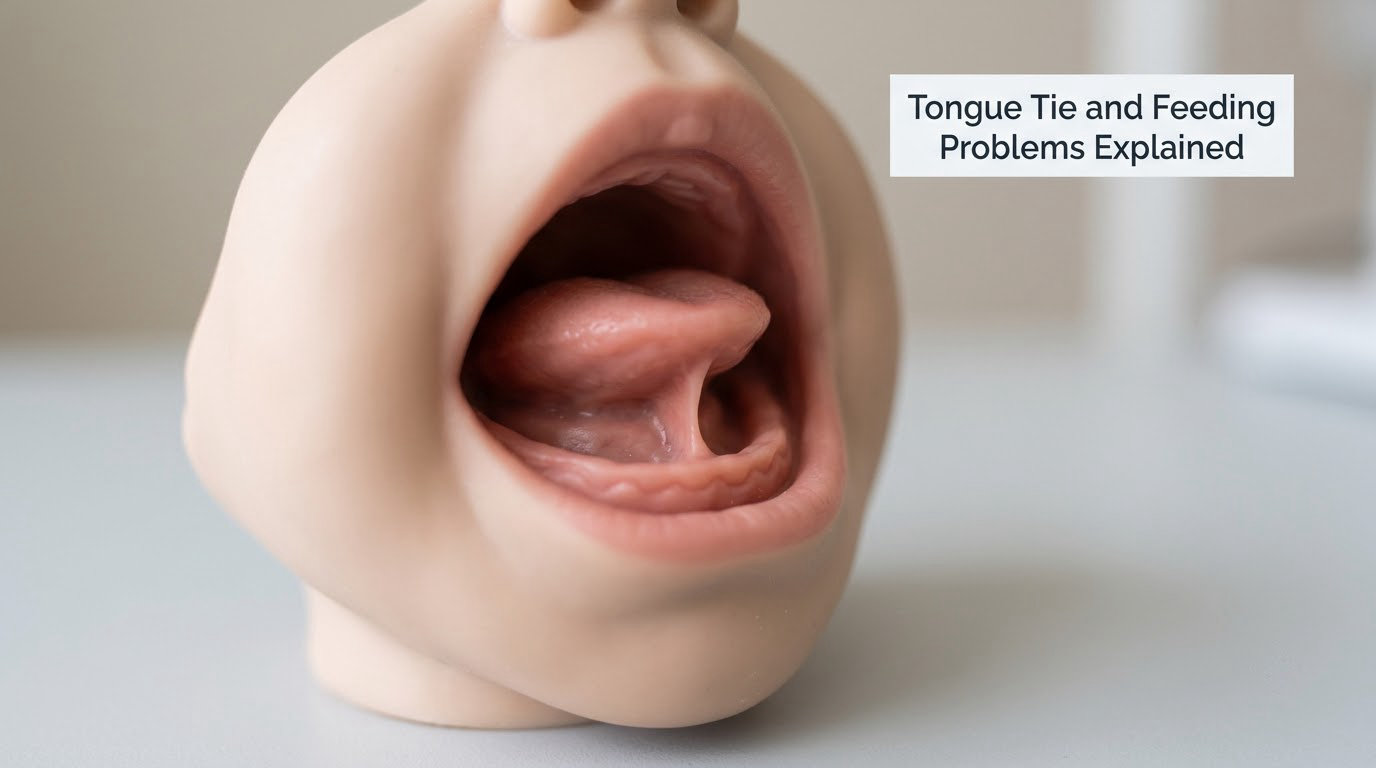
Not every feeding difficulty is a tongue tie. Position, latch technique, milk supply, muscle tone, reflux and prematurity all cause similar-looking symptoms, and several of them can sit alongside a tie rather than behind it.
That honest reframe matters in both directions. Assuming every feeding problem is a tie sends healthy babies through unnecessary procedures. Assuming a confirmed tie is harmless sends a struggling baby another week without help. The goal is a proper assessment, not a verdict from a photo.
What Is a Tongue Tie?
The lingual frenulum is normal anatomy. Every mouth has one, and it anchors the tongue so it does not float loose in the oral cavity. A tongue tie is that same band when it is uncommonly thick, short or tight enough to limit tongue movement.
Clinicians use the umbrella term tethered oral tissues, or TOTs, for restrictions in several places in the mouth. Some describe severity with a grading system, and a Hazelbaker assessment scores how the tongue actually moves and functions rather than how it looks when a baby cries.
Anterior versus posterior tongue ties
An anterior tie sits at or just behind the tip of the tongue. It is easier to see, and a heart-shaped or notched tongue tip during crying is a common clue. A posterior tie sits further back, where the tissue attaches close to the base of the tongue, and often looks completely normal from the outside.
Posterior ties are the ones most often missed at a routine newborn check. A clinician lifting the tongue tip sees nothing unusual, the parent is still describing a baby who cannot stay latched, and everyone leaves the room unsure. If you feel dismissed, ask specifically for an assessment of tongue movement and function, not just a look at the tie.
Appearance also misleads in the other direction. A visibly white, tight band can produce a perfectly functional latch, and a nearly invisible posterior tie can produce a very poor one. The tissue tells you less than the movement does.
How Can a Tongue Tie Affect Feeding?
At the breast, the tongue has three jobs. It extends past the lower gum, cups the breast, and moves in a wave to squeeze milk out. A restricted tongue can do none of those well, so the baby ends up nipple-feeding rather than breast-feeding. It slides off, the latch breaks with a click, and the nipple gets compressed between the hard palate and the tongue instead of being drawn deep into the mouth. Milk transfer drops, feeds drag on, and the parent pays for it in pain.
At the bottle, the job is different but still needs a tongue. The tongue has to sit forward over the nipple, control the flow with its tip, and move the bolus back to swallow. A restricted tongue often lets the nipple slide to the back of the mouth, so the baby gulps, chokes, dribbles milk from the corners, and swallows air. Bottle-fed babies tend to show these signs more clearly than breastfed babies, partly because the flow is easier to watch.
Symptoms vary even between two babies with the same grade of tie. One gains weight beautifully and never notices it. Another struggles from the first feed. Tongue shape, breast shape, nipple size, milk flow, and the baby’s own oral motor skills all change the picture.
What Signs Suggest a Tongue Tie?
Look at what happens during a feed rather than at a photograph of the tongue. Parents usually notice the pattern faster than any single sign.
Signs in your baby:
- Difficulty latching, or latching and slipping off repeatedly
- Clicking, smacking or popping sounds at the breast
- Tongue that cannot extend past the lower lip, or cannot lift toward the roof of the mouth
- A notched or heart-shaped tongue tip when the baby cries or lifts it
- Feeds lasting a long time followed by signs of hunger
- Milk dribbling from the corners of the mouth, coughing, or gulping air during bottle feeds
- Frequent gas, fussiness or reflux-type symptoms
- Wet diapers that stay light and weight gain that stalls
- Trouble moving food around the mouth when solids begin
Signs in a breastfeeding parent:
- Nipple pain that starts in the first minute or two of the latch and does not ease once feeding settles
- Nipples that look flattened or compressed right after a feed
- Cracking, bleeding or open wounds that keep reopening
- Feeling that the baby is chewing rather than sucking
- Blocked ducts or mastitis, and supply that begins to drop
Nipple pain is the most under-served part of this picture. Persistent pain is one of the strongest reasons mothers stop breastfeeding, and it deserves to be taken seriously on its own, whether or not a tie turns out to be involved.
None of this is a diagnosis. A symptom list is a reason to book an assessment, not a way to rule anything in or out from the sofa at 2 a.m.
What Other Issues Can Cause Feeding Problems?
Most feeding problems are not caused by a tongue tie. These are the explanations that come up again and again, and several can hold hands with a real tie at the same time.
- Positioning. If the baby is not held close enough, upright enough, or with the head free to tilt back slightly, the tongue cannot reach a good position no matter how mobile it is.
- Latch technique. A shallow latch that the baby can maintain often looks like a tongue problem. This one is usually solved in a single visit with a lactation consultant.
- Oral anatomy. A high or very flat palate, a large tongue in a small mouth, or a short upper lip can limit the seal just as effectively as a tight frenulum.
- Tone and neck tightness. Babies with low muscle tone or a tight neck often arch, cannot hold the head in a feeding position, or clamp down. Torticollis is worth mentioning to a clinician.
- Prematurity and illness. A premature baby, a baby with a cleft palate, macroglossia, or a baby who is simply unwell will feed poorly for reasons no release can fix.
- Reflux, sleep and nasal congestion. Reflux pain, frequent sleep fragmentation and a blocked nose all interfere with feeding, and all look a lot like a latch problem from the outside.
- Milk supply. When supply is low, babies latch, stay briefly and come off unsatisfied, which is often misread as a tie.
- Bottle flow. A fast-flow teat, a vented bottle held at the wrong angle, or propping a bottle instead of holding it produces choking and gas. Nipple shield, teat and slow-flow strategies do more here than a procedure.
- Neurodevelopmental difference. In the first months this is hard to separate, but an unusually hard time feeding alongside other differences in tone, alertness or responsiveness deserves a developmental assessment rather than a repeat latch appointment.
Parents in breastfeeding forums describe this pattern constantly: a confirmed tie plus poor weight gain, but several contributing factors at once. Successful stories usually pair a release with positioning work and latch support rather than the procedure alone.
How Is a Tongue Tie Assessed?
A proper assessment is about function. The clinician watches a feed, watches the baby move its tongue, and checks weight and hydration. A tongue that looks tight while crying tells them very little on its own.
Who does what:
- Pediatrician checks growth, hydration and the baby’s overall health, and can refer onward.
- IBCLC (international board certified lactation consultant) assesses latch, positioning and milk transfer at the breast or bottle, which is often the most informative first visit.
- Pediatrician or ENT judges anatomy and decides whether a release is warranted, and performs a frenotomy when appropriate.
- Pediatric dentist evaluates and releases ties, including many posterior ones, and is a common route for families who want a provider focused on oral function.
- Oral motor therapist works on tongue movement, suck and swallow skills, usually alongside rather than instead of a release.
Weight and hydration are the numbers that matter most. Wet diapers, output over 24 hours and the growth curve tell you whether feeding is actually working, and they are what a clinician will look at before agreeing to any procedure.
Questions worth asking before a release is discussed: What exactly is restricted, and how? How many feeds have you observed? What is the weight trend? What happens if we wait four weeks? Is a release likely to change feeding, and what if it does not? Are you assessing this as a question about how the tongue functions, or about how it looks?
What Can Parents Do at Home?
Low-risk changes often resolve feeding problems on their own, and they are worth trying before anything irreversible.
For breastfeeding, bring the baby close with the shoulders above the hips and the head free to extend slightly, and try a football hold or a laid-back hold if the standard cradle position is a fight. A nipple shield can sometimes bridge a shallow latch while the technique is retrained. Feed responsively rather than on a schedule that forces your baby to catch up.
For bottle feeding, hold your baby rather than propping the bottle, use paced feeding with breaks built in, try a slower flow teat, and pause often so your baby can set the pace and swallow properly.
Protecting supply while you wait is worth real effort. Pump to replace any feed where transfer is poor, so your body keeps receiving the removal signal and you are not building a supply problem on top of a latch problem.
What not to do: no forceful tongue stretching, no deep suction, no cutting the tie at home, and no scraping or prodding the wound after a release. Aggressive stretching in the first days can cause exactly the re-attachment families end up back in clinic for. If you are unsure whether a stretch is gentle, ask to watch a clinician do it once first.
What Are the Warning Signs That Need Prompt Care?
Most feeding wobbles are not emergencies. A few things are.
Contact your pediatrician the same day if your baby is feeding poorly and has noticeably fewer wet diapers, has dry mouth or fewer wet nappies than expected for 24 hours, is feeding for a very short time and staying hungry, has worsening jaundice, or is unusually sleepy, floppy or hard to rouse. Poor weight gain across two or more weigh-ins deserves a conversation even when the baby otherwise looks well.
Go to urgent or emergency care now for breathing difficulty, pauses in breathing, blue or very pale colour, a weak or high-pitched cry, a baby who is difficult to wake, or a seizure. Repeated choking or coughing during feeds, and any sign a baby is not taking fluids at all, need prompt medical assessment rather than another feeding-technique try.
Feeding through cracked, bleeding nipples also needs medical care, and so does mastitis with fever. Pain that lasts beyond the first few seconds of a latch is a clinical problem, not a rite of passage.
Frequently Asked Questions
Does every tongue tie cause feeding problems?
No. Most infants with ankyloglossia feed comfortably and gain weight normally without any intervention. Studies trying to predict which ties matter have been inconsistent, and expert bodies note that a visible tie alone is a poor predictor of feeding difficulty. A tie becomes relevant when tongue movement is restricted and an assessment connects that restriction to your baby’s actual latch, transfer or weight gain.
How is a tongue tie different from a tongue or lip tie?
They are all tethered oral tissues, but in different places. A lingual or tongue tie anchors the tongue to the floor of the mouth and limits tongue movement. A lip tie involves the tissue between the upper lip and gum, which can pull the lip inward and affect a seal at the breast. A labial tie rarely interferes with bottle feeding, and evidence for releasing one to improve feeding is much weaker than for tongue ties.
Can tongue tie affect bottle-fed babies as well as breastfed babies?
Yes. A restricted tongue still has to hold a teat forward and control flow, so bottle-fed babies may click, cough, choke, dribble milk from the corners of the mouth and swallow a lot of air. The signs are often easier to spot with a bottle because the flow is visible. Bottle-fed babies also tend to show improvement sooner after a release, because the change in flow control takes effect quickly.
Does a tongue tie always need surgery or a procedure?
No. Observation is a reasonable approach when the baby is gaining weight and feeding is not painful, since frenulum tissue stretches with growth and mild ties often cause no problem at all. A release, usually a simple frenotomy, is more likely to be advised when restricted movement is clearly limiting latch or milk transfer and the baby or the parent is struggling. The decision should follow an assessment, not a photograph.
Is tongue tie linked to autism?
There is no established causal link. No good-quality research shows that releasing a tongue tie prevents, treats or is associated with autism, and major pediatric bodies have addressed this claim directly. A tongue tie is a common finding, and common findings turn up in babies with and without neurodevelopmental differences. If you have concerns about your baby’s development, developmental screening is far more useful than a tie release.
When should a feeding problem be treated as urgent rather than typical?
Treat it as urgent if your baby is struggling to breathe, pauses while breathing, changes colour, has a weak cry, is hard to wake, or stops taking fluids entirely. Those need emergency care. Same-day contact with your pediatrician is appropriate for noticeably fewer wet diapers, dry mouth, ongoing hunger after short feeds, worsening jaundice or marked sleepiness. Steady weight gain and comfortable feeds are not urgent, even when they are frustrating.
What to Do First
Start by writing down what a normal feed looks like for your baby and what the difficult ones look like, including feed length, latch attempts, sounds, and how your nipples look afterwards. Note wet diapers and how often your baby seems satisfied. Then call your pediatrician with those specifics rather than with the word tongue tie.
Ask for an assessment of feeding itself, and request a visit with a board certified lactation consultant if latch or transfer is the problem. Weight and hydration tell you how urgent this is; a photograph of a tongue tells you very little.
None of this is a verdict on you or your baby. Feeding difficulty is common, it is fixable, and the people who do it every day are the right people to sort out which cause you are actually dealing with.