
Nervous is normal. Most people rehearse how to talk to their employer about pumping breaks for weeks, and nearly all of that anxiety comes down to a single fear: that asking will mark you as unprofessional. The opposite is closer to the truth. Pumping time is a legal right rather than a favor, and the conversation goes best when it is brief, specific and written down.
Here is the short version of the law. The PUMP for Nursing Mothers Act, part of the Fair Labor Standards Act (FLSA), provides up to 30 minutes of break time, up to three times in an eight-hour shift, for up to one year after birth, in a space that is shielded from view, free from intrusion, and not a bathroom. Federal law does not require that time to be paid, and it prohibits retaliation for requesting or using it.
What follows is the whole conversation: what to gather beforehand, a script you can say out loud today, a copy-and-adapt email, and what to do when the answer is yes but nothing changes. If you need to know the plan before you need the script, start with the step-by-step section.
| Part of the right | Federal minimum (FLSA / PUMP Act) | Check your state, because many go further |
|---|---|---|
| Length of each session | Up to 30 minutes | Some states allow longer sessions |
| Sessions per shift | Up to 3 in an 8-hour shift | Some states require more frequent breaks |
| How long it lasts | Up to 1 year after birth | Some states extend the coverage window |
| The space | Shielded from view, free from intrusion, never a bathroom | Some states spell out stricter space rules |
| Pay | Not required federally | Several states require paid pumping time |
| Retaliation | Prohibited for requesting or using break time | State remedies may be available as well |
| Who is covered | Most employees, with exemptions for some categories of work | State law can cover workers the federal law exempts |
State rules change and are not uniform, so verify your own state’s position with your state labor department rather than assuming the federal minimum is the ceiling.
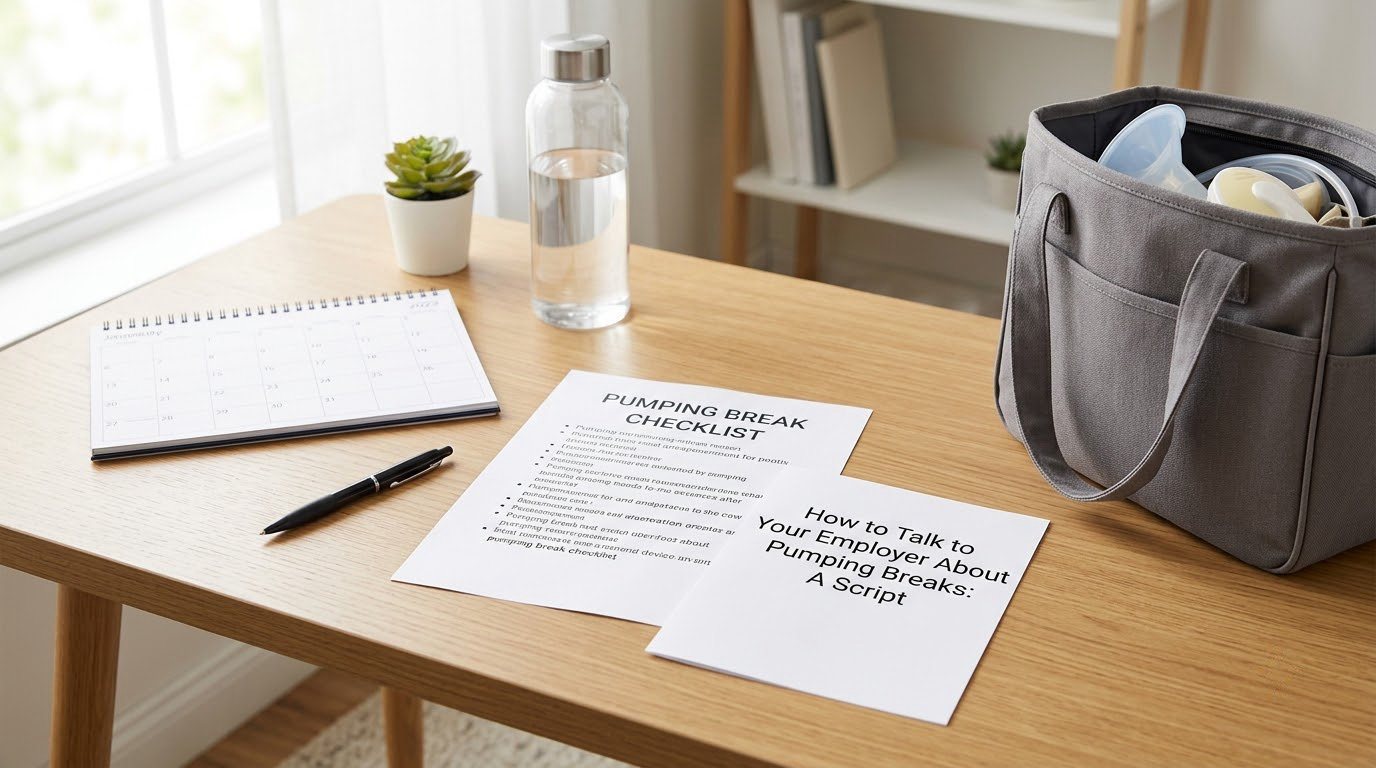
Table of Contents
- What You Need Before the Conversation
- Step-by-Step: How to Talk to Your Employer About Pumping Breaks
- Choose the Right Time and Setting
- Start With the Practical Need
- How to Talk to Your Employer About Pumping Breaks: The Script
- Ask Questions and Listen for a Solution
- Confirm the Plan in Writing
- Address Delays or a Denied Request
- Test the Plan and Make Adjustments
- Common Mistakes to Avoid
- Quick Tips for a Productive Conversation
- Frequently Asked Questions
- Are pumping breaks required for every US employee?
- How many pumping breaks can I request each day?
- Can my employer require me to pump in a shared space?
- Are pumping breaks paid, and do state rules add protections?
- Should I email my manager or contact HR first?
- What should I do if my employer keeps delaying pumping breaks?
- Conclusion: Send the Request, Then Follow Up in Writing
What You Need Before the Conversation
Preparation takes about fifteen minutes and it does most of the work. You are not building a case. You are arriving with a schedule, a location and a piece of paper, so nobody has to improvise in front of you.
- Your dates. Your due date, your actual return-to-work date, and how many weeks out that is. Starting two weeks before you return is the sweet spot: early enough to arrange a room, late enough that the request is about a real schedule rather than a maybe.
- Your employer’s existing policy. Search the handbook, the intranet and your onboarding emails for “lactation,” “pumping” or “breastfeeding.” Some employers already have a policy and a room, and nobody has told the managers about it.
- Your two contacts. HR owns the formal accommodation, the space and the written policy. Your manager owns the day-to-day schedule and coverage. In a small business those may be the same person, and that is fine.
- Your medical picture. How often you need to pump, roughly how long each session takes including setup, packing and cleaning parts, and whether you are exclusively pumping. If you have notes from an IBCLC, midwife or obstetrician, keep them handy; HR may ask for documentation and it is easier to supply it the first time.
- Your practical asks. Number of sessions, length of each, a location, fridge access for expressed milk, and what happens if the room is occupied when you arrive.
- A backup. A second pump, a hand expression kit, or simply a plan for what you do on days when the space is double-booked. Knowing your backup keeps you from negotiating from panic.
- A one-page outline. Even a few bullet points on your phone. You will not need them, and that is the point.
Step-by-Step: How to Talk to Your Employer About Pumping Breaks

Choose the Right Time and Setting
Ask for a scheduled meeting rather than catching your manager in a hallway. Ten minutes, private, and not at 4:45 on a Friday. If the request involves a room, a policy or a document, send the written request to HR first and copy your manager, so the formal part is on record before the schedule talk happens.
In person works best when your manager already trusts you. Video is fine. Writing is fine and often better, because it gives your manager something to approve rather than a problem to solve while you watch.
Start With the Practical Need
Open with logistics, not with feelings or medical detail. You do not owe your employer a diagnosis, a story about your delivery, or a description of your supply. You are requesting time and space to do something ordinary.
A workable opening sounds like this: “I am coming back on the fourth, and I will need to pump a few times a day starting that week. I have put together a schedule that fits our coverage. Can we look at it together for fifteen minutes?”
People are much more receptive to a request that arrives with a solution attached. Managers are not being asked to solve a mystery; they are being asked to approve a plan.
How to Talk to Your Employer About Pumping Breaks: The Script
Say it out loud once before the meeting. I have found that people who rehearse the first thirty seconds are the ones who stay calm through the rest.
“I am back on the fourth and I am going to be pumping while I am here. Under the PUMP Act, nursing employees get up to 30 minutes, up to three times a shift, for the first year, in a private space that is not a bathroom. I have a schedule drafted that keeps coverage in place, and I would like to start the conversation about the room and the fridge.”
Then stop talking. Most managers say something in the first few seconds after that, and it is usually logistical rather than hostile.
If you want a version to send ahead of the meeting instead of saying aloud, this template works and is the most requested thing in the parent communities I read. Adapt the bracketed parts, then send it as a PDF so the schedule is attached:
Subject: Pumping accommodations request ahead of my return on [date]
Hi [HR contact and manager name],
I am returning to work on [date] after parental leave and expect to be pumping regularly while I am working. I am writing now so we can have a workable arrangement in place from day one rather than sorting it out in week two.
What I am requesting: up to [three] sessions of up to 30 minutes per eight-hour shift, roughly every three hours, starting [date]. My proposed times are [times]. Each session includes setup, pumping, cleaning and storing, so 30 minutes covers the whole task.
On space, I understand [room] is designated for lactation use. If it is ever occupied, please let me know and I will use [backup location] so nothing is left uncovered.
Could you confirm in writing the room, the schedule and whether the time is paid? I am also happy to share documentation from my provider if that is useful.
Thank you,[your name]
For a very small employer with no HR function, keep the same content and drop the request for written policy. Ask only for a written confirmation of the schedule and the location. For an hourly or shift worker, adapt it by naming the exact window on the shift and who covers it, since coverage is the part a small team worries about most.
Ask Questions and Listen for a Solution
Turn the conversation into a set of four concrete questions. Managers answer questions far more easily than they resolve open-ended requests.
- Which space may I use, and how do I reserve it when someone else is in there?
- Where can expressed milk be stored, and is there a fridge I can label?
- Who covers my work during a session, and what happens if coverage falls through on a busy day?
- How often will we review whether this is working?
Then listen more than you talk. A manager who says “I am not sure we have a room” is giving you information, not a refusal. That is the moment to ask what would make it possible, and to raise your backup location.
If you are offered a shared or multi-user room, ask specifically whether it has a working lock and a solid door with no window. That is the arrangement most commonly treated as meeting the standard of being shielded from view and free from intrusion, and you can ask HR to confirm the room in writing rather than settling for a guess.
Confirm the Plan in Writing
This is the step that protects you, and it is the one people skip. Within a day of the meeting, send a short neutral summary that includes every element you agreed on: number of sessions, length of each, start date, location, fridge access, who covers you, what happens when the room is occupied, and when you will review it together.
Subject: Confirming our pumping schedule from [date]
Hi [name],
Thank you for the time earlier. Here is what I heard so we have it in the same place: [three] sessions of up to 30 minutes, at approximately [times], starting [date], in [room], with milk stored in [fridge], and [name] covering while I am out. If the room is in use, I will use [backup]. We will check in on [date] and adjust if needed.
Let me know if I have any of that wrong.
Notice the tone. You are confirming, not accusing, and the last line invites correction rather than picking a fight. That framing is what keeps the relationship intact while still creating a record.
Address Delays or a Denied Request
If the answer is no, or the answer is a series of maybes, keep the same factual tone. You are not escalating emotionally; you are moving one step along a short ladder.
- Written follow-up with a date. Restate the request in writing and ask for a decision by a specific date. “Could you let me know by Friday whether we can do this?” is a reasonable question.
- Take it to HR formally. Send the accommodation request to HR as an accommodation rather than a scheduling question, and reference the FLSA and the PUMP for Nursing Mothers Act by name.
- Check your state rules. Ask your state labor department what your state requires, because several states go beyond the federal minimum on frequency, duration or pay.
- Get individualized help. A local legal aid clinic, a state labor agency or a nursing-parent group in your area can tell you what applies where you live. This is general information, not legal advice, and local rules are the part that actually decides your case.
On the pushback that comes up most often, which is being told to pump during your existing lunch or rest break: it is worth having a calm answer ready. A single 30-minute lunch is not three separate 30-minute pumping sessions with travel, setup and cleaning, and federal law counts pumping break time separately from meal periods. You can say that plainly and then ask what they would like to propose instead.
On the “unprofessional” comment, which comes up often enough to be worth a prepared answer. If someone frames the request as a favor or questions your commitment, restate the ask as a scheduling question with a schedule attached, copy HR, and keep the tone flat. A legal right is not something you should be grateful for, and retaliation for requesting or using break time is exactly what federal law prohibits.
Keep a simple log while all of this is happening: date, planned times, actual times, what happened, who you emailed. It takes two minutes a day and it is the difference between a memory and a pattern if you ever need to show someone the pattern.
Test the Plan and Make Adjustments
Treat the first two weeks as a trial run and review them out loud. Many problems are logistical rather than legal, and most are easy to fix early: a schedule that collides with a standing meeting, a fridge that is full, a room that is booked every Tuesday.
Ask for the revision early and in the same neutral tone. “The 10 a.m. slot keeps colliding with the team check-in, can we move it to 10:30?” is a much easier conversation than the one that happens in week six when your supply has already started to drop.
One more practical note for remote and hybrid workers. The same standard of a private, shielded space applies to a home setup, so a room other than a bathroom where you can close the door and be left alone is the baseline. Turning your camera off during a session is a reasonable workplace norm rather than a federal requirement, so put it in writing as a team expectation if you need it.
Common Mistakes to Avoid
Almost every difficult pumping-break conversation that I read about went sideways for one of these reasons, and each one is easy to fix.
- Waiting too long. Asking on your first day back means you have no room, no fridge and no agreed schedule, and every adjustment costs you a session. Start one to two weeks out.
- Relying on the conversation alone. A verbal yes with no written record is very hard to act on later. Send the summary the same day.
- Making claims you have not verified. Do not tell an employer that a specific state statute requires something you have not read. Say what federal law covers, then ask HR to confirm the state position. Overreaching once damages your credibility for the rest of the discussion.
- Assuming every worker is protected the same way. Federal exemptions for certain categories of work mean some colleagues are outside the FLSA, while state law may still cover them. If your job falls in a grey area, that is a question for a labor agency or legal aid rather than for a forum.
- Letting missed breaks pile up silently. A pattern of skipped sessions is harder to fix than a single flagged one. Log it and raise it the first week it happens rather than the fourth month.
- Skipping HR entirely. Your manager controls the calendar. HR controls the policy, the space and the record. Loop in both, in that order of ownership, and copy them on the same thread.
- Blaming your manager in the first email. The escalation ladder only works if each step above it is clean. Facts, dates, requests.
Quick Tips for a Productive Conversation
Keep the meeting short and end it with two or three specific decisions rather than a general agreement. Write down the time you will review the plan, and put that review in your calendar before you leave the room.
Use neutral language about your own plans rather than about other people’s behavior. “I need three sessions” carries further than “people keep interrupting me.” If coverage is the real worry, name it and offer a solution, since a manager who feels responsible for a gap will find a way to cover it or ask for a change they can actually plan around.
Do not rehearse the emotional part. Rehearse the logistics. The feelings tend to show up anyway, usually around week two of a return when your supply is changing, and having a written plan in your inbox is what makes that week survivable.
Frequently Asked Questions
Are pumping breaks required for every US employee?
Not every worker, because pumping time comes from the Fair Labor Standards Act, which has exemptions. Some agricultural workers, certain executives and certain public-sector employees fall outside FLSA coverage. Hourly workers who are not exempt are generally covered. State law can extend protection to people the federal law skips, so check with your state labor department or a legal aid clinic for your situation.
How many pumping breaks can I request each day?
Up to 30 minutes of break time, up to three times in an eight-hour shift, for up to one year after birth. In practice most nursing parents aim for roughly every three hours to hold supply, which often means using the full three sessions. Some states allow more frequent or longer breaks, so your state rules may set a higher floor than federal law does.
Can my employer require me to pump in a shared space?
The space must be shielded from view and free from intrusion, and it cannot be a bathroom. If the only option is a multi-user room, ask specifically whether it has a working lock, a solid door and no window, and ask HR to confirm the room in writing. Federal rules do not describe a single room design, which is why a written confirmation matters.
Are pumping breaks paid, and do state rules add protections?
Federal law does not require pumping break time to be paid, and an employer may treat it as unpaid or offset it against other time. Several states require paid pumping time and allow more frequent or longer breaks. Ask HR directly whether the time is paid for your arrangement, and verify your state’s position with your state labor department, since those rules change.
Should I email my manager or contact HR first?
Do both, aimed at different things. Send HR the formal accommodation request covering policy, space and documentation, and tell your manager the schedule you have drafted. In a small business where there is no HR function, start with your manager but always send the follow-up summary by email so a written record exists.
What should I do if my employer keeps delaying pumping breaks?
Move one step at a time. Send a written follow-up asking for a decision by a specific date, then take the request to HR as a formal accommodation citing the FLSA and the PUMP for Nursing Mothers Act. Keep a simple log of planned and missed sessions. After that, check your state rules and get individualized help from a state labor agency or a local legal aid clinic.
Conclusion: Send the Request, Then Follow Up in Writing
The first thing to do is small. Put your return-to-work date on a calendar, draft three sessions into your day, and send the accommodation request to HR with your manager copied. Then book the fifteen-minute conversation, say the script out loud once beforehand, and send the written summary the same day you meet.
Everything after that is follow-up, and follow-up is where this stops being a favor and starts being a right.