The United States has no federal paid parental leave. What you get is a stack of up to four separate layers: unpaid but job-protected leave under the Family and Medical Leave Act, a state paid family leave program in some states, short-term disability benefits that usually cover only the birthing parent, and whatever your employer chooses to add on top.
Only the first of those is a legal entitlement, and it pays nothing. That single fact explains most of the confusion people run into when they try to plan a leave. Last reviewed October 2026. This is general information, not legal advice.
Table of Contents
- What Is Parental Leave in the United States?
- How Much Parental Leave Is Available?
- What Does the Federal FMLA Provide?
- Who is eligible for FMLA?
- What counts as a qualifying reason?
- How Does State and Paid Leave Work?
- Can You Take Parental Leave for Adoption or Child Placement?
- How Much of Parental Leave Is Paid?
- How Do You Request Parental Leave?
- What Job Protections Apply During Leave?
- Can You Split, Interrupt, or Combine Parental Leave?
- What Happens When You Return to Work?
- Parental Leave Rules by Situation: A Quick Comparison
- Frequently Asked Questions
- Is parental leave mandatory in the United States?
- Do all US employees qualify for parental leave?
- Can parental leave be paid?
- Can an employer require an employee to use paid leave first?
- What if the employee lives in one state and works in another?
- How much notice should an expectant parent give an employer?
- The Short Version
What Is Parental Leave in the United States?
Parental leave is time off work to bond with and care for a new child, whether that child arrives through birth, adoption, or foster placement. In the US it is a category rather than a single benefit, and the word gets used loosely in ways that cause real problems at the HR desk.
| Term | What it means | Who it covers |
|---|---|---|
| Parental leave | Any leave taken to care for a new child | Birth, adoptive, and foster parents |
| Maternity leave | Leave tied to pregnancy, birth, and recovery | Pregnant and birthing parents |
| Paternity leave | Leave taken by the non-birthing parent | Partners and second parents |
| Bonding leave | Leave specifically to care for and bond with a new child | Either parent, either kind of arrival |
| Family and medical leave | The federal and state category that includes parental leave plus medical and caregiving leave | Eligible employees of covered employers |
| Pregnancy disability leave | Medical leave for pregnancy or childbirth complications | The pregnant or birthing parent only |
The distinction matters because short-term disability pays out for the pregnancy layer but not the bonding layer. A partner can draw bonding leave and cannot draw the birthing parent’s disability benefit for the same weeks.
How Much Parental Leave Is Available?
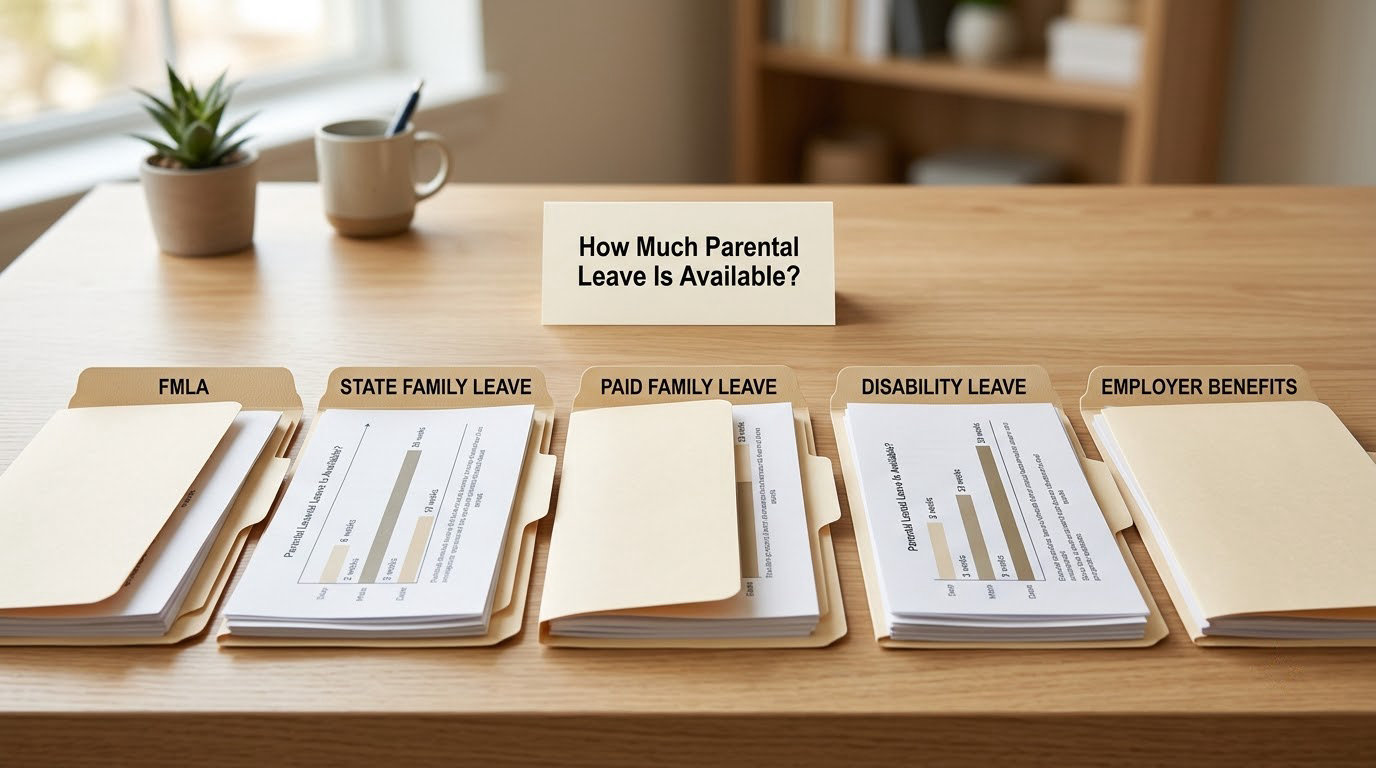
Most US parents land somewhere between eight and sixteen weeks once the layers are combined. Here is how the four fit together as of 2026.
| Layer | Typical amount | Paid? | Job protected? | How you claim it |
|---|---|---|---|---|
| FMLA | Up to 12 weeks in a 12-month period | No | Yes | Employer forms and certification |
| State paid family leave | Up to 12 weeks for a birth parent, often more for the primary caregiver, depending on the state | Partly, as a share of prior wages | Usually, in states with a program | Apply to the state agency, often before the due date |
| Short-term disability | Roughly 6 to 8 weeks for a vaginal birth, more after a cesarean or a complicated delivery | Yes, subject to the policy cap | Not on its own | Claim with the disability carrier or employer |
| Employer policy and PTO | Anything from zero to 20 weeks | Only if the employer pays | Usually yes for the paid portion | Company handbook and HR |
The order matters. Disability benefits usually run first because they apply only to the medical recovery window, and FMLA bonding time sits on top. A parent in a state program might use six weeks of state benefit, six weeks of PTO, and leave two weeks unused.
What Does the Federal FMLA Provide?
The Family and Medical Leave Act gives eligible employees up to 12 weeks of unpaid, job-protected leave in any 12-month period. The U.S. Department of Labor administers it, and the same 12 weeks cover birth, bonding, a serious family illness, military caregiver needs, and certain medical leave for the employee.
Who is eligible for FMLA?
Three separate tests have to line up, and a person can fail any one of them.
- The employer test. The employer must be a public agency, a public school, or a private employer with 50 or more employees within 75 miles of the worksite. Under the current administration, the Department of Labor has narrowed who counts as an employee for coverage purposes, so telemployees and contingent workers may not add to that headcount.
- The tenure test. The employee must have worked for the employer for at least 12 months.
- The hours test. The employee must have logged at least 1,250 hours of service in the 12 months before leave starts.
The tenure test is where people get caught. A due date of August 29 with eligibility starting September 26 does not qualify, and that exact near-miss keeps showing up on working-moms message boards. If your due date lands within weeks of your anniversary, ask HR now rather than after delivery.
What counts as a qualifying reason?
Bonding with a newborn, an adopted child, or a child placed in foster care all qualify. So do prenatal care, a serious pregnancy complication, and recovery after birth. Note that bonding leave caps at 12 weeks total regardless of how many children arrive.
Military caregiver leave runs up to 26 weeks under a separate calculation. Because 2026 brought a shortened federal court decision window for certain FMLA cases, anyone with a live dispute should check current court timelines rather than relying on older summaries.
How Does State and Paid Leave Work?
State programs are where parental leave in the US actually starts to look paid. Each one sets its own benefit percentage, weekly cap, waiting period, and job-protection rule, and the details change as new programs launch. Roughly a third of states now run a paid program.
The pattern is consistent enough to be useful. Washington, California, Massachusetts, Connecticut, Colorado, Oregon, New York, New Jersey, and Rhode Island were the early programs, with Delaware, Maine, Minnesota, and Maryland joining as their 2026 effective dates arrived.
Two mechanics trip people up. First, most programs pay a percentage of your prior wages up to a weekly maximum, so a high earner is replaced at a lower effective rate. Second, many programs have a waiting period of one to seven days before benefits begin, which means you file in advance rather than after the baby comes.
Because these details move, verify yours at your state agency rather than trusting any chart, including this one. Search your state’s name plus paid family leave and go to the government agency directly.
Can You Take Parental Leave for Adoption or Child Placement?
Yes. FMLA bonding leave covers a child placed in your care through adoption or foster placement, and most state paid family leave programs cover the same events with the same waiting-period rules.
The paperwork differs by arrangement. For a private adoption you generally certify the placement date and that the child is in your custody, and a private agency may ask for documentation. For a foster placement through an agency, you provide the agency’s placement paperwork. For a kinship or informal arrangement, the documentation is murkier and the rules differ by state.
Surrogacy sits somewhere in between. A gestational surrogate’s own recovery is medical leave for her, while the intended parents can generally use FMLA bonding leave once the child is placed with them.
How Much of Parental Leave Is Paid?
Less than most people expect. The honest answer is that the FMLA itself pays nothing, and parental leave in the US is paid only if one of the other three layers kicks in.
Short-term disability is the most widely used pay source in the country because most employers offer it and roughly half of private-sector workers are covered. It pays a percentage of your salary up to a weekly cap, and it typically pays out for six to eight weeks around a vaginal birth. One parent on a birth-month forum described the familiar pattern: disability covers the early recovery, then vacation and sick time cover the rest of the planned 12 weeks.
State benefits add a second income stream, but only in states that have them and only up to a percentage of wages. Employer policy is the wildcard: some companies pay full wage for a set number of weeks, many pay nothing, and a top-up that covers the gap between your state benefit and your full salary is worth asking about directly.
The Family and Medical Leave Act also lets an employer require accrued paid leave to be used first, or to substitute paid leave for unpaid leave. That rule catches people constantly, so it is worth its own question below.
How Do You Request Parental Leave?
Start around 30 weeks pregnant. Earlier than that feels premature, and later than that leaves the state program’s waiting period working against you.
- Check your employer test. Ask HR whether the company is a covered employer under the current Department of Labor interpretation.
- Check the state program. Find your state’s agency, confirm the benefit percentage and weekly cap, and note the waiting period.
- Call your disability carrier. Confirm the benefit amount, the certification process, and how many weeks your plan covers.
- Read the employer handbook. Find the parental leave policy, the PTO accrual rules, and whether paid leave can be substituted.
- Notify your employer in writing. FMLA generally asks for at least 30 days of advance notice when the leave is foreseeable, which a due date certainly is.
- Complete the certification. A health care provider completes the medical certification and returns it to you or your employer.
- Set the dates. Medical leave usually runs first, then bonding leave. Ask how the two interact.
- Confirm the designation notice. Your employer must tell you in writing whether you are eligible and how much leave is available.
Ten questions worth asking HR: How much paid parental leave does the company offer, and for whom? Does it apply to all parents equally? Can PTO be substituted for unpaid FMLA weeks? Does employer matching continue during leave? What is the notice requirement? What documentation is required? Who is my HR contact for leave? Does the policy apply to hourly and part-time staff? How are leave dates recorded if I go out in two blocks? When should I expect the designation notice?
What Job Protections Apply During Leave?
For FMLA-covered leave, the job and all its benefits must be restored on return. That includes the same position, or an equivalent one with the same pay, benefits, and conditions, and it includes keeping health insurance active at the same cost you already pay.
The protections are real. Employers cannot fire you, cut your hours, reduce your pay, or interfere with your leave for an eligible reason. Retaliation for requesting FMLA is itself a violation.
The limits are worth knowing. Restoration does not apply if the employee gives definite notice of intent to resign and that notice is accepted. Employers also have a limited, conditional right in the rare case of serious misconduct under governing law. And if the role disappears through a legitimate business reason unrelated to the leave, the restoration guarantee can be weaker.
Separate federal law sits underneath all of this. The Pregnancy Discrimination Act bars employment discrimination because of pregnancy, childbirth, or related medical condition, and the Americans with Disabilities Act can require reasonable accommodations during pregnancy for conditions that qualify as disabilities. If leave is being denied or pressured, that is a separate set of rights.
Can You Split, Interrupt, or Combine Parental Leave?
Yes to combining, with limits. Intermittent leave lets you take FMLA in separate blocks instead of one continuous stretch, and reduced-schedule leave lets you work fewer hours per week on a schedule your employer approves.
Three boundaries are firm. Bonding time caps at 12 weeks, total, per child. Medical leave for your own serious health condition is tracked separately and can extend the total. And leave has to be scheduled so it does not disrupt the employer’s operations, which means intermittent bonding leave usually needs employer agreement.
Ordering your leave before the birth is allowed. Plenty of parents take unpaid FMLA a few weeks before the due date for a scheduled cesarean or to finish a nesting period, then take medical and bonding time after delivery. Many state programs have a maximum start window, so check yours.
What Happens When You Return to Work?
You come back to the same job or an equivalent one, with your benefits and seniority intact. If the medical leave was for your own condition, the same-practitioner rule applies: treatment must come from the provider who certified you, or you may need recertification.
Federal law gives nursing mothers reasonable break time and a private space other than a bathroom. Expect that space to be a small room with a lock and a chair, and check whether your state law adds pumping time on top.
The planning that helps most is practical rather than legal. Confirm the return date in writing, keep copies of everything, and ask whether you want a phased return. Postpartum recovery runs on its own schedule and going back too early is a decision many parents reverse once they are already back.
Parental Leave Rules by Situation: A Quick Comparison
Use this table to find where to start. It is a starting point, not an answer.
| Your situation | What to look at first |
|---|---|
| Birthing parent at a covered employer | FMLA for the full 12 weeks, short-term disability for the first 6 to 8, then state benefit or PTO |
| Non-birthing parent or partner | FMLA bonding leave, then your state’s primary caregiver benefit if the birthing parent returns to work first |
| Adoptive parents | FMLA bonding leave plus your state program, with placement documentation instead of medical certification |
| Foster parents | FMLA and state programs generally cover placement, agency paperwork required |
| Self-employed or gig worker | No FMLA. Look for your state’s voluntary plan and your own disability coverage |
| Employee of a small employer | State law may still apply even when FMLA does not. Ask the state agency |
| Part-time or hourly worker | FMLA applies if the hours and tenure tests are met. State programs use different tests for hourly staff |
| Worker in a state with no paid program | FMLA plus disability for the birthing parent, plus employer policy and PTO |
For help with a specific situation, your state paid family leave agency answers eligibility questions for free, the Department of Labor handles FMLA questions, and the EEOC takes discrimination complaints. If leave is being denied or you are being pushed out, an employment lawyer is the faster route.
Frequently Asked Questions
Is parental leave mandatory in the United States?
No. There is no federal law that requires an employer to grant parental leave. The Family and Medical Leave Act guarantees up to 12 weeks of unpaid, job-protected leave, but only for eligible employees at covered employers. Paid parental leave comes from state programs or employer policy, both of which are optional from the federal government’s point of view.
Do all US employees qualify for parental leave?
No, and the barriers are specific rather than obvious. The FMLA requires a covered employer (50 or more employees within 75 miles, or a public agency or school), 12 months with that employer, and at least 1,250 hours worked in the prior 12 months. Hourly and part-time workers often fail the hours test even when the company is covered.
Can parental leave be paid?
Sometimes, and where it exists it is usually partial. State paid family leave programs replace a percentage of prior wages up to a weekly cap, and short-term disability benefits commonly pay for 6 to 8 weeks after a vaginal birth. The FMLA pays nothing, so an unpaid 12-week leave is still the most common experience for US parents.
Can an employer require an employee to use paid leave first?
Yes. Federal rules allow an employer to require accrued paid leave to be used before unpaid FMLA weeks, or to substitute paid leave for unpaid leave, provided the substitution is a reasonable leave policy you were given notice of. If your employer applies this and you were not told earlier, ask for it in writing, because the requirement and the notice are both part of the rule.
What if the employee lives in one state and works in another?
Two rules decide most of it. FMLA coverage follows your employer, not your address, so living across a state line does not change your federal rights. State paid family leave and state disability benefits generally follow the state where you work. If you work from home for an employer in another state, ask each agency directly, because remote work arrangements are handled differently.
How much notice should an expectant parent give an employer?
Thirty days of advance written notice is the standard for a foreseeable event like a due date, and employers generally must give you a written eligibility notice within five business days and a designation notice within seven calendar days of receiving your certification. Giving notice early is what lets the state program’s waiting period work in your favor instead of against you.
The Short Version
How parental leave works in the United States comes down to one rule: the job is protected, the pay is not. Start the process around 30 weeks pregnant, file for state benefits and disability before delivery, and use PTO to fill whatever gap is left. If your due date falls near your work anniversary, that conversation with HR is the one to have first.