Kangaroo care for premature babies is skin-to-skin contact: a diapered baby placed upright on a parent’s bare chest, covered with a blanket, usually for an hour or more at a stretch. In the neonatal intensive care unit it can start as soon as the team says the baby is stable, and it sits alongside incubator care rather than replacing it.
Most parents meet the idea at a bad moment. You have been handed a baby who weighs about a kilogram, told to hold them, and quickly noticed there are wires. So this guide walks through what a session actually looks like, how long the contact usually runs, what the evidence does and does not show, and what to ask the team on your unit.
Updated for 2026. This is general information about a widely used neonatal care practice. It cannot tell you whether your own baby is ready, and it does not replace the advice of your NICU team.
Table of Contents
- What Is Kangaroo Care?
- How kangaroo care for premature babies works
- What the baby’s position should look like
- Why kangaroo care for premature babies differs by gestational age and health status
- What Are the Benefits for Premature Babies?
- What Benefits Can Parents and Babies Receive Together?
- How Much Kangaroo Care Is Recommended?
- What Can Parents Do During a Kangaroo Care Session?
- Is Kangaroo Care Safe in the NICU?
- What Can Families Do When the NICU Does Not Offer It?
- How Does Kangaroo Care Affect Feeding and Family Bonding?
- Frequently Asked Questions
- Does kangaroo care replace time in the incubator?
- Can kangaroo care help a premature baby breathe better?
- Do premature babies need to wear a diaper during kangaroo care?
- Is kangaroo care beneficial when the parent is taking medication?
- Can kangaroo care be done by fathers, partners, or grandparents?
- The First Step for Parents
What Is Kangaroo Care?
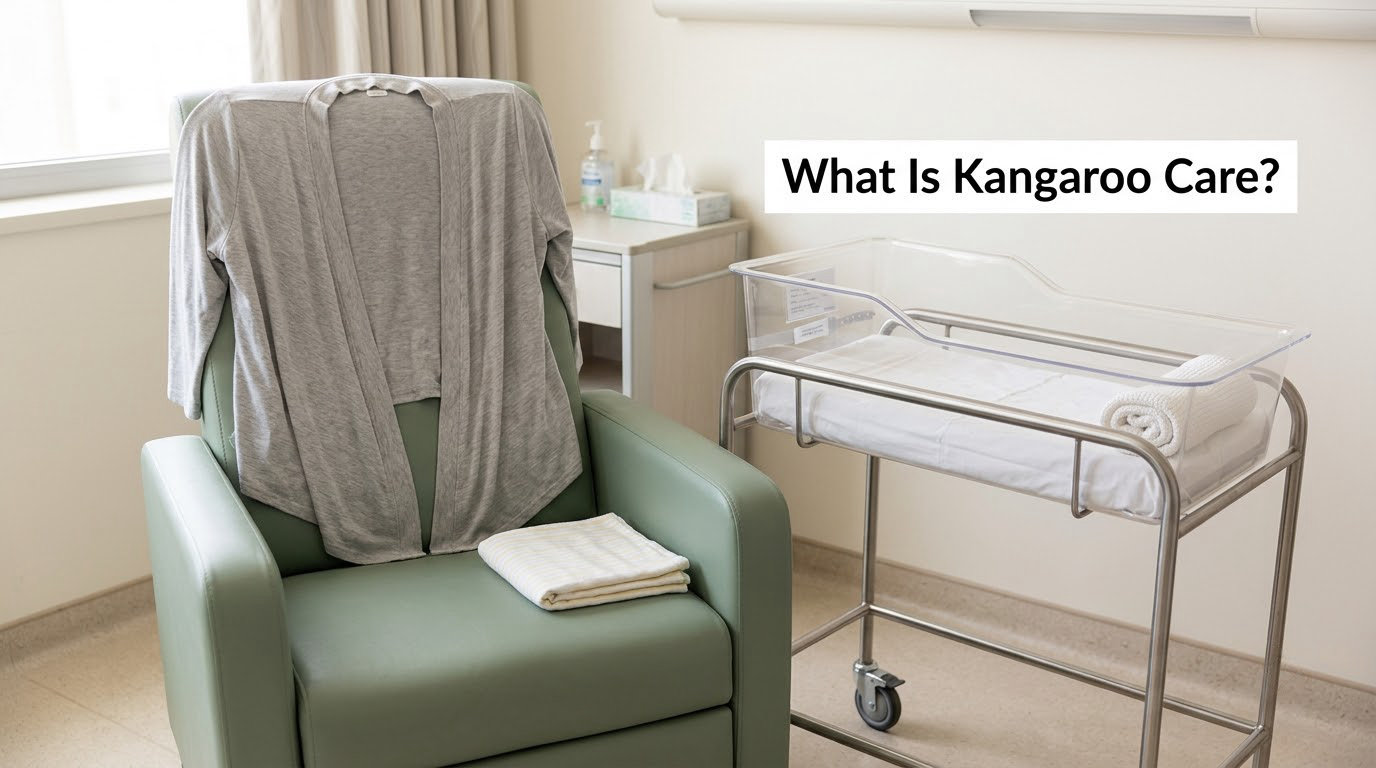
Kangaroo care is a method of holding your baby skin-to-skin on your bare chest. Your baby wears only a diaper and possibly a hat and socks, and you cover their back with a blanket so they stay warm. It is also called skin-to-skin contact, or kangaroo mother care (KMC).
The name comes from how a mother kangaroo carries her young in a pouch. The practice itself began in the late 1970s at the Instituto Materno Infantil in Bogotá, Colombia, where neonatal staff ran out of incubators and started carrying babies against their chests instead. It spread from there and is now recommended by the World Health Organization as a core part of care for preterm and low-birth-weight babies.
It is worth separating two things that get mixed up. Skin-to-skin contact right after birth, sometimes called the golden hour, is a first routine step for many babies. Kangaroo care is the ongoing, repeated practice that can run for hours at a time, in a NICU, often over days or weeks.
How kangaroo care for premature babies works
It works because a premature baby is built in a way that makes ordinary life hard. Small babies have a large surface area compared with their body mass, so they lose heat quickly and cannot replace it. They are also easily overwhelmed by light, noise and constant movement, and their own systems for regulating temperature, breathing and heart rate are still immature.
Against a bare chest, a parent becomes the external thermostat. The baby hears a heartbeat and a voice at womb levels and rate, and the smell and warmth of skin are familiar rather than strange. That settled state tends to lower stress hormones, which lowers oxygen demand, which helps everything else settle. So a calm adult holding a still baby is not just comfort. It changes measurable things.
A typical session runs like this. You change into an open-front gown or bring your own wrap, sit or lie back in the reclining chair, and remove everything above your waist except what the unit asks you to remove. The nurse helps lift the baby out of the bassinet and settles your baby upright against your chest, head turned to one side so the airway stays open. Monitoring leads and tubes are secured so they follow the baby rather than pulling.
Then it is mostly stillness. First sessions often run an hour or two; longer sessions are possible once the team knows how your baby responds. When the session ends, the nurse moves the baby back, checks vital signs, and adjusts the plan for next time.
What the baby’s position should look like
Upright is the point. Your baby rests chest to chest on you, head and neck turned to one side and slightly up, so the airway stays open and the chin is not pressed into the skin. The nurse supports the head, and the arms and legs stay loose enough to flex and kick.
Because you are holding a small baby on an adult chest, the blanket or your wrap covers your baby’s back and the sides, which is where heat escapes. The blanket should not ride up over the head, and nothing should cover the face. Some units also add a small hat and socks, since the scalp and feet lose heat quickly.
You should never position your baby yourself at the start. The nurse sets the position, keeps an eye on the monitors and the airway, and hands the baby over ready. Trying it before the first walkthrough is how parents end up with a monitor cable wrapped around their fingers.
Why kangaroo care for premature babies differs by gestational age and health status
There is no one kangaroo care protocol that suits every baby in a NICU. Practice is stratified by birth weight, gestational age and how well the baby is coping at that moment. Breathing support, heart rate stability, temperature control, ongoing illness, cardiac needs and the volume of equipment around the bed all change what the team is comfortable with.
What changes is the pacing and the starting point, not the idea. A larger, more stable baby might start with a shorter session earlier. A baby under a kilogram with oxygen needs might have fewer and more carefully measured sessions, and the team might build up from very still hands or a scent-and-voice session. Some babies tolerate more contact than they did the day before, and some need less after a bad night.
Ask your unit what its own guidance is rather than assuming a number. Every NICU has a written policy, and it reflects the babies that unit actually cares for.
What Are the Benefits for Premature Babies?
The evidence base here is unusually large for a neonatal practice, and much of it comes from settings where incubators were scarce, which is where the mortality benefit was first measured. Here is what research associates with skin-to-skin contact, grouped by what it affects.
| System | What studies associate with kangaroo care |
|---|---|
| Temperature | Better thermoregulation and less hypothermia, because the parent’s chest acts as an external heat source |
| Heart and breathing | More stable heart rate, more regular breathing patterns, and steadier oxygen saturation |
| Sleep | Longer quiet sleep cycles and less restless sleep |
| Feeding and growth | Faster time to full feeds, improved weight gain, more successful breastfeeding and earlier milk expression |
| Immune and infection | Associated with lower risk of infection and sepsis, and lower mortality where incubators were limited |
| Stress and pain | Lower stress hormone levels and reduced pain response during routine procedures such as a heel prick |
| Brain development | Better neurodevelopment scores, with follow-up studies reporting differences that persist into later childhood |
Some of this is settled enough to state plainly. Temperature, heart rate, breathing and feeding benefits are consistent across decades of research and across birth weights.
Long-term developmental findings are more encouraging than they are conclusive. A recent Stanford Medicine study reported that preterm babies who received more skin-to-skin contact scored higher on neurodevelopment testing at 12 months. Earlier follow-up work by Charpak and colleagues reported larger brain structure volumes in young adults born preterm who had received kangaroo care. Those results point in the same direction, but neither settles the question, and researchers still describe the developmental effects as an area still being studied.
What Benefits Can Parents and Babies Receive Together?
The evidence on parents is smaller but points in the same direction. Skin-to-skin time is associated with lower parental stress, less anxiety, and higher confidence about caring for the baby. After weeks of watching a machine hold your child, holding them yourself changes something.
Fathers and partners are not a substitute category here. They report feeling more settled with a very small baby during skin-to-skin sessions, and evidence on partner-held contact suggests similar physiological and attachment benefits. Grandparents and other family members can take part in many units too, which is useful when the birth parent is exhausted or pumping.
There is a practical side effect worth naming. Parents learn their baby’s cues during these sessions: the difference between a fussy movement and a startle, the signs of an imminent feed, the settling that comes with a slower rhythm. That learning tends to show up later, at the crib at home.
How Much Kangaroo Care Is Recommended?
World Health Organization guidance recommends kangaroo mother care for preterm and low-birth-weight babies as a routine part of care, and describes it as something that can be provided for up to 24 hours a day, with at least 8 hours of uninterrupted contact recommended where the baby tolerates it. That figure is a goal, not a schedule most families hit.
In practice the hours depend on the baby and the unit. Parents on neonatal forums describe the same pattern repeatedly: a baby under a kilogram getting a single longer session in a day, while a baby between one and one and a half kilograms gets several shorter ones. Staffing, nurse workload and how many babies need holding that shift all affect what happens.
| Baby and situation | What sessions often look like |
|---|---|
| Under 1 kg or still settling | One carefully measured session a day at first, then increased if vital signs stay stable |
| 1 to 1.5 kg, medically stable | Two or more sessions spread across the day, which many families use for daytime practice |
| Growing and nearly ready for discharge | Longer blocks, sometimes several hours, preparing for unbroken contact at home |
| After a difficult night or an infection | Shorter, or paused, with the team deciding when to restart |
Ask your unit for the target hours for your baby rather than for the unit average. Caregivers with pumping schedules can plan around a known time instead of hoping for a gap in the day.
What Can Parents Do During a Kangaroo Care Session?
You are not running a treatment. A nurse stays responsible for the baby the whole time, and your role is to hold still and be there. The sequence usually runs along these lines.
- Prepare. Take a shower if you can, leave scented products off, tie hair back, and empty your bladder before settling in. These are practical, not fussy. Long sessions go much better when you are not shifting.
- Dress for it. Most hospitals provide an open-front gown; some families bring a wrap or shirt that opens down the front. Skip perfume, lotion and fragranced products, and remove jewellery that sits against the baby.
- Watch the transfer. Sit first if you have been told to. The nurse, and sometimes a respiratory therapist, will lift your baby and settle them upright with the head turned to one side, then talk you through where the wires go.
- Get comfortable, then stop moving. Adjust your chair, pillow and blanket before the baby is settled. A parent who keeps shifting means a baby who gets moved and startled.
- Keep the room calm. Phones on silent and out of the crib side, voices low, and no sudden standing up. If you need to move, tell the nurse first.
- Stay awake. Holding a baby skin-to-skin is not a place for sleeping. A sleeping adult means a baby in an unprotected position, so if you are drowsy, the session ends and the baby goes back to the bassinet.
- Plan the ending with the nurse. The transfer back is the fiddly part, so agree roughly how long you have before the session wraps up.
Is Kangaroo Care Safe in the NICU?
Yes, when the team says your baby is ready. Kangaroo care is routine in most NICUs and is the recommended approach, not an experimental extra. The safety comes from the monitoring and the staffing around it, not from the technique itself.
Before a baby starts, the team looks at the same things every time: breathing support and oxygen needs, heart rate and rhythm stability, temperature control, current illness or infection risk, blood pressure, and how recently the baby had a procedure or a destabilising event. A baby with an unstable airway, an active infection risk, or a serious cardiac problem may need to wait. Those are clinical decisions made on the day.
During a session your baby stays on the monitors, usually with an oximeter and leads reorganized to fit, and the nurse watches saturation, breathing and heart rate continuously. Babies can drop their oxygen saturation briefly, particularly during the transfer itself, which is why staff place the baby, then reposition in stages rather than moving quickly. It is one of the questions parents ask most often on NICU forums, and it is a normal part of the session rather than a sign something went wrong.
Two practical precautions run through most units. Infection control matters: wash your hands, stay away if you are unwell, and step aside when staff ask you not to come in. And keep yourself well enough to be safe, which means no smoking, no alcohol, no sedating medication and no falling asleep.
Being clear about limits builds confidence. Contact is paused for the same reasons any intensive care is paused, and a paused session is information the team acts on rather than a failure on your part.
The guidance here follows what the World Health Organization and the American Academy of Pediatrics recommend, along with practice descriptions published by neonatal programmes such as Stanford Children’s Health and the March of Dimes.
What Can Families Do When the NICU Does Not Offer It?
If your unit does not run a formal kangaroo care program, that is a conversation rather than the end of it. Many hospitals will hold a baby skin-to-skin during cares or rounds even without a named program.
Ask what the unit’s criteria are and who makes the decision each day. Written family-centred care policies, parent education classes and volunteer programs are all things a family can request, and some children’s hospitals run them openly. Kangaroo mother care is also standard in many countries outside North America, so a unit abroad may simply call it KMC rather than having a special name for it.
Say what you need plainly. Asking to be involved in your baby’s care today, and to be taught the transfer, usually gets further than a general request to hold more.
How Does Kangaroo Care Affect Feeding and Family Bonding?
Feeding is where the practical gains show up. Direct breastfeeding at the breast counts as skin-to-skin contact, and even non-nutritive sucking during a session is normal. Before a baby can latch, skin-to-skin still does useful work: it is associated with earlier initiation of milk expression and with a milk supply that comes in sooner.
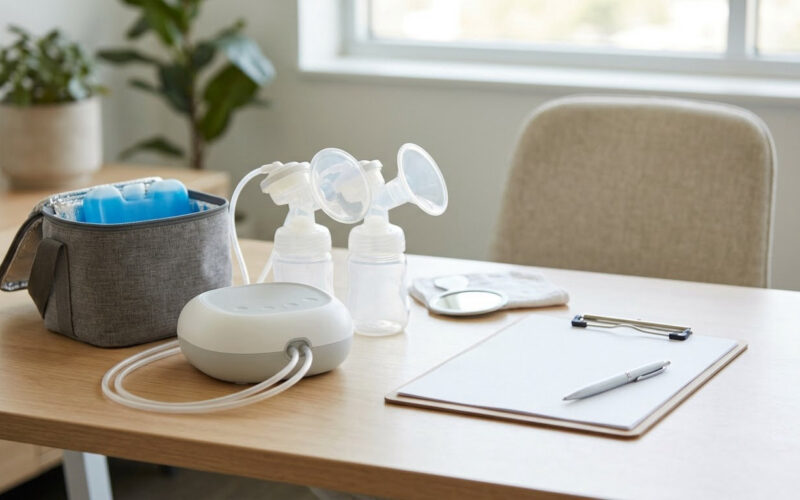
Many mothers worry that a session and a pump session are competing items in one day. They can run together, and many units have wearable pumps for exactly this. Pumping while your baby is on your chest preserves contact and supply at the same time. Ask your unit’s lactation team to set it up rather than improvising it around lines.
Bonding follows the same logic. Premature birth often removes the ordinary cues: no home, no birth weight surprise into your arms, days of watching through plastic. Skin-to-skin contact gives a parent a recurring, predictable moment of being the one holding the baby, and parents often describe it as the part of the day that felt like theirs.
Feeding goals stay individual. Plan any breast milk or formula feeding with your team, and let them set the pace.
Frequently Asked Questions
Does kangaroo care replace time in the incubator?
No. Skin-to-skin contact is added to a baby’s care, not swapped for it. Incubators and open warmers stay in use for temperature support, monitoring and treatment between sessions, and most babies return to their bassinet or incubator after each hold. In lower-resource settings, where incubators are scarce, kangaroo care has substituted for them and saved lives, which is why WHO promotes it worldwide.
Can kangaroo care help a premature baby breathe better?
Research associates skin-to-skin contact with a more regular breathing pattern, a steadier heart rate and fewer drops in oxygen saturation. Settled babies use less energy and less oxygen, and a calm, warmed baby tends to breathe more steadily than a cold, exposed one. Your baby stays on monitors during the whole session, so the team can see how they respond and adjust the plan.
Do premature babies need to wear a diaper during kangaroo care?
Usually a diaper and nothing else, though many hospitals also add a small hat and socks because the scalp and feet lose heat quickly. Nothing should cover your baby’s face or head, and your own clothing should be open to the chest so their skin rests directly against yours. Some babies wear an ostomy appliance or a surgical dressing, in which case the nurse shows you how the contact area is managed.
Is kangaroo care beneficial when the parent is taking medication?
Most prescribed medicines do not stop a parent doing skin-to-skin care, and stopping is not usually necessary. Because the parent is not the one feeding the baby, the usual direct-exposure concerns are limited, though some drugs can affect milk supply. Bring your list to the NICU team and ask, particularly for sedating medication, chemotherapy, or any drug with specific handling instructions.
Can kangaroo care be done by fathers, partners, or grandparents?
Yes. Fathers, partners, grandparents and other family members can usually hold a preterm baby skin-to-skin, and many hospitals extend this to trained volunteers through formal programs. Partner-held sessions are associated with similar stress reduction and bonding benefits. Ask your unit who it allows, what training it requires, and whether anyone needs to stay home from work or illness first.
The First Step for Parents
Ask your neonatal team two questions at the next round: when will my baby be ready to start, and who will show me the transfer. Then ask how many hours a day they are aiming for and when they will review whether that is working.
Everything else follows from their answers. You will hold your baby.