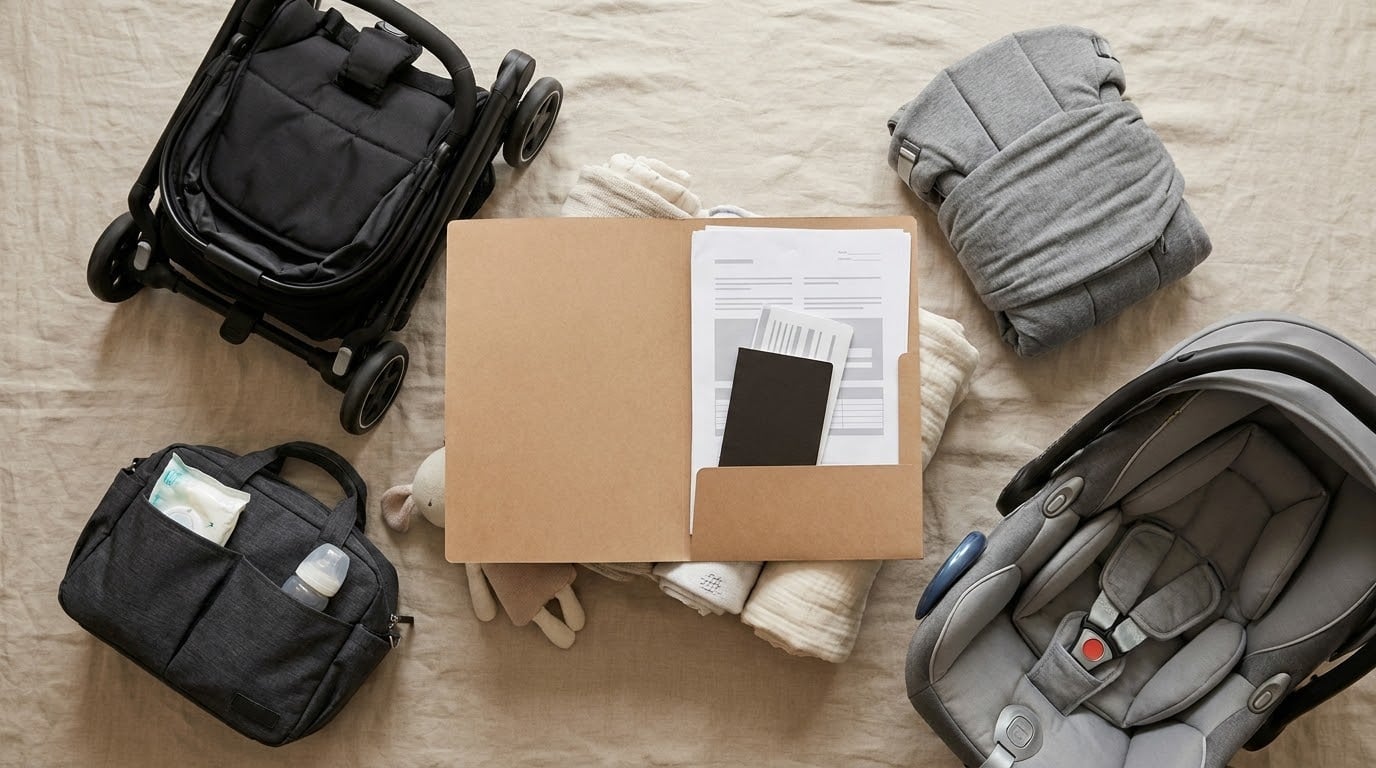
Flying with a baby is mostly a planning problem, not a flying problem. Book the right ticket, confirm the airline’s infant rules before you pay, carry a baby carrier through security, pack for the flight plus ten extra hours, and feed the baby during takeoff and landing. That sequence handles almost everything that goes wrong.
The short answer to when you can start: most airlines accept infants from around two days old, though American Airlines requires a doctor’s letter for babies under seven days. Pediatric guidance generally suggests waiting until a baby is two to three months old and checking with your pediatrician first, especially if the baby was born early. Flights between three and six months are the sweet spot, because the baby can hold a head up but hasn’t started crawling.
This guide walks through the whole process, from choosing a flight to getting a car seat onto the car at the other end. Budget roughly two hours of extra time on either side of the journey, and read this once before you book and again the week before you leave.
Table of Contents
- What You Need
- Step-by-Step: How to Travel With a Baby by Plane
- 1. Choose a Baby-Friendly Flight
- 2. Confirm the Airline’s Infant Rules
- 3. Choose the Right Car Seat or Bassinet
- 4. Pack a Compact Travel Kit
- 5. Get Through the Airport With Less Stress
- 6. Manage Feeding, Sleep, and Comfort On Board
- 7. Handle Delays and Common Problems
- 8. Finish the Trip Safely
- Common Mistakes
- Frequently Asked Questions
- Can I fly with a baby on my lap?
- Do airlines allow car seats or bassinets for infants?
- What documents does my baby need to fly internationally?
- How do I manage feeding and diaper changes during a flight?
- Can I bring a stroller and baby car seat as checked baggage?
- How can I reduce jet lag when traveling with a baby?
- Conclusion
What You Need
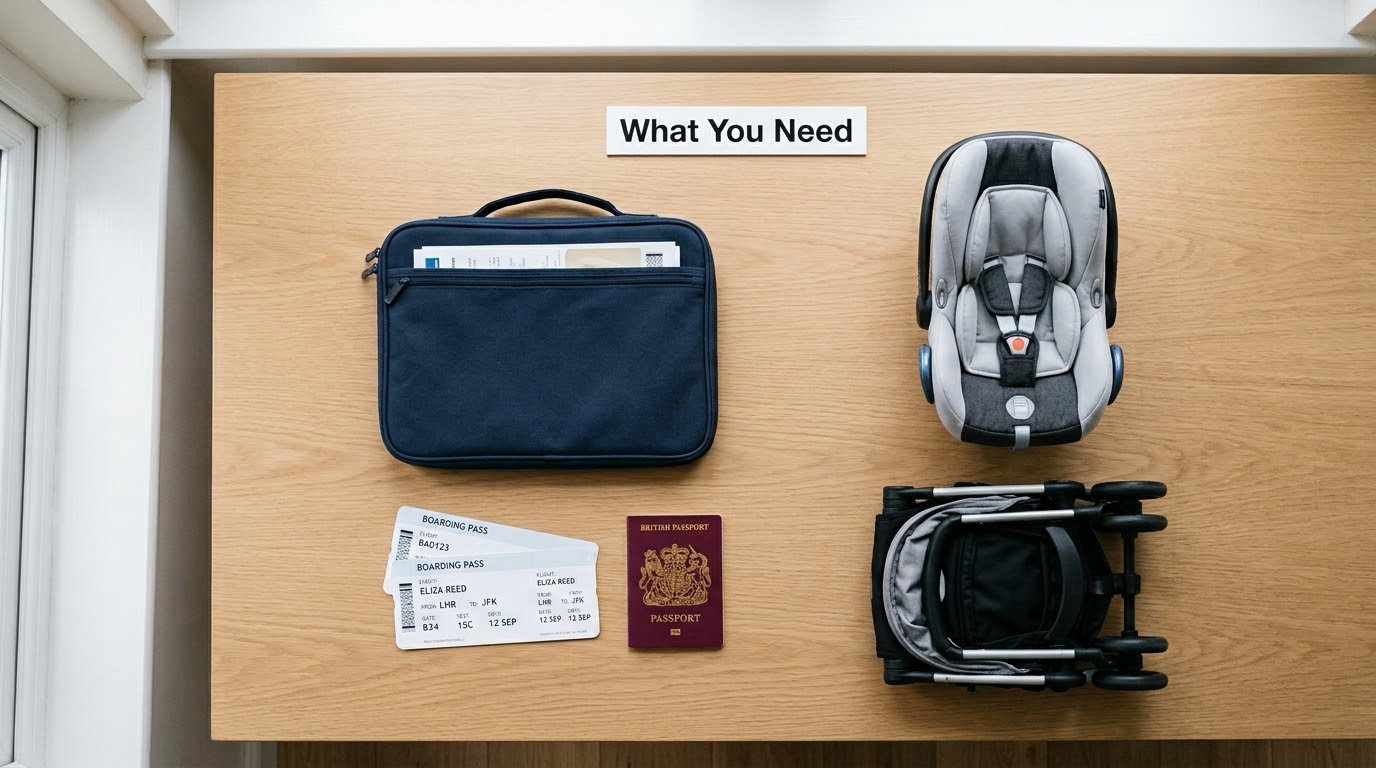
Everything on this list is easier to arrange now than at the gate. Documents can take weeks to sort out, gear rules differ per airline, and some items have to be requested on your reservation before the flight is ever booked.
- Proof of your baby’s age. Airlines routinely ask for proof of age for lap infants, and gate agents do not accept a screenshot. A certified birth certificate, a hospital record, or a passport for the baby works. Take a full-color photo of the document on your phone as a backup, but bring the paper original or a certified copy.
- A passport for the baby, if you are crossing a border. Every infant needs their own passport, including newborns. Processing takes weeks, so apply well before the trip. Check the destination country’s entry rules, because some places require a visa or a vaccination record even for infants.
- A booking with the infant attached. A baby cannot be added to an existing reservation at the airport. Domestic US flights generally carry a lap infant free of charge, one per paying adult. International flights usually charge a percentage of the adult fare plus taxes, commonly around ten percent.
- A soft baby carrier. Parents on forums call this the single item they cannot travel without, because your hands are otherwise full at check-in, at security, and at the gate. A wrap or a structured carrier both work through the screening queue.
- A stroller and an infant car seat. Most airlines check a stroller and a car seat free of charge, either at the ticket counter or at the gate. Confirm the policy on your airline’s own website, because some carriers gate-check only and others send larger gear straight to the baggage hold.
- A bassinet request, if it applies. Bassinets are offered on long-haul flights and are given out first come, first served. Put the request in your reservation during booking rather than hoping at the gate.
- Health details. If your baby is under seven days old, ask your doctor for a medical clearance letter to fly and carry it with you. If your baby was premature, has a chronic condition, or recently had surgery or an ear infection, ask your pediatrician whether travel is a good idea right now and when.
- Medication and a contact list. Any prescription medicine travels in the original labeled container, and it belongs in your carry-on, not a checked bag. Carry the dosing syringe, a written dosing schedule, and your pediatrician’s phone number.
If you want the domestic versus international rules side by side, they are short: domestically you need proof of age and no fare, internationally you need a passport for the baby plus a percentage fare, and in both cases formula, breast milk, and purees are allowed through security in quantities larger than the standard liquid limit.
Step-by-Step: How to Travel With a Baby by Plane
1. Choose a Baby-Friendly Flight
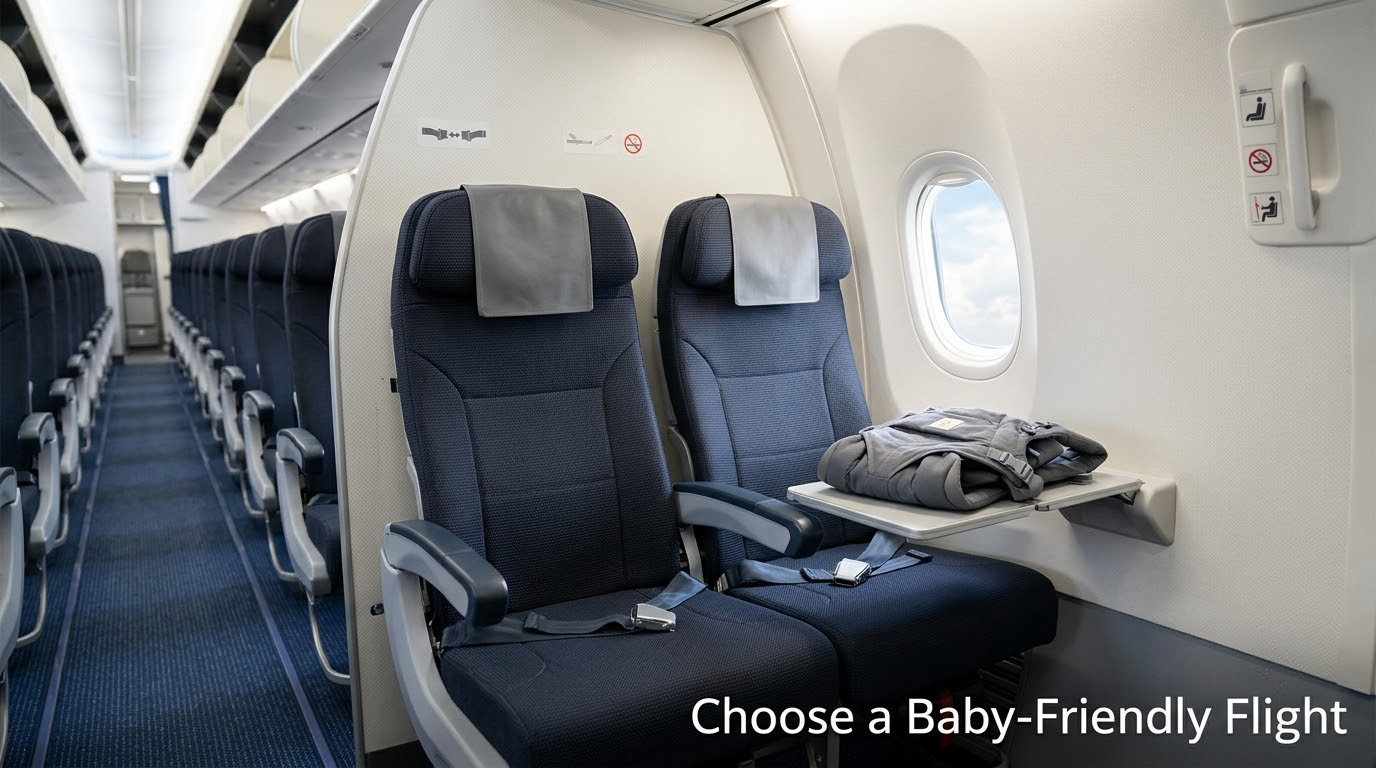
Pick the flight around the baby, not around the deal. A cheap 6 a.m. connection is a bad match for an infant who sleeps after lunch, and a red-eye is worth serious thought because a baby who sleeps through the night may make it manageable while you get a stretch.
Time of day matters more than most people expect. Babies under six months tend to be most settled during their usual daytime nap window, so a mid-morning departure often works better than an early one. After six months, watch for the fussy stretch and try to fly through it rather than around it.
Short flights are easier. A two-hour hop is far less disruptive than two hours and forty-five minutes plus a layover, because the disruption usually comes from the connection rather than the flying. When a connection is unavoidable, build in a generous gap, and aim for at least a couple of hours domestically and considerably more internationally, where you may need to clear immigration, collect bags, and go through security again.
Watch for these red flags: a last flight of the day, a tight connection, a codeshare where the operating airline sets the rules, and a route that puts you on a small regional aircraft with limited lavatory space and no bassinet fittings. Try to avoid the tightest connections for your first trip with a baby.
You will know the flight is right when you can say out loud how long your baby will be on the aircraft and roughly what time of day that is. If you cannot, keep searching.
2. Confirm the Airline’s Infant Rules
Read the rules on the operating airline’s website, not the booking site’s summary and not a forum answer from two years ago. Rules vary by carrier and even by aircraft, and the airline that sold you the ticket may not be the airline whose staff you meet at the gate.
Confirm all of the following in writing on your own booking:
- The minimum and maximum age. The common lower limit is around two days, with a medical clearance requirement under seven days on some carriers, and most airlines cap lap infants at under two years old.
- Whether lap infant seats are sold on your specific flight. Some flights reach their limit of lap infants and simply cannot take another.
- The fare. Domestic US lap infant travel is generally free; international is usually a percentage of the adult fare plus taxes.
- How many lap infants one adult may carry, and whether a second adult must be present for two infants.
- What proof of age the airline accepts and whether staff can check it before you reach the gate.
- Whether the stroller and car seat are checked at the counter or at the gate, and whether gate checking is offered on your route.
- Whether bassinets are available on your aircraft and how to request one.
Photograph the policy page and save it in your phone’s files. If a gate agent tells you something different, a calm reference to the airline’s own written policy settles most arguments in about a minute.
Done means your reservation shows the infant attached by name and date of birth, and you have the fare rule, age proof rule, and gear rule written down somewhere you can reach without internet.
3. Choose the Right Car Seat or Bassinet
There are three arrangements, and they suit different trips. A lap infant costs nothing domestically and keeps your hands free, but the baby gets no seat, no seat belt, and no emergency oxygen mask. A purchased seat with an airline-approved rear-facing car seat is the safest option on board, and for most families the strongest one. A bassinet is a wall-mounted sleep space on long-haul aircraft, and it is the difference between a manageable twelve-hour flight and a genuinely hard one.
For the car seat, use one that carries the manufacturer’s FAA approval label. Read the car seat manual and the airline’s installation instructions and follow both. Airlines publish their approved list, and if your model is not on it you will find out at check-in, not at the gate.
Install rear-facing as the child restraint manufacturer directs. If you need to use a belt extender or a positioning cushion to make the installation work, check with the manufacturer and your airline first, because a restraint installed with the wrong accessory can fail in a crash. Never improvise with bags or cushions.
For the bassinet, request it on the reservation, arrive early, and ask at the gate again on the day. Weight limits are strict and are usually somewhere around 22 pounds, so a growing baby can age out of it. Have a fallback plan in your head if the answer is no, because it is often no.
The AAP recommends that infants travel in a properly installed, rear-facing child restraint rather than on an adult’s lap for the added protection it provides, particularly on longer flights. If you can afford a separate seat, that is the choice to make. For a short hop, a lap infant is a reasonable trade that many families make comfortably.
The decision is complete when you can point to the exact arrangement your baby will have on this flight, and you have the gear to execute it in your hand.
4. Pack a Compact Travel Kit
Pack for the flight duration plus ten to fifteen hours of buffer. That is the number experienced parents repeat, and it covers delays, cancellations, and the trip home. Airlines rarely carry baby formula, breast milk storage support, or diapers onboard in any quantity you would want to rely on, so everything comes with you.
Build the kit in small pouches that each do one job, because at some point you will open one on a plane with one hand while holding a baby with the other.
- Feeding. Enough formula, nursing cover, bottles, and nipple covers for the journey plus buffer. Pre-measure formula into individual containers if you can, and bring a small kettle or ask for hot water after security. Solid foods and purees for older babies, plus one or two extra options your baby has already eaten, because a new food on a plane is a bad idea.
- Diapering. More diapers than the flight length suggests, ideally overnight diapers for the flight itself since they hold a blowout far better. Wipes, a small changing mat, diaper cream, a disposal bag for used diapers, and a separate waterproof wet bag for anything soiled.
- Clothing. One spare outfit for the baby and one spare shirt for you, in case something soaks through. Dress the baby in something easy to change, and skip anything with complicated fastenings during travel hours.
- Health. Medicine in original labeled containers, a thermometer, saline drops and a bulb or aspirator for a blocked nose, and the dosing syringe your baby is used to.
- Comfort and sleep. One familiar lovey that has been in the crib at home, a small blanket appropriate to the cabin temperature, white noise if your baby uses it, and either infant earmuffs or a hat for the takeoff.
- Entertainment. One or two quiet items rather than a bag of toys. Many families have learned that a handful of noisy new toys creates more fuss than it prevents.
- Documents. The paper proof of age, passport, birth certificate, medical letter, insurance information, and a printed copy of the itinerary for each caregiver.
On liquids: the TSA allows formula, breast milk, purees, and other toddler foods to pass through security in quantities larger than the standard limit. Tell the officer what you have before you reach the belt and expect a secondary inspection. Keep everything together and accessible rather than buried, because the screening step is easier when nothing needs digging out.
Wear the baby through security in the carrier. Walking through the machine in a carrier is allowed, and it saves you the struggle of taking a sleeping baby out of it.
You are packed when everything needed for the flight fits in one carry-on you can manage plus a checked bag that holds nothing you need in the air.
5. Get Through the Airport With Less Stress
Arrive early. Two hours before a domestic flight and three before an international one is a reasonable target when a baby is involved, since check-in, feeding, and a diaper change all take longer than they do without one. Many parents confirm online, arrive, feed and change the baby, then go to the counter.
At the counter, present the proof of age for your lap infant before you are asked. Get the stroller and car seat tagged with your destination, and if you can see it in the weigh queue, you will know it is tagged correctly.
At security, pack the liquids so they are easy to pull out, put the baby in a carrier for the walk through, and expect a gentle extra look at bottles and pouches. It is routine.
Boarding strategy depends on whether you are alone. If you are flying solo with the baby, board early with the priority group. Overhead space fills fast, and getting the stroller and car seat stowed above rather than in the hold gives you them back at deplaning. If you are traveling with a partner, board toward the end of the group so you are not sitting in the aisle for the entire line, then get settled quickly.
Whatever the strategy, ask the gate agent one question: is there an open seat nearby? Some agents will move a lap infant family into an empty seat when the cabin is not full, and parents on forums describe this as a genuine lifesaver. It is a request, not an entitlement, and no one is entitled to be offended if the answer is no.
Change a diaper in the aircraft lavatory right before boarding if your baby wears a diaper. Waiting on the jet bridge in a fresh diaper beats starting the flight already dressed for a blowout.
Boarding is smooth when your baby is fed, changed, and dressed in something you do not mind getting messy, and your gear is in one bag you can lift.
6. Manage Feeding, Sleep, and Comfort On Board
Keep the routine you have at home rather than the schedule printed on a travel guide. Nursing or bottle-feeding on takeoff and landing is the single most useful trick for ear pressure, because swallowing and sucking help the middle ear equalize as cabin altitude changes. A pacifier does the same job and is easier to offer when a feed is not practical.
If you are dealing with a fussy baby who will not latch, offering a pacifier during the descent is a reasonable substitute. Some parents dip a clean pacifier in water or gripe water as a backup, but use only what your own pediatrician has said is appropriate for your baby, and never give medication to a baby without checking the label and the dose with them first.
Cabin pressure is low and the air is dry, which dries a baby’s airways. Offer breast milk, formula, or water according to your baby’s usual routine and age, and use saline drops for a stuffy nose rather than reaching for a cold medicine. If your baby is under twelve months and you would not normally give cow’s milk as a drink, this is not the flight to start.
Cabin noise is loud enough to startle a newborn and loud enough to be a problem for small ears over a long flight. Infant earmuffs sized for babies help more than most parents expect. A feed at the same time as the worst of the takeoff noise works as well as anything.
For sleep, match the flight to nap time where you can, keep the same lovey, and use the same nap length you use at home rather than pushing for a schedule the baby does not follow. On long-haul, a bassinet genuinely enables sleep because your arms are free.
If the baby cries, so what. Cry is the expected sound of air travel with an infant, flight attendants are used to it, and most other passengers have been there. The calming toolkit that works is: check hunger, check diaper, offer a feed, change the light or add a burp, then try movement and sound. Repeating that cycle is more useful than a long list of gadgets.
Do not hand a crying baby to a stranger who offers to help. Most parents regret that, and almost nobody minds a parent trying.
7. Handle Delays and Common Problems
Plan the failure cases before you need them, because the ones that matter are simple and have obvious responses.
If the flight is delayed or cancelled. Keep your cool and work the airline’s app first, since rebooking goes faster through it than at the counter. Your documents and baby supplies are still with you, which is the whole reason you packed them in your carry-on. Ask about the infant at check-in when you rebook, so the new seat is set up correctly from the start.
If the bassinet is unavailable. Ask whether any other bassinet is open on another aircraft of the same type, or whether a spare exists after a swap. If not, an empty seat or a wall you can prop a blanket against is the fallback. Many families bring a small travel blanket for exactly this reason.
If the stroller or car seat is delayed. Both are usually delivered by baggage services or pulled from oversize belt. Do not leave without them: a car seat is required for the ride home in most places, and a carrier can get you to the arrivals hall while you wait.
If the baby gets sick. Airlines carry a basic first aid kit, and flight attendants can help with water, a sick bag, and locating a lavatory. Keep your own supplies on you. Do not give any medicine that was not discussed with your pediatrician at home. Most childhood illnesses on flights are viral and resolve on the ground, so on long flights where your baby seems genuinely unwell, a diversion with medical evaluation at the nearest airport may be the safer choice.
If supplies run out. Ask the flight attendant before you assume, because galleys sometimes carry a small amount of formula and basic baby items, though you should never plan around it. Airports at your connection point and destination almost always have a shop with diapers and formula.
If you are separated during a rebooking. Keep a printed copy of every traveler’s name and document details in the diaper bag, so whoever is rebooking can read it out loud.
The trip is under control when you have a plan for the four things most likely to go wrong, and you have not left anything important in a bag you cannot reach.
8. Finish the Trip Safely
Deplaning is often the fastest part of the journey. Families who board late tend to deplane fast, and a calm, fed baby steps out without a fuss. Ask a flight attendant for help with the stroller if you are traveling alone and juggling too much.
At the destination, collect the car seat from baggage claim before you leave the secure area. If it has been gate-checked, it may come down with the oversize items, and if it is delayed, ask baggage services to deliver it to your hotel or accommodation and keep the tracking number.
Use the car seat correctly on the ground. Install it in the vehicle following the child restraint manufacturer’s instructions, and check that the harness height and recline suit your baby’s size after the flight. A seat that is correctly installed in a rental car at one in the morning still has to be installed that way the next morning.
Rental car companies will fit a seat for you if your own is delayed, though the service varies. If you are booking a rental and you would rather not deal with fitting a seat in a rental car, a luggage service that rents and delivers travel equipment is an option worth pricing before you go.
On arrival, expect one rough night and give yourself permission for it. Keep the first day’s wake times close to home where you can, get outside light into the morning, and hold onto the usual naps as much as possible. Jet lag in babies under six months is usually a matter of temporary disruption rather than a reset, and it settles quickly.
The trip is done when the car seat is installed properly, the travel gear is accounted for, and everyone has eaten something.
Common Mistakes
Booking without confirming that lap infants are available on that flight. Aircraft have a hard limit, and when it is reached the airline can refuse the infant at check-in. Add the infant during booking, not later, and if you are told the flight is full, choose another flight before you pay.
The fix: add the baby to the reservation yourself, then read the confirmation back to make sure a date of birth and an infant name are attached to it.
Treating a bassinet request as a guarantee. Bassinets are first come, first served, and they go quickly even when the flight looks empty. Request one at booking, ask again at check-in and at the gate, and carry a backup plan.
The fix: assume the answer may be no and bring the comfort items that let you manage without one.
Packing the baby supplies in checked baggage. If the bag is delayed you cannot feed the baby or clean the baby, and the rules about what you may carry on make this entirely avoidable.
The fix: diapers, formula, medicine, documents, and one full outfit stay in the cabin with you, always.
Forgetting the documents, or relying on a phone photo alone. Gate agents can ask for proof of age and a screenshot is often not accepted.
The fix: paper proof of age, the baby’s passport and visa when crossing a border, the medical letter if the baby is under seven days old, and photo backups stored in the diaper bag.
Using a car seat that is not on the airline’s approved list, or installing it with an accessory you have not checked. This is both a boarding refusal risk and a safety problem.
The fix: confirm the model on the airline’s approved list, read the car seat manual, and ask the airline and the manufacturer about any extender or cushion before you use it.
Skipping the backup feed and the backup diaper. The bag is empty, the plane is on the runway, and there is no second option.
The fix: pack for the journey plus ten to fifteen hours, keep an overnight diaper in the top pouch of the diaper bag, and carry one extra outfit for you as well as the baby.
A few closing tips that parents consistently find worth it: babywear the baby through security, change a diaper before boarding rather than during, offer a feed or pacifier on the way down, and go easy on yourself. A baby who cries for part of a flight is having a normal day, and you handled it.
Frequently Asked Questions
Can I fly with a baby on my lap?
Yes. A lap infant, usually any baby under two, travels free on domestic US flights when seated on an adult’s lap, with one lap infant allowed per paying adult. International flights usually charge a percentage of the adult fare plus taxes. Lap infants do not get their own seat, oxygen mask, or seat belt, so pediatric guidance favors a purchased seat with an approved rear-facing car seat, especially on longer flights.
Do airlines allow car seats or bassinets for infants?
Most airlines allow an airline-approved, FAA-labeled car seat on a purchased ticket, and many also let you fly with a car seat that sits in the cabin. Bassinets are offered on long-haul aircraft, usually in bulkhead rows, and are given out first come, first served, so request one when you book. Check the carrier’s approved car seat list and bassinet availability before you pay, because they vary by aircraft.
What documents does my baby need to fly internationally?
Your baby needs their own passport, and for most destinations a visa or an entry permit. Carry the passport, a certified birth certificate, proof of any required vaccinations, and copies of every document. Airlines often ask for proof of age for lap infants on domestic flights too. Leave generous weeks for passport processing, and check the destination country’s rules, since entry requirements for infants can differ from those for adults.
How do I manage feeding and diaper changes during a flight?
Bring enough formula, breast milk, or nursing supplies for the flight plus ten to fifteen hours, since airlines do not reliably stock baby items onboard. Pack diapers in an easy-reach pouch, use overnight diapers for the flight, and bring a wet bag for anything soiled. Use the aircraft lavatory for changes, which usually has a fold-down changing table, and ask a flight attendant where the nearest one is on a small plane.
Can I bring a stroller and baby car seat as checked baggage?
Yes. Most airlines check a stroller and an infant car seat free of charge, either at the ticket counter or at the gate. Gate checking often gets you the stroller back at deplaning and keeps it with you during a connection. Attach a contact tag to each item, fold it before you hand it over, and expect the car seat to arrive in the oversize belt or be delivered to your accommodation if it is delayed.
How can I reduce jet lag when traveling with a baby?
Shift the baby’s schedule toward destination time a few days before you fly when you can, and choose a flight that lands at a reasonable hour rather than the cheapest one. On arrival, get outdoor light in the morning, keep daytime bright and naps short in the first stretch, and keep the usual bedtime routine. Babies under six months usually settle within a few days, and feeding on the new schedule helps more than anything else.
Conclusion
Learning how to travel with a baby by plane comes down to five actions, and every one of them happens before you reach the airport. Choose a flight that fits your baby’s age and daily rhythm, confirm the operating airline’s infant rules and fare, attach the infant to your reservation, and settle the car seat or bassinet arrangement early because bassinets go first come, first served. Then pack the cabin bag for the journey plus ten to fifteen hours and keep documents, diapers, feeding supplies, and one spare outfit with you rather than in a checked bag.
On the day, arrive early, wear the baby through security, board early if you are alone and later if you have a partner, and feed during takeoff and landing. Everything else on this page is contingency for the trip that does not run to plan, and you will handle it fine.