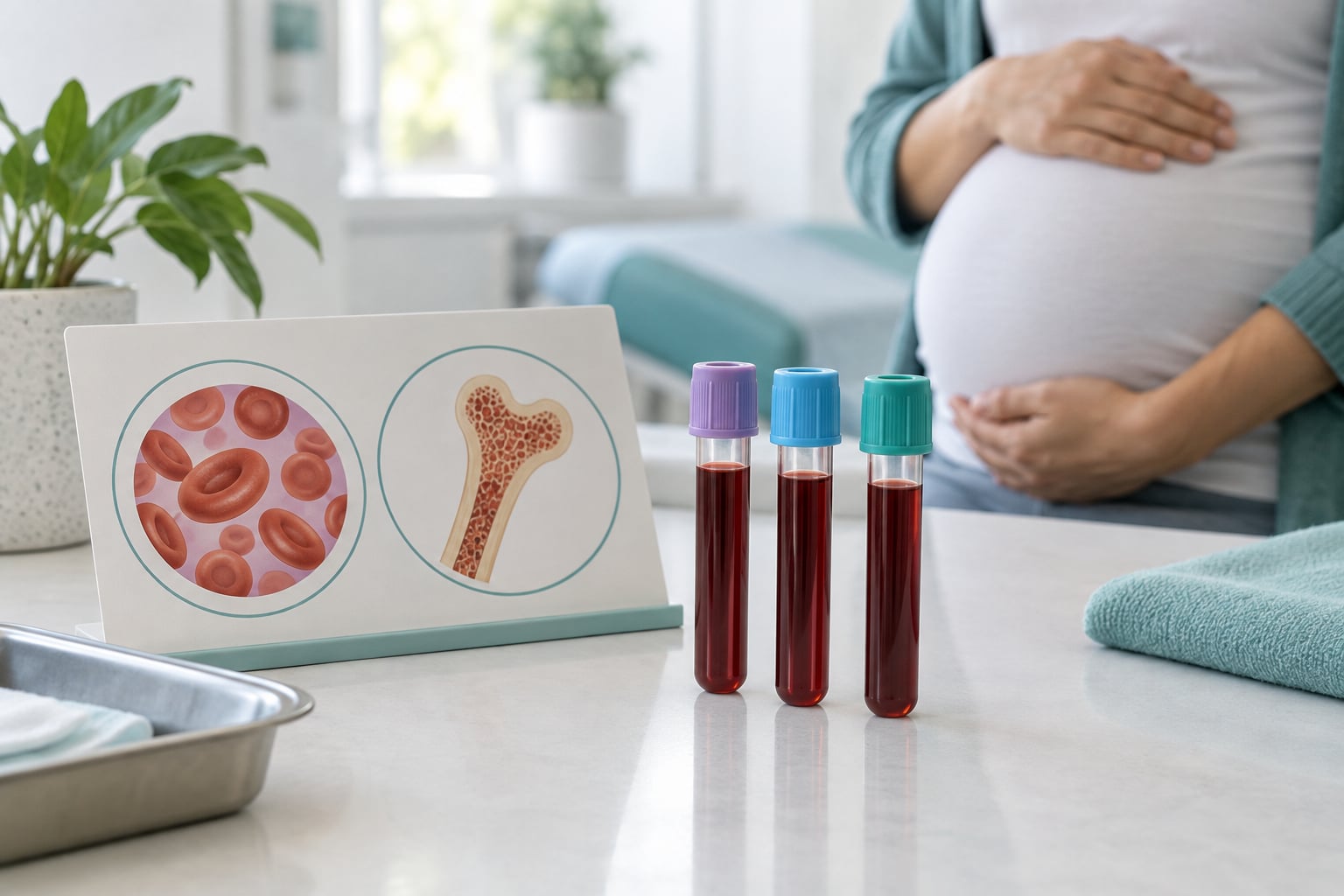
Anemia in pregnancy explained in plain language: it means your blood carries less hemoglobin than it should, so less oxygen reaches your tissues and your baby. It is usually iron deficiency, it is found with a routine blood test, and it is one of the most common and most treatable conditions in prenatal care.
Most people who get it recover completely. The catch is that the symptoms look almost exactly like ordinary first-trimester exhaustion, which is why anemia in pregnancy is easy to walk past without a blood test.
This guide covers what anemia is, why it happens, what the lab numbers actually mean, how clinicians treat it, and when to pick up the phone. It is general education written for search readers. It is not a diagnosis, and nothing here replaces a conversation with your obstetric clinician, midwife, or hematologist.
Table of Contents
- What Is Anemia in Pregnancy?
- Why Is Anemia in Pregnancy Explained So Often?
- What Are the Most Common Causes of Anemia in Pregnancy?
- What Symptoms Can Anemia in Pregnancy Cause?
- How Is Anemia in Pregnancy Diagnosed?
- How Do Hemoglobin, Ferritin, and Iron Tests Differ?
- What Does Low Ferritin With Normal Hemoglobin Mean?
- Can Iron Deficiency Affect Pregnancy?
- How Is Anemia in Pregnancy Treated?
- Do You Need Iron Supplements During Pregnancy?
- What Happens During an IV Iron Infusion?
- What Can You Eat to Support Healthy Iron Levels?
- When Should You Contact a Healthcare Professional?
- Frequently Asked Questions
- Is it possible to have low ferritin and normal hemoglobin during pregnancy?
- How much iron does a pregnant woman need each day?
- Can anemia harm my baby during pregnancy?
- Should I take an iron supplement while pregnant?
- Is a hemoglobin level of 8.2 too low in pregnancy?
- Key Takeaways
What Is Anemia in Pregnancy?
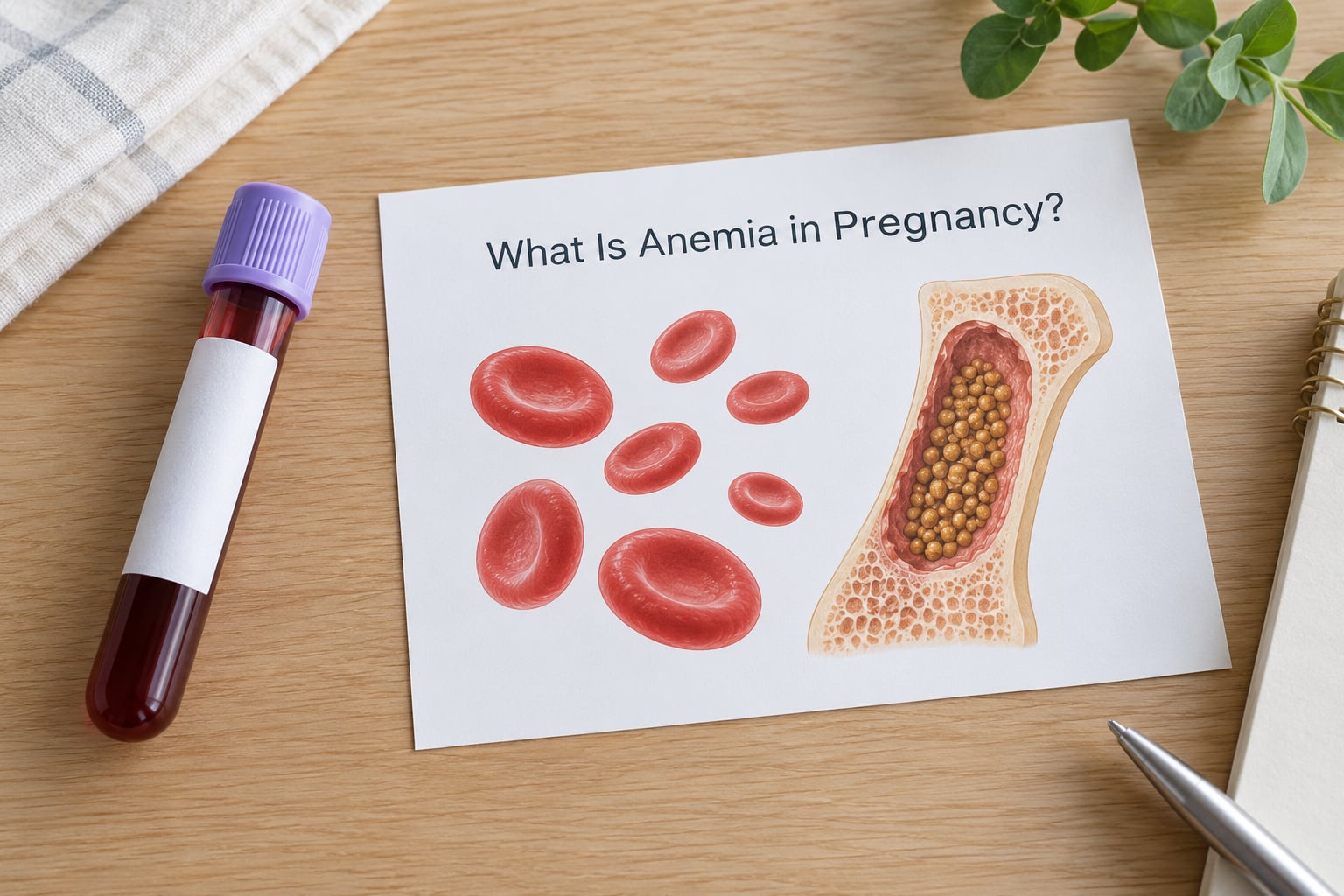
Hemoglobin is the protein inside red blood cells that binds oxygen. Anemia is the condition of having less hemoglobin than your body needs. Without enough of it, your muscles, your brain, and your developing baby get less oxygen than they should.
Two different things get tangled together during pregnancy, and separating them makes the whole topic easier. The first is dilution: your blood volume expands by roughly 45% across pregnancy, and most of that expansion happens in the plasma, the liquid part. Your red blood cells get spread through more liquid, so the concentration reads lower on a lab report even when your iron stores are fine.
The second is depletion: your iron supply simply cannot keep up with the extra red blood cells being built, and with the iron a fetus needs to grow. That is true iron deficiency anemia, and it is the one that matters.
Clinicians diagnose anemia in pregnancy with these hemoglobin cutoffs, which is why the numbers matter more than the symptoms:
| Trimester | Hemoglobin below this suggests anemia | Typical notes |
|---|---|---|
| First trimester | 11 g/dL (110 g/L) | Dilutional effect is usually strongest early |
| Second trimester | 10.5 g/dL (105 g/L) | Lowest threshold of the three |
| Third trimester | 11 g/dL (110 g/L) | Volume expansion peaks near term |
| Severity, mild | 10.0 to 10.9 g/dL | Often no symptoms |
| Severity, moderate | 7.0 to 9.9 g/dL | Fatigue usually noticeable |
| Severity, severe | Below 7.0 g/dL | Urgent evaluation |
These are the WHO figures most widely used, and ACOG refers to the same threshold set. But thresholds are not one-size-fits-all. Laboratories carry their own reference ranges, and a clinician will read your number alongside your symptoms, your diet, your history, and how your values have moved since your last draw.
It also helps to separate three terms that get used loosely in online discussions:
- Anemia — hemoglobin below the threshold for your stage of pregnancy.
- Iron deficiency — depleted iron stores, usually shown by a low ferritin, with or without anemia.
- Physiological anemia of pregnancy — the mild dilution described above, which is expected and not a deficiency.
Now the other lab values you will see on the same report:
| Test | What it measures | What a low or high value hints at |
|---|---|---|
| Hemoglobin (Hgb) | Oxygen-carrying protein concentration | Low: anemia, whatever the cause |
| Hematocrit (Hct) | Percentage of blood volume made of red cells | Low: usually tracks a low hemoglobin |
| Ferritin | Your stored iron reserve | Low: iron depletion, often before anemia shows |
| Transferrin saturation | How much of your iron-carrying protein is loaded | Low: iron is not getting where it needs to go |
| MCV | Average red cell size | Low: typical of iron deficiency |
Why Is Anemia in Pregnancy Explained So Often?
It comes up constantly because pregnancy raises the body’s iron requirement while the same pregnancy makes iron harder to take in and absorb, so anemia is common even in people who eat well.
Here is the arithmetic behind it. Before pregnancy, the recommended daily iron intake for a non-pregnant adult is about 18 mg a day. During pregnancy, the requirement rises to 27 mg a day, and that is on top of the extra iron going into expanded blood volume and into the placenta and fetus. No diet reliably delivers that without real planning, which is why nearly all prenatal vitamins contain iron and why screening is routine.
On top of the higher requirement, several things work against you. Nausea in the first trimester can push you away from the very foods that carry iron. Heartburn and reflux make many women avoid red meat. Tea, coffee, and dairy eaten alongside a meal can quietly block absorption of the iron in that meal.
There is also a timing problem. Stores that were already thin before conception get drawn down steadily, and the drop usually shows up in labs before you notice anything. Add a multiple gestation, which roughly doubles iron demand, or a short gap between pregnancies, and the picture gets tighter still.
What Are the Most Common Causes of Anemia in Pregnancy?
There is more than one reason, and one diagnosis rarely explains every case. Clinicians work through them in roughly this order.
Iron deficiency anemia. By far the most common. It can start from a diet gap, from heavy menstrual bleeding before pregnancy, from frequent vomiting, or from reduced absorption after bariatric or small bowel surgery.
Anemia of pregnancy from blood volume expansion. The dilution effect. Hemoglobin looks lower because the denominator grew, not because iron vanished. It is real but mild, and it needs monitoring rather than aggressive treatment.
Folate deficiency. Folate matters for cell division and for the neural tube, and a shortfall shows up as an anemia that looks similar to iron deficiency on a routine count. It is uncommon in people who take prenatal vitamins with folic acid.
Vitamin B12 deficiency. More likely in people who follow a strictly vegan diet, and also in those who had bariatric surgery or who take metformin long-term. It can be present for years before any symptoms appear.
Blood loss. Pregnancy itself rarely causes significant bleeding, but some who are already anemic arrive depleted. Bleeding earlier in pregnancy, or a procedure such as a fibroid removal, can push numbers down sharply.
Inherited blood disorders. Sickle cell disease, thalassemia trait, and other hemoglobinopathies mean the red cells themselves are abnormal rather than merely under-supplied. Every provider screens for these, because management differs and some increase clot risk during pregnancy.
Chronic kidney, digestive, or inflammatory conditions. Less common, and worth mentioning because anemia can be the first clue. Kidney disease reduces the hormone that drives red cell production. Celiac disease, Crohn’s, and some autoimmune conditions reduce absorption or interfere with it. These cases usually need a specialist.
One diagnosis does not explain every case, and people often carry more than one factor at a time. A low ferritin with an entirely normal hemoglobin is still worth a conversation, even though it does not meet the anemia cutoff.
What Symptoms Can Anemia in Pregnancy Cause?
Symptoms overlap with pregnancy itself, which is exactly the problem. Nearly everyone feels tired, so fatigue alone tells you very little. The pattern that matters is fatigue that does not match your usual pattern, or that keeps getting worse instead of easing.
- Persistent fatigue — tiredness that rest does not fix, or that hits hardest climbing stairs.
- Weakness — feeling like your legs are heavy, or that ordinary tasks take more effort than they used to.
- Pale skin, lips, or nails — and paler-than-usual inner eyelids, which people often check without realizing.
- Dizziness or lightheadedness — especially when standing up quickly.
- Shortness of breath — feeling winded on stairs you used to manage easily.
- A pounding or racing heartbeat — particularly when you are resting or lying down.
- Headaches — often alongside the dizziness.
- Craving ice — pagophagia is a classic and oddly specific clue to iron deficiency.
- Restless legs — uncomfortable urge to move the legs at night, linked to low iron stores.
Anemia in pregnancy can also be completely silent. Plenty of people walk in with a low hemoglobin and no symptoms at all, which is exactly why the routine blood test matters more than how you feel.
How Is Anemia in Pregnancy Diagnosed?
Diagnosis is bloodwork, and in most cases it happens whether or not you feel unwell. Your provider orders a complete blood count at your first prenatal visit and again later in pregnancy, typically around the end of the first trimester and again near the start of the third trimester. A postpartum check about six weeks after delivery catches anemia that arrived late or that never resolved.
If hemoglobin comes back low, the next step is usually iron studies: ferritin first, often with transferrin saturation, serum iron, and TIBC. A routine screening panel may also include blood type and antibody screening, a sickle cell trait screen, and a folate or B12 level when the picture points that way.
How Do Hemoglobin, Ferritin, and Iron Tests Differ?
| Result | What it can indicate | What the clinician does with it |
|---|---|---|
| Low hemoglobin, low ferritin | Iron deficiency anemia | Iron treatment plus dietary work, repeat labs to confirm response |
| Normal hemoglobin, low ferritin | Iron depletion without anemia | Discusses prevention and monitoring rather than urgent correction |
| Low hemoglobin, normal ferritin | Not simply iron deficiency | Looks for folate or B12 deficiency, blood loss, kidney or digestive disease, inherited conditions |
| Low hemoglobin with normal MCV | Suggests a non-iron-deficiency pattern | Looks for hemoglobinopathy, blood loss, or chronic illness |
| Low MCV with normal hemoglobin | Thalassemia trait is a common explanation | May order electrophoresis before any iron is given |
None of these values means much in isolation. Your clinician interprets them beside your symptoms, your diet, your medical and obstetric history, and the reference ranges your own laboratory uses.
What Does Low Ferritin With Normal Hemoglobin Mean?
It means your iron stores are running down but your hemoglobin has not fallen far enough yet to be called anemia. Many providers call this iron deficiency without anemia. It is common, it is easy to overlook, and it is worth mentioning at an appointment even though no treatment has been prescribed.
Some clinicians watch and recheck. Others treat it preventively, especially when the trend across several labs is clearly downward, when you are carrying more than one baby, or when your hemoglobin is already near the threshold. Ask which approach you are on and when the next blood test happens, so you are not guessing between appointments.
Can Iron Deficiency Affect Pregnancy?
Most cases are mild and resolve. Untreated or more severe anemia is associated with a longer list of outcomes, and risk varies with severity and with the underlying cause. Association is not destiny: plenty of people with significant anemia have entirely healthy pregnancies with close monitoring.
For the pregnant person, risks that clinicians watch for include unusual fatigue that limits daily functioning, increased susceptibility to infection, an easier route to low blood pressure or blood-pressure complications in some cases, and reduced tolerance of blood loss at delivery. Iron deficiency has also been linked with higher rates of postpartum depression and with longer recovery after birth, which is why the six-week postpartum check is not optional bookkeeping.
For the baby, the concerns that come up in research and guidance are preterm birth and low birth weight, along with lower iron stores at birth. Severe maternal anemia has been associated with neonatal complications. Folate deficiency carries a separate and well-established concern around neural tube defects, which is one reason folic acid in prenatal vitamins is non-negotiable.
Low iron alone is not a cause of miscarriage in the way an acute medical emergency is. Persistent anemia is a marker of a body under strain, and your provider will weigh it alongside everything else in your pregnancy.
How Is Anemia in Pregnancy Treated?
Treatment follows a ladder, and your clinician picks a rung based on severity, cause, how far along you are, and how well you tolerate the step below. Nothing here is a plan for you; it is a description of the standard sequence so the steps make sense when your provider talks through them.
- Adjust the diet when the deficiency is mild and you are not suffering symptoms. This means iron-rich foods plus absorption habits, and it works best as a habit rather than a rescue.
- Start an oral iron supplement when ferritin is low or hemoglobin is below threshold. Ferrous sulfate, ferrous fumarate, and ferrous gluconate are the common forms, usually taken on an empty stomach with something containing vitamin C.
- Change or adjust the oral regimen if side effects prevent you from taking it, or if repeat labs show no response after a reasonable interval. Different formulations, alternate dosing days, or a lower dose taken more often are options a clinician may try.
- Intravenous iron when oral iron is not tolerated, has not worked, or the deficiency is severe or late in pregnancy. It replaces the need to wait weeks for gut absorption.
- Blood transfusion reserved for severe anemia, particularly close to delivery when a significant blood loss is anticipated. It is uncommon.
- Treat the cause, not just the number whenever there is bleeding, an absorption problem, an inherited blood disorder, or kidney or digestive disease. Iron alone will not fix those.
Do You Need Iron Supplements During Pregnancy?
Most prenatal vitamins contain some iron, and many providers recommend supplementing on top of that once ferritin or hemoglobin falls low. The honest answer is: it depends on your labs, and the difference between a reasonable dose and more than you need is real.
More iron is not always better. Excess iron causes constipation, nausea, abdominal discomfort, and dark stool, and in a person who is not deficient it does nothing useful. Unsupervised high-dose iron is also genuinely dangerous in a household with small children, because iron overdose is a leading cause of childhood poisoning.
If a supplement is prescribed and the side effects make you quit, say so rather than stopping quietly. Constipation can often be eased with more fluid and fibre, nausea is easier to manage with a different timing or a different form, and dark stool on its own is expected rather than a warning sign. Adjusting the plan is far better than abandoning it and assuming nothing is happening.
What Happens During an IV Iron Infusion?
People ask this constantly and most patient guides skip it, so here is the plain version. You are seated, a small IV is placed in your arm, and the iron solution is delivered over roughly an hour or two. Some clinics give a small test dose first and watch you for a short period, which is standard practice with certain formulations.
Most people feel nothing unusual during the infusion. Afterwards, some notice fatigue, a mild headache, body aches, or a temporary flushing feeling during the infusion itself. Ferritin often rises within a couple of weeks, and people frequently report that the tiredness that had been constant starts easing in the days and weeks afterward. Even so, the timeline varies, and the effect is not instant.
What Can You Eat to Support Healthy Iron Levels?
Food works best as a foundation that supplements sit on top of. It is also not a substitute for evaluation when anemia is already significant, and changing your diet should never delay a call to your provider.
Heme iron comes from animal sources and is absorbed most efficiently: red meat, liver, poultry, shellfish, and fish. Liver is exceptionally iron-dense but high in vitamin A, so keep it occasional rather than daily.
Non-heme iron comes from plants and is absorbed less efficiently: lentils, beans, chickpeas, tofu, fortified cereals, pumpkin seeds, quinoa, leafy greens such as spinach and Swiss chard. Vegetarians and vegans can absolutely meet pregnancy iron needs, but they usually need to plan meals deliberately and supplement as advised.
Pairing raises absorption. A source of vitamin C with an iron-rich meal — citrus, kiwi, strawberries, peppers, broccoli — measurably improves uptake. Beans with a squeeze of lemon do more work than the beans alone.
Timing matters. Coffee, tea, dairy, and calcium supplements taken in the same meal reduce iron absorption. Many providers suggest waiting an hour or two either side. Coffee is the one people most often refuse to give up, and moving it out of the breakfast window is usually easier than quitting.
One fix worth knowing. Cook legume-heavy stews and chili in cast iron, which adds a meaningful amount of iron to the dish. For plant-based iron, soak beans, sprout them, or use sourdough starters, all of which reduce phytates that block absorption.
When Should You Contact a Healthcare Professional?
Routine anemia care belongs with your obstetric clinician or midwife, and anything persistent or unusual deserves a hematologist. Seek urgent, immediate care for any of the following:
- Fainting, or feeling like you are about to pass out
- Chest pain, or pain when you breathe deeply
- Shortness of breath at rest
- A racing or pounding heartbeat that will not settle
- Heavy or unusual vaginal bleeding during pregnancy
- Bleeding that is not related to a routine check
- Symptoms that are worsening quickly over days
Contact your care team promptly, without waiting for a scheduled visit, if fatigue is severe enough that you cannot manage ordinary tasks, if you are newly and persistently short of breath, if you are dizzy most of the time, or if your supplement brings on vomiting or severe abdominal pain.
For the next routine appointment, it is worth asking directly: was my ferritin checked along with my hemoglobin, is my ferritin trending down, should I repeat these labs, and would a hematology referral be appropriate? Bringing specific questions tends to get specific answers, and it removes the ambiguity that leaves you worrying between visits.
Frequently Asked Questions
Is it possible to have low ferritin and normal hemoglobin during pregnancy?
Yes. This pattern is called iron deficiency without anemia: your stored iron is depleted while hemoglobin has not yet dropped below the threshold. Many providers monitor it and recheck labs, while others treat it preventively, particularly when values are trending downward or you are carrying more than one baby. Either way, it deserves a mention at your next appointment, along with a clear plan for when the next blood test happens.
How much iron does a pregnant woman need each day?
The recommended daily intake rises to about 27 mg during pregnancy, up from roughly 18 mg for a non-pregnant adult. That covers the iron going into expanded blood volume and to the placenta and fetus. Most prenatal vitamins contain a portion of that amount. Because diet alone rarely closes the gap, providers commonly add a supplement once ferritin or hemoglobin falls low, adjusted to your own lab results.
Can anemia harm my baby during pregnancy?
The main associations are preterm birth and low birth weight, along with lower iron stores at birth for your baby. Severe maternal anemia has been linked with additional neonatal complications. Risk depends on how severe the anemia is and what is causing it, and many people with low iron have entirely healthy pregnancies with monitoring. Folate deficiency carries its own separate concern around neural tube development.
Should I take an iron supplement while pregnant?
Do not start one on your own. Most prenatal vitamins already contain iron, and taking more when you are not deficient causes side effects without benefit, while high doses are dangerous to small children in the home. If your provider recommends a supplement and the side effects are making it hard to continue, tell them instead of stopping quietly, because the dose, form, or timing can usually be adjusted to fit you better.
Is a hemoglobin level of 8.2 too low in pregnancy?
That falls in the moderate range, below the first and third trimester threshold of 11 g/dL and below the second trimester threshold of 10.5 g/dL. It deserves prompt review with your obstetric clinician, usually with iron studies to confirm the cause. It is not usually an emergency on its own, but it warrants a plan: treatment, a repeat blood test to confirm response, and a discussion of whether a hematology referral would help.
Key Takeaways
Take one action first: pull your latest prenatal results and read the hemoglobin and ferritin lines side by side with your trimester. If either looks off to you, that is a reasonable thing to raise at your next visit, even if you feel fine.
Beyond that, keep three things in mind. Anemia in pregnancy is common and treatable, and it is found by blood test rather than by how you feel. Iron deficiency is the usual cause, and iron stores can run low before your hemoglobin does. And treatment is individualized: what is right for someone with a ferritin of 6 in the first trimester is not right for someone mildly anemic at 36 weeks.
This guide is general education, not a diagnosis. Your obstetric clinician, midwife, or hematologist can interpret your numbers in context and decide with you what to do next.