Telehealth prenatal care is prenatal care delivered remotely by video or phone instead of in the office. Your provider reviews your history and symptoms, talks you through taking your own blood pressure, weight, and sometimes fetal heart rate, and orders any lab work or ultrasound separately. Hands-on exams still happen in person, usually on a set schedule.
That last sentence is the part most people find surprising. A virtual visit is not a replacement for prenatal care, it is one way of delivering part of it.
If you are pregnant in 2026 and have been offered a virtual prenatal appointment, you probably have three questions: what actually gets checked, do I still need an ultrasound, and can I say no to a video visit? This guide answers all three, plus what to do if something feels off.
A note before we start: this is general information about how telehealth prenatal care works, not medical advice for your pregnancy. Nobody can assess your individual risk over a web page. Talk to your own obstetrician, midwife, or maternity care team about your situation.
Table of Contents
- What Is Telehealth Prenatal Care?
- How Telehealth Prenatal Care Works Step by Step
- 1. Scheduling the visit and learning the format
- 2. Completing intake forms before the call
- 3. Testing the platform ahead of time
- 4. Connecting with your provider
- 5. Taking home measurements together
- 6. Lab work and ultrasound happen separately
- 7. Follow-up by message, portal, or a booked visit
- What Happens During a Virtual Prenatal Visit?
- How Does a Provider Check Pregnancy Without an In-Person Visit?
- What Pregnancy Care Can Be Done Online?
- What Are the Limits of Telehealth During Pregnancy?
- How to Prepare for a Telehealth Prenatal Appointment
- How Privacy, Technology, and Access Work
- Frequently Asked Questions
- Can prenatal care be completely done by telehealth?
- What measurements can I take at home for a prenatal video visit?
- Is telehealth prenatal care private and secure?
- What pregnancy symptoms require an in-person visit or emergency care?
- How do I know whether telehealth or an office visit is better?
- Conclusion: Start by Asking Your Prenatal Provider
What Is Telehealth Prenatal Care?
Also called telemedicine or remote prenatal care, it covers the parts of prenatal care that do not need a clinician’s hands: symptom check-ins, result reviews, education, medication questions, and support between appointments. The people involved are usually the same ones you would see in person, such as an obstetrician, a certified nurse midwife, a family practice clinician, or a maternal-fetal medicine specialist for a high-risk pregnancy.
What changes is the setting. Instead of an exam table with a Doppler and a paper cuff, there is a screen and whatever you keep in your kitchen drawer. Most telehealth prenatal visits are synchronous, meaning you and your provider talk live on video. Some are asynchronous, which is really just secure messaging and a portal, used for a question or a form rather than a full appointment. A growing number of practices pair video visits with remote patient monitoring, where readings from a home cuff or scale go straight into your medical record between appointments.
How it differs from a standard prenatal visit comes down to three things. The physical exam is missing. Labs and imaging happen somewhere else, on their own schedule. And the interval between hands-on checks can stretch out, which is the part patients in online communities argue about most.
The benefits are real. For someone two hours from the nearest labor and delivery unit, or who cannot get an hour away from work, or who has no childcare, a video check-in can be the difference between care and no care. It also reduces exposure when someone is sick, and it makes it easier to raise the small worries that never fit into a fifteen-minute office slot.
The limitation is just as real. Nobody can palpate a uterus, measure fundal height, listen to a fetal heartbeat with a clinical Doppler, or perform a screening test through a camera.
How Telehealth Prenatal Care Works Step by Step
This is the part competitors tend to skip. Here is the full arc, from booking to follow-up.
1. Scheduling the visit and learning the format
You book a slot through the practice portal, the phone, or a scheduling link from a text or email. You should be told which platform it uses, whether it is video or audio only, how long the appointment runs, and what to have ready. Telehealth prenatal appointments are commonly shorter than office visits, often somewhere around ten to thirty minutes, so the reason for the visit matters a lot when you book.
2. Completing intake forms before the call
This is the part patients most often do not expect, and it is often the most valuable part. One patient in a What to Expect community thread described her first prenatal appointment as four detailed intake questionnaires covering family medical history, genetic history, and prior pregnancies, followed by a review of the last menstrual period, an estimated due date, expected weight gain, medications to take and avoid, and red-flag symptoms.
Expect questions about your cycle and dating, prior pregnancies and outcomes, medications and supplements, chronic conditions, family history of genetic conditions, and anything that worries you. Have your dates written down before you sit down to type.
3. Testing the platform ahead of time
Open the link, check that your camera and microphone work, and find out how to get help if the connection drops. Doing this ten minutes early beats doing it on camera. Most practices will give you a phone number for exactly that problem.
4. Connecting with your provider
You join, often a few minutes early, and the provider usually confirms identity and that you are somewhere private. The conversation covers how you feel, what has changed since the last visit, and any symptoms you have noticed.
5. Taking home measurements together
If your provider wants a blood pressure, weight, or fetal heart rate, they will walk you through it on camera, which means you do the technique and they watch. This is where specific instruction matters. A home blood pressure reading taken with the wrong cuff size reads wrong, and a fast reading reads high.
6. Lab work and ultrasound happen separately
Your provider can send requisitions to a lab or imaging center, and often those are the nearest in-person touchpoints in a mostly virtual schedule. Patients on community forums report exactly this: orders go out electronically, you go to the location, and the result lands in the portal for the next conversation.
7. Follow-up by message, portal, or a booked visit
Before the call ends, you should leave with a clear plan. What was discussed, what got ordered, when results will be reviewed, and when the next in-person hands-on visit is. Knowing that date in advance does more for anxiety than almost anything else.
What Happens During a Virtual Prenatal Visit?
The visit itself is mostly talking, and the order is fairly consistent.
You start with how you feel and what has changed. That includes new symptoms, movement patterns, sleep, digestion, mood, and anything that has shifted since the last appointment. Your provider is also watching how you appear, which sounds obvious but carries real information, particularly if you look unwell and are not aware of it.
Next comes questions, the part people remember. You can ask about anything, and you can ask again. Patients often save up a list and then run out of time, so write the questions down beforehand and keep them visible during the call.
Then home measurements, if any are needed for this visit. Some visits need nothing beyond conversation, which is common for a low-risk check-in two weeks after a normal visit.
Results get reviewed when they exist. Labs and imaging from the last few weeks are typically walked through line by line, which is a genuine advantage of a screen: a clinician can pull up a full trend and talk to you about what it means without an exam interrupting.
Medication and supplement questions come up often, including what to take, what to stop, and what to ask your own doctor about. Your provider will write or send prescriptions where the rules allow, and will tell you if something needs an in-person prescription visit instead.
You end with a plan and next steps. Sometimes that is simply a repeat virtual visit. Often it is a referral, a lab, an ultrasound, or a booked in-person appointment.
How Does a Provider Check Pregnancy Without an In-Person Visit?
Clinicians work from what you report, what you measure at home, and results that come in separately. They are assessing trends rather than doing an exam, and the tools are simpler than people expect.
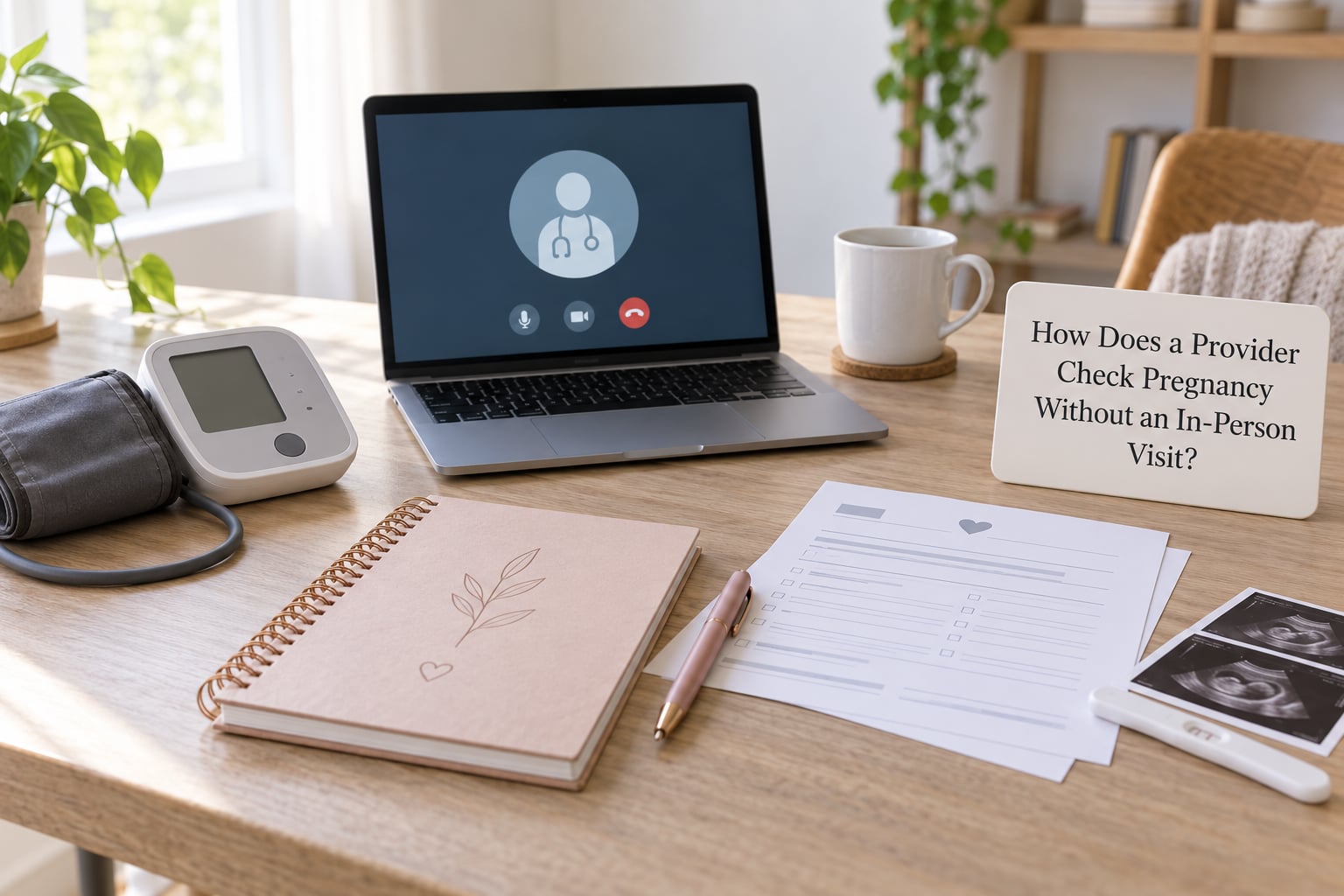
Here is what a home monitoring setup can actually involve, and what your provider does with each number.
- Blood pressure cuff. Two readings, taken seated with your arm supported, several minutes apart. Your provider compares them with your prior readings and the pattern expected for your gestational age, then decides whether monitoring needs to increase or an in-person visit is warranted.
- Scale. Weight, usually on a consistent day and time. Providers look at the trend against expected gestational weight gain rather than a single number.
- Fetal movement log. Patterns and timing of movement rather than a count alone, compared against your own baseline.
- Handheld Doppler or fetal monitoring app. A fetal heart rate you located yourself, if your provider asked for it. The number gets recorded and may trigger an in-person check or further testing.
- Glucose meter. Readings on a prescribed schedule. Patterns get reviewed, though the formal glucose screen itself is still done in person.
- Patient portal. Photos or notes sent between visits, added to your record and reviewed asynchronously before the next call.
What none of this replaces: fundal height measurement, a clinical Doppler for fetal heart rate and position, pelvic examination, a Group B strep screen late in pregnancy, the glucose tolerance test itself, the anatomy ultrasound, and any procedure. Those require hands, instruments, or a machine.
Remote patient monitoring is the version where readings flow into your record automatically between visits rather than typed in at appointment time. A 2017 randomized trial in the American Journal of Obstetrics and Gynecology, the Barbour study of telemedicine prenatal care for women living in rural areas, used a web-based platform where patients entered their own weight, blood pressure, and fetal heart rate. It is one of the studies most often cited in this space, and it is worth reading in the original if you want the detail on what self-entry did and did not replace.
What Pregnancy Care Can Be Done Online?
More than people first assume. Common telehealth uses include:
- Routine low-risk check-ins between the in-person visits, covering symptoms, movement, and general wellbeing.
- Result review for blood work, urine tests, and imaging, often the single most useful thing a screen does well.
- Prescription and supplement questions, including what is safe in pregnancy and what your own clinician advised against.
- Nutrition counseling and general dietary guidance, especially early when nausea makes eating a puzzle.
- Mental health follow-up during pregnancy and after delivery. One patient in a community thread described telehealth as the only way she could keep regular care for depression and anxiety through her pregnancy.
- Genetic counseling. A 2020 model described in PMC, by Vora and colleagues, has patients see a specific genetic counselor by video while keeping access to the rest of the prenatal genetics pathway.
- Preparation for the next appointment, so you know what to ask and what is being checked and why.
- Forms, referrals, and insurance paperwork that would otherwise eat fifteen minutes of an office visit.
Group prenatal care models such as CenteringPregnancy are a different format, built around facilitated groups rather than one-to-one visits. Some practices now offer a virtual version. If that appeals to you, ask whether yours does.
What Are the Limits of Telehealth During Pregnancy?
Being clear about this is the most useful thing a page like this can do. The honest answer is that telehealth covers a real and growing share of prenatal care, and there are specific things it cannot do.
Some care always needs to happen in person:
- An ultrasound, including the early dating scan and the mid-pregnancy anatomy scan
- Blood work and urine testing drawn by someone else
- Blood pressure measurement by a clinician when readings are concerning
- Pelvic examination, cervical checks, and group B strep screening
- The glucose tolerance test and other diagnostic screening
- Any procedure, injection, or treatment
- Care of a high-risk pregnancy, which needs hands-on assessment on a schedule your provider sets
Then there are symptoms where you should not wait for a video visit. Contact your maternity care team right away, or go to an emergency department, for:
- Vaginal bleeding that is not light spotting
- A gush or steady leak of fluid from the vagina
- Severe or persistent abdominal pain, or pain that does not ease
- A noticeable decrease or change in fetal movement, particularly if the pattern has changed
- Severe headache with vision changes, sudden swelling of the face or hands, or upper abdominal pain
- Fever, chest pain, or trouble breathing
Do not use a portal message for any of these. A pregnancy can be uncomplicated until something changes quickly, which is the reason practitioners themselves keep arguing for routine hands-on assessment. If you are unsure whether something counts, call. Being told it is fine costs you one call.
One more limit worth naming honestly: distance between in-person visits. Patients on community forums describe schedules where hands-on checks happen every other month, and the anxiety that creates is legitimate. If the gap between visits makes you uneasy, that is a reasonable thing to raise with your provider rather than something to sit with.
How to Prepare for a Telehealth Prenatal Appointment
Ten minutes of preparation makes the whole call go better.
Pick a private room and a private number. You may need to talk about your body, your mental health, or your home life. If a partner or child is in the room, tell the provider at the start of the call rather than in the middle of it.
Test the technology in advance. Open the link, confirm the camera shows your face and not the ceiling, check the microphone, and find out what the practice wants you to do if the call drops. Charge the phone or laptop.
Light your face, not the window. A lamp or window in front of you works better than a window behind you, which turns you into a silhouette.
Wear something you can move in. If your provider may want to check your abdomen, or you may need to show skin for a rash, loose clothing that lifts easily saves a minute and an awkward moment.
Gather your records. Insurance card, medication and supplement list, prior prenatal records, and any lab requisitions you were given.
Write your questions down. Keep them in front of you. The most common complaint about telehealth visits is that they are too short, and most of that is recoverable by prioritizing.
Track what changed since the last visit. Symptoms, movement, weight, sleep, mood, and any new medication. Two minutes of notes is worth a lot on the call.
Ask about the schedule in advance. Confirm when the next in-person visit is and what it will cover, so you can plan labs, imaging, and childcare around it.
How Privacy, Technology, and Access Work
On privacy, a virtual prenatal visit should happen on a HIPAA-compliant platform with encryption, which is the standard for any platform handling protected health information. Practices commonly use a branded patient portal, a third-party video vendor, or both. You are entitled to know which one, and to be told what happens to recordings if any are made. If that feels important to you, ask at booking rather than during the call.
Portal messaging is usually the practical back channel. Questions about a medication or a form get answered asynchronously, with a stated turnaround time. It is not appropriate for anything urgent, and it is not a substitute for a visit.
On access, a few things are worth asking before your first appointment:
- Whether you can switch a virtual visit to a phone call, or an in-person visit, and how much notice is needed
- Whether an interpreter is available, and whether it can be arranged for video visits
- Whether captions or other accessibility accommodations are available on the platform
- Whether the visit is billed the same as an in-person visit, what your copay looks like, and whether your plan requires you to be in a specific setting
- What happens if you need labs, and whether they can be done closer to home
Two honest caveats. Telehealth rules and insurance coverage for maternity care vary by state and change often, so treat any specific coverage answer as a starting point rather than a fact, and check with your insurer and your practice. And for people with reliable internet, a quiet room, and a nearby lab, telehealth is a convenience. For people driving 45 minutes each way with no childcare, it is the whole reason they get care at all. Both of those are true at the same time.
Frequently Asked Questions
Can prenatal care be completely done by telehealth?
No. Ultrasound, blood and urine testing, blood pressure checks by a clinician, pelvic examinations, the glucose tolerance test, and group B strep screening all require equipment or hands, so they happen in person. Telehealth usually fills the gaps between those visits rather than replacing them. Some practices do offer a fully virtual schedule for a low-risk pregnancy, with every lab and scan booked separately.
What measurements can I take at home for a prenatal video visit?
Most commonly blood pressure from a home cuff, your weight, a log of fetal movement patterns, and sometimes a fetal heart rate you locate yourself with a handheld Doppler. Your glucose meter readings count too if your provider has asked for a schedule. Take blood pressure seated with your arm supported, rest a few minutes, and take two readings a minute or two apart, then report both.
Is telehealth prenatal care private and secure?
It should be. Prenatal visits carry extra sensitivity, so practices are expected to use HIPAA-compliant platforms with encryption, plus a secure patient portal for documents and messaging. Ask which platform is used and whether anything is recorded. If you would rather not discuss mental health or personal circumstances on video, ask for a phone visit or an in-person appointment instead.
What pregnancy symptoms require an in-person visit or emergency care?
Do not wait for a video visit for bleeding that is more than spotting, a gush or leak of fluid, severe or persistent abdominal pain, a clear decrease or change in fetal movement, severe headache with vision changes or sudden swelling, or fever, chest pain, or trouble breathing. Contact your maternity care team immediately, or go to an emergency department. A portal message is not a response for anything urgent.
How do I know whether telehealth or an office visit is better?
If your pregnancy is low-risk and the visit is a check-in, result review, education, or a mental health follow-up, telehealth usually covers it well. Choose in person when you want a physical exam, a blood pressure check by a clinician, or when a long stretch between hands-on visits makes you uneasy. You can always ask to convert a virtual visit, and you do not have to justify that request.
Conclusion: Start by Asking Your Prenatal Provider
The short version: telehealth prenatal care handles the conversations, the result reviews, and the between-visit check-ins, while the scans, the labs, and the hands-on exams stay on a real schedule you can see in advance. Whether that arrangement fits you depends on your pregnancy, your access, and how you feel about the gap between in-person visits.
Before your first appointment, ask four things. Which visits are virtual and which are in person. When is the next hands-on visit and what does it cover. Which platform is used, and what it costs. And what would need to change if you wanted an in-person visit instead.
Then keep a list of your own questions, because the visit will be shorter than you expect. And whatever the format, your care team still needs to know about bleeding, fluid, pain, or a change in movement. That part does not go through a screen.
Again, this is general information about how telehealth prenatal care works, not medical advice. Your own provider knows your history and your risk factors, so bring your questions to them.