
If your insurer has denied a pregnancy, delivery, NICU, or postpartum claim, you have the right to ask them to look at it again — and most people never do. The process is a written internal appeal on a deadline, followed by an independent external review if the first answer goes against you. It takes a few weeks of paperwork, and a letter of medical necessity from your OB or midwife usually does more work than anything you say on the phone.
This guide walks through how to appeal an insurance denial for maternity care, step by step, with the deadlines attached to each step. It is written for US readers dealing with a private plan, an employer plan, or Medicaid; the exact paperwork changes with the plan and the state, so treat the outline below as the process, not the form.
Table of Contents
- What You Need
- Step-by-Step: How to Appeal an Insurance Denial for Maternity Care
- 1. Confirm the Denial and Check the Plan Rules
- 2. Gather Medical and Billing Evidence
- 3. Write a Clear Appeal Letter
- 4. Submit the Appeal and Track the Deadline
- 5. Ask for Urgent Review or Go to External Review
- Common Mistakes
- Frequently Asked Questions
- Can insurance deny pregnancy coverage?
- What are the odds of winning an insurance appeal?
- Is my newborn’s insurance denial a separate appeal from mine?
- Why was my short-term disability claim denied for maternity leave?
- How long do I have to appeal a denied maternity claim?
- Do I need a lawyer to appeal an insurance denial?
- Conclusion
What You Need

Start with the denial letter itself. Federal rules require a written notice that names the claim, the reason, the clinical criteria used, and where to send an appeal — if you only got a letter with a code and no explanation, call the plan and ask for the full notice with the medical criteria attached.
Then gather these documents. Missing one rarely sinks an appeal, but a complete packet usually reverses denials that would otherwise stand.
- The complete denial notice, including the claim number, date of service, denial code, and the plan’s own medical or administrative criteria.
- Your plan documents — the summary of benefits and coverage, and the section on appeals, pre-service denials, and external review.
- The Explanation of Benefits (EOB) for that claim, plus the itemized bill from the hospital or provider showing each charge as a separate line.
- Diagnosis and procedure codes (the ICD-10 and CPT codes on the bill), so you can compare what was billed against what was denied.
- Your provider’s letter of medical necessity, written by the OB, midwife, maternal-fetal medicine specialist, or neonatologist who actually made the clinical decision.
- Your medical records for the pregnancy and the hospital stay: prenatal visits, the delivery record, the newborn’s NICU admission summary and daily notes, and any lab or imaging reports.
- Proof of prior authorization — the authorization number, the letter or portal screenshot, and the name of the representative who approved it.
- A second opinion from another clinician, if the denial rests on whether something was medically necessary. Many plans give this real weight.
- Clinical guidelines from ACOG, the American Academy of Pediatrics, or the relevant specialty society that support the care you are asking for.
One more thing worth having open while you collect: a blank page with a numbered claim, policy, and authorization reference at the top. Every letter you send and every call you make should repeat those identifiers, because appeals routinely get lost in a queue when the paperwork is thin on numbers.
Step-by-Step: How to Appeal an Insurance Denial for Maternity Care
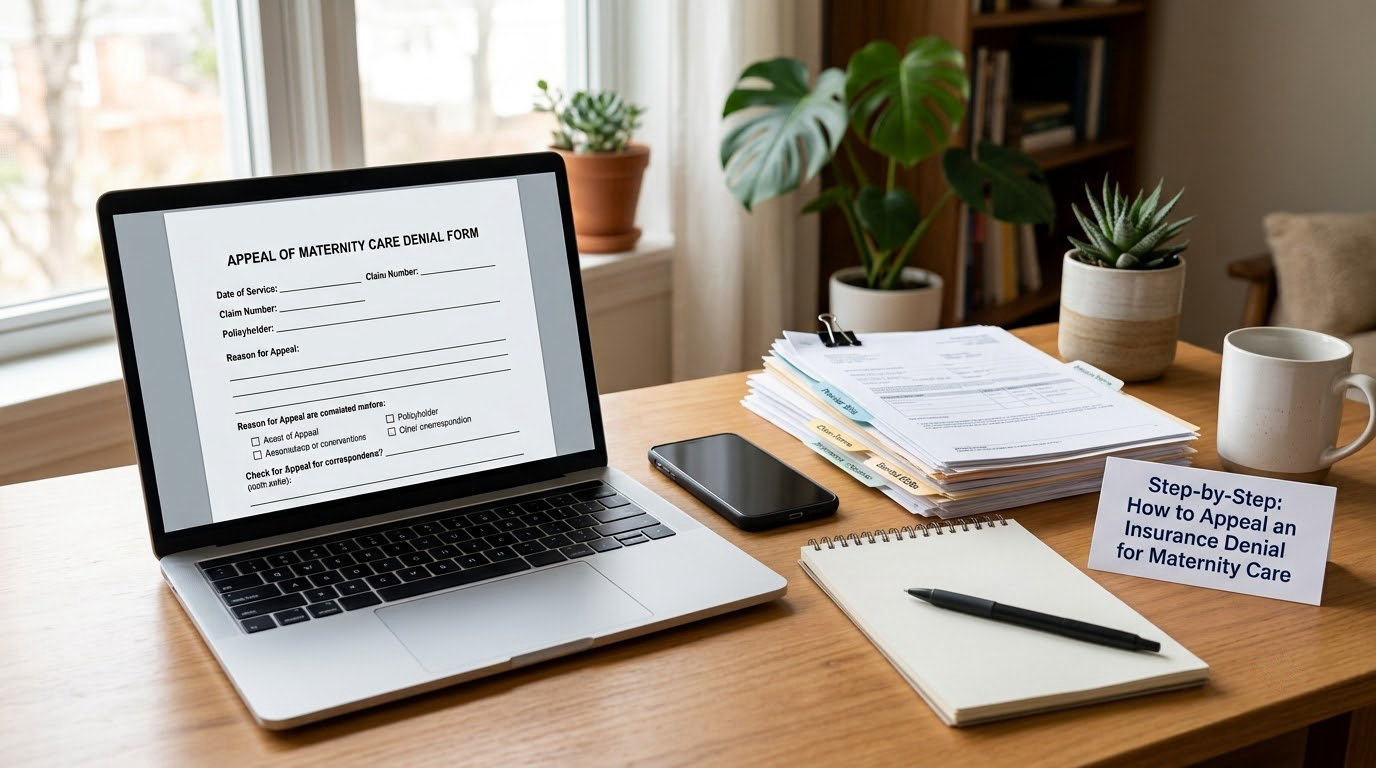
1. Confirm the Denial and Check the Plan Rules
The first step to appeal an insurance denial for maternity care is to find out exactly what was denied and why. Pull the denial notice and write down the specific service, the date, the billed amount, and the stated reason. “Not medically necessary” and “not a covered benefit” are different arguments, and appealing the wrong one wastes your deadline.
Call member services and ask them to read the denial reason back to you. Forum contributors on r/BabyBumps point out that what the representative tells you on the phone is not always what the letter says, and that the call is the fastest way to learn which department handles the appeal and whether the denial is pre-service (a prior authorization refusal) or post-service (a claim that was processed and refused).
Sort the denial into one of four buckets, because each needs a different argument:
- Medical necessity — the plan says the service was not necessary. You answer with clinical records, a letter of medical necessity, and guidelines.
- Prior authorization — the service was never approved before it happened. You answer with the authorization, the call log, and proof the provider obtained it.
- Network or coding — the provider was out of network, or the claim was coded wrong. You answer with network status, a corrected claim, or a network appeal.
- Benefit or administrative — a benefit maximum, a coordination-of-benefits problem, a filing deadline. You answer with plan language and correct filing.
While you have the plan open, find the appeal instructions. Note the filing deadline, the mailing address or portal, the required form, and the address for expedited review. Self-funded employer plans follow different rules from fully insured plans, and Medicaid goes through a state fair hearing process rather than an insurer appeal — so identify which type you have before you write anything.
How do you know which you have? Call the number on your insurance card and ask: “Is my plan self-funded or fully insured, and who is the plan administrator?” Employer HR or the plan administrator’s summary will usually say “self-funded” or “administered by” a named company.
2. Gather Medical and Billing Evidence
Build the evidence in two piles: clinical records that show why the care was needed, and billing records that show what was actually billed and why it was refused. Appeals fail most often when one pile is missing entirely.
On the clinical side, the strongest document is a letter of medical necessity from the treating clinician. It should name the diagnosis, describe the clinical finding or risk that required the service, state the treatment plan, and explain what happens if the care is delayed or declined. Handing your OB’s office a written request gets a better result than asking at the end of an appointment.
You can hand your provider this request:
“I have a denial from my insurer for [service] dated [date], claim number [number]. They denied it as [stated reason]. Would you be able to write a letter of medical necessity for the appeal that includes my diagnosis, the clinical reason this care was needed, the treatment plan, and any relevant guidelines? The plan wants it on the provider’s letterhead within [deadline].”
On the billing side, request the itemized bill, not the summary statement. It shows each charge with its own revenue code, which lets you match a specific line to the denial code. Ask the hospital billing office for the claim number, the date it was submitted, and whether any prior authorization number was attached — for an inpatient maternity or NICU stay, providers are responsible for obtaining authorization, not the patient, and a missing authorization in their hands is a conversation you can hand back to them.
Keep copies of everything and start a log: date, who you spoke with, what they said, and the reference number from the call. Build the same record for the baby’s separate claims.
That last point catches a lot of parents by surprise. Your claim and your newborn’s claim are two separate claims, often billed separately, sometimes by different facilities, each with its own denial letter and its own deadline. Appeal them as two appeals even when the denial arrives in one envelope.
3. Write a Clear Appeal Letter
Keep the letter to one or two pages. Reviewers read a stack of these, and clinical facts do more work than emotion. A calm, specific letter with numbers and records is the version that gets a careful review.
Use this structure, then fill in the blanks:
Member name, member ID, date of birth, plan name, group number, claim number, date of service, provider name and NPI, and the date of the denial letter.
Subject line: Appeal of denial — [specific service], claim [number], date of service [date].
Paragraph 1 — what you are appealing. State that you are appealing the plan’s decision to deny [service] provided on [date] at [facility], claim [number], denial dated [date], denial code [code], reason stated by the plan: “[exact wording from the letter].”
Paragraph 2 — why the care was necessary. Give the diagnosis, the clinical facts, and the provider’s recommendation. Say what the plan’s stated criteria were and, factually, why the situation meets or exceeds them. Quote the criteria the plan itself cited and answer each one.
Paragraph 3 — the specific error or the plan conflict. Explain the point you are contesting: the service is within the covered benefit, the criteria were not met or were misapplied, the authorization was obtained on [date] under number [number], the provider is in network under the plan’s own directory, or the coding was submitted incorrectly and has been corrected. Cite the plan section you are relying on.
Paragraph 4 — the remedy you are asking for. Be specific: you are asking the plan to overturn the denial and pay claim [number], or to reprocess it under the covered benefit, or to cover [service] going forward. A vague request for “reconsideration” is easier to deny than a precise one.
Paragraph 5 — attachments and contact. List every enclosure by name: letter of medical necessity, itemized bill, prenatal records, delivery record, NICU admission summary, prior authorization confirmation, second opinion, relevant clinical guideline, EOB. Give one phone number and one email.
Before you send it, read it once for clinical accuracy. If a fact in your letter is not in your records, cut it.
4. Submit the Appeal and Track the Deadline
Send it the way the plan’s instructions specify — the member portal, the appeals address on the denial letter, or a fax number — and keep proof. A portal confirmation page, a certified mail receipt with return confirmation, or a fax transmission report is your record that you filed on time. Write the deadline on the top of your copy, then set a reminder for two weeks before it.
Deadlines differ more than most people expect, so check yours rather than assuming.
| Plan type | Typical window to file an internal appeal | Plan response time | Expedited review |
|---|---|---|---|
| Marketplace or fully insured commercial plan | Often 180 days from the denial notice; some plans allow less | Generally 30 to 60 days | 72 hours |
| Large employer plan (often self-funded) | Plan document controls; commonly 180 days | Generally 30 to 60 days | 72 hours |
| Short-term disability and leave claims | Plan document controls; often 30 to 60 days | Varies by employer | Frequently allowed |
| Medicaid and CHIP | State fair hearing request, often 90 days or more from the notice | State-set timeline | Available in most states |
These are typical ranges, not guarantees. Your plan document controls, and rules differ by state, so confirm the number that applies to you before the calendar decides for you.
After you submit, keep a written record of everything: a spreadsheet with the date, the document sent, the method, and the confirmation number. Ask the plan for a written acknowledgment and a reference number. If the date passes without a response, call, then follow up in writing — an unanswered appeal is not a decision, and the delay itself is worth documenting.
5. Ask for Urgent Review or Go to External Review
If waiting for the normal window could seriously harm you or your baby, you can request an expedited appeal. Maternity situations that commonly qualify include preterm labor, a scheduled emergency delivery where authorization is still pending, an admission to the neonatal intensive care unit, or a time-sensitive treatment where delay causes harm. Say plainly why the standard timeframe is medically inappropriate for your situation, and attach the provider’s statement that says so.
If the internal appeal is denied, you can request an independent external review, usually handled by an Independent Review Organization. That reviewer takes a fresh look, considers whether the plan met its own obligations, and the result generally binds the plan. File it within the window your denial letter states, which can be longer than the internal appeal window and is often measured in months rather than weeks.
| What to compare | Internal appeal | External review |
|---|---|---|
| Who reviews it | The plan’s own claims and medical staff | An independent reviewer, usually an Independent Review Organization |
| Is the result binding | Binding unless you escalate further | Generally binding on the plan |
| Typical filing window | Often 180 days from the notice | Often longer; check your letter |
| Typical decision time | 30 to 60 days, or 72 hours expedited | Usually longer than the internal appeal |
| Cost to you | Nothing | Nothing |
Know which regulator to contact next, and it depends on the plan. A fully insured plan is regulated by your state insurance department, which handles external reviews and complaints. A self-funded employer plan is regulated federally under ERISA, so a claim about the plan’s administration goes to the US Department of Labor rather than your state department. Medicaid denials go to the state agency through a fair hearing, and there is often an administrative appeal level before the hearing.
Ask for a named contact and a case number at every level, and escalate in writing each time. Add the Patient Advocate Foundation, a state insurance department consumer division, or a local legal aid clinic when the case involves a large bill, an ongoing NICU stay, or a pattern of denials you cannot resolve alone.
Common Mistakes
Paying the hospital bill in full before the appeal resolves. People on parenting forums describe this as the most expensive mistake they made: payment removes your leverage and converts a covered claim into a personal debt. Ask the hospital for an itemized bill, a payment hold while the insurance claim is pending, and written confirmation of that hold before you send any money.
Conflating the insurer’s denial with the hospital’s bill. These are two separate problems and you may need both: an appeal to the insurer about the denial, and a bill dispute with the hospital or provider about coding, charges, or charity care. The hospital also has a financial assistance or charity care application worth filing, and those are usually separate from the insurance appeal.
Appealing the wrong decision. A pre-service denial of prior authorization and a post-service claim denial follow different routes. Check the letter and call before you file.
Writing the letter as an emotional appeal. Facts about the diagnosis, the records, the plan’s own criteria, and the remedy you want do the work. A long personal account about how hard the pregnancy was rarely moves a claims reviewer.
Missing the deadline while gathering documents. File on time with what you have, then send a supplement if your plan allows it. A late appeal is often closed no matter how well documented it is.
Not asking for a specific outcome. State exactly what you want: the denial overturned, the claim reprocessed, or the service covered. Ask for a specific payment or coverage decision in writing.
Confusing the mother’s and the newborn’s appeals. Two claims, two letters, two deadlines. Treat them as two files.
On the phone, keep it narrow. Give the member ID, the claim number, the date of service, and the question you are asking. Do not volunteer details you were not asked for, do not guess at medical facts, and do not agree to anything on a recorded line that you have not read in writing. If you do make a call, note the date, the representative’s name, and the reference number, then confirm it in writing by email.
Frequently Asked Questions
Can insurance deny pregnancy coverage?
A plan cannot refuse to cover you or drop you because you are pregnant, and under the ACA it cannot exclude a pre-existing condition, which includes pregnancy. It can still deny a specific claim, based on medical necessity, authorization, network status, or benefit limits. Those denials are appealable, and pregnancy itself is never the reason. A denial that cites pregnancy as its basis deserves a close read and a complaint to your state insurance department.
What are the odds of winning an insurance appeal?
Roughly one in five in-network claims is denied, and fewer than one in a hundred patients ever appeal, so the pool that does appeal is unusually well documented. Reported success rates commonly fall between 40% and 60% for at least partial reversal, and simple errors such as coding or a missing authorization overturn far more often than a genuine medical-necessity dispute. Maternity denials tied to network status or authorization tend to resolve fastest.
Is my newborn’s insurance denial a separate appeal from mine?
Yes, usually. Your delivery claim and your baby’s claims, including a NICU stay or newborn screening, are separate claims with separate denial letters, claim numbers, and deadlines. A single letter can cover more than one claim, but each one has to be identified by number and appealed on its own schedule. Check the newborn coverage enrollment timing as well, since a baby is usually covered for the first stretch of days under a parent’s plan and then needs enrollment.
Why was my short-term disability claim denied for maternity leave?
Most short-term disability denials for maternity leave turn on policy language rather than the pregnancy itself, such as the definition of the disability period, the length of the benefit, or how the plan treats recovery from delivery. The appeal usually succeeds when it includes the delivery date, a clinician’s statement that medical recovery is required, and the plan’s own definition of the covered disability period, quoted back to them. Request that definition from HR or the plan administrator before you write.
How long do I have to appeal a denied maternity claim?
It depends on the plan, and it is often shorter than people expect. Commercial and employer plans commonly allow 180 days from the notice of denial, but some allow far less, and short-term disability claims often carry a 30 to 60 day window. Medicaid follows a state fair hearing timeline. Check your denial letter and plan document the day it arrives, write the date on your copy, and set a reminder two weeks before it.
Do I need a lawyer to appeal an insurance denial?
Usually not for a single straightforward denial, because an internal appeal costs nothing and the plan must respond within the stated window. Get help when the amounts are large, when a NICU stay or ongoing treatment is involved, when a self-funded employer plan is involved, or when you have already been denied at both levels. A patient advocate or the Patient Advocate Foundation can usually help at no cost, and legal aid clinics handle a portion of these cases.
Conclusion
Do one thing today: find the filing deadline on the denial letter and write it on the front of the file. Everything else, the records, the letter of medical necessity, the itemized bill, the phone log, can be gathered inside that window, and most families who win these appeals win them on documentation and follow-up rather than on argument.
The exact process depends on your plan and your state, and the two that cause the most confusion are the newborn’s separate appeal and the difference between a self-funded and a fully insured plan. Keep copies of everything, do not pay a contested bill in full before the appeal resolves, and bring in a patient advocate or qualified legal help when the denial touches a NICU stay, a large bill, or ongoing care you cannot postpone.