
If you are trying to pin down what to expect at your first prenatal appointment, the short version is this: it is usually booked between 6 and 10 weeks along, most often around week 8 counted from the first day of your last menstrual period, and it does three jobs. It confirms the pregnancy, it takes a full health history, and it builds your care plan for the months ahead. Expect paperwork, a few baseline measurements, some lab work, and a long conversation. You are not getting the full exam every visit will eventually include, and you are allowed to ask questions the entire time.
Most first visits run 45 minutes to a little over an hour, because there is genuinely a lot to cover once. Some practices split it into two appointments: a virtual or nurse intake call in weeks 6 to 10, then the in-person exam between weeks 9 and 14. If your office does that, neither half is the “real” one.
Below is what the visit usually looks like from check-in to checkout, what to bring, and the questions worth writing down before you walk in. Where something varies by clinic or by your medical history, I have flagged it rather than pretending there is one standard answer.
Table of Contents
- What Is a First Prenatal Appointment?
- How to Prepare for Your First Prenatal Visit
- What Happens at Your First Prenatal Appointment?
- What to expect at your first prenatal appointment, step by step
- Which Tests or Screenings May Be Discussed?
- Genetic and carrier screening are choices, not requirements
- What first-visit tests may cost
- Questions to Ask at Your First Prenatal Appointment
- What Happens After the Appointment?
- Frequently Asked Questions
- How early should I go to my first prenatal appointment?
- Do all first prenatal appointments include an ultrasound?
- What should I bring to my first prenatal visit?
- Can I ask about birth plans during the first appointment?
- What if I am taking medication or supplements already?
- What symptoms should I report before or during the first visit?
- A Simple First-Step Plan
What Is a First Prenatal Appointment?
The first prenatal visit is the appointment that creates the baseline for everything that comes after it. Your due date, your starting weight, your blood pressure range, and your lab values are all established here, so later visits have something to compare against.
Timing moves around a bit. Providers generally like to see patients between 6 and 10 weeks, and the week 8 mark is the most common booking because it is far enough along to confirm a pregnancy with an ultrasound or hear a heartbeat, and early enough to catch anything that needs adjusting before the second trimester. Scheduling also depends on your health history: patients with diabetes, thyroid disease, high blood pressure, a previous pregnancy loss, or a family history of certain conditions are usually seen sooner.
Nobody needs a reason to go early. If you want a pregnancy test confirmed at 4 weeks, that is a reasonable call. And if you are suddenly 12 weeks in with no appointment, book the first one you can get rather than waiting for the next opening.
How to Prepare for Your First Prenatal Visit
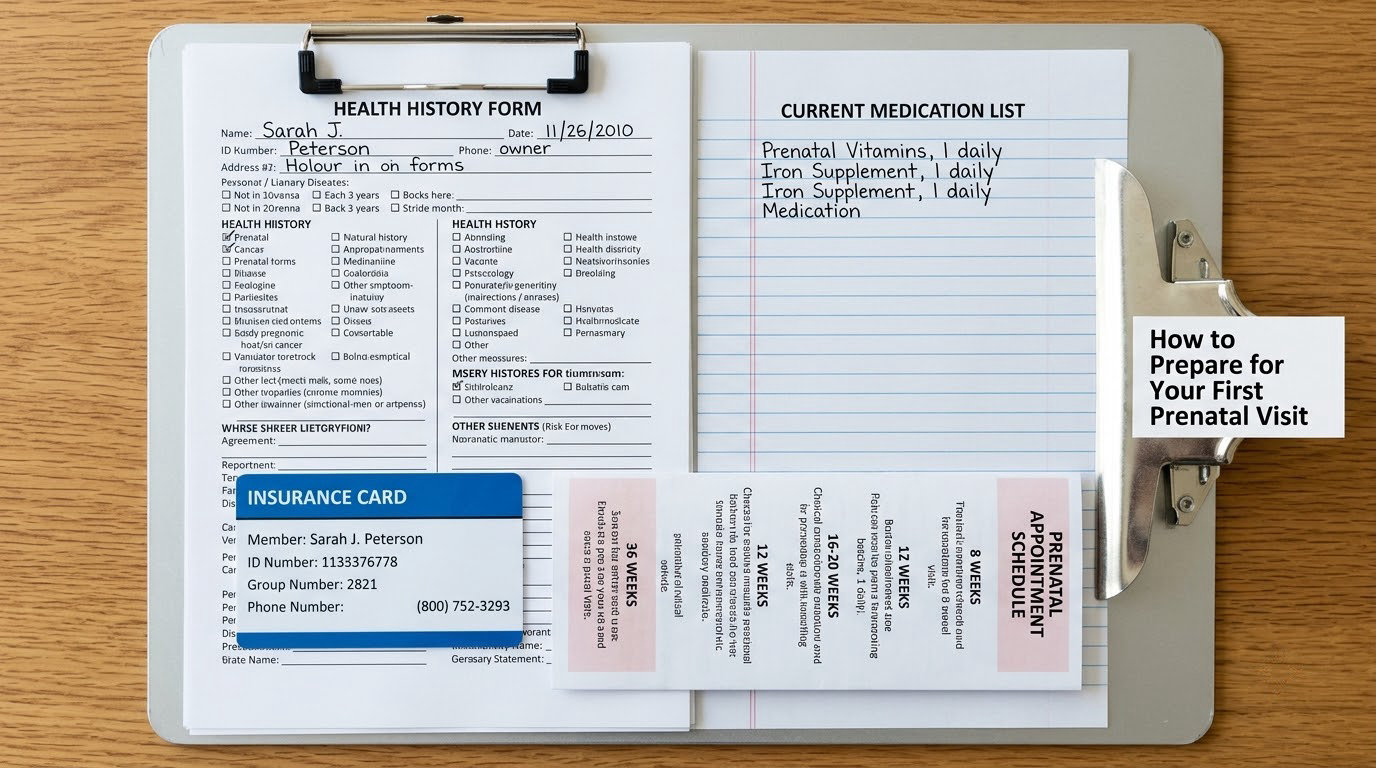
Ten minutes of preparation makes the visit noticeably better. Write down or gather the following before you go:
- The date your last period started. If you are not sure, an estimate is fine. Gestational age and the due date are both calculated from it.
- Every medication and supplement you take, including prescription drugs, over-the-counter pain relievers, prenatal vitamins, herbal products, and anything you take occasionally. Bring the bottles or a photo of the labels.
- Your insurance card and photo ID, plus any referral your plan requires.
- Records from previous pregnancies, including prenatal records, delivery notes, or genetic test results, if you have them.
- Your family health history. Think about parents, siblings, and grandparents: diabetes, high blood pressure, heart disease, thyroid problems, cancer, blood clots, and any inherited condition.
- Your questions, written down. People forget half of what they meant to ask in the room.
- A support person, if you want one. A partner, a friend, or a parent is welcome at almost every practice.
A few practical details. Wear something you can easily get in and out of, particularly if you are expecting a pelvic exam. Most offices will ask for a urine sample, and it is usually a clean catch: wash your hands, clean the area, start urinating, then catch the middle of the stream in the cup. You do not usually need to fast for first-visit labs, but ask when you book if your clinic wants you to. Some practices draw eight or more tubes of blood at once, which feels worse in theory than in practice.
What Happens at Your First Prenatal Appointment?
Here is the visit in order. Not every step happens at every appointment, and the length of each part varies by clinic, gestational age, and what you arrive with.
What to expect at your first prenatal appointment, step by step
- Check-in and paperwork. Insurance verification, consent forms, and often a long digital or paper questionnaire. Get this done online ahead of time if the office offers it.
- The health history interview. The provider asks about your medical conditions, surgeries, current and past medications, allergies, family history, prior pregnancies, and lifestyle. Expect questions about alcohol, caffeine, nicotine, cannabis, and other substances. These are screening questions, not traps, and honest answers lead to better care.
- Baseline measurements. Height, weight, and body mass index, plus blood pressure. These numbers set your trajectory for the whole pregnancy.
- Physical exam. A heart and lung check, a look at your breasts and abdomen, and often a pelvic exam to check the cervix and the size and position of the uterus. A Pap test or cervical cultures are done if you are due for them, which is usually based on age and the date of your last one.
- Lab work. A blood draw and a urine test. We list the common panels below.
- A dating ultrasound, sometimes at this visit and sometimes a few weeks later. It confirms how far along you are, checks for a heartbeat, and rules out a multiple pregnancy.
- The care plan. Scheduling, costs, what to do about nutrition and activity, and how to reach the office between appointments. Most practices book the next visit for somewhere around 9 to 14 weeks.
The pelvic exam is the part most people worry about, and it deserves a direct answer. It typically takes a few minutes. You lie back, feet in stirrups, and the provider checks the cervix and uterus through a speculum, sometimes with a swab. You can ask for a chaperone, you can ask the clinician to explain each step before it happens, and you can decline or postpone any part of the exam. A support person in the room is reasonable to request. If you have a history of trauma, say so before the exam begins rather than during, so the plan can be adjusted.
Which Tests or Screenings May Be Discussed?
These are routinely discussed, not imposed. Which ones actually happen at the first visit, which happen later, and which are optional depends on your provider, your history, and your choices.
| Test or screening | What it looks at | When it is usually discussed |
|---|---|---|
| Blood type and Rh factor | Your blood group and whether you are Rh positive or negative | First visit; identifies whether you need Rh immune globulin later |
| Complete blood count / hemoglobin | Red blood cell and iron levels, to screen for anemia | First visit, then again in the second trimester and near delivery |
| Rubella and varicella immunity | Whether you are immune to measles, rubella, and chickenpox | First visit |
| Hepatitis B, HIV, and STI screening | Infectious disease status, required in most jurisdictions | First visit, with consent |
| Urine sample and urinalysis | Protein, sugar, and infection signs; often a clean catch | Every visit |
| Pap test and cervical cultures | Cervical screening and infection swabs | First visit if you are due |
| Dating ultrasound | How far along you are, heartbeat, number of babies | Often 8 to 12 weeks |
| Cell-free DNA testing (NIPT) | Screening for certain chromosomal conditions from about 10 weeks | Offered to all patients; optional and personal |
| Carrier screening | Inherited conditions such as cystic fibrosis, spinal muscular atrophy, fragile X, and sickle cell disease | Offered at any visit; often done before or during pregnancy |
Genetic and carrier screening are choices, not requirements
Mainstream guidance, including from ACOG, is that genetic screening should be offered to all pregnant patients regardless of age or risk, and that declining is a perfectly reasonable decision. Screening tests estimate chances; they do not diagnose. If you want more detail before deciding, ask what each test can and cannot tell you, and ask when results would arrive.
What first-visit tests may cost
Most prenatal visits and standard first-trimester labs are covered by insurance when you are already in network, but the copay, your deductible, and lab billing vary widely by plan and state. NIPT and carrier screening are sometimes billed separately and may not be fully covered. Ask the office for the self-pay price of any optional test before you consent to it, and ask which lab your insurance requires, since using an out-of-network lab can leave you with a bill.
Questions to Ask at Your First Prenatal Appointment
Bring this list and pick the ones that matter to you. Ten minutes of question time is normal and expected.
- What is my estimated due date, and how confident are you in it?
- Do my symptoms so far fit a normal early pregnancy?
- Which of the labs being run today are required, and which are optional?
- What does a healthy weight gain range look like for me?
- What should I be eating, and how much caffeine is reasonable?
- Which of my medications and supplements should I change, and which should I keep taking?
- What is safe for me to do with exercise, work, travel, and sleep right now?
- Is a first-trimester screening test right for me, and when would I decide?
- How do I reach the nurse line or an on-call clinician after hours?
- What symptoms mean I should call today rather than wait for my next visit?
- When is my next appointment, and how do I reschedule?
- What will the total cost of my care look like, including lab work?
- Will I see the same provider each time, or does the office rotate?
- Can we discuss my birth preferences now, or is that a later conversation?
On birth plans: you can absolutely raise the topic at the first visit. You do not have to have a finished plan, and practices differ on when they want it. Some want it at the first appointment, others around 28 weeks, some at 36 weeks. Ask which policy your office follows so you know what to expect.
What Happens After the Appointment?
Before you leave, make sure you have four things: the date of your next appointment, a written summary of every test that was ordered or discussed, the office’s after-hours number, and the name of someone to ask for when you call with a question.
Complete any lab work within the window the office gives you. Many practices want genetic samples back within a set timeframe so results land before the anatomy scan, and late samples sometimes have to be redrawn.
Expect a call or a portal message about results, and do not assume silence means everything was fine. Ask how results are communicated and how long they usually take. If something comes back outside the expected range, a nurse will usually call to explain it and book a follow-up. Abnormal early results are common, often reflect nothing serious, and frequently need a repeat test rather than a change in care.
Some symptoms should not wait for your next appointment. Call the office, and go to urgent or emergency care when they say to, if you have heavy bleeding rather than light spotting, severe or one-sided pelvic pain, a fever, fainting, or vomiting so often you cannot keep fluids down. In the first trimester, heavy bleeding with or without pain needs urgent evaluation, and pain with bleeding or fever always does.
Most offices also run on group prenatal care, where visits happen with a cohort of patients at set times and include education time alongside the appointment. If your practice offers it, ask how it differs from one-on-one visits before you decide.
Frequently Asked Questions
How early should I go to my first prenatal appointment?
Most providers schedule the first prenatal visit between 6 and 10 weeks along, with about 8 weeks after the first day of your last menstrual period being the most common timing. Earlier is fine if you want a pregnancy confirmed or you have a medical reason to be seen. Booking sooner is also reasonable if you are 4 weeks along and anxious. Neither 4 weeks nor 12 weeks is disqualifying, so call the office and ask what they recommend for you.
Do all first prenatal appointments include an ultrasound?
No. Some practices order a dating ultrasound around 8 to 12 weeks, and some schedule it a few weeks later depending on how the visit went and how far along you were. A transvaginal early ultrasound is common before 12 weeks; an abdominal one usually comes a little later. If you do not have one at the first visit, that is normal. Ask when yours is planned so you know what to expect.
What should I bring to my first prenatal visit?
Bring your insurance card and photo ID, a written list of every medication and supplement you take, the first day of your last menstrual period if you know it, and records from earlier pregnancies or genetic testing. Write your questions down before you go, and bring a support person if having someone there would help. Wear clothing that is easy to get in and out of, since a pelvic exam is often part of the visit.
Can I ask about birth plans during the first appointment?
Yes, and it is worth asking, even if you do not have a finished plan yet. Ask which point in your pregnancy your provider wants to go through labor and delivery preferences, because practices differ: some start at the first visit, others wait until around 28 or 36 weeks. You can also ask how your hospital or birth center handles things like movement in labor, monitoring, and support people, so you know the rules early.
What if I am taking medication or supplements already?
Tell your provider about everything you take, including prescriptions, over-the-counter pain relievers, prenatal vitamins, herbal products, and anything occasional. Bring the bottles or a photo of the labels so doses are accurate. Do not stop a prescription on your own before the visit. Some medications are fine in pregnancy and some need adjusting, and your clinician can also confirm whether your prenatal vitamin contains enough folic acid.
What symptoms should I report before or during the first visit?
Report anything that worries you, including bleeding or spotting, cramping or pelvic pain, nausea and vomiting, breast changes, fatigue, dizziness, headaches, or mood changes. Mention the timing and how severe it is, and say whether anything makes it better or worse. Heavy bleeding, severe or one-sided pain, a fever, fainting, or an inability to keep fluids down need prompt contact with your provider or urgent care.
A Simple First-Step Plan
Before your first prenatal appointment, write down the key health details: the first day of your last period, every medication and supplement, your medical and family history, and any concerns you want addressed. Bring those notes with your insurance card, prior records, and a list of questions written down in the order you care about most.
On the day, ask how the practice wants results communicated and how to reach the nurse line after hours, then schedule the next visit before you leave. If you want to know how the visit compares to what others experienced, ask your provider directly: they will describe the routine parts, and you can add what you want done differently.
This article is general information, not medical advice. Your prenatal care team can give guidance specific to your history, your medications, and your pregnancy. Reach out to your provider or midwife for anything about your own care, and treat bleeding, severe pain, fever, or fainting as urgent.