If you are reading about amniocentesis, you are probably weighing a fairly simple question against a fairly complicated one. Amniocentesis is a diagnostic test in which a clinician uses ultrasound guidance to take a small sample of amniotic fluid from around the baby, usually after 15 weeks of pregnancy. It gives a clear answer about specific conditions where screening only gives a probability, and it carries a small but real risk that honest sources do not hide from you.
This is general educational information, not medical advice. Your own obstetrician, maternal-fetal medicine specialist or genetic counselor can tell you what applies to your pregnancy, and the figures below vary by operator experience, gestational age and circumstance.
Professional bodies such as ACOG and the RCOG publish patient guidance on prenatal diagnosis, and their general position is that amniocentesis done by an experienced operator is a safe, well-established procedure. What follows is what the procedure involves, how long the whole process takes, what the results mean, and the main risks in plain language.
Table of Contents
- What Is Amniocentesis?
- Why Is Amniocentesis Recommended?
- How Is the Procedure Performed?
- How Long Does Amniocentesis Take?
- What Can Amniocentesis Results Tell You?
- Normal, abnormal, and everything in between
- What Are the Main Risks of Amniocentesis?
- Your first 72 hours are when the risk concentrates
- How Do You Prepare for Amniocentesis?
- What Happens After the Procedure?
- Warning signs: when to call and when to wait
- How to Decide Whether Amniocentesis Is Right for You
- Frequently Asked Questions
- Does amniocentesis hurt?
- Can amniocentesis cause a miscarriage?
- How soon can I get amniocentesis results?
- What happens if the fluid leaks after amniocentesis?
- Which is better, NIPT or amniocentesis?
- Is it normal to feel sick after an amniocentesis?
- A Clear Conversation Is the Best First Step
What Is Amniocentesis?
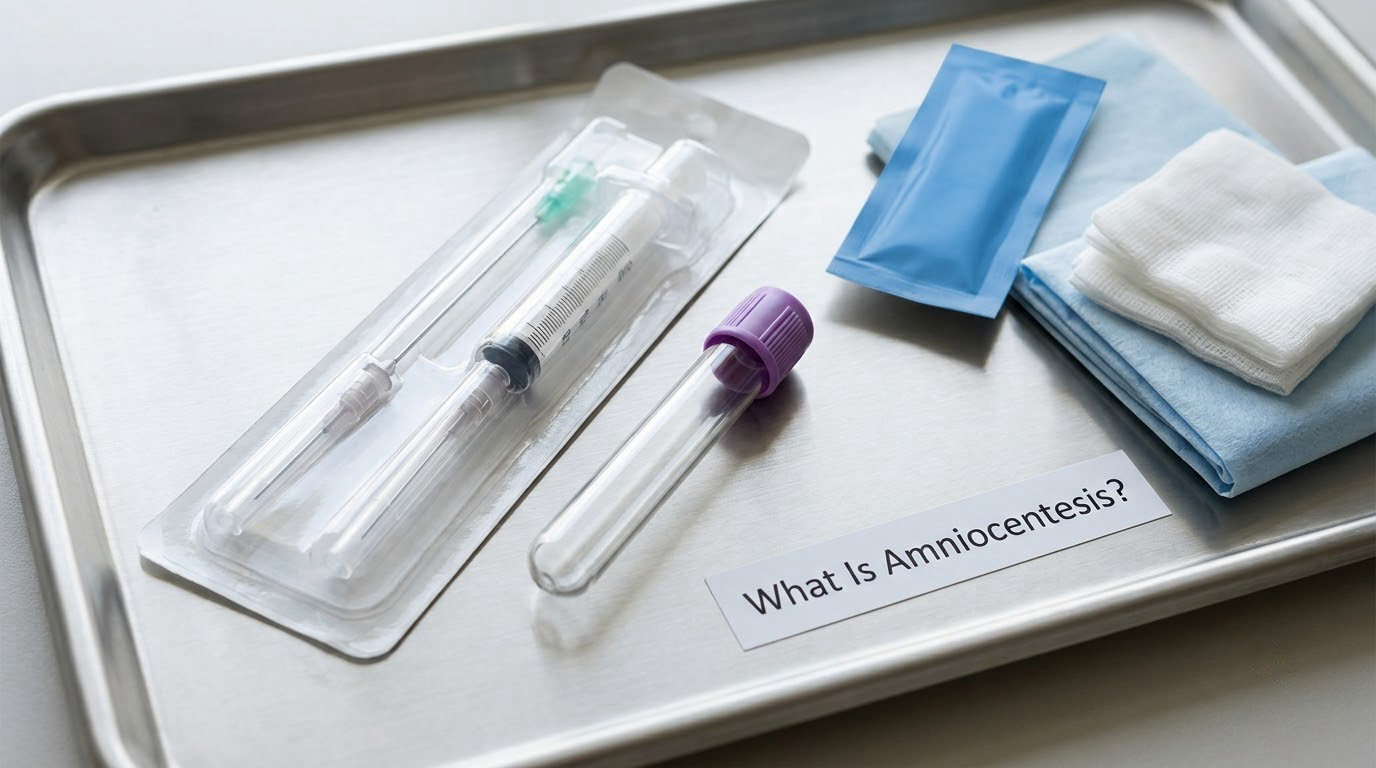
Amniocentesis is an invasive prenatal test: a thin hollow needle passes through the abdomen into the amniotic sac, about 15 to 20 ml of fluid is withdrawn, and most of it is put back before the needle comes out. The fluid contains fetal cells, which the laboratory grows and studies, and the fluid itself is tested for markers such as alpha-fetoprotein.
The single most useful thing to understand is the difference between screening and diagnosis. NIPT and the combined or quad screen look at cell-free DNA or blood markers and tell you how likely something is. Amniocentesis looks directly at fetal chromosomes and DNA, so it answers the question rather than estimating it. That is why people accept a small procedural risk for it.
| Test | Typical timing | Type | Pregnancy loss risk | Accuracy for the conditions it checks | Results time |
|---|---|---|---|---|---|
| Amniocentesis | 15 weeks and later | Diagnostic | Roughly 1 in 100 or lower after 15 weeks with an experienced operator | About 99% for the conditions it tests | Rapid result in 1 to 3 days; full results 10 to 14 days |
| CVS (chorionic villus sampling) | 10 to 13 weeks | Diagnostic | Comparable, around 1 in 100 to 1 in 200 | About 99% | Rapid result in 1 to 3 days; full results 10 to 14 days |
| NIPT (cell-free DNA) | From 10 weeks | Screening | None, because no needle is used | Very high screening sensitivity with a small false-positive rate | About 1 week |
CVS is the earlier diagnostic option. It cannot test for open neural tube defects, which is why many people who have a CVS go on to have an amniocentesis in the second trimester. NIPT carries no procedural risk but is a screen, not an answer, and roughly one in a hundred high-risk NIPT results turns out to be a false positive.
Why Is Amniocentesis Recommended?
Clinicians offer amniocentesis for a specific set of reasons, and you are entitled to ask which one applies to you before you decide anything. Age of 35 or older at the expected delivery date is the classic reason, because the risk of a chromosomal condition rises gradually with age and many people want the certainty anyway rather than a probability. An abnormal screening result is the other common one, whether that is a high-risk NIPT or an abnormal combined screen.
An ultrasound finding can also prompt it. That might be a soft marker, such as an echogenic bowel loop or a short nasal bone, or it might be a structural concern that deserves a genetic explanation. Family history matters too, particularly if a previous pregnancy had a chromosomal abnormality or if either parent carries a balanced translocation. There are also medical reasons unrelated to chromosomes, such as checking for fetal infection like CMV or toxoplasmosis, measuring fetal lung maturity before a planned early delivery, or assessing anemia in an Rh-negative pregnancy.
Sometimes the reason is simply preference. Some people want the answer because they would act on it and some because knowing helps them prepare, and that is a legitimate reason. None of these situations means you are required to have the procedure. Declining it and continuing the pregnancy regardless of the result is a decision people make every day, and a good clinician will not pressure you either way.
How Is the Procedure Performed?
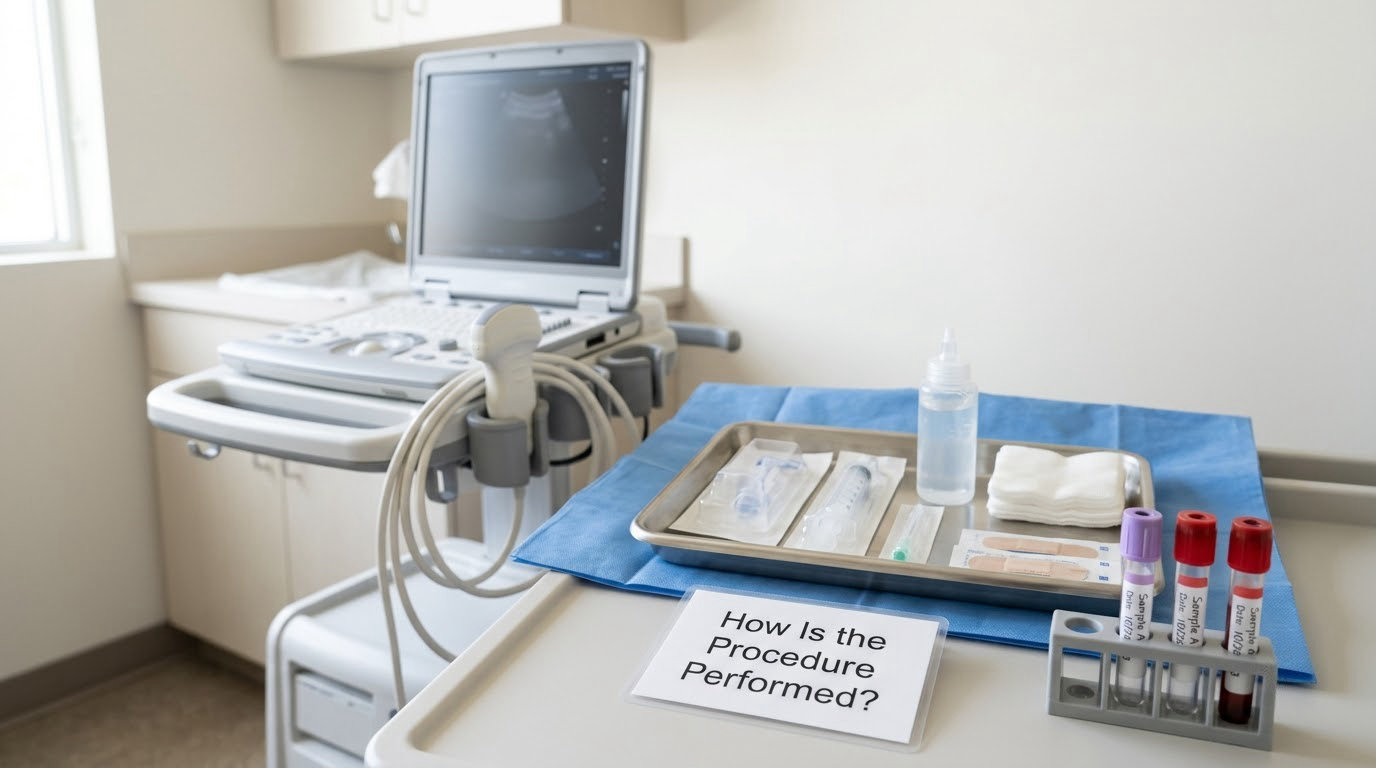
The procedure itself is short and takes place in an outpatient clinic, usually with you lying on your back. Most people describe the sensation as uncomfortable rather than painful, and most go home within an hour.
- Before you arrive, a dating ultrasound confirms how far along you are. It also confirms that there is a pregnancy to sample and lets the team find the safest pocket of fluid.
- You lie back and the ultrasound maps the baby, the placenta and the umbilical cord. The clinician picks a route that avoids the baby and the cord, usually on the side where there is room.
- The skin is cleaned with an antiseptic such as povidone-iodine. You may feel cold, and you will smell the antiseptic for a while afterward.
- A local anaesthetic is offered. It numbs the skin and the tissues underneath, and it is what makes the next part tolerable. Most people say they could feel pressure and layers of tissue but not sharp pain.
- A thin needle, usually 20 to 22 gauge, passes in under continuous ultrasound. You will feel a sting and then a stretching or cramping sensation as it passes through the abdominal wall and the uterus.
- The first fluid drawn is discarded. That small amount may contain your own cells, and throwing it away keeps them out of the sample the laboratory works with.
- About 15 to 20 ml is collected into labeled tubes. Some people report feeling the fluid move, or a hot flushed feeling, because the fluid is near body temperature. If the first pass returns only foam or blood, a second attempt may be needed, and many providers limit themselves to two attempts in one day.
- The fluid is returned to the sac and the needle is withdrawn. The site is covered with a small dressing, and you are monitored briefly with the baby’s heartbeat checked before and after.
If you are Rh-negative, expect an injection of anti-D immunoglobulin, sometimes called RhoGAM, either before or shortly after the procedure. It is a routine precaution against your immune system reacting to the baby’s blood cells.
How Long Does Amniocentesis Take?
The procedure takes roughly five to ten minutes, and the appointment usually runs 30 to 45 minutes once you include the pre-procedure scan and the observation period afterward. Most people go home the same day.
The wait for results is the part people underestimate. A rapid aneuploidy test such as FISH often comes back within one to three days, the full karyotype takes 10 to 14 days, and a chromosomal microarray can add more time on top of that. If your clinic needs to send the sample to a specialised laboratory, add several days to that. Ask what tests are being ordered and when you should expect to hear.
On parent forums, the waiting is described far more often as the hard part than the needle. If you know which results are arriving on which day, the silence is easier to sit with than an open-ended wait.
What Can Amniocentesis Results Tell You?
A result comes back in one of three shapes, and it helps to know all three before you consent.
Normal, abnormal, and everything in between
Most results are normal. Some come back abnormal for a chromosome condition such as trisomy 21, 18 or 13. A smaller number are neither clearly normal nor clearly abnormal, and that middle category is usually a variant of uncertain significance on the microarray, meaning the laboratory found a small change it cannot classify as harmful or harmless. Your genetic counselor interprets those in the context of your pregnancy rather than reading the report on its own.
A normal amniocentesis is a strong result for the conditions it tested, but it is not a guarantee of everything. It does not exclude every single-gene condition, most metabolic disorders, or conditions that only show up later in development. If you have a specific family history, ask which conditions a standard panel would miss.
| Result | What it covers | Typical turnaround |
|---|---|---|
| Rapid aneuploidy testing (FISH) | The common chromosome conditions, such as trisomy 21, 18 and 13 | 1 to 3 days |
| Karyotype | All chromosomes at a coarser level, including larger structural changes | 10 to 14 days |
| Chromosomal microarray | Smaller deletions and duplications that a karyotype can miss | Often 1 to 3 weeks |
| Alpha-fetoprotein and acetylcholinesterase | Open neural tube defects such as spina bifida | Usually with the full results |
What Are the Main Risks of Amniocentesis?
The biggest risk is a small increase in the chance of pregnancy loss. Most patient guidance puts procedure-related loss at around 1 in 100 or lower when the procedure is performed after 15 weeks by an experienced operator, and estimates range more widely before 15 weeks. That figure varies by operator, by how many procedures that clinician performs, and by your circumstances before the procedure, which is why asking your clinic for its own recent numbers is a reasonable question to ask.
Some of that loss is background risk that would have happened anyway. Pregnancies that reach the second trimester already carry a baseline risk of loss, and studies that try to separate the two produce different numbers. Treat any single figure you read, including the one here, as a range rather than a promise.
The main downsides and complications, roughly in order of how often they come up:
- Pregnancy loss. Around 1 in 100 or lower after 15 weeks, higher before 15 weeks.
- Fluid leaking from the vagina. A small amount of clear fluid is not unusual in the days afterward. A significant loss of fluid needs medical attention.
- Vaginal bleeding or bleeding from the puncture site. Light spotting is common, and heavy bleeding is not.
- Cramping and soreness. Period-like cramps for a few hours to a few days, and tenderness at the site.
- Infection. Rare, and lower when the procedure is done in a clean clinical setting with antibiotic cover where indicated.
- Amniotic fluid mixing with your blood. Reported in a small number of procedures, which is part of why Rh-negative patients are given anti-D.
- Rh sensitization. Prevented in almost all cases by the anti-D injection.
- Needle injury. Extremely uncommon when an ultrasound is used continuously to guide the needle, and the reason the scan is not optional.
- A failed sample. If the fluid cannot be obtained, the procedure may need repeating on another day.
- A result that is difficult to interpret. This is not a physical risk, but it is a real one and people rarely expect it.
Your first 72 hours are when the risk concentrates
Most procedure-related losses happen within the first three days, and the risk falls sharply after that. That is why most aftercare advice concentrates on the first 24 to 72 hours, and why that window is also the one where anxiety is highest. It is worth saying plainly: if you get past three or four days with no change, you are through the part of the risk curve that the procedure contributed to.
There are also situations where an amniocentesis may not be the right choice. Very low fluid, an active infection such as HIV or hepatitis B, and blood-thinning medicines that cannot be paused all change the risk conversation. Bring all of it up before you consent.
How Do You Prepare for Amniocentesis?
Preparation is mostly administrative, and it is worth doing early because the test is often offered quickly after a high-risk screen arrives. Call the clinic or your provider and ask about the following before the day itself.
- Medications. Tell them about everything you take, including blood thinners, aspirin, over-the-counter supplements and herbal remedies. Ask whether any need to be paused and for how long.
- Allergies. Povidone-iodine, latex, local anaesthetics and antibiotics are the ones worth flagging explicitly.
- Blood type and Rh status. Find out in advance so you know whether anti-D will be offered.
- Previous procedures. Tell them about any prior amniocentesis, CVS, cerclage or uterine surgery.
- Infection exposure. Recent fever, a cold, or any suspected infection is worth mentioning, because sometimes the appointment gets rescheduled.
- Food, drink and bladder. Follow whatever your clinic instructs. Many ask you to eat normally beforehand and to arrive with a partially full bladder so the uterus sits higher and the fluid pocket is easier to reach.
- Transport and company. You may feel woozy, especially if you are someone who faints at blood draws. Bring someone, and plan not to drive yourself home if that is you.
- What to bring. Loose clothing that lifts easily above the waist, a pillow if you want to support your back, and a list of your questions.
Ask for the specific questions too. How many amniocenteses does the person doing it perform each year? What is your clinic’s own recent loss rate? Which tests are being ordered, and when will each result arrive? Who will call me with the results, and what should I do in the meantime if I cannot reach them?
What Happens After the Procedure?
Most people feel fine enough to go straight home, and many go back to normal within a day. The pattern below is roughly what the first week looks like.
In the first 24 hours, expect cramping, tenderness at the needle site, and a general sense of being unwell. Nausea, sometimes vomiting, does happen and catches people out because they are not warned about it. Rest, keep fluids up, and follow whatever activity guidance your clinic gave you.
From day two to day seven, cramping usually eases but the site can stay tender, and some people are noticeably sore for several days rather than one. Backache is common and usually settles. Plenty of parents say they took a day or two off work, which is more than the standard 24-hour advice suggests they needed.
For sleep, side sleeping with a pillow between your knees or supporting your bump usually settles the lower back. A warm pack, not a hot one, and the paracetamol your clinician has approved will do more than most people expect.
Warning signs: when to call and when to wait
Sort what you are feeling into one of these two lists, because the ambiguity is what makes the first few days so hard.
Call your clinic today:
- Heavy bleeding, like a period or worse
- Clear fluid leaking from the vagina that continues or increases
- Fever, chills, or feeling hot and unwell
- Abdominal pain that is getting worse instead of settling
- Contractions, or a change in the usual pattern of your baby’s movements
Usually expected and tends to settle within a day or two:
- Period-like cramping
- Spotting that is pink or brown and light
- Soreness at the puncture site
- Feeling tired, or mildly nauseous
- Lower backache
Seek urgent care for heavy bleeding, a gush of fluid, fever with pain, or a significant reduction in fetal movement rather than waiting for a routine call back.
How to Decide Whether Amniocentesis Is Right for You
Whether amniocentesis is worth the risk comes down to what you would actually do with the answer, how you feel about the procedure, and how much uncertainty you can carry. There is no correct answer that fits everyone, and no answer that is right for you on someone else’s behalf.
A workable way through it is to write down four things before the appointment. First, what you would do if the result were abnormal. People who would continue the pregnancy regardless often find that the uncertainty itself was the deciding factor; people who would want more time, more information or a different birth plan often find the answer is worth having. Second, which specific conditions you want tested and which you would not want to know about. Third, how much risk you are comfortable with once your clinic gives you their own numbers rather than a range from the internet. Fourth, how long you can wait without the information driving you.
If you already know you will continue the pregnancy whatever the result says, that is a complete and reasonable position, and declining the procedure carries no medical risk at all. If you want the answer, a small procedural risk against near-certainty about a serious condition is a trade many families make without regret. Guilt shows up on both sides, which is worth knowing in advance.
A prenatal genetic counselor is the single most useful appointment you can make. They are trained in exactly this conversation, they can tell you what your specific numbers mean in context, and they will not push you toward a choice. Book one before you consent if at all possible.
If you and your partner disagree, the framing that helps is not who is right but what each of you would do differently with the information. Occasionally that reveals the disagreement is smaller than it looked. If it does not resolve, a counselor can act as a neutral third party rather than taking sides.
On cost, be upfront about it. The procedure, the laboratory tests, and genetic counseling are often billed separately, and some plans cover diagnostic testing but not counseling. Ask the clinic for a written estimate before the day, and check whether your insurer requires pre-authorisation. Getting the full cost in writing prevents an unpleasant surprise weeks later.
Whatever you decide, ask your clinician for your clinic’s own amniocentesis numbers before you sign the consent form. Everyone has a rate. Knowing yours is better than guessing from a figure written for a completely different patient.
Frequently Asked Questions
Does amniocentesis hurt?
Most people describe the procedure as uncomfortable rather than sharply painful, because a local anaesthetic numbs the skin and the needle passes through the abdomen under continuous ultrasound guidance. People report a sting, then pressure and a stretching feeling as the needle moves through tissue, and some notice a hot flushed sensation while fluid is drawn. The whole procedure takes about five to ten minutes, and the cramping afterwards is commonly compared to period pain.
Can amniocentesis cause a miscarriage?
Amniocentesis is generally considered safe when performed by an experienced clinician, but it is not risk-free. The main concern is a small increase in the chance of pregnancy loss, and estimates vary by gestational age, operator experience and individual circumstances. Most guidance puts procedure-related loss at around 1 in 100 or lower after 15 weeks, and higher before 15 weeks. Ask your clinic for its own recent figures.
How soon can I get amniocentesis results?
The timing depends on the laboratory and on which tests were ordered. Rapid aneuploidy testing such as FISH often returns within one to three days, a full karyotype takes 10 to 14 days, and a chromosomal microarray can extend that further. Ask your provider which tests are being run and when each should arrive, and who will contact you with them.
What happens if the fluid leaks after amniocentesis?
A small amount of vaginal spotting or clear fluid leakage can occur, and a little leakage often settles on its own within a day. Persistent or heavy leakage needs medical attention. Call the clinic that performed the procedure for guidance. Seek urgent care for a gush of fluid, heavy bleeding, or fever alongside abdominal pain, and let your provider know your fluid and blood type in case anti-D is needed.
Which is better, NIPT or amniocentesis?
They answer different questions. NIPT is a blood test with no procedural risk, but it gives a probability and produces false positives and false negatives. Amniocentesis is diagnostic, accurate for the conditions it tests, and carries a small procedure-related risk of pregnancy loss. Many people use NIPT as a screening step and amniocentesis only when they want a definitive answer.
Is it normal to feel sick after an amniocentesis?
Yes. Nausea, sometimes vomiting, along with cramping, tenderness at the puncture site and general tiredness, is reported by a fair number of people in the hours and days afterward. It usually settles with rest, fluids and time. Contact your clinic if the sickness comes with fever, chills or abdominal pain that is getting worse rather than easing.
A Clear Conversation Is the Best First Step
Amniocentesis is a short, ultrasound-guided procedure that takes about five to ten minutes, gives a definitive answer on the conditions it tests, and carries a small risk of pregnancy loss that is higher before 15 weeks than after. Most of what makes it frightening is uncertainty rather than pain, and almost all of that uncertainty can be reduced before you consent.
Ask your obstetrician or maternal-fetal medicine specialist whether the procedure is appropriate for your circumstances, ask a prenatal genetic counselor what your specific screening numbers mean, and ask the clinic for its own loss rate and its expected result timeline. Those three conversations will tell you more than any article, including this one.