Short answer: NIPT detects roughly 99% of cases of Down syndrome, and it is a screening test, not a diagnosis. If you are asking how accurate is NIPT for Down syndrome, the honest answer has three parts: the detection rate is excellent, the false-positive rate is very low, and the chance that your result is correct depends on how common Down syndrome is in people like you.
That last part is where most confusion starts. A test can miss about 1 in 100 affected pregnancies and still throw up a false alarm in many pregnancies that are entirely unaffected. Both things are true at the same time.
Quick accuracy breakdown for trisomy 21:
- Sensitivity (detection rate): about 99%, with published meta-analysis figures of 99.2% and 99.7%.
- Specificity: above 99%, corresponding to a false-positive rate of roughly 0.04% to 0.09%.
- Positive predictive value (PPV): the chance a high-chance result is real. It ranges from about 71% to about 96% depending on the underlying prevalence of Down syndrome in the population being screened.
| Measure | Reported figure for trisomy 21 | What it means |
|---|---|---|
| Detection rate (sensitivity) | ~99% (range 99.2% to 99.7% in meta-analyses) | About 1 in 100 cases is missed |
| False-positive rate | 0.04% to 0.09% | About 1 in 1,100 to 1 in 2,500 unaffected pregnancies screens high chance |
| PPV at 1 in 1,000 prevalence | ~71% | Most high-chance results are still false in a low-risk population |
| PPV at 1 in 100 prevalence | ~96% | High-chance results are far more trustworthy |
| Amniocentesis / CVS miscarriage risk | ~0.1% to 0.3% | The risk people weigh against an invasive confirmatory test |
| Earliest gestational age | About 10 weeks | Earlier than the combined or quad screen |
Medical note: this article is general information, not medical advice. It cannot tell you anything about your own pregnancy. Decisions about screening and diagnostic testing belong with your obstetric clinician or a genetic counselor who knows your history.
Table of Contents
- How Accurate Is NIPT for Down Syndrome?
- What Does NIPT Measure?
- How Accurate Is NIPT for Detecting Down Syndrome?
- What Do Sensitivity and Specificity Mean?
- Why Can NIPT Give a False Positive?
- Why Can NIPT Miss Down Syndrome?
- Does Maternal Age Change NIPT Accuracy?
- How Does NIPT Accuracy Differ in Twin Pregnancies?
- What Happens After a High-Risk NIPT Result?
- How Do You Discuss NIPT Results With a Clinician?
- Frequently Asked Questions
- Can NIPT testing be wrong for Down syndrome?
- What is the most accurate test for Down syndrome?
- What is the likelihood of a false positive NIPT test for Down syndrome?
- How often is NIPT wrong about Down syndrome?
- Does NIPT tell you if baby has Down syndrome?
- What Should You Do First?
- Sources and Clinical References
How Accurate Is NIPT for Down Syndrome?
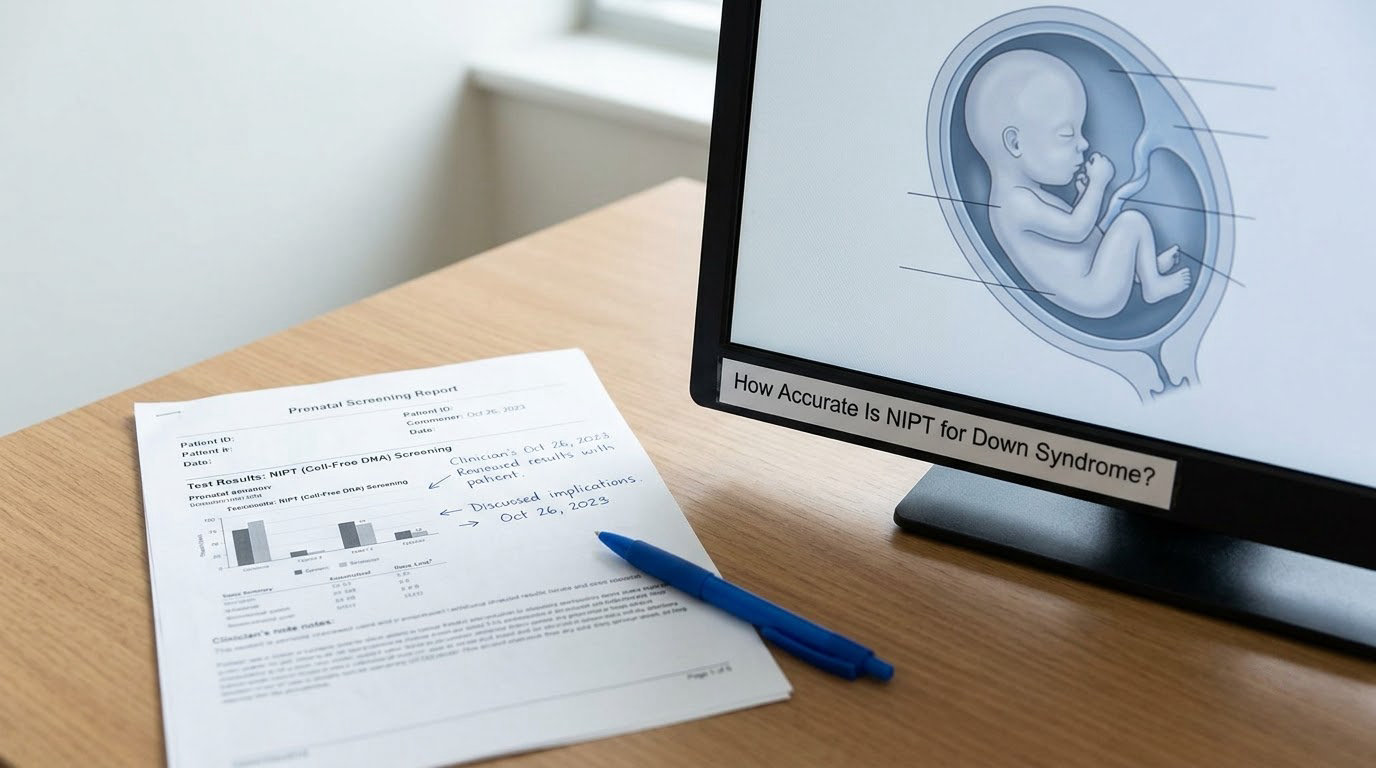
NIPT, or non-invasive prenatal testing, has a detection rate of about 99% for Down syndrome. It is the most accurate screening test currently available, and it carries no risk to the pregnancy. It is not, however, 100% definitive in either direction.
Three separate numbers get collapsed into the phrase “99% accurate,” and they do different jobs. Sensitivity describes how many affected pregnancies the test catches. Specificity describes how many unaffected pregnancies it correctly clears. Positive predictive value describes how likely a high-chance result is to be real, and it is the only one of the three that changes from one patient to the next.
Down syndrome, also called trisomy 21, is the most common chromosomal condition seen at birth. It is also one of the easiest for NIPT to detect, which is why trisomy 21 accuracy figures sit near 99% while figures for trisomy 13 run as low as 44%.
What Does NIPT Measure?
NIPT is a blood test. It analyzes cell-free DNA — fragments of DNA that circulate in the maternal bloodstream, most of which come from the mother, with a smaller fetal portion. That fetal portion is what the laboratory sequences.
The laboratory reports the fetal fraction, which is the percentage of the sample that is fetal DNA. It then looks for extra copies of chromosome 21 material. An excess suggests trisomy 21, and the result comes back as high chance, low chance, or no-call.
The word “chance” is doing real work in that report. NIPT estimates probability. It does not count chromosomes in the fetus itself, so it cannot give a definitive yes or no.
The difference matters because diagnostic tests do count chromosomes. Chorionic villus sampling (CVS) and amniocentesis take a direct sample and can return a firm answer. That is the entire reason a screening result is followed by a conversation about whether to confirm.
How Accurate Is NIPT for Detecting Down Syndrome?
For trisomy 21 specifically, detection rates of about 99% are consistently reported. Gil and colleagues’ meta-analysis of cell-free fetal DNA screening reported a detection rate of 99.7% with a false-positive rate of 0.04%. Other meta-analyses report 99.2% detection with a 0.09% false-positive rate.
Published figures vary because they depend on how a study was run. Confirming every screen with an invasive test, which every rigorous study does, produces different numbers than a study that follows only the pregnancies clinicians chose to test. Maternal age mix matters too, as does which laboratory platform was used and how low the fetal fraction ran.
Real-world false-positive rates often sit a little higher than meta-analysis figures, because the patients screened in routine practice include low fetal fractions, twin pregnancies and IVF pregnancies that controlled studies tend to exclude. Clinicians who quote you a specific number for your situation are usually reading it off their own lab’s data.
What Do Sensitivity and Specificity Mean?
Sensitivity answers: of 100 babies with Down syndrome, how many did the test flag? Specificity answers: of 100 babies without it, how many did the test correctly clear?
Here is how a test with 99.7% sensitivity and a 0.04% false-positive rate behaves in two very different populations, using a group of 10,000 pregnancies each.
| Scenario | Affected pregnancies | True positives caught | False positives | PPV |
|---|---|---|---|---|
| Prevalence 1 in 1,000 (a lower-risk population) | 10 | ~10 | ~4 | ~71% |
| Prevalence 1 in 100 (a higher-risk population) | 100 | ~100 | ~4 | ~96% |
Look at the false-positive column. In both rows the test generates roughly four false alarms out of 10,000, because the false-positive rate does not change with age. What changes is how many true cases there are to sit alongside them.
That is base-rate reasoning, and it is the single most useful concept in understanding NIPT accuracy. When the condition is uncommon, an excellent test still produces enough false alarms to outnumber the true positives.
Why Can NIPT Give a False Positive?
The most common explanation is confined placental mosaicism. The placenta and the fetus are separate tissues with separate DNA. If the extra chromosome 21 material is present in the placenta but not the baby, the test reads high chance and the baby is unaffected.
A vanishing twin does something similar. An early pregnancy loss of a second embryo can leave its DNA circulating, and that DNA may carry a chromosomal pattern different from the surviving fetus.
Other contributors include:
- Low fetal fraction. Below roughly 4%, the lab often cannot run the analysis reliably, and will report a no-call rather than guess.
- Maternal chromosomal findings. Rare rearrangements or mosaicism in the mother’s own cells can shift the reading.
- Sampling and reporting factors. Insufficient sample, a delayed or compromised sample, or simply a technical failure in a specific run.
- Triploidy and structural chromosome changes. These can distort the chromosome 21 signal in ways that produce a misleading high-chance call.
A normal ultrasound does not cancel a high-chance result, and a high-chance result does not override a normal ultrasound. Clinicians weigh both. What the ultrasound mainly rules out is a different situation: a pregnancy where the anatomy itself is clearly abnormal, which raises the concern independently of the blood test.
Why Can NIPT Miss Down Syndrome?
With a detection rate near 99%, misses are uncommon, but they do happen. The most common reason is simply not enough fetal DNA to analyze confidently.
Placental-versus-fetal differences can work the other way too. If the placental sample under-represents the fetal chromosome pattern, a genuinely affected fetus can read as low chance.
Timing contributes. Testing too early leaves less fetal DNA in circulation. Some laboratories do not process samples before 10 weeks for this reason.
Multiple pregnancies complicate the biology. In twins, the total fetal DNA contribution and its distribution between the two fetuses both vary, and neither fetus is separately assessed.
There is also the harder category: a low-chance result followed by a scan showing a soft marker, or a clinician’s concern after birth. The right response is not to dismiss the blood test but to raise it with your clinician, because a low-chance NIPT reduces the prior chance and does not zero it out.
Does Maternal Age Change NIPT Accuracy?
The sensitivity and specificity of the test itself do not change with maternal age. What changes is prevalence, and therefore PPV.
Down syndrome is much more common at older maternal ages. A high-chance result at 41 carries a very different meaning from the same result at 25, not because the laboratory got better or worse, but because there are more true cases in the second group for the result to be among.
This is also why the same screening result produces such different reactions in different households. Two parents can receive an identical report and be facing genuinely different odds.
One more wrinkle: reported false-positive rates can drift with age as well, because some of the false positives come from age-related maternal chromosomal changes rather than anything about the fetus.
How Does NIPT Accuracy Differ in Twin Pregnancies?
Twin pregnancies carry real limitations that singletons do not. Both fetuses contribute DNA to the same sample, so the laboratory is reading a blended signal and cannot fully separate the two.
In dichorionic twins, where the babies have separate placentas, a small proportion of DNA can come from either placenta. In monochorionic twins, which share one placenta, a finding present in the shared placenta but not in either fetus can produce a high-chance result for a condition neither baby has.
Total fetal fraction also tends to run lower in twins, which raises the rate of no-call results. Many laboratories specify a lower threshold for multiple pregnancies, or decline to screen twins at all above a certain order.
If you are expecting twins, ask your provider specifically how their laboratory handles multiple pregnancies. The general accuracy figures quoted in this article come largely from singleton studies.
What Happens After a High-Risk NIPT Result?
A high-chance result is a starting point, not an ending. The pathway below is the general one most prenatal services follow.
- Contact your prenatal provider promptly. Ask for the full report, not just the summary line, including the fetal fraction and the screen’s stated limitations.
- Review ultrasound findings carefully. Ask whether the dating scan and any later scans showed structural differences relevant to the result.
- Meet with a genetic counselor. A genetic counselor works through what your specific result means for your pregnancy, in detail and without pressure.
- Decide about confirmatory testing. CVS is generally done from about 11 to 14 weeks and samples placental tissue. Amniocentesis is generally done from about 15 weeks and samples amniotic fluid.
- Weigh the small procedural risk. Published miscarriage risk for CVS and amniocentesis is roughly 0.1% to 0.3%, and that is weighed against the unresolved chance that the screening result is real.
- Plan the waiting period. Confirmatory results often take one to two weeks. Many clinics offer a call to go through the result with you, and it is worth asking for that in advance.
People describe the wait as the hardest part, and it usually is. Knowing the timeline in advance, and who will call you when the result lands, makes it more bearable.
How Do You Discuss NIPT Results With a Clinician?
Seven questions are worth writing down before the appointment. They get you past the headline number and into what applies to you.
- What is my specific PPV, based on my age and my lab’s own data?
- What was my fetal fraction, and did it fall inside the lab’s acceptable range?
- What are the limitations of the specific platform used for my test?
- Do my ultrasound findings agree or disagree with the result, and how are you weighing them?
- What would CVS versus amniocentesis tell me differently, and at what point in pregnancy would each be offered?
- Is there anything about my history that changes the prior chance, such as a previous affected pregnancy?
- What happens next if I decide not to have confirmatory testing?
Asking for your clinic’s own statistics rather than a published average is the single most useful thing you can do. Your provider sees hundreds of these results a year and can tell you what their lab actually produces.
Frequently Asked Questions
Can NIPT testing be wrong for Down syndrome?
Yes. NIPT is a screening test, so it can be wrong in both directions. It misses roughly 1 in 100 cases of trisomy 21, and it reports high chance in a small number of unaffected pregnancies, mostly because of placental mosaicism or a vanishing twin. Only CVS or amniocentesis can confirm the result.
What is the most accurate test for Down syndrome?
The most accurate test is amniocentesis or CVS, which sample fetal or placental tissue directly and return a definitive chromosome result, with a small procedural risk of about 0.1% to 0.3%. NIPT is the most accurate screening test, detecting about 99% of cases without any risk to the pregnancy.
What is the likelihood of a false positive NIPT test for Down syndrome?
For trisomy 21 the reported false-positive rate is about 0.04% to 0.09%, which is roughly 1 in 1,100 to 1 in 2,500 unaffected pregnancies. Whether your specific high-chance result is a false alarm depends on your age and baseline risk, which together determine the positive predictive value.
How often is NIPT wrong about Down syndrome?
It misses about 1% of trisomy 21 cases. Most misses trace back to too little fetal DNA in the sample, a placental-versus-fetal difference, or testing that some laboratories decline to run before 10 weeks. False positives are rarer still for trisomy 21, though real-world rates can run slightly above published meta-analysis figures.
Does NIPT tell you if baby has Down syndrome?
No. NIPT estimates the chance that a chromosome condition is present, which is why reports are worded as high chance or low chance rather than affected or unaffected. A low-chance result makes Down syndrome much less likely but not impossible. A definitive answer requires chorionic villus sampling or amniocentesis.
What Should You Do First?
Get the full report in hand, not the one-line summary, and read the fetal fraction and the stated limitations. Then take that report to your prenatal clinician or a genetic counselor and ask what the numbers mean for your age and your circumstances.
Keep one sentence in mind as you do: NIPT is a screening test, not a diagnosis. It is very good at telling you who deserves a closer look. Confirming is a separate decision, made with a clinician who knows your pregnancy.
Sources and Clinical References
- Gil MM, et al. Meta-analysis of cell-free fetal DNA screening for trisomy 21. Ultrasound in Obstetrics and Gynecology.
- Bianchi DW, et al. Noninvasive prenatal testing for fetal aneuploidy. NEJM 2014;370:799-808.
- Norton ME, et al. Cell-free DNA analysis for trisomy 21. NEJM 2015.
- RCOG Scientific Impact Paper No. 15: non-invasive prenatal testing for chromosomal abnormality.
- NHS Fetal Anomaly Screening Programme guidance on combined and quadruple testing.
- ACOG and SMFM practice guidance, with ISUOG guidance, on cell-free DNA prenatal screening.