If you have been offered a NIPT test, here is the short version: it is a blood test, usually done from 10 weeks of pregnancy, that counts tiny fragments of DNA from the placenta floating in your blood to estimate the chance that your baby has Down syndrome, Edwards syndrome or Patau syndrome. It is a screening test, not a diagnosis. This guide covers what it screens for, how to read the words on your report, and what happens next whichever result you get.
Most people who book NIPT fall into one of two groups. Some want early reassurance, because the blood test can be done earlier than any other prenatal screening. Others are there because of an age-related risk, a family history, or a high-risk result on an earlier combined screen.
Whichever camp you are in, the hardest part is rarely the blood draw. It is the report, and the weeks of waiting for it. People describe that gap on r/NIPT and r/pregnant as the hardest stretch of the whole pregnancy, and they describe the same thing: not knowing whether a number on a page means a problem or nothing at all.
NIPT test explained in plain language comes down to two ideas: what the number on the page is actually measuring, and what it is not. So let us take the report apart word by word. This is general information to help you have better conversations with your care team, not medical advice. Decisions about your pregnancy belong with a midwife, obstetrician or genetic counsellor who knows your history.
Table of Contents
- What Does a NIPT Test Screen For?
- NIPT Test Explained in Plain Language: The Core Idea
- What Do NIPT Results Mean?
- A plain-English glossary of the words on your report
- What Is the Difference Between Screening and Diagnosis?
- How Accurate Is NIPT?
- Can NIPT Have False Positives or False Negatives?
- When Is NIPT Usually Done?
- What Are the Risks and Limitations of NIPT?
- How Much Does NIPT Cost?
- Questions to Ask Your Doctor or Genetic Counselor
- Frequently Asked Questions
- Is NIPT screening or diagnostic?
- What does a low risk NIPT result mean?
- What does a high risk NIPT result mean?
- Is 14 weeks too late to have NIPT?
- How common are inconclusive NIPT results?
- What to Do Next
What Does a NIPT Test Screen For?
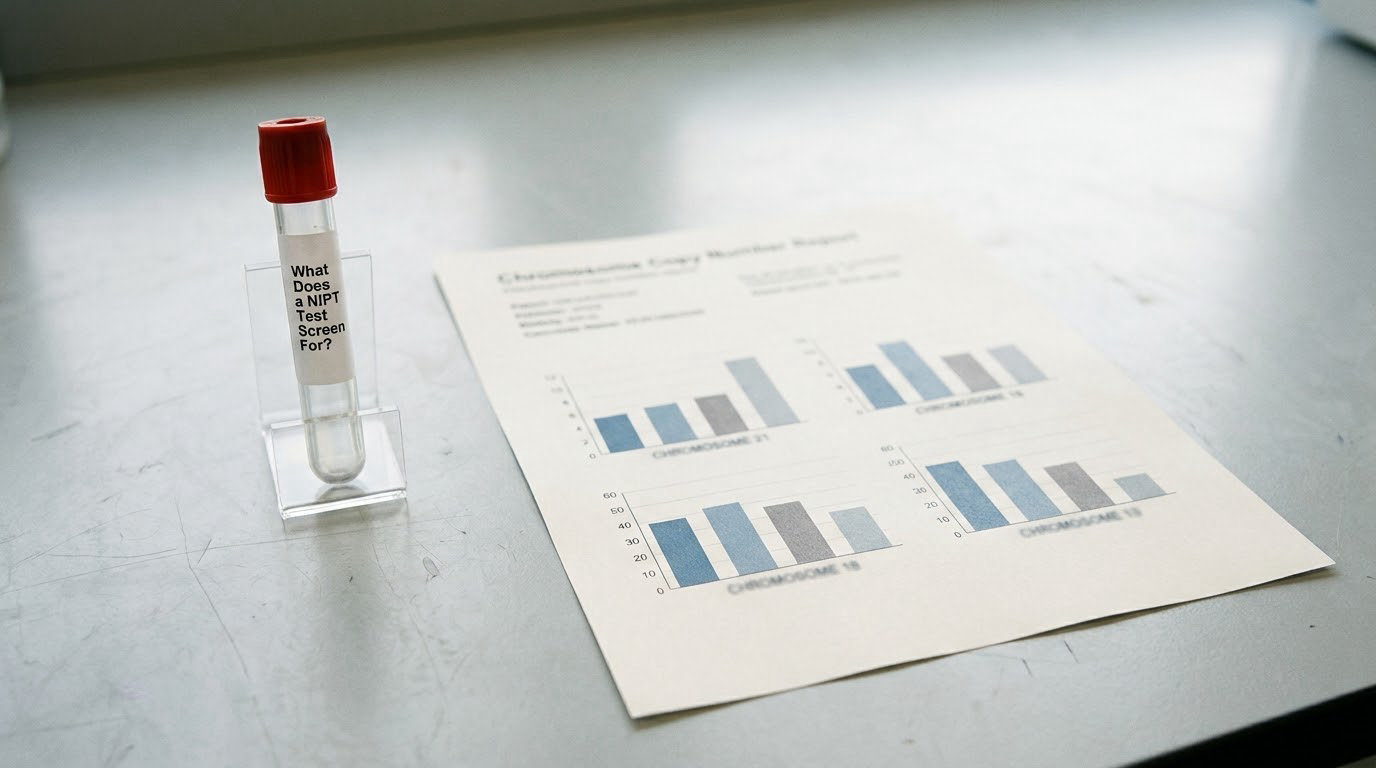
NIPT, short for non-invasive prenatal testing, is a screening test done from 10 weeks of pregnancy. It analyses small fragments of DNA from your blood to estimate the likelihood of a small number of chromosome conditions. Standard NIPT covers three conditions: trisomy 21 (Down syndrome), trisomy 18 (Edwards syndrome) and trisomy 13 (Patau syndrome). That is the whole of a standard panel.
Some panels add more. A sex chromosome panel looks at conditions such as monosomy X (Turner syndrome), triple X and Klinefelter syndrome. A microdeletion panel looks for a small group of rarer conditions where a piece of a chromosome is missing. Expanded panels can add rare autosomal trisomies and, in some cases, a genome-wide screen for additional chromosome abnormalities.
Here is what matters about those extra panels. The conditions they look for are much rarer than Down syndrome, which means far more of the high-risk results they produce turn out to be wrong when you check them properly. On the r/NIPT forum, microdeletion flags are described over and over as the result that causes the most distress and the most false alarms. A positive on a rare condition is not a small version of a positive on Down syndrome. It behaves differently, and the numbers around it do not work the same way.
NIPT Test Explained in Plain Language: The Core Idea
Here is how the whole thing works without the science degree. While you are pregnant, small pieces of DNA from the placenta cross into your bloodstream. This is called cell-free fetal DNA, usually shortened to cfDNA. A laboratory takes one blood sample, reads the DNA fragments it finds, and works out how much of each chromosome is represented.
Most bodies have two copies of every chromosome. A trisomy means three. If the sequencing finds a noticeably higher share of chromosome 21 material than expected, the lab flags trisomy 21 as higher risk and gives you a number expressing how strong that signal is.
Two details are worth holding onto. First, most of that cfDNA comes from the placenta, not directly from the baby, which is why a placenta difference and a baby difference can produce different results. Second, the output is a probability, not a verdict. NIPT tells you how the numbers lined up, not whether a condition is present.
What Do NIPT Results Mean?
A NIPT result comes back in one of a small number of forms, and each one tells you something different. Most results are low risk, which is the outcome the large majority of people get.
| Result | What the lab is saying | What happens next |
|---|---|---|
| Low risk | The chromosome pattern looked typical. It is a reassuring estimate, not a guarantee. | Routine prenatal care continues. You still have standard scans and screening for other things. |
| High risk | The pattern on one or more chromosomes looked atypical and the lab is flagging increased likelihood. | Genetic counselling, then a discussion about diagnostic testing to confirm or rule it out. |
| No result (no call) | There was not enough usable signal from this sample to report a risk figure. | Often a repeat blood draw, or a diagnostic test if the timing allows. |
| Uninformative | The sample was processed but the data did not support a reliable call for a specific condition. | Reviewed by the lab or your provider, usually alongside an ultrasound and other screening. |
Take a concrete example. Suppose your report reads one in 1,000 for trisomy 21. That is the language labs use for a very strong low-risk signal. It does not mean your baby has a 0.1% chance of Down syndrome, and this is where most people misread the page. The number describes the strength of the lab’s finding, not the chance that the baby is affected.
Now take a high-risk report reading one in 100, about a 1% chance. Even a strong high-risk call for a common trisomy still leaves most of those pregnancies unaffected, particularly in younger parents where the underlying chance is already low. This is where the positive predictive value matters, and we come back to it below. It is the single most useful idea on this page.
A plain-English glossary of the words on your report
Reports are written for clinicians. This is the translation.
| Term | What it means in plain language |
|---|---|
| NIPT / NIPS | Non-invasive prenatal testing or screening. The same blood test. |
| Aneuploidy | A chromosome condition where there is an extra or missing copy of a chromosome. |
| T21, T18, T13 | Shorthand for trisomy 21 (Down), trisomy 18 (Edwards) and trisomy 13 (Patau). |
| Cell-free fetal DNA (cfDNA) | Fragments of DNA from the placenta that circulate in your blood. |
| Fetal fraction (ff%) | The percentage of the DNA in your blood that came from the placenta. Too low and the lab may not report. |
| Z-score | How far the chromosome reading sits from what is expected. A larger gap means a stronger signal. |
| Positive predictive value (PPV) | Of every 100 high-risk results, roughly how many are true. This changes with how common the condition is. |
| No call | The sample did not produce a usable answer. A lab problem with your sample, not a finding about your baby. |
| Confined placental mosaicism | The placenta has a different chromosome pattern from the baby. A common reason a high-risk result does not match reality. |
| Vanishing twin | An early twin pregnancy that has stopped developing. Its DNA can skew your result. |
| Diagnostic test | Amniocentesis or CVS. These give a yes or no answer about specific chromosomes. |
One more piece of context belongs here. Risk rises with maternal age, and these figures change from year to year and country to country, so ask your provider for the current numbers rather than relying on a chart you found online. What matters is the shape: the risk is low in your twenties, rises through your thirties, and climbs more steeply after 40. NIPT performs well at every age. The number that shifts with age is the positive predictive value, because the prior chance of the condition is different.
What Is the Difference Between Screening and Diagnosis?
Screening estimates how likely something is. Diagnosis tells you whether it is there. That is the entire difference, and it is the one line of this topic worth keeping. If you take a single sentence away from nipt test explained in plain language, take that one.
A screening test such as NIPT looks at a pattern in a sample and produces a probability. A diagnostic test such as amniocentesis or chorionic villus sampling looks directly at the baby’s or placenta’s chromosomes and produces an answer about those specific chromosomes. NIPT is a screening test. Amniocentesis and CVS are diagnostic tests. No blood test is a diagnostic test.
Why does this matter so much? Because a high-risk screening result and a confirmed diagnosis are very different pieces of information, and the decisions people make about them are not the same. Investigative reporting has documented cases in which people ended a pregnancy on the strength of a screening result that was never confirmed. That does not happen often. It happens often enough that ACOG Practice Bulletin No. 163, and similar guidance from NICE and the NHS Fetal Anomaly Screening Programme, all frame NIPT explicitly as screening that requires confirmation before any irreversible decision.
Both amniocentesis and CVS carry a small risk of miscarriage, which is why clinicians do not offer them routinely after a low-risk screen. That risk is usually quoted in the region of well under one percent, and your provider will give you the current figure for your situation.
How Accurate Is NIPT?
For the three common trisomies, NIPT is the most accurate screening test available, with detection rates commonly reported above 99% for trisomy 21. Detection rate means the chance that the test flags a case that is truly there. It is not the same thing as how likely a positive result is to be correct.
| Concept | Plain-language meaning |
|---|---|
| Sensitivity | Out of 100 babies who genuinely have the condition, how many does the test catch? For the common trisomies, over 99. |
| Specificity | Out of 100 babies who do not have the condition, how many does the test correctly clear? Also very high. |
| Positive predictive value | Out of 100 high-risk results, how many babies actually have the condition? This is the number that varies most, and it is the one that should shape your reaction. |
Worked example, using round numbers. Imagine a condition affecting 1 in 1,000 pregnancies and a test that is 99% sensitive and 99.99% specific. In a group of 10,000 pregnancies, 10 babies have the condition and the test catches almost all of them. The other 9,990 do not, and a test that specific produces roughly one false positive in every 10,000. That single false positive lands in the same pile as the true cases, which pushes the positive predictive value well below where people expect it to sit.
This is arithmetic, not alarm. It explains why a clinician can be calm about a high-risk flag and why the same flag for a rare microdeletion carries far less certainty than the same flag for trisomy 21. Rare condition, low PPV, high anxiety. The gap between how upset people feel and how certain the result is is one of the most reported experiences in the r/NIPT community.
Accuracy also shifts with the details of your pregnancy. Fetal fraction, gestational age, maternal weight, whether the pregnancy is a twin pregnancy, and the panel chosen all change the numbers. A single universal accuracy figure is not a useful thing to carry around.
Can NIPT Have False Positives or False Negatives?
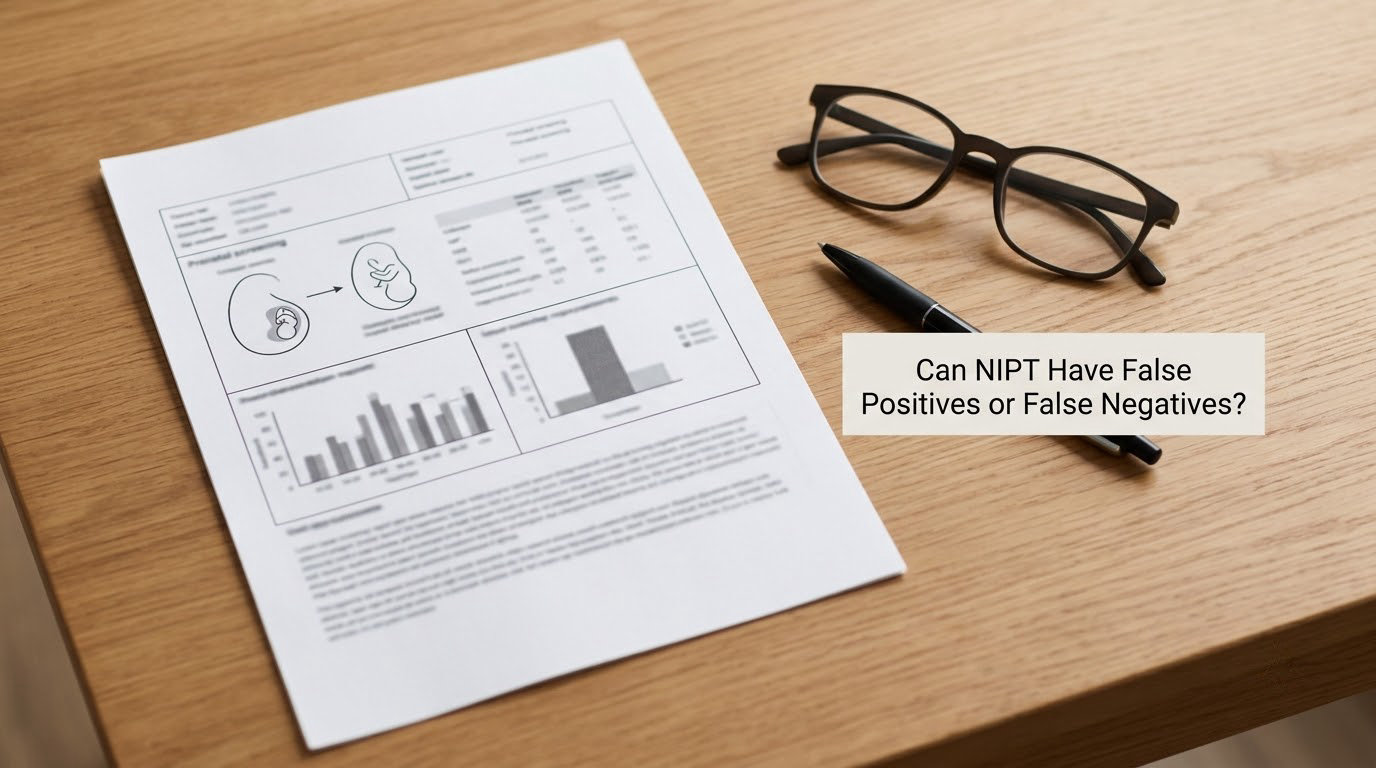
Yes, and knowing why makes the result much easier to sit with. A false positive means the test flagged a condition that is not there. A false negative means the test did not flag a condition that is there. Both happen, which is exactly why NIPT is described as screening rather than diagnosis.
The usual reasons for a false positive are all variations on the same theme, which is that the DNA being measured is not purely the baby’s. Confined placental mosaicism, where the placenta’s chromosome pattern differs from the baby’s, accounts for a substantial share. A vanishing twin early in a twin pregnancy adds DNA from a pregnancy that is not continuing. Maternal chromosome differences, including some balanced rearrangements and the sex chromosome patterns that occur naturally, can also tilt the reading. A low fetal fraction and a higher maternal BMI both push the result toward a no call rather than a clean answer.
False negatives are less common but real. Too little placental DNA, testing earlier than the lab’s confident window, and conditions outside what the panel covers all play a part. On forums, parents often add the same piece of context after a high-risk result: a completely clean ultrasound makes a false positive more likely. That is a reasonable thing to discuss with your provider, not a substitute for their advice.
There is also the version where you get no answer at all. Someone in the r/NIPT community described drawing at 10 weeks, getting a low fetal fraction, drawing again at 12 weeks, and getting the same result twice. It is frustrating and it is usually not ominous, but a repeat draw means more waiting, and the waiting is the part people remember.
When Is NIPT Usually Done?
NIPT can usually be done from 10 weeks of pregnancy, and it is one of the earliest prenatal screening tests available. Some providers prefer to wait until 10 or 11 weeks because the amount of placental DNA in your blood is more reliable by then. A 12-week draw is routine and is not late.
The upper end of the window is not a hard cliff. What does narrow as the weeks pass is your room to confirm a result if you need to, because CVS is generally done earlier in the pregnancy than amniocentesis, and both are easier to arrange sooner rather than later. If you are pregnant and wondering whether a particular week still works, ask your provider directly rather than assuming, because policies differ and the answer is usually yes.
At the appointment itself, the whole procedure is a blood draw from your arm. No fasting, no lying still, no unusual preparation. Results commonly arrive within one to two weeks, though turnaround varies by lab and by whether the sample needs a repeat. Book an appointment to talk through the results, ideally with a partner, doula or support person if that helps, before the report lands rather than after.
What Are the Risks and Limitations of NIPT?
The physical risk of NIPT is effectively nil. It is a blood test. The real risks are about what happens to your decisions afterwards, and they are worth taking seriously even though no one warns you about them.
A high-risk result can put you into a decision you never wanted to face, often under time pressure, while the people around you have strong opinions. Investigative journalism has documented this in detail, and parent forums describe the same emotional load in their own words. Partner anxiety is real too, and support people often get no preparation at all before a result arrives.
There are practical limits too. NIPT does not screen for autism. It does not screen for open neural tube defects, which are what the mid-trimester anomaly scan looks for. It does not detect most single-gene conditions, and it will not pick up every chromosomal difference. A low-risk NIPT result does not mean the baby has no condition, and it is not a clean bill of health. People ask whether NIPT would show a miscarriage. It would not, in the sense that it is not designed to assess viability, and a low-risk result says nothing about whether a pregnancy will continue.
You can also decline NIPT. Declining prenatal screening is a legitimate, informed choice, and it is a normal part of prenatal care. It is a decision to make with your care team, alongside discussing the scans and tests you do want, rather than a gap in your care.
NIPT is also not always appropriate or reliable in every situation. Early twin pregnancies, some IVF scenarios, and a few rarer situations need more careful interpretation, and your provider may recommend a different test. If you are in one of those groups, ask what your options are rather than assuming the standard pathway applies.
How Much Does NIPT Cost?
NIPT cost varies widely by provider, region, insurance coverage and which panel you choose, so the useful answer is where to check rather than a single number. Self-pay prices differ by country and by clinic, and public or NHS-funded programmes in the UK cover the standard screen for eligible pregnancies through the fetal anomaly screening programme, while other systems work differently. Ask your provider or clinic for the current self-pay figure for the specific panel you are being offered, and check whether your insurer covers prenatal genetic screening before you assume you will pay full price.
Two practical points. First, the panel matters. A standard screen and an expanded panel covering microdeletions and rare trisomies are not the same price, and the expanded option is the one that produces the most anxiety-inducing results. Second, the quoted price may or may not include the genetic counselling and the follow-up appointment, which is the part people actually need most. Ask what is bundled in before you book, and get the answer in writing.
Treat any figure you find online, including in this article, as a starting point for a conversation rather than a quote.
Questions to Ask Your Doctor or Genetic Counselor
Take this list to your appointment. Writing the questions down beforehand is the single change that tends to make the most difference, because you will not remember all of them afterwards.
- Which panel am I being offered, and which conditions does it actually cover?
- What is the difference between this and the screening my care pathway would offer anyway?
- What are the limitations of this test, and what does it not screen for?
- Who will contact me with my results, and how?
- If my result is high risk, what happens next and how quickly?
- Can I speak to a genetic counsellor before deciding whether to have a diagnostic test?
- If I get a no call result, what is the plan for a repeat draw?
- What is the miscarriage risk of amniocentesis and of CVS, for my situation?
- When do I need to decide if I want diagnostic testing?
- Who handles my data, and how is it stored?
- What does this cost me, and what does my insurer cover?
- What happens at the 12 to 14 week scan and the mid-trimester scan?
Add your own question about how you want results delivered, and about who you want with you when you open that envelope. Those two answers change the experience more than people expect.
Frequently Asked Questions
Is NIPT screening or diagnostic?
NIPT is a screening test, not a diagnostic one. It estimates the likelihood that a baby has a chromosome condition such as Down syndrome by analysing DNA fragments in the mother’s blood. A diagnostic test such as amniocentesis or CVS gives a yes or no answer for specific chromosomes. Any irreversible decision should follow diagnostic confirmation, not a screening result alone.
What does a low risk NIPT result mean?
A low risk result means the chromosome pattern read as typical and the lab found no strong signal for the conditions on your panel. It is a reassuring estimate rather than a guarantee, and it is not a clean bill of health. NIPT does not screen for open neural tube defects, autism or most single-gene conditions, so routine scans and the rest of your prenatal care still matter.
What does a high risk NIPT result mean?
A high risk result means the lab found a chromosome pattern that looked atypical, not that your baby has a condition. Because the conditions on a panel differ in how common they are, the chance a high-risk result is real changes with each one. Book a follow-up conversation, ask about genetic counselling, and discuss whether a diagnostic test such as amniocentesis or CVS is right for you.
Is 14 weeks too late to have NIPT?
No, 14 weeks is within the usual window. NIPT can be done from 10 weeks onwards and remains available into the second trimester. What changes as weeks pass is your room to confirm a result if you need to, because CVS is generally offered earlier than amniocentesis. Providers and local policies vary, so ask your midwife or doctor about timing and your options.
How common are inconclusive NIPT results?
A no call result is uncommon overall, and it is a finding about the sample rather than about your baby. It usually happens when too little placental DNA is present, which is more likely early in pregnancy, in twin pregnancies, or at a higher body mass index. Most people who get a no call have a repeat blood draw a week or two later, and a clear result the second time. Ask your provider what their plan is.
What to Do Next
Three things, in this order. First, get a follow-up appointment booked the day your result arrives, whether it is low risk, high risk or a no call, and bring the questions list above. Second, if the result is high risk or uninformative, ask for a genetic counsellor before you decide anything about diagnostic testing. Third, do not make a decision that cannot be undone on the strength of a screening result alone. NIPT test explained in plain language comes down to that: it is information, not a conclusion, and it is designed to be one input into a conversation with a clinician, not the end of one.
Bring your partner, your doula, or whoever you want with you. People who are not pregnant carry this anxiety too, and they deserve the same preparation as the person who is.
This article is for general education and is not a substitute for medical advice. For decisions about your own pregnancy, speak with your midwife, obstetrician or genetic counsellor. Last reviewed for accuracy in 2026.