A nanny share is an arrangement where two families hire one nanny together, splitting her schedule and her cost, so she cares for children from more than one household, usually in one family’s home. In 2026 it costs about $25 to $40 an hour for the combined job, which works out to roughly $12 to $20 an hour, or $1,200 to $2,400 per family per month, once employer taxes and benefits are added.
That is 30 to 40 percent less than a solo nanny, and often more than center-based daycare for a family that values a one-to-two ratio and a caregiver who stays for years. The catch is that finding a compatible second family is genuinely harder than most people expect, and both households become separate employers on paper whether they want to or not.
Everything below reflects typical US ranges that shift by region and change over time, so treat the numbers as a starting point for your own math rather than a quote.
Table of Contents
- Nanny Share How It Works and What It Costs: At a Glance
- Nanny share how it works and what it costs, in a minute
- The two ways a share works
- What a nanny share costs in 2026
- What Affects the Price
- Where you live
- How many children and how many days
- Why a share is not a straight half
- The all-in bill, line by line
- Taxes, payroll, and the halving trap
- Benefits, sick days, and coverage
- Agency fees and emergency backup
- How a share compares with solo care and daycare
- Host home expectations that show up on the bill
- What happens when one family leaves
- Ways to Save on a Nanny Share
- What not to cut
- Frequently Asked Questions
- How much does a nanny share cost per month?
- Do both families in a nanny share have to pay payroll taxes?
- Can both families use the dependent care FSA and the child and dependent care credit?
- Is a nanny share cheaper than daycare?
- What are the main drawbacks of a nanny share?
- What happens if one family leaves a nanny share?
- Where to Start This Year
Nanny Share How It Works and What It Costs: At a Glance

Both families agree on three things before anything else: the schedule, the home where care happens, and the cost split. After that each household hires the nanny as its own household employee with its own payroll. The nanny never gets split down the middle as a rate. She charges one higher rate for the whole job, and the families divide that single rate between them.
That one distinction is the whole thing. A share is not a solo nanny working half time for half the money. It is one caregiver, on the books for two employers, doing more work than either family could book alone, and being paid accordingly.
Nanny share how it works and what it costs, in a minute
- The nanny names a combined hourly rate, usually about 1.3 times her solo rate, for caring for both families’ children.
- Each family pays its agreed share of that combined rate, not half of a solo rate.
- Each family is its own household employer: separate EIN, separate payroll, separate W-2, separate unemployment and workers’ comp coverage.
- Employer payroll taxes, roughly 10 to 11 percent on top of wages, belong to the families, not the nanny.
- Sick days, paid holidays, mileage, supplies and a payroll service add real dollars that most quick estimates skip.
- Full-time care lands near $1,200 to $2,400 per family per month nationally, more in expensive metros.
The two ways a share works
| Model | How the day runs | Suits |
|---|---|---|
| Simultaneous care | Both children are in one home at the same time, usually a one-to-two ratio. Care rotates between homes so neither family feels like a guest in the other’s space. | Two infants, or two toddlers close in age who both need the same nap window. |
| Split schedule | One family has the mornings, the other has the afternoons. The location may stay fixed or rotate by the day or the week. | Children more than a year or so apart, or families whose work starts at different hours. |
Simultaneous care gives each child a companion, which parents often underestimate as a benefit and children clearly feel as one. It also means one home absorbs the whole day, and that home needs gates, a safe sleep setup for two children, and a realistic allergy protocol.
Split schedules are easier on the house and harder on the calendar. Two families with genuinely different work hours can run a share for years this way, and the fixed location avoids a lot of packing and unpacking.
What a nanny share costs in 2026
| Cost line | Typical US range |
|---|---|
| Combined hourly rate for the share | $25 to $40 |
| Each family’s hourly cost, split evenly | $12 to $20 |
| Per family per month, 3 days a week (about 24 to 30 hours) | $1,300 to $2,400 |
| Per family per month, 4 days a week (about 32 to 36 hours) | $1,800 to $3,000 |
| Per family per month, full-time 40 hours | $2,300 to $3,500 |
| Employer payroll taxes, added to wages | Roughly 10 to 11 percent |
| Solo nanny, same hours, for comparison | $3,500 to $6,500 per month |
Multiples of 4.3 weeks a month are the standard shortcut. A family paying $15 an hour for 40 hours a week is looking at about $2,580 in wages per month, then roughly $260 more in employer taxes, then PTO and holidays and a payroll fee on top of that. Add in a metro like Austin, where an all-in per-family figure of about $2,939 a month is a reasonable benchmark against roughly $4,680 for the same care solo.
Updated for 2026 costs, and regional bands help more than national averages do. Families in New York, San Francisco, Los Angeles, Boston, Seattle and Washington are usually quoted $35 to $45 combined for a two-child share. Chicago and Denver tend to land near $28 to $33. Lower-cost metros more often see $25 to $29.
What Affects the Price

Where you live
Metro is the single biggest lever, and it moves faster than anything else on the list. Cost of living, state minimum wage, and how thin the local nanny market is all feed into the number. Families in the same city can be quoted rates that differ by several dollars an hour based on how many qualified caregivers are actually looking for work.
How many children and how many days
Nannies price by the number of children in their care, not only by the hour. In practice the convention is a per-child premium of roughly $1 to $3 an hour for each additional child, on top of a base rate for the first. A combined share with two children usually carries a higher combined rate than a two-child solo job does, because the caregiver is managing two households of logistics.
Days matter just as much. Three days a week is usually where a share looks best financially, since fixed costs like the payroll service and the family’s own setup time spread over fewer hours.
Why a share is not a straight half
This is where most confusion lives, and the math deserves two minutes. Take a Chicago example: a nanny whose solo rate is $22.21 an hour may quote $28.87 for the combined share, which is the solo rate times 1.3. Divided evenly, each family pays $14.44 an hour.
Against a $22.21 solo rate, that family saves about $7.77 an hour, close to 35 percent. The other family gets the same deal, and the nanny earns $6.66 an hour more per hour than she would have in either solo job. Everyone wins, which is why nannies generally accept shares when the combined rate is set properly.
What does not work is taking a solo rate and cutting it in half. Paying $11.10 an hour for twenty hours of work is a pay cut dressed up as a bargain, and in cities like Seattle, Denver and many California metros it sits below minimum wage once measured correctly. The rate is not halved. The hours are divided.
The all-in bill, line by line
Headline wages tell you maybe two-thirds of the bill. Here is the rest, built on the Austin all-in example that tends to get quoted in cost guides:
| Line item | Per family per month | What it covers |
|---|---|---|
| Wages, 40 hours a week | About $2,300 | Care at roughly $13.35 an hour |
| Employer payroll taxes | About $230 | Social Security and Medicare, federal and state unemployment |
| Amortized paid time off | About $95 | Ten to fifteen days a year, accrued and paid out |
| Paid holidays | About $60 | Usually eight to nine days at a stretch |
| Payroll service | About $55 | Per employer, per month, per family |
| Mileage reimbursement | About $25 | Activities, errands, pickup runs |
| Supplies and activity fund | About $100 | Diapers, wipes, first aid, class fees if agreed |
| Total, all in | About $2,939 | Compare with about $4,680 for the same care solo |
Two items in that table cause arguments more than anything else. Mileage and the activity fund matter more than their size, because one family usually wants swim lessons and the other one does not. Decide those in the agreement, not in month three.
Taxes, payroll, and the halving trap
Each family is a separate household employer. That means each one gets its own employer identification number, files its own new hire report, runs its own payroll, issues its own W-2, and buys its own workers’ comp coverage. The IRS reference for this is Publication 926, and household employees report wages on Schedule H.
Consolidating is the tempting shortcut and a bad idea. If one family pays the nanny and the other reimburses, the arrangement looks like a single employer to an unemployment claim, and the family that cut corners ends up facing back taxes and penalties. Two payrolls cost more in fees and cost far less in exposure.
Sources disagree on one technical point, so ask your payroll provider rather than trust a blog. Some measure the 40-hour overtime threshold per family, against that family’s own hours. Others measure the combined total across both households, which is the stricter reading. Where the combined total crosses 40 while neither family does, the difference matters. Get the answer in writing.
Benefits, sick days, and coverage
Real sick days, paid holidays, an annual raise on the work anniversary, and a current CPR and first aid certification are the terms experienced families ask for first. In one survey of 410 share families across 22 metros, two-family shares lasted an average of 14 months and three-family shares about 7, so the arrangement that looked permanent last spring is frequently gone before the second birthday.
Shares with a monthly check-in between the families lasted about 19 months. Shares without one lasted about 8. That is a five-minute habit with a bigger effect than almost anything else in the agreement.
On the insurance side, workers’ comp is not optional in most states, and California’s rules apply regardless of headcount. A household-employee rider on the host home’s policy and a written background check should both be in place before day one.
Agency fees and emergency backup
Families who use an agency or a placement service get help when a caregiver is sick or quits, and they pay for it in a placement fee and a percentage taken from the ongoing hours. Direct hiring removes the percentage and leaves the family managing the gap alone. There is no middle option here, only a trade between support and cost.
Work out the sick-day policy before you need it. The most common arrangement is a set number of paid sick days per family per year, and a shared rule that a child stays home when they have a fever or a contagious illness, which both households agree to in advance rather than mid-week.
How a share compares with solo care and daycare
| Option | Per family per month | What you trade |
|---|---|---|
| Solo nanny | $3,500 to $6,500 | Highest cost, one-to-one attention, no partner family required |
| Nanny share, full time | $1,200 to $2,400 | Two families to coordinate, a smaller pool of matches |
| In-home family child care home | $700 to $1,200 | Often unlicensed above three children, uneven quality, less flexibility |
| Center-based daycare | $1,000 to $2,200 | Larger groups, more illness exposure, fixed schedules, waitlists |
Families leaving daycare over illness exposure often cite a share as the way out, since exposure is limited to two households instead of a room of fifteen. The cost lands close to center-based care, and the flexibility is better. The coordination work is also higher, and that is the part families underestimate.
Host home expectations that show up on the bill
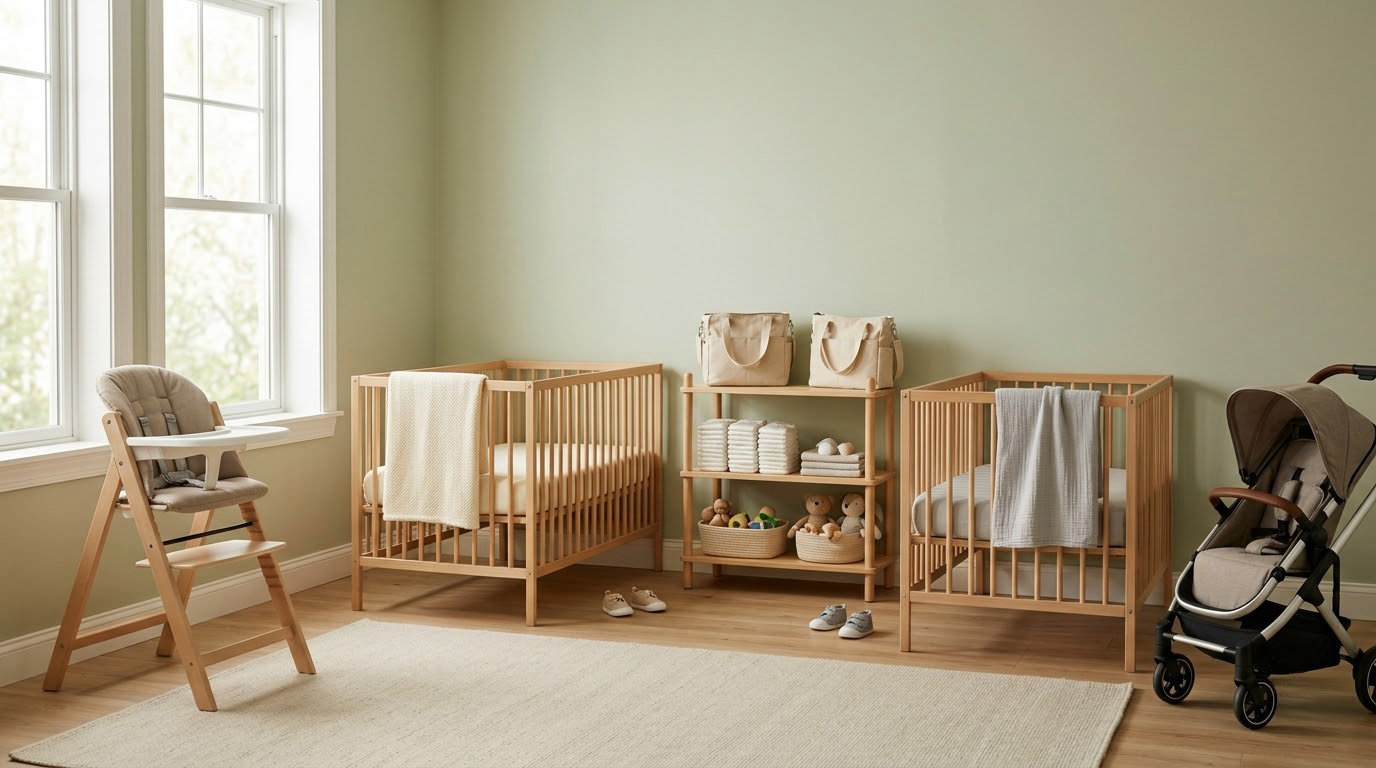
Whichever home hosts becomes a childcare environment, and that has costs and consequences. Stair gates, a second crib or a safe sleep setup, outlet covers, cabinet latches, and a pantry that can absorb a second family’s preferences all appear in the first month.
If a guest baby is under one, the logistics get specific. Breastfeeding parents need a private place to pump and somewhere to store milk that is not shared with the host family’s food. Formula and bottle sterilization, diaper and wipe supply, and a written allergy protocol for the whole house matter more than any decorating decision.
Then there is the parent’s own load, which is rarely written down anywhere. Hosting another family’s child adds pickup routines, illness exposure, and a guest presence in the home during your workday. For some parents that is a welcome change of pace. For others, especially parents already running a household alone, it is the deciding factor, and worth counting before you sign anything.
What happens when one family leaves
One family leaving is the most common failure, and the fix is a notice period, usually 30 to 60 days, plus a written plan for what happens during it. Some families agree a bridge rate during the transition so the remaining family is not hit with the full solo rate overnight. Others name a deadline for finding a third family, which is where a licensing limit can appear: most states require licensing above three unrelated children in care, so a third family is not an automatic option.
Some families keep a second candidate warm, and some share platforms help with a transition. It is a lot of extra work for something that usually works out, but it is far less work than a month of single-family rates with no coverage.
Ways to Save on a Nanny Share
Most of the savings come from the structure rather than from squeezing the caregiver. Here is what actually moves the number, in rough order of impact.
- Fewer days, more predictable. Three fixed days a week usually costs far less than five vague ones, and the caregiver prefers it because the income is steady.
- Guaranteed hours instead of per-use hours. A set weekly minimum protects the nanny’s income, which is what keeps her in the share rather than searching for a solo job that pays more.
- Keep the care location fixed. One home means one setup, one set of supplies, and no daily packing. Split schedules work too, but calendar coordination is where hours quietly disappear.
- Direct hire instead of an agency. You drop the placement fee and the ongoing percentage. Budget for doing the payroll and background check yourself.
- Write the agreement and reread it yearly. Shares with a written contract lasted roughly twice as long in survey data, which is the cheapest saving available.
- Agree on extras in advance. Classes, swimming, outings, and the activity fund are the top sources of billing disputes. A short list with a monthly cap ends them.
- Share the driving. Splitting mileage, a second car seat, and the cost of a stroller or a second crib spreads a fixed cost that would otherwise land on the host family.
- Pool supplies. Diapers, wipes, and first aid are cheaper bought in bulk for two children than bought separately for two households.
- Use both tax breaks. Each family can run its own dependent care pre-tax account, and each can claim the Child and Dependent Care Credit. Together they often offset a meaningful share of the monthly bill.
- Compare three real quotes. Ask each candidate caregiver for their solo rate, then ask what combined rate they would quote for two families. The gap between quotes is frequently several dollars an hour.
What not to cut
The caregiver’s rate is the last thing to touch. Nannies consistently report that families offering a combined share rate below the going solo rate are the main reason they leave, and a replacement search routinely runs six months. Families who cut the rate to save a few hundred a month end up paying that back and losing continuity for their child, which is the thing most families were trying to buy in the first place.
The second thing not to cut is the agreement. A month of a clear written schedule beats a year of informal goodwill.
Frequently Asked Questions
How much does a nanny share cost per month?
In 2026 a shared nanny runs about $25 to $40 an hour for the combined job, so roughly $12 to $20 an hour per family. Full-time 40-hour care lands near $1,200 to $2,400 per family per month in most US metros, and closer to $2,300 to $3,500 in expensive cities once employer taxes, paid holidays, and amortized time off are added.
Do both families in a nanny share have to pay payroll taxes?
Yes. Each family is a separate household employer, so each needs its own EIN, new hire report, payroll, W-2, and workers’ compensation coverage. Employer Social Security, Medicare, and unemployment taxes add roughly 10 to 11 percent on top of wages. One family paying the nanny and the other reimbursing is the shortcut that creates back-tax exposure if she ever files for unemployment.
Can both families use the dependent care FSA and the child and dependent care credit?
Each household claims its own qualifying expenses, so both can use a dependent care pre-tax account up to their plan’s limit and both can claim the Child and Dependent Care Credit, which is 50 percent of qualifying expenses capped at $3,000 for one child or $6,000 for two or more. Accounts that exceed the credit generally cannot be claimed for the same expenses, so run the numbers before you enroll.
Is a nanny share cheaper than daycare?
It depends on your metro and your hours. A full-time share runs about $1,200 to $2,400 per family per month, which is often close to or a little above center-based daycare. What you get for the difference is a one-to-two ratio, a caregiver who stays for years, far less illness exposure than a room of fifteen, and schedules that flex with your work week.
What are the main drawbacks of a nanny share?
The coordination work is the big one, and finding a compatible second family is harder than most people expect. Beyond that, illness policy disagreements, after-hours and weekend coverage conflicts, disputes over extra activities, and schedule drift when one parent’s job changes all wear down a share. Shares are also less stable than they look, averaging about 14 months for two families in survey data.
What happens if one family leaves a nanny share?
Plan for it in writing. Most agreements set a 30 to 60 day notice period and a transition plan during it, often including a bridge rate so the remaining family is not billed the full solo rate overnight. Some families name a deadline for recruiting a third family, though most states require licensing above three unrelated children in care, so a third household is not always available.
Where to Start This Year
Start by deciding how many days a week you actually need, then ask three caregivers for their solo rate and what they would quote for a combined share. The spread between those quotes is often bigger than anything you can negotiate later.
Next, find one other family nearby with a similarly aged child and overlapping hours. Nanny share platforms, local parent groups, and your own network are where compatible matches come from, and the search usually takes longer than the negotiation will.
Then write the agreement before the first day, covering the schedule, the cost split, sick days, holidays, activities, notice periods, and overtime. Families who do this last twice as long, which is worth far more than the handful of dollars a month you might shave off the rate.