Medicaid coverage for pregnancy and birth includes prenatal visits, lab work, medically necessary imaging, labor and delivery including cesarean section, and 12 months of postpartum care. The newborn is usually enrolled automatically at birth. Eligibility, cost sharing and provider rules are set state by state, so the details depend on where you live.
I have talked with families and clinicians across this topic enough to know where the confusion sits. Almost nobody is confused about whether Medicaid pays for a delivery. The confusion is about the edges: why a bill arrived anyway, why the baby’s charges were separate, and what happens to coverage on the first birthday. This guide walks through those edges in the order you will run into them.
Two words of caution before we start. First, this is general information, not legal or financial advice, and rules change often. Second, the honest answer to almost every question about this topic ends with the same three words: in your state.
Table of Contents
- Medicaid Coverage for Pregnancy and Birth: The Basics
- How Medicaid differs from marketplace and employer insurance
- Why Medicaid coverage for pregnancy and birth is different in every state
- Who May Qualify for Medicaid During Pregnancy?
- How Medicaid coverage for pregnancy and birth changes once you are pregnant
- What documentation an application usually needs
- How Do You Apply or Switch to Medicaid?
- Presumptive eligibility: coverage that can start the same day
- When to apply so a newborn is not left uncovered
- What Prenatal and Birth Services Does Medicaid Cover?
- Does Medicaid Cover Delivery Fees and Hospital Costs?
- What Does Medicaid Cover After the Baby Is Born?
- What Costs Might Still Be Your Responsibility?
- How Can You Avoid Surprise Medical Bills?
- What If You Are Denied or Lose Medicaid Coverage?
- Frequently Asked Questions
- Can I use Medicaid during pregnancy if I already have marketplace insurance?
- How does pregnancy change Medicaid eligibility?
- Will my newborn automatically have Medicaid coverage after birth?
- Does Medicaid cover emergency delivery and hospital treatment?
- What should I do if I was told my pregnancy is not covered?
- Conclusion
Medicaid Coverage for Pregnancy and Birth: The Basics
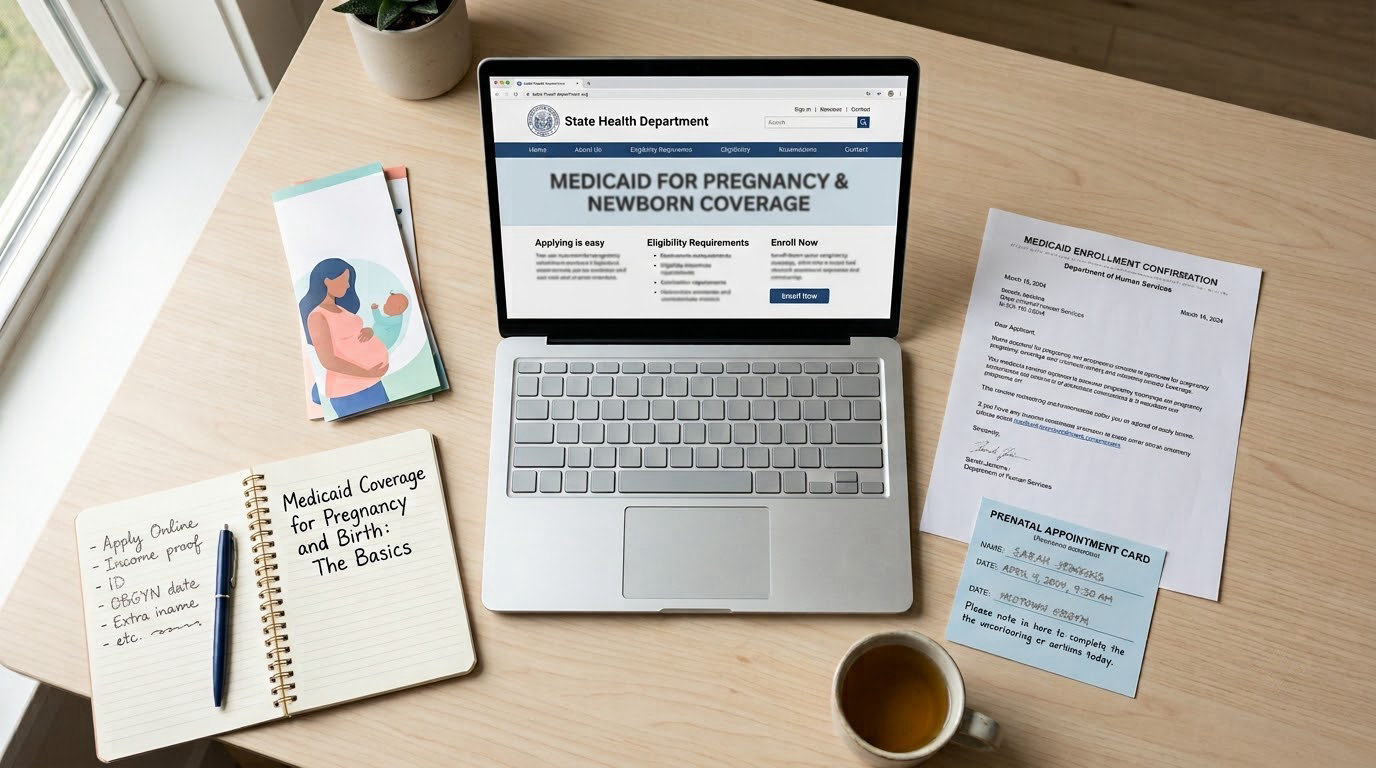
Medicaid is a joint federal and state program that pays for health care for people with low income. States set the rules within federal guardrails, administer the program and decide what benefits look like in practice. A pregnant person who qualifies generally receives full medical coverage for the length of the pregnancy and for a year after delivery, at low or no cost.
Medicaid finances a large share of births in the United States. KFF, the health policy research organization, reports that Medicaid covers about four in ten births nationwide, which makes it the primary payer for maternity care in many communities and the reason most prenatal clinics are set up to bill it routinely.
How Medicaid differs from marketplace and employer insurance
Marketplace plans are private insurance sold through the federal exchange, and employer coverage is private insurance through a job. Medicaid is public coverage, administered by the state, and it is not the same thing. The practical differences that matter during a pregnancy are the cost sharing, the provider network and how easily you can change plans mid-pregnancy.
Medicaid is generally the most generous option available for maternity care. Many enrollees pay nothing at all for pregnancy-related visits, and several states waive cost sharing entirely for pregnancy and postpartum services. Marketplace plans must cover maternity care as an essential health benefit, but they come with deductibles, copays and coinsurance that Medicaid does not impose in the same way.
Why Medicaid coverage for pregnancy and birth is different in every state
Five variables decide what you actually get. They are your state, your household income relative to the federal poverty level, your household size, your immigration status, and whether your plan is a managed care plan with its own network and rules.
That last point trips people up more than the others. Once you are enrolled, you are usually assigned to a managed care organization that contracts with a specific group of hospitals and clinicians. Two pregnant people in the same state can have entirely different provider directories. Coverage is not one national benefit package with fifty small edits.
Who May Qualify for Medicaid During Pregnancy?
Eligibility usually falls into one of two pathways. The first is standard Medicaid, based on income, household size and category, where pregnant people often qualify under the limits that apply to their category. The second is pregnancy-specific eligibility, where many states set a higher income ceiling, frequently in the range of 185 to 215 percent of the federal poverty level, and cover the pregnancy plus the postpartum year.
The federal poverty level is a yearly figure published by the Department of Health and Human Services. States calculate their income limits as a percentage of it, and the percentages differ by state and by population group, so the monthly number that matters to you depends on where you apply.
How Medicaid coverage for pregnancy and birth changes once you are pregnant
In a state that offers pregnancy-specific Medicaid, the limit is higher than the standard threshold. A household just above the ordinary cut-off may still qualify once pregnancy is counted. Some states also count the unborn child when the household is measured for eligibility, and some disregard the income of a parent living in the home.
Counting the unborn child in the household is a real rule in a number of states, and it moves the number. The same family of four can look like a household of five on a pregnancy application. If your income is close to the line, ask the agency how they are counting you.
What documentation an application usually needs
Expect to give an income estimate for the household, your due date or proof of pregnancy, identification, and immigration documentation if you are not a citizen. Many agencies also ask for existing insurance information, because having employer coverage does not always disqualify you and can instead route you into a program that coordinates with it.
You do not always need all of that in hand to apply. The presumptive eligibility process described below is built for people who have very little paperwork at the moment they need care.
How Do You Apply or Switch to Medicaid?
There are four practical routes. You can apply through your state Medicaid agency, usually online, by phone or on paper. You can apply through the federal marketplace and check the Medicaid box, which sends your information to the state if your income qualifies. You can ask a clinic or hospital to complete a presumptive eligibility application. Or you can be enrolled automatically through a qualified entity, which some hospitals and health centers can do for you on the spot.
Start with the marketplace or the state agency rather than starting with a hospital, because the state route is the one that produces a decision letter you can hold on to. Apply as early as you can, even in the first trimester, since approval backdating and continuous coverage rules work best when the application is processed while you are already covered by something.
Presumptive eligibility: coverage that can start the same day
Presumptive eligibility is the mechanism built for pregnant people who are uninsured or who need coverage immediately. If you visit a qualified provider, such as a participating hospital, clinic or health center, and you attest to income and pregnancy, that entity can make a same-day eligibility determination and activate Medicaid coverage for that day forward while the full application is processed.
The determination is temporary. It typically covers a limited period, and the state still requires a complete application. Ask the clinic directly whether they are a qualified entity for presumptive eligibility, because not every practice participates, and the ones that do usually have a staff member who handles it at check-in.
When to apply so a newborn is not left uncovered
Two timing rules do the work here. A birth changes your household, which opens a special enrollment period on marketplace plans, typically 30 days from the date of birth, and gives you a chance to report the change to an employer plan. Second, if your income went up during the pregnancy, the state can redetermine your eligibility after you give birth, and the newborn is generally assessed as part of that household.
Ask the state agency, before delivery, what it needs from you to enroll the baby. Some states enroll the newborn automatically and notify you. Others need the name, the date of birth and the hospital records. Knowing which one you are in removes a lot of stress from the postpartum period.
What Prenatal and Birth Services Does Medicaid Cover?
Medicaid covers medically necessary prenatal care, which means the visits, tests and treatment your clinician orders. That set typically includes routine obstetric visits, blood tests and laboratory work, urinalysis, blood pressure and weight monitoring, screening for gestational diabetes and preeclampsia, and genetic screening when it is indicated.
Imaging is covered when it is medically necessary, which covers the routine ultrasounds most pregnancies need. Some states apply specific rules to optional screening tests, so if you are considering additional testing, ask your plan rather than assuming.
Prescription drugs are covered, including the prenatal vitamin and medications for pregnancy conditions. Mental health and substance use treatment are covered too, and postpartum depression screening at the standard well-woman visit is a covered service. Lactation counseling and support for breastfeeding are generally included. Family planning, including contraception after delivery, is also part of the benefit.
Dental and vision care are the ones people assume and then discover are patchy. Many states cover a limited dental benefit for pregnant members because oral health affects pregnancy outcomes, but the scope varies, and adult vision coverage is often minimal or separate. Check your plan’s benefit handbook.
Doulas, midwives and birth centers are where coverage is least predictable. A number of states reimburse doula services through Medicaid, and New York and Colorado are often cited as examples, but the number of visits and the reimbursement rules are state decisions. Certified nurse-midwives are generally covered when they practice in a participating setting, because they are licensed providers. Independent midwives and freestanding birth centers are covered far less consistently, and the answer for home birth is usually no unless your plan specifically says so.
Does Medicaid Cover Delivery Fees and Hospital Costs?
Yes, for medically necessary hospital labor and delivery services. That includes the admission, monitoring, vaginal delivery, cesarean section when it is needed, anesthesia and epidural, the newborn’s immediate care in the same facility, and the routine postpartum hospital stay. The claim is generally submitted by the hospital to your plan rather than itemized to you.
The caveat is network participation. A hospital that does not contract with your managed care plan may not be covered, and the same goes for an anesthesiologist who is out of network even when the hospital itself is in. This is the most common reason a Medicaid member sees an unexpected bill after a delivery, and it is worth confirming before you go in.
Cost sharing exists in Medicaid, but it is usually modest and varies by state. Many states set no copayment for pregnancy-related services or no cost sharing at all for members under a certain income level. The hospital should collect what your plan tells it to collect, which is often nothing.
What Does Medicaid Cover After the Baby Is Born?
The newborn is usually enrolled automatically. Under the deemed newborn rule, an infant born to a mother who was enrolled in Medicaid on the day of delivery is treated as covered from the date of birth, without a separate application and without waiting for a Social Security number.
The mother’s own coverage is now the 12-month postpartum extension. Federal law made the extension permanent, so coverage that once ended at 60 days now runs for a full year after delivery. During that year, Medicaid covers postpartum visits, contraception, mental health care, treatment for conditions identified during pregnancy such as gestational diabetes or hypertension, and ongoing care for the baby if the baby is enrolled.
Even with automatic newborn enrollment, confirm it. People on pregnancy forums ask this question constantly, and the answer is usually that the record exists but the paperwork is not visible to the family. Call the member services number on your card, ask whether the baby has an active Medicaid number, and ask for the start date. If the birth happened at a facility in a different state from your plan, mention that, because out-of-state claims are slower.
Ask about maternity case management if you are enrolled in a managed care plan. These programs pair you with a nurse or coordinator who helps with scheduling, transportation, home visiting programs, breastfeeding support and referrals to community services. They are free to members and often the easiest benefit nobody has told you about.
What Costs Might Still Be Your Responsibility?
A few possibilities, and they are worth knowing in advance. Copayments and cost sharing, if your state imposes any on pregnancy services or on prescriptions. Services the plan does not cover, such as certain optional tests or non-emergency services requested without medical necessity. Out-of-network providers, whether hospitals, clinicians, anesthesiologists or midwives. And balance billing, which is the difference between what a provider billed and what your plan allowed, in the limited situations where it is permitted.
You may also see a bill for something during an episode of care that turned out not to be covered once submitted. That happens, and it is not proof that anybody erred.
A bill arriving does not automatically mean the provider is billing incorrectly, and unpaid medical bills can reach a collection agency and, in some cases, a credit report. If you receive something you do not recognize, request an itemized bill first, then contact the plan with the itemized version. Itemization separates charges for the mother from charges for the newborn, which is exactly where most confusion originates.
How Can You Avoid Surprise Medical Bills?
Start before you are admitted. Call the number on your Medicaid card and ask four questions: what is my coverage start date, who is my managed care plan, is my hospital in network, and is my obstetrician in network. If your plan requires prior authorization for a procedure or admission, ask who is obtaining it and when.
At every appointment, bring your card and say your name and the last four of your member number. Small errors in identity matching at a hospital are a common and entirely fixable source of denials. When you are admitted, ask the admissions staff which network your anesthesiologist and any specialist belong to.
Keep your own records. Save your approval letter, your card, your effective date, itemized bills, receipts for copayments, and every letter from the plan. If a claim is denied, the appeal clock starts when the notice arrives, not when you disagree with it.
One point that gets misread constantly: the federal rule about emergency services says that a hospital cannot charge you more than your in-network cost sharing for an emergency, and that a pregnant patient presenting in active labor counts as an emergency. It does not mean every service related to your pregnancy, in that hospital, is in network. Postpartum and newborn claims still get processed on their own terms.
What If You Are Denied or Lose Medicaid Coverage?
Read the notice first, and read the reason. Denials usually cite a category, which is often income, household composition, immigration status or missing documentation. Compare that reason against what you actually submitted. A wrong household size or a missed form causes most of these, and both are correctable.
Submit corrected documents and request reconsideration in writing, keeping a copy. If the denial stands, most states offer a state fair hearing, an administrative appeal or both, and you can usually request one by mail, by phone or online. The state Medicaid agency is required to tell you about these options on the denial letter itself.
Ask about the deadline early, because they are short, often 30 to 90 days from the notice. Losing coverage during a pregnancy is also usually a qualifying event for a marketplace special enrollment period, so a denial does not have to end your coverage entirely. And a denial does not stop your providers from screening you for Medicaid on the spot, so keep asking at each visit.
Frequently Asked Questions
Can I use Medicaid during pregnancy if I already have marketplace insurance?
Yes, in many states. Having marketplace coverage does not automatically disqualify you, because states may have pregnancy-specific eligibility rules with higher income limits, and some let pregnant people count the unborn child in the household. You can report the pregnancy to your marketplace plan, and the plan must cover maternity care as an essential health benefit either way. The practical question is cost: Medicaid usually removes deductibles and copays that a marketplace plan would leave you with, so it is worth running the numbers for your own income and family size.
How does pregnancy change Medicaid eligibility?
Pregnancy usually changes eligibility by raising the income limit and by extending the length of coverage. Instead of a standard threshold, many states offer pregnancy-specific Medicaid for households up to roughly 185 to 215 percent of the federal poverty level, and some count the unborn child when calculating household size. After delivery, coverage continues for 12 months rather than ending after 60 days. Rules vary by state, so the only reliable number is the one from your state Medicaid agency.
Will my newborn automatically have Medicaid coverage after birth?
Usually, yes. Under the deemed newborn rule, an infant born while the mother is enrolled in Medicaid is covered from the date of birth, with no separate application and no need to wait for a Social Security number. That is a state-level rule with federal minimums, so details differ. After delivery, call member services and confirm the baby has an active Medicaid number and a start date, especially if the birth happened out of state or you switched plans during the pregnancy.
Does Medicaid cover emergency delivery and hospital treatment?
Yes. Labor and delivery is treated as an emergency, and Medicaid covers medically necessary hospital labor and delivery services, including cesarean section, anesthesia and the hospital stay. Emergency Medicaid also covers the delivery itself for people who are not eligible for full Medicaid, including some with immigration restrictions, though coverage may end right after discharge. The cost to you depends on your state’s cost-sharing rules and on whether every clinician involved was inside your plan’s network.
What should I do if I was told my pregnancy is not covered?
Ask for the reason in writing, then act on it. Most denials come down to income, household size, immigration status or a missing document, and all four are fixable. Submit the corrected information, request reconsideration, and if the denial holds, request a state fair hearing using the deadline printed on the notice. In the meantime, ask your prenatal office whether it can complete a presumptive eligibility application for you, which can activate coverage the same day.
Conclusion
Start by checking your state’s rules, because the income limit, the application route and the provider network are all set locally. Apply or update your enrollment as soon as you know you are pregnant, and ask your prenatal office about presumptive eligibility if you are uninsured. Then confirm your effective date, your network and the services your plan covers before you receive care, and again for the baby after birth.
Most surprises in this system come from assumptions, not from billing errors. Ask the questions early, keep your paperwork, and you will spend your energy where it belongs: on the new person who is about to arrive.