One thing before we start: this is about chorionic villus sampling, the prenatal diagnostic procedure, not the CVS Health home pregnancy tests that sit on pharmacy shelves. If you landed here looking for how to read a pharmacy pregnancy test, that is a different thing entirely.
CVS testing explained for expectant parents usually comes up at a specific moment, often after a screening result has already caused a jolt. A blood screen came back high risk. An early ultrasound looked unusual. A relative has a condition you might carry. Suddenly a test you had never heard of is on the calendar, and you have about two weeks to decide whether you want it.
Here is the short version. CVS is a diagnostic test, it can be done between about 10 and 13 weeks, it involves taking a small sample of placental tissue under ultrasound guidance, and it gives a definitive answer for the conditions it is able to detect. It does not detect everything, and a normal result is reassuring rather than a guarantee. Below is a fuller walkthrough.
- What it is: an invasive prenatal diagnostic test that samples placental tissue called chorionic villi.
- When: usually between 10 and 13 weeks, after a dating scan around 8 to 9 weeks.
- How long it takes: the appointment itself is often 15 to 30 minutes.
- Results timing: a rapid result commonly in a few days, a full result commonly 7 to 14 days.
- Risk: commonly quoted as a miscarriage risk of about 1 in 200 to 1 in 400, with some first-trimester series reporting figures closer to 2 percent.
- It is a choice. Deciding not to test is a legitimate path, and taking time to think is normal.
Table of Contents
- What Is CVS Testing?
- How Does CVS Testing Work?
- Transabdominal or transcervical: which one you get
- What the sample actually goes through
- When Is CVS Usually Done?
- What Can CVS Test Tell You?
- How Are CVS Results Interpreted?
- Three kinds of result you might get
- What confined placental mosaicism means
- What Are the Risks and Limitations of CVS?
- CVS vs. Amniocentesis: What’s the Difference?
- CVS vs. Noninvasive Prenatal Screening: What’s the Difference?
- How to Prepare for CVS
- Questions to Ask Your Prenatal Care Team
- What Happens After CVS Results?
- Frequently Asked Questions
- How early can CVS detect a genetic condition?
- Does CVS always give a definitive answer?
- Can CVS determine a baby’s sex?
- What happens if CVS results are abnormal?
- Is CVS more risky than amniocentesis?
- How long does it take to receive CVS results?
- What to Do First
What Is CVS Testing?
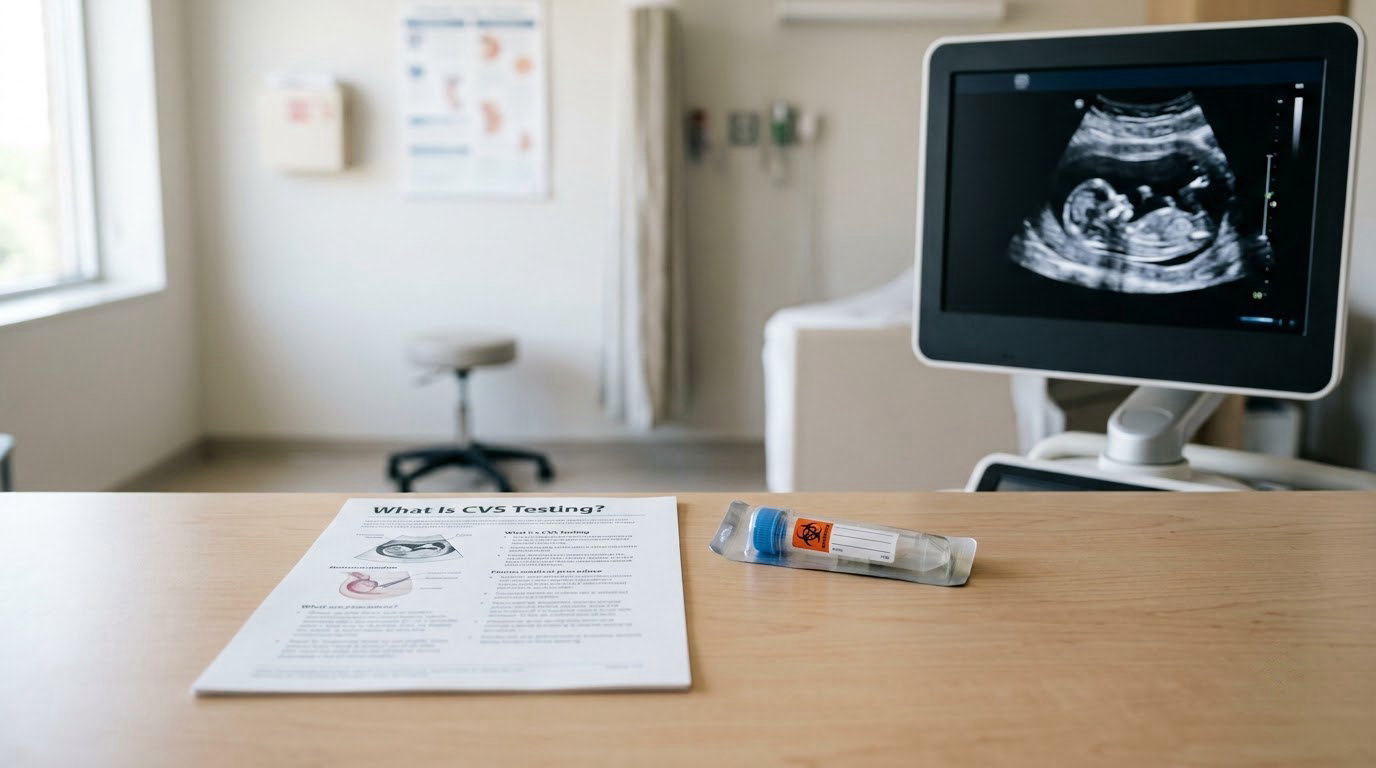
Chorionic villus sampling is a prenatal diagnostic test done between roughly 10 and 13 weeks of pregnancy, in which a small sample of placental tissue, the chorionic villi, is taken under ultrasound guidance and examined in a laboratory for chromosomal and genetic conditions. Unlike a screening test, a CVS result is considered definitive for the conditions it can detect.
The reason the placenta is sampled rather than the baby is practical. The chorionic villi form early and share genetic material with the fetus, so they carry the same chromosomal information. They are also easier and safer to reach than the amniotic sac at this stage. You can think of the sample as a stand-in that is read in a lab, not at the bedside.
That distinction between screening and diagnosis is worth sitting with, because it underpins almost every question parents ask. A screening test estimates risk. It works by measuring an indirect signal, such as cell-free DNA in maternal blood, and it produces a number that may be high risk, low risk or, frustratingly, no result at all. A diagnostic test looks at the chromosomes or genes directly and produces a yes or no for the conditions it tests.
CVS is on the diagnostic side. That is its main appeal and also the source of a lot of its emotional weight. People often arrive at a CVS appointment already frightened, because they have just had a screening result that raised a possibility rather than confirming anything.
How Does CVS Testing Work?
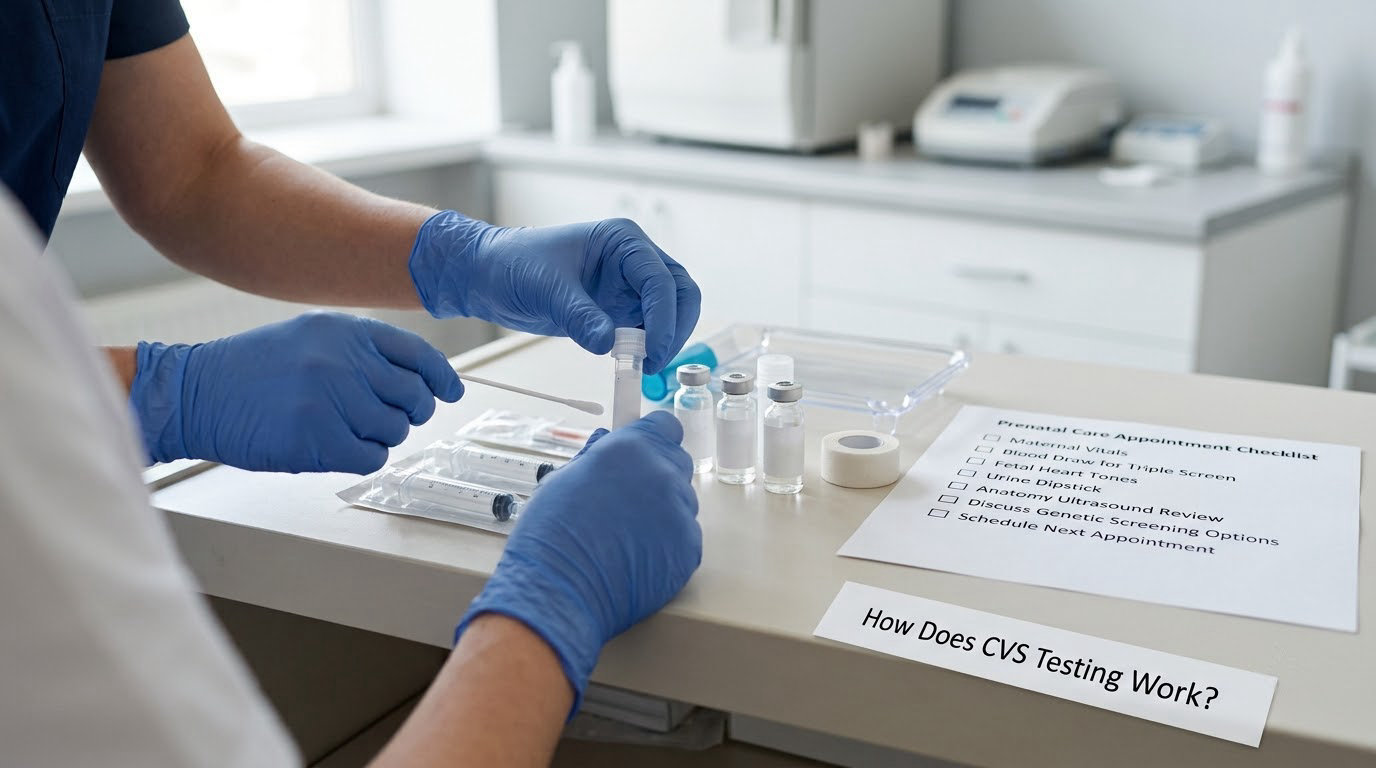
The procedure is shorter than most people expect. A specialist uses ultrasound throughout to see exactly where the needle or catheter is going, and the whole appointment commonly takes 15 to 30 minutes.
- The dating scan comes first. Most clinics want an ultrasound around 8 to 9 weeks to confirm how far along the pregnancy is before CVS is offered. Without that, the result of the procedure itself cannot be dated accurately.
- Ultrasound locates the placenta. The sonographer or obstetrician maps where the chorionic villi sit relative to the uterus and decides which route to use.
- The site is cleaned. The abdominal or vaginal area is prepped with an antiseptic solution to reduce infection risk.
- Local anesthetic is given. A small injection numbs the skin and the tissue beneath it. Some clinics offer a numbing gel or spray for the transcervical route as well.
- The sample is taken. Either a thin needle is passed through the abdomen into the placenta, or a soft tube is guided through the cervix. Ultrasound guides both, and the aim is a small amount of villi, usually described as about 20 to 25 cells worth of tissue.
- The sample goes to the laboratory. Cells are grown and analysed. You then go home, rest for a day or two, and wait for results.
Transabdominal or transcervical: which one you get
There are two routes, and the provider picks one based on where your placenta happens to be sitting. The transabdominal route goes through your belly, which is generally the more common choice. The transcervical route passes a soft catheter through the cervix, which tends to be used when the placenta is positioned in a way that makes the abdominal approach awkward.
Parents often ask whether one is better. Honestly, the route matters far less than the operator’s experience with it, and both approaches yield comparable diagnostic accuracy when the sample is adequate. The route is decided in the room, on the scan, not in advance. That is normal, and it is not a sign that something has gone wrong with your pregnancy.
What the sample actually goes through
Three lab processes are relevant to what you will hear about your results, and a glossary helps here: karyotype is a full look at the chromosomes arranged in a standard picture, FISH (fluorescence in situ hybridization) is a faster targeted test for a handful of common conditions, and microarray is a broader scan that picks up smaller missing or extra pieces of genetic material that a karyotype can miss. Not every clinic offers all three, and your provider will tell you which analysis is being run on your sample.
When Is CVS Usually Done?
CVS is offered at 10 to 13 weeks of pregnancy, with most procedures falling between 11 and 13 weeks. After about 14 weeks, amniocentesis becomes the usual diagnostic option instead, which is the practical reason the two tests have such different windows.
Timing is not arbitrary. The chorionic villi have to be developed enough to sample but the procedure needs to happen before the placenta and the pregnancy move into the second-trimester pattern. The 8 to 9 week scan, usually described as a dating scan, exists to establish how many weeks you actually are, since a pregnancy dated by last menstrual period can be out by a week or more either way.
The appeal of an early result is time. A clear answer at 12 weeks gives you several months to seek further information, arrange specialist care if it is wanted, connect with support services, or simply sit with the information before you have to act on it. That interval is something parents consistently describe as valuable, even when the news itself is hard.
Exact availability varies. Some clinics do not offer CVS at all and refer elsewhere. Some have limits around placenta position, maternal cell contamination in the sample, or certain obstetric situations. Local guidance and your provider’s judgement set the real window, not a single national rule.
What Can CVS Test Tell You?
A standard CVS with karyotype or microarray analysis can confirm or exclude chromosomal conditions such as trisomy 21 (Down syndrome), trisomy 18 and trisomy 13, as well as sex chromosome conditions. Microarray extends the reach to smaller deletions and duplications that a standard karyotype will not pick up.
Where a parent is known to carry a specific gene variant, or where a single-gene disorder is in the family history, CVS tissue can also be used for targeted DNA analysis. This has to be arranged deliberately in advance, because the sample needs to be handled correctly from the moment it is taken. If that is your situation, raise it before the appointment rather than after.
| Test | What it examines | What it can tell you |
|---|---|---|
| Karyotype | Whole chromosomes | Trisomy 21, 18 and 13, sex chromosome conditions, large structural changes |
| Microarray (CMA) | Chromosomes at finer resolution | Everything a karyotype finds, plus microdeletions and duplications |
| Targeted DNA analysis | A specific known gene variant | Whether the baby has inherited that particular variant |
Now the limits, and these matter as much as the capabilities. CVS cannot detect every genetic condition. Most conditions are not caused by chromosome number or by the deletions and duplications a microarray sees, and no prenatal test is a check on a child’s future health, development or lifelong wellbeing. A normal CVS means no condition was found in the categories that were tested. It is a strong result, not a promise.
How Are CVS Results Interpreted?
Most families hear news twice, and almost nobody is warned about this in advance. Results usually arrive in stages: a rapid FISH result within a few days for the most common conditions, then the full karyotype or microarray result commonly 7 to 14 days after the sample reaches the laboratory. Expecting a second call is far less frightening than not expecting one.
Three kinds of result you might get
Normal. No chromosomal or genetic abnormality was found in the categories tested. This is the most common outcome, and for many families it ends the diagnostic process. Some clinicians will still recommend amniocentesis if a screening result was high risk, and that recommendation is worth discussing rather than assuming.
Unclear or uninterpretable. Occasionally the sample is too small, the cells do not grow, or the laboratory cannot produce a clear read. This is a technical failure rather than a finding, and it is usually resolved by repeating the procedure or by doing amniocentesis. It says nothing about the baby.
Abnormal. A chromosomal or genetic difference is identified. This is where a genetic counselor becomes central, and where the conversation is much longer than the phone call itself.
What confined placental mosaicism means
This is the piece most parents have never heard of before it happens to them, and it is the single biggest source of confusion in CVS results. A small number of cells in the placenta can carry a different chromosome pattern from the cells in the fetus. When the abnormal cells are confined to the placenta, the baby is usually unaffected. This is called confined placental mosaicism.
It matters because it produces results that look contradictory. A rapid FISH can come back showing mostly normal cells while the fuller karyotype, examining more cells, shows a different picture. Or a high-risk NIPT can be followed by a CVS that does not confirm the finding. Neither result is a mistake. They are measuring different tissue and different numbers of cells, and the placenta is not a perfect mirror of the baby.
The usual resolution is amniocentesis, which samples amniotic fluid rather than placenta and therefore gives a read on fetal cells. If your result contains the words mosaic or confined, that follow-up conversation is the point at which to ask about it specifically.
One more technical detail worth knowing: laboratories ask for a maternal blood sample alongside the CVS sample so they can detect and rule out maternal cell contamination, where a few of your own cells get mixed into the sample and distort the read. That is routine housekeeping, and it explains why you may be asked for an extra blood draw on the day.
What Are the Risks and Limitations of CVS?
The most discussed risk is miscarriage. Major medical bodies including ACOG and the RCOG describe the procedure-related risk as low, commonly quoted around 1 in 200 to 1 in 400. Some first-trimester series report figures closer to 2 percent. The figures vary because the studies count different things and because your baseline risk is not zero to begin with.
That last point deserves emphasis. Somewhere between 1 and 2 percent of pregnancies are lost in the first trimester on their own, without any procedure involved. So when a provider tells you the added risk is small, they are describing an increment, not the total. Parents who have already had a loss, or who are carrying a high-risk screen, sometimes carry a higher baseline than average, and your provider can usually estimate that more accurately than a general figure.
Common after-effects are mild: cramping, and small amounts of spotting or bleeding for a day or two, which most people describe as heavier than a normal period or lighter, depending on the provider’s threshold. Seek urgent care for heavy bleeding that soaks a pad, leaking fluid, fever, or pain that does not settle. Those are not things to wait out.
Then there are the practical limits. Some pregnancies are not suitable for CVS because of placenta position or attachment, and the attempt may simply not be possible on the day. If that happens, the plan is usually amniocentesis at a later gestation. Parents describe that moment as a gut punch, particularly when it follows an already worrying scan, so it is worth asking your clinic how they handle an unsuccessful attempt before the day itself.
Your provider will also weigh your individual risk. A previous pregnancy loss, certain blood conditions, infection, and some medicine use all change the picture. This is exactly the kind of conversation that a named, credentialed clinician is there for.
CVS vs. Amniocentesis: What’s the Difference?
Both are diagnostic tests. The difference is timing, tissue, and how quickly the answer arrives.
| Criterion | CVS | Amniocentesis |
|---|---|---|
| Typical timing | 10 to 13 weeks | Usually 15 weeks or later |
| Sample taken | Placental tissue (chorionic villi) | Amniotic fluid |
| Route | Needle through the abdomen, or catheter through the cervix | Needle through the abdomen |
| Results speed | Rapid result in days, full result 7 to 14 days | Commonly 1 to 2 weeks |
| Quoted miscarriage risk | About 1 in 200 to 1 in 400, some series near 2 percent | Generally quoted slightly higher, often about 1 in 300 to 1 in 500 |
| Cannot detect | Neural tube defects, some placental mosaicism patterns | Neural tube defect markers are measured directly, which is its own advantage |
| Typically chosen when | You want the earliest definitive answer | You need a later test, or CVS is not feasible |
The trade-off is genuinely close. CVS gets you an answer several weeks earlier, which matters for planning. Amniocentesis samples fetal cells rather than placental cells, so it resolves the mosaic-pattern questions CVS can raise, and it can measure markers of neural tube defects. It is also the option when the placenta is positioned so that CVS cannot be done.
Both carry a small procedure-related risk, and neither is routinely better across every situation. The choice usually follows gestational age, what your scan showed, and what your clinician recommends. Your own preference matters here, and there is no wrong answer.
CVS vs. Noninvasive Prenatal Screening: What’s the Difference?
This is the comparison that causes the most confusion, because parents are told a test has a high detection rate and then assume it is diagnostic. It is not.
| Criterion | NIPT (cell-free DNA screening) | CVS (diagnostic) |
|---|---|---|
| Type | Screening test | Diagnostic test |
| Method | Blood draw, fragments of fetal DNA in maternal blood | Placental tissue sample under ultrasound |
| Risk of false positive or no result | Yes, both are recognised outcomes | Very low for the conditions tested |
| Best for | Estimating chance of common trisomies | Confirming or excluding a suspected condition |
| Complementary use | Flags risk that CVS can then confirm or clear | Resolves a high-risk screen with a real answer |
For the three trisomies most often present at birth, NIPT detection rates are commonly quoted above 99 percent, which is genuinely impressive for a blood test. But a high detection rate is not the same as a diagnosis, and false positives do occur, as do false negatives. NIPT is also less able to interpret some sex chromosome findings, which is exactly where results often go quiet and confusing.
CVS works the other way round. It is highly accurate for the conditions it directly examines, but it cannot see the conditions that NIPT can flag indirectly, and it cannot rule out everything. The two are not competitors. NIPT raises or lowers a probability; CVS answers a narrower question with far more certainty.
How to Prepare for CVS
Preparation is mostly practical and mostly about comfort. Your clinic will give you its own directions, which always take precedence over anything general below.
Wear something with a separate waistband, because the abdominal route means the site is exposed and cleaned. Some clinics ask you not to apply lotions or make-up over the abdomen that day.
Ask about fasting and bladder fullness. Full bladder guidance in particular varies, because it affects how the uterus sits on the scan and whether the placenta is easy to reach.
Bring someone if you can. The waiting is the part people remember, and having someone there makes the wait shorter rather than the procedure easier.
Write your questions down in advance. They always come back to you during the wait, not during the appointment.
Before you leave, confirm three practical things: what activity is fine in the following 48 hours, when the rapid result is expected, and who will call you with the news.
On sensations, descriptions vary a lot. Many parents describe the procedural part as uncomfortable rather than painful, with cramping that feels like strong period cramps and a pulling sensation during sampling. Local anesthetic helps with the insertion, not the cramping. Accounts from other parents run the other way too, with some calling the whole thing painless and others finding an amnio the harder of the two procedures. Your own threshold is the only one that counts.
Afterwards, most providers suggest rest for a day or two, avoiding heavy lifting and strenuous exercise, and holding off on sex for a similar period. Work, travel and driving are usually fine unless your provider says otherwise, and the practical reality is that many people go back to normal within 48 hours.
Questions to Ask Your Prenatal Care Team
These are worth taking into the appointment in writing, whatever you have already been told.
- Why are you recommending CVS in my case, and what result are we hoping to resolve?
- Which laboratory analysis will be run on my sample: karyotype, microarray, targeted DNA, or a combination?
- Is there anything about my placenta position or my history that makes this harder or riskier?
- What is your honest estimate of the procedure-related risk for me specifically, not the general figure?
- What happens to my results if I decide not to have the procedure?
- What does an unclear or mosaic result mean in my case, and what would be the next test?
- When exactly will I hear the rapid result, and when the full result?
- Who calls me, and at what number and time of day?
- Can I speak with a genetic counselor before or after the test?
- If a result needs follow-up, who coordinates that and how quickly can it happen?
- What support services exist for both continuing the pregnancy and ending it?
- What would you want to know if I decided to keep the pregnancy and manage a known condition?
That last question is worth asking even if you are not thinking about it right now. Parents who planned ahead describe having far more options available to them than parents who did not.
What Happens After CVS Results?
If the result is normal, the usual next step is a conversation with your provider and, in some cases, routine pregnancy care. If the result needs explaining, the sequence generally looks like this.
- Someone calls you. Usually your provider’s office or a genetic counselor, ideally by a number where you can talk privately.
- You get a genetics appointment. A genetic counselor goes through the report with you, explains what the finding means in plain language, and outlines the options.
- You discuss further testing. This may be amniocentesis, more detailed analysis, or further ultrasound, depending on what was found.
- You take the time you have. Knowing the result earlier usually means you have weeks, not hours, before decisions are due. That time is yours to use.
- Support is offered. Specialist services, parent support groups and counselling are available for both continuing and ending a pregnancy, and neither choice is treated here as the right one.
One important separation: urgent medical symptoms need urgent care, whatever the result says. Heavy bleeding, leaking fluid, fever or severe pain are a phone call to your maternity unit today, not something to hold until results arrive.
Separately, a normal result does not remove every question. If your NIPT was high risk and CVS is normal, that combination deserves a proper discussion rather than a sigh of relief, because the two tests measure different things. Asking why they differ is a reasonable question to bring back to your clinician.
Frequently Asked Questions
How early can CVS detect a genetic condition?
CVS is generally offered between 10 and 13 weeks of pregnancy, which makes it one of the earliest ways to get a definitive answer rather than a risk estimate. A dating scan around 8 to 9 weeks usually comes first. Results can confirm or exclude the conditions the laboratory is testing for within one to two weeks of the procedure, subject to the analysis being run.
Does CVS always give a definitive answer?
For the conditions it directly examines, a CVS result is considered diagnostic rather than a probability. It does not rule out everything. Most conditions are not chromosome-level, and no test predicts a child’s health, development or future. Placental mosaicism can also produce a result that needs repeating or confirming by amniocentesis.
Can CVS determine a baby’s sex?
Yes, CVS can usually identify fetal sex because the analysis examines chromosomes, and sex chromosome information typically arrives with the rapid result rather than waiting for the full report. Providers often discuss this in advance, so if you would rather not know, say so before the sample is taken. It is a reasonable and routine thing to ask for.
What happens if CVS results are abnormal?
A clinician or genetic counselor will call you and arrange a genetics appointment to go through the report, usually within days. You can discuss further testing such as amniocentesis, additional scans, and what the finding means. Because the result arrives in the first trimester, there is usually time to gather information and decide what you want to do without rushing.
Is CVS more risky than amniocentesis?
Both carry a small procedure-related risk of miscarriage, and guidance from bodies such as ACOG and the RCOG generally places them in a similar low range, commonly quoted as about 1 in 200 to 1 in 400. Some amniocentesis figures sit slightly higher. Your personal risk depends on your own history, so ask your provider for an estimate based on you.
How long does it take to receive CVS results?
Results usually come in two stages. A rapid FISH result for the most common conditions often arrives within a few days, and the full karyotype or microarray result commonly takes 7 to 14 days. Knowing that two calls are likely, rather than one, prevents a long silence being mistaken for bad news.
What to Do First
Before anything else, book a conversation with your obstetric clinician, midwife or genetic counselor and ask the reason CVS is being suggested in your case, what it can and cannot answer for you, the risk figure based on your own history, and what the alternatives are. Bring the question list above and take the time you need.
This is general educational information about prenatal testing, not advice about your pregnancy. Your own care team knows your history, your scan and your local services, and the decision about whether to test, and what to do next, belongs with them and with you.