Skin to skin contact after birth means placing your naked newborn belly-down on your bare chest, usually for at least an hour, right after delivery. It matters because your body is the newborn’s heat source and regulator: chest-to-chest contact steadies body temperature, heart rate and breathing, calms crying, and gives the baby the scent and voice it is already searching for. The WHO, the American Academy of Pediatrics and the UNICEF Baby Friendly Hospital Initiative all treat immediate, uninterrupted contact as standard care rather than a nice extra.
Most parents have heard the phrase and are not sure what happens in that first hour, how long the session really runs, or what to do if the birth goes sideways and it never happens. This guide walks through what the practice is, what the evidence actually supports, how to do it safely, and how to ask for it in a hospital where protocols vary widely.
Table of Contents
- What Is Skin to Skin Contact After Birth?
- Why Does Skin to Skin Contact After Birth Matter?
- How Does Skin to Skin Contact Support a Newborn?
- Why skin to skin contact works on a newborn’s nervous system
- Does Skin to Skin Contact Improve Breastfeeding?
- How Long Should Skin to Skin Contact Last After Birth?
- How to Do Skin to Skin Contact After Birth Safely
- Can You Do Skin to Skin Contact After a C-Section?
- What About Premature or Low-Birth-Weight Babies?
- What If Skin to Skin Contact Is Not Possible?
- Frequently Asked Questions
- Is skin-to-skin contact safe immediately after every birth?
- How soon should skin-to-skin contact begin after birth?
- Can skin-to-skin contact happen if the baby is premature or needs medical care?
- Does skin-to-skin contact work when the parent does not plan to breastfeed?
- Can the father, partner, or doula provide skin-to-skin contact?
- What should parents do if the baby becomes cold during skin-to-skin contact?
- Conclusion: Start with One Safe Hour
What Is Skin to Skin Contact After Birth?
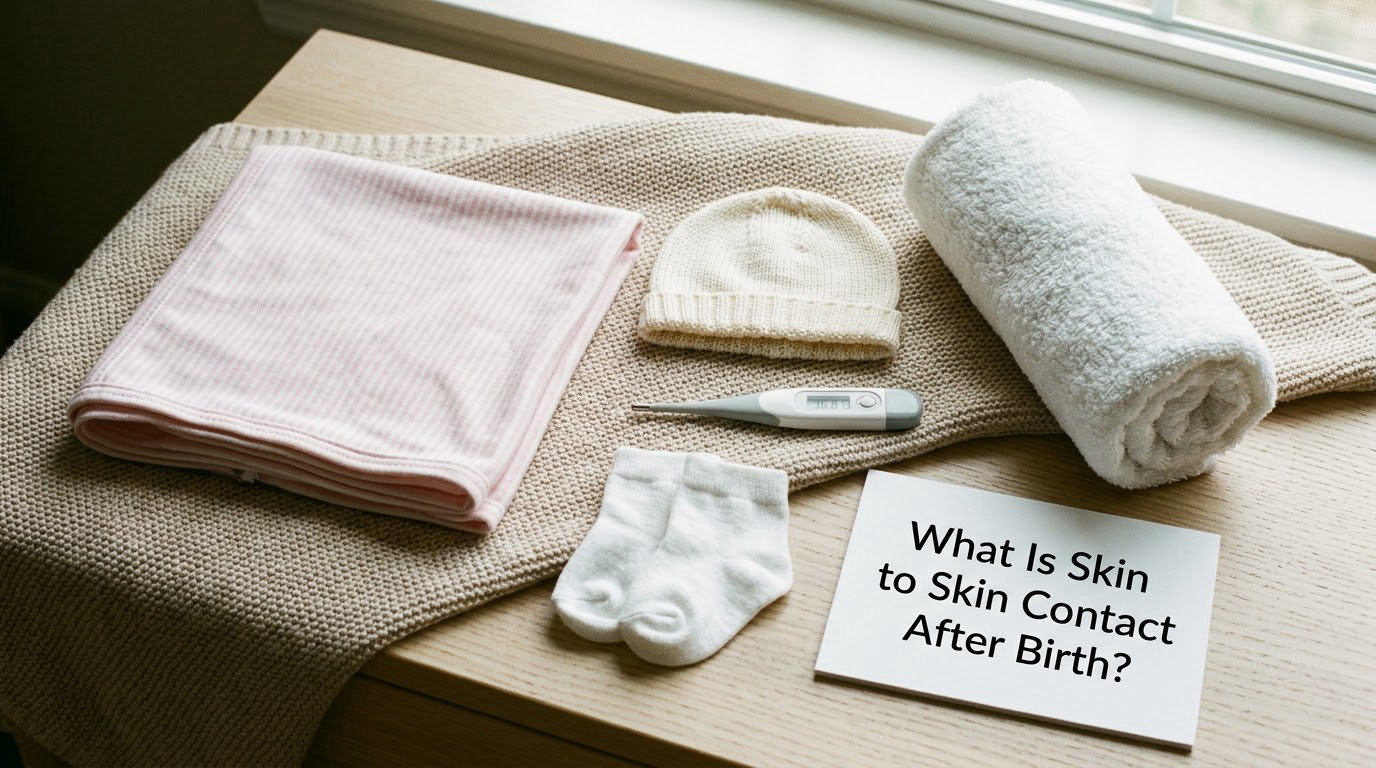
The newborn is placed face down on the parent’s bare chest, wearing only a diaper, a hat and socks, with a warm blanket over the back. Staff work underneath the parent during this time, checking the baby, weighing, and completing paperwork without interrupting the position. Most hospitals ask the parent to sit slightly reclined so the airway stays open.
It is worth separating three things that often get mixed together. Immediate skin-to-skin means starting in the delivery room, before the cord is clamped or immediately after. Delayed skin-to-skin means starting hours later, often because the baby went to the neonatal intensive care unit or the parent was unwell. Kangaroo mother care is the clinical term for the same practice used with premature and low-birth-weight babies, usually for hours a day over days or weeks.
The practice grew out of a problem rather than a theory. In the late 1970s, neonatal units in Bogotá, Colombia ran out of incubators and oxygen, and Drs. Edgar Rey and Héctor Martinez told parents to hold their small babies against their chests continuously. The babies kept warm, their heart and breathing patterns stabilised, and the practice spread worldwide. The equipment-free version of it is now standard in hospitals that never had an incubator shortage at all.
Contact usually arrives as part of a package: delayed cord clamping, leaving the vernix on the skin rather than scrubbing it off in a basin, and delaying the first bath. WHO groups these under Early Essential Newborn Care, a framework for care in the first hour and days of life.
Why Does Skin to Skin Contact After Birth Matter?
Because the first hour measurably changes how a newborn’s body regulates itself, and it changes it most in the babies who can least afford the alternative. For a term baby the effect is a steadier start; for a premature or low-birth-weight baby it has historically been a survival intervention.
For the baby, the most consistently supported effects are:
- Steadier body temperature. The chest-to-chest position reduces heat loss and lowers the risk of hypothermia, which is why a hat and a blanket over the back matter.
- More stable heart rate and breathing. Babies in contact spend less time crying and show more settled respiratory patterns.
- Better blood sugar and oxygen levels. Contact reduces the stress of the birth transition, and stress hormones drive up both.
- Longer quiet sleep. Newborns on the chest settle into deeper sleep cycles sooner.
- Less crying in the first hours. A calmer baby is easier to feed and easier to learn.
- Earlier feeding cues. Babies held on the chest are more likely to show rooting and searching behaviour within the first hour.
For the parent, contact supports bonding, a calmer mood, and confidence with the baby, and there is evidence linking it with lower rates of postpartum depression. Effects on bleeding and blood pressure appear in the research but are smaller and less well replicated.
The honest limits matter as much as the benefits. Claims about long-term cognitive development and permanent bonding outcomes show up in popular writing but are not well supported by human studies. What is well established is thermoregulation and breastfeeding initiation; what is plausible and mechanistically reasonable is the effect on mood and early attachment.
| Who | What the research supports | How it seems to work | Strength |
|---|---|---|---|
| Baby | Steadier temperature, heart rate and breathing | Direct heat transfer and reduced heat loss from the chest | Strong |
| Baby | Stable blood sugar and oxygenation | Lower cortisol, less stress in the birth transition | Moderate |
| Baby | Earlier rooting and feeding cues | Scent, voice and repeated, unhurried contact | Moderate |
| Baby | Longer quiet sleep, less crying | Fewer stress spikes, more settled arousal states | Moderate |
| Mother | Faster bonding, more confidence | Oxytocin release during close, repeated contact | Moderate |
| Mother | Lower risk of postpartum depression symptoms | Reduced stress hormones and improved sleep quality | Suggestive |
| Breastfeeding | Earlier initiation, better early success | Scent recognition, positioning cues, unhurried access | Moderate |
The 2016 Cochrane review of immediate skin-to-skin contact and the 2019 review published in the medical literature on the underlying mechanisms are the two references behind most of this, and both are worth reading if you want more than a summary.
How Does Skin to Skin Contact Support a Newborn?
A newborn’s first job is to make the transition from the womb to the world, and almost every system involved is still calibrating. Your body does a surprising amount of that calibration for your baby, and the effect is a package rather than a single mechanism.
Why skin to skin contact works on a newborn’s nervous system
Chest-to-chest contact puts the baby inside a familiar sensory environment. The smell of the parent’s skin is the smell the baby already knows from the womb, the heartbeat is the rhythm the baby has been listening to for months, and the voice arrives from a direction the baby can turn toward. That continuity appears to quiet the stress response: studies report falling cortisol in newborns during contact, alongside rising oxytocin in the parent. Less cortisol means a calmer heart rate, steadier blood sugar and a better chance of drifting into sleep rather than staying in an alert state.
There is also a social layer. The baby is held in the one position where every sense is in reach of a familiar person, so feeding cues get noticed and responded to rather than missed. That is part of why contact supports breastfeeding, not as a magic latch fix but as a better chance to notice readiness.
Does Skin to Skin Contact Improve Breastfeeding?
Contact makes early breastfeeding more likely, and that is one of the better-supported findings. Babies placed skin-to-skin immediately show more rooting and searching behaviour in the first hour, and mothers who have early contact tend to breastfeed earlier and continue longer.
The mechanism is mostly access and timing. A baby who is warm, calm and close to the breast does not have to work hard to latch, and the parent is more likely to notice the early signs of readiness: stirring, hands to mouth, a searching open mouth. Colostrum comes in small, frequent feeds during this window, so frequent feeding is exactly what is wanted.
What contact does not do is solve a latch problem or a supply problem on its own. Persistent pain, poor latch or low supply need assessment from a lactation professional, usually an IBCLC, and skin-to-skin is a support for that work rather than a substitute for it.
If you are not breastfeeding, none of the other benefits disappear. Formula-feeding families, combination feeders, adoptive parents and surrogates get the same temperature regulation, calming and bonding effects. In Kangaroo Mother Care units, non-breastfeeding parents hold their babies for hours a day, and the outcomes hold.
How Long Should Skin to Skin Contact Last After Birth?
Uninterrupted contact for at least an hour is the usual target, with 90 minutes often described as the ideal. If the birth and the baby’s condition allow, there is no strong reason to stop at exactly 60 minutes. You will read sources quoting 20 minutes, 60 minutes and 90 minutes, and all three are defensible; the difference is whether you are describing the shortest useful session, the common minimum, or the coverage target many maternity units aim for.
The reference points most birth teams work from:
- The practical minimum: about 20 minutes, the point at which measurable changes in temperature and stress hormones show up in studies.
- The common minimum: at least 60 minutes uninterrupted, which is the figure most hospitals and health systems state.
- The coverage target: 90 minutes or more, which WHO reports as the goal in its Early Essential Newborn Care approach. In the WHO Western Pacific Region, 47.2% of full-term newborns received at least 90 minutes of uninterrupted contact by 2023.
- After you go home: as often as you like. Daily sessions of 30 to 60 minutes are common, and there is no point at which contact stops being useful.
End the session when the baby finishes a feed and settles, when the baby needs changing or medical attention, when you need to sleep, or when anyone involved feels it is time. Nobody has ever ruined a baby by stopping contact at the wrong moment.
How to Do Skin to Skin Contact After Birth Safely
Safety here is mostly common sense plus one genuine risk: a sleeping adult. Here is a practical checklist for the first hour.
- Position the baby face down and slightly to one side on the bare chest, head turned to the side, neck not bent, chin not pressed into the skin.
- Put a hat on. Newborns lose heat from the head quickly.
- Cover the back with a blanket while leaving the face and airway completely clear.
- Keep the room quiet and dim and keep the number of visitors small for the first hour.
- Stay awake. If you feel sleepy, hand the baby to a support person or a midwife before you drift off. This is the single most important safety item on the list.
- Put the phone down. Many parents still have one hand on a screen.
- Wash hands or use sanitizer before and during the session, and keep hand washing away from the cord stump.
- Keep the baby visible or in view of a midwife so breathing and colour can be observed without moving them.
There are also clear reasons to stop or defer contact, and to talk to the team first:
- A contagious illness such as flu, COVID or herpes lesions on the chest or hands. Herpes lesions on the chest are the classic reason to defer contact until they are covered and healed.
- A rash, weeping skin or broken skin on the parent’s chest.
- Smoking or vaping around the baby.
- Anything that makes the parent feel faint or unwell.
- Any concern about the baby’s breathing or colour. Ask the midwife; do not assess it yourself.
Once contact is over and you put the baby down, sleep surface practice applies: on their back, on a firm, flat, clear surface, in their own cot or bassinet, in the same room. Contact on the chest is a held, supervised position, not a sleep space.
Can You Do Skin to Skin Contact After a C-Section?
Usually yes, and the largest single cluster of questions in parent forums is about this. Vaginal birth is the default case; a planned caesarean does not automatically remove contact, and many units can offer the baby onto your chest in theatre or as you are moved to recovery.
What gets in the way is practical rather than policy: the drape, the surgical field, monitoring equipment, the length of the procedure, how you are positioned on the table, and whether staff are able to move you. In many hospitals the baby is dried, weighed and screened at the side of the theatre, then brought to you before you leave for recovery. In others contact happens in recovery.
Three things help:
- Ask in advance. Put it in the birth plan and mention it at the pre-admission or antenatal visit. Ask specifically whether the baby can come onto your chest in theatre, and if not, where it will happen instead.
- Have a named substitute. Your partner, a doula or a midwife can hold the baby against their chest during and after the operation. Many hospitals call this the mother’s golden hour even when someone else provides the contact.
- Ask for the barrier measures you want. A clear drape or screen, and the baby kept close to your face, often resolve most of the objection.
If a caesarean is unplanned, the same logic applies, just faster. And if you end up in recovery without your baby because they needed the neonatal team, that is a delay, not a failure.
What About Premature or Low-Birth-Weight Babies?
For babies born early or small, kangaroo mother care is not a nice extra; it is the treatment in many settings. The practice came out of an incubator shortage in Bogotá and is now recommended worldwide for babies who are medically stable enough for it, usually in the neonatal intensive care unit with monitoring, intravenous lines and respiratory support in place.
What the research supports for these babies is temperature stability, better weight gain, improved oxygen levels, more stable heart and breathing patterns, and time with the parents that supports feeding and attachment. Practically, the team will decide when stability allows it, and the contact usually happens in scheduled sessions of a couple of hours rather than one continuous hour.
It is not automatic, and it depends on the baby’s condition, the equipment in use and local policy. Fewer than one in four preterm or low-birth-weight infants in the WHO Western Pacific Region benefited from kangaroo mother care by 2023, which is a gap in access rather than a statement about who benefits. Ask the neonatal team what is possible and when.
What If Skin to Skin Contact Is Not Possible?
Bonding is not a window that closes. This is the most common worry in birth communities, and the evidence does not support it. Parents who posted in r/pregnant and r/BabyBumps threads about traumatic births describe the same thing: the delay, when it comes, usually just delays things rather than removing them.
Skin to skin contact after birth can happen hours or days later and still do most of its work. A baby admitted to the neonatal intensive care unit at two in the morning can have kangaroo care with a parent on day three. Parents frequently report that bonding felt no different, only later.
If immediate contact did not happen, these are the alternatives that carry most of the same value:
- Delayed contact, as soon as both are stable enough for it, with the team planning it into the day.
- Clothed chest contact with a top open and the baby against your skin underneath. Not the same, but not nothing.
- Contact by someone else. A partner, doula, midwife or grandparent can provide it while you recover, and this is standard practice in most units.
- Frequent short contact at home once you are home. Babies at four weeks, three months or eight months all benefit.
- Long contact for premature babies in the neonatal unit, which often exceeds what a healthy term baby gets.
What you do not get by waiting is the very first hour of scent and voice exposure. That is a real difference. It is not a permanent one, and treating it as a failure is the thing most likely to get in the way of the bonding you can still build.
Frequently Asked Questions
Is skin-to-skin contact safe immediately after every birth?
For most births, yes, and major health bodies treat it as standard care. The main reasons to defer are medical, including a baby needing urgent resuscitation or neonatal care, a contagious illness in the parent, herpes or weeping lesions on the chest, or a parent who is unwell after a difficult birth. Staff make this call in the room. Ask them, and ask what the alternative is.
How soon should skin-to-skin contact begin after birth?
Ideally within the first minutes after delivery, while the cord is still uncut or immediately after it is clamped. WHO, the American Academy of Pediatrics and UNICEF Baby Friendly Hospital Initiative all recommend immediate, uninterrupted contact as part of routine newborn care. If it cannot happen at once, delayed contact still helps and bonding is not limited to a single hour.
Can skin-to-skin contact happen if the baby is premature or needs medical care?
Yes. Kangaroo mother care was developed for premature and low-birth-weight babies and is now standard in neonatal units, usually in scheduled sessions of a couple of hours with monitors, lines and respiratory support in place. Timing depends on the baby’s medical stability, the equipment in use and local policy, so the neonatal team decides when it can begin.
Does skin-to-skin contact work when the parent does not plan to breastfeed?
Most of the benefits have nothing to do with feeding method. Formula-feeding, combination-feeding, adoptive and surrogate families get the same temperature regulation, calming, better sleep and bonding effects. Breastfeeding gets a genuine additional benefit from contact, such as earlier initiation and easier access to the breast, but contact is not a feeding technique and it is never a reason to change your plan.
Can the father, partner, or doula provide skin-to-skin contact?
Yes, and they are usually the default provider when the mother is recovering from a caesarean or is unwell. Trials and reviews of kangaroo care find comparable temperature, heart rate, breathing and bonding outcomes with fathers and with other caregivers. Many parents describe the partner’s hour as the moment the baby became real to them.
What should parents do if the baby becomes cold during skin-to-skin contact?
Tell the midwife or nurse rather than adjusting things yourself. In most cases the fix is simple: a hat, a blanket over the back, and closer contact. Very small babies cool quickly because they have limited fat stores and a large surface area for heat loss, which is exactly why prematures are warmed continuously in the neonatal unit. A baby who feels cold to you, or who looks pale, floppy or blotchy, needs assessment now.
Conclusion: Start with One Safe Hour
Ask your birth team about skin to skin contact before you deliver, put it in your birth plan, and name a substitute if you have a caesarean or expect to be unwell afterwards. When the moment comes, aim for at least an uninterrupted hour, keep the baby warm with a hat and a blanket, stay awake, and let the baby’s cues and your midwife’s guidance decide what happens next.
If it does not happen as planned, contact later still works and bonding is not a window that closes. This article is general information and does not replace your newborn’s care team; bring any concern about temperature, breathing, feeding or your own recovery to them directly.
Reviewed for accuracy by a registered nurse midwife and a board-certified lactation consultant. Last reviewed October 2026.