
Yes, you can use the Family and Medical Leave Act for maternity leave. If you work for a covered employer, have been there at least 12 months, and have logged 1,250 hours, you are entitled to up to 12 unpaid, job-protected workweeks to recover from childbirth and bond with your baby, all within one year of the birth.
That short answer is the part most people get wrong. FMLA is job protection, not a paycheck. It keeps your position and your health insurance, and it stops an employer from firing you for taking the time off, but the 12 weeks are unpaid unless you layer other benefits on top. Learning how to use FMLA for maternity leave is really two jobs: qualifying correctly, and stacking the leave so the money works.
As a midwife, I field this question in almost every prenatal visit, usually around the halfway mark. The paperwork is genuinely not hard when your employer cooperates. What trips people up is timing — they wait until the week of the birth to say anything, then the forms take three weeks to come back from a busy clinic. Get ahead of it and the whole thing is boring, which is the goal.
This guide walks through the process in the order it should happen, from confirming eligibility to the day you walk back in. Rules and timelines vary by state and by employer, and nothing here is legal or medical advice for your specific situation — treat it as a plan to discuss with HR, your benefits administrator, and your clinician.
Table of Contents
- What You Need Before You Start
- Step-by-Step: How to Use FMLA for Maternity Leave
- Step 1: Confirm That You Qualify
- Step 2: Estimate Your Leave and Recovery
- Step 3: Tell Your Employer in Time
- Step 4: Complete the FMLA Paperwork
- Step 5: Submit Medical Certification
- Step 6: Confirm Benefits, Pay, and Job Protection
- Step 7: Plan the Return to Work
- Common Mistakes and How to Fix Them
- Frequently Asked Questions
- Can I use my FMLA for maternity leave?
- Does FMLA pay you 100%?
- What is the 3 day rule for FMLA?
- How do I get FMLA approved for pregnancy?
- Can I use FMLA intermittently after the baby is born?
- What do I do if my employer denies or ignores my request?
- Conclusion
What You Need Before You Start

Gather these before you contact anyone. Missing one of them is the reason requests stall.
- Proof you work for a covered employer. The employer must employ 50 or more people within a 75-mile radius of your worksite. Public agencies and public schools are covered regardless of size.
- 12 months of service. Not 12 months of pregnancy — 12 months employed by this employer, including time you spent on leave or on a union-approved temporary assignment.
- 1,250 hours worked in those 12 months. Unpaid time does not count toward this, and neither do hours the employer did not actually pay you for.
- Your approximate due date and how much time you realistically want to take.
- Your provider’s contact information, so the medical certification goes straight to the right office.
- Contact details for your leave administrator — usually HR or a third-party leave administrator named in your employee handbook.
- Your PTO balance and short-term disability plan name, if you want to replace some of the unpaid weeks.
One thing to understand before you go further: prenatal leave, recovery leave, and bonding leave all draw from the same 12-week bank. You do not get 12 weeks before the birth and another 12 after. It is one balance, measured over a 12-month period that many employers calculate on a rolling basis rather than a calendar year, so check which one your employer uses.
Parents on forums like r/pregnant and r/workingmoms ask the same question every time: is the paperwork the hard part? The paperwork is not. The only real difficulty is an employer who does not complete their half of the process.
Step-by-Step: How to Use FMLA for Maternity Leave
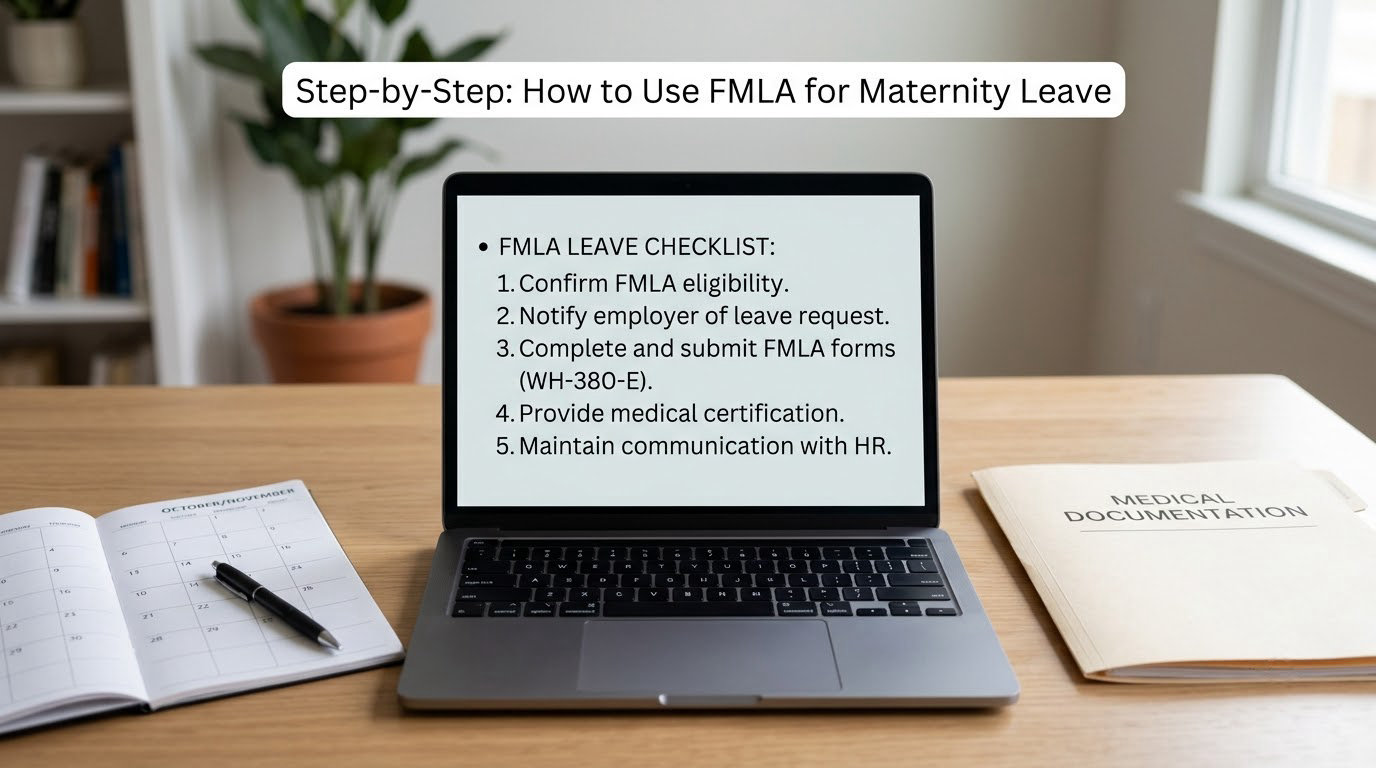
Here is the chronological version, from about 30 days out to your first day back. Use it as a calendar rather than a reading list.
| When | Your action | Employer’s deadline |
|---|---|---|
| 30 days before leave | Give written notice of the leave and the expected dates | Eligibility notice within 5 calendar days |
| Within days of asking | Request the medical certification and the leave request form | Designation notice within 7 calendar days |
| Within days of asking | Hand the certification to your provider’s office | Employee returns it within 15 calendar days |
| 5 weeks before due date | Confirm pay arrangements: PTO, short-term disability, state leave | Written confirmation of substitution choices |
| 6 weeks after a vaginal birth, 8 after a cesarean | Keep appointments; log any intermittent or reduced-schedule days | Records of each intermittent day |
| 1-2 weeks before you return | Request the fitness-for-duty certification if required | Job restoration in the same or an equivalent position |
Step 1: Confirm That You Qualify
The test is arithmetic, and most people clear it easily. Twelve months employed, 1,250 hours worked in that window, and a worksite with 50 or more employees inside a 75-mile radius.
Part-time workers often assume they are excluded because they never logged 1,250 hours. Check your hours before you assume anything. A 25-hour-a-week schedule for a full year lands at about 1,300 hours, which clears the bar, and overtime hours your employer was required to pay also count. The law does not distinguish between full-time, part-time, and temporary staff, though temporary and contract workers with no expectation of continued employment are the group most likely to run into trouble, and some parents on temp contracts have been told their assignment simply ends when they go out.
Two situations trip people up. If you worked for a different company within the same corporate family, only the current employer’s service may count. And some states and large cities have their own paid family leave that runs alongside or instead of FMLA, so your state labor department is worth a call before you assume FMLA is your only option.
Step 2: Estimate Your Leave and Recovery
Plan the leave in two halves: time before the birth for prenatal appointments, complications, or medically prescribed bed rest, and time after for recovery and bonding.
Six weeks is a common return point after an uncomplicated vaginal delivery, and eight weeks is common after a cesarean section. Those are not rules, and the number that matters is the one your provider writes on the certification. If you deliver preterm, if the baby is admitted to the neonatal intensive care unit, or if you have a difficult recovery, tell your provider early — that changes what they can certify.
Keep prenatal use of FMLA to a minimum unless there is a real medical reason, because every week spent before the birth is a week unavailable afterward. Complications, a pregnancy-loss recovery, and multiples are all situations where using the balance early makes sense.
Step 3: Tell Your Employer in Time
Give at least 30 days advance written notice when the leave is foreseeable, which maternity leave almost always is. A dated email to your leave administrator saying you expect to be out on approximately these dates is sufficient notice in practice.
You do not have to have the exact due date. Say what you know and promise to update. Here is language that works:
“I am pregnant and expect to deliver in mid-June. I plan to begin leave around that time and expect to return in early September. Please send me the FMLA leave request and medical certification forms. My provider’s office information is below.”
If the birth happens early, or you have an emergency, give notice as soon as practicable instead. Verbal notice is acceptable when the 30-day window does not exist, and the 30 days are not a hard cutoff — a delayed request can still be valid, it just makes the employer’s job harder. The rule people confuse this with is the three-day rule, which is about certification timing, not about requesting leave late.
Step 4: Complete the FMLA Paperwork
Several different documents are involved and they come from different people. Knowing which is which saves a week of waiting.
- Your written notice — the email above. You write it.
- Notice of Eligibility and Rights and Responsibilities — the employer sends it, usually within five calendar days of your request. It states whether you are eligible, whether you qualify as a key employee, and what your rights are.
- Designation Notice — the employer sends this within seven calendar days once they have enough information. It tells you exactly which days count as FMLA leave, how much of your 12 weeks is used, and how many remain. Keep this document.
- Medical Certification — your health care provider completes it, you return it to the employer, usually within 15 calendar days.
- Leave request form — employer-specific, dates and contact details only.
- State or employer forms — a separate application for state paid family leave or a short-term disability claim.
Your employer is not permitted to ask for your medical records, only the certification form. Refuse anything broader in writing.
Step 5: Submit Medical Certification
Here is where parents tell me they got stuck: the doctor completes half the form, or it sits on a desk for three weeks. Ask for the certification at a scheduled prenatal visit, well before your due date, and treat the submission as its own task with a deadline.
On the certification your provider states whether you have a serious health condition, gives the expected leave dates or a range, and addresses whether the condition is an incapacity or a need for treatment on an outpatient basis. They may also list the frequency of visits and whether you will be unable to work at all or intermittently. FMLA treats pregnancy, childbirth, and nursing as serious health conditions, so the underlying eligibility is usually straightforward; the details and the dates are the work.
Your provider cannot share your diagnosis with your employer, and you do not have to authorize it. Give them the forms, let them complete them, and keep a copy yourself.
If the form comes back incomplete, ask your employer for the missing item in writing and give the clinic a deadline. If your leave extends past the expected dates, the employer may request recertification. If your condition changes materially, they may ask a second or third opinion at their own expense, and you have the right to object in writing before an opinion is arranged.
Step 6: Confirm Benefits, Pay, and Job Protection
Get the pay question answered in writing before you go out. FMLA itself pays nothing. What replaces it depends on where you work and what you have.
- Accrued paid leave. Your employer may substitute accrued vacation or sick leave for unpaid FMLA weeks, and you can insist on or decline that in writing. The choice has to be documented and cannot be changed later.
- Short-term disability. Most policies have a maternity benefit separate from FMLA, often a percentage of salary for a set number of weeks. You claim it after the birth or after a pregnancy loss, using the carrier’s own form, not the FMLA certification.
- State paid family leave. A cash benefit from a state program, applied for through your state, usually after a waiting period.
- Your own savings. Unpaid weeks still accrue health coverage. Ask what the premium will be and whether your employer reimburses it; if the premium rises during your leave, that amount may come out of your final paycheck.
The stacking order is usually the same: disability benefit for the medically defined recovery period, then paid leave substitution for the bonding weeks. Submitting both claim forms on the same day is normal and expected. Confirm in writing that your 12-week FMLA balance is not consumed by weeks that another benefit is already covering, and that your group health insurance continues throughout.
Step 7: Plan the Return to Work
FMLA entitles you to restoration to the same job or an equivalent one with equivalent pay and benefits. A few exceptions exist, the most commonly cited being a key employee, which applies when you are among the highest-paid 5 percent within 75 miles and the employer would suffer substantial economic hardship in restoring you.
If you are not ready to come back on schedule, you can ask to return intermittently or on a reduced schedule. The arithmetic is unusual: a reduced schedule counts a full day of FMLA per week, and intermittent leave counts each day actually used. If you plan to take two half-days a week, check with your leave administrator first about how it will be counted.
Some employers require a fitness-for-duty certification before you return. They may require it only for a specific condition, and you are entitled to review the certification’s scope before you return. Keep your employer updated in writing about any change in your return date, and continue the weekly check-ins that nursing and pediatric appointments naturally generate — intermittent leave has to be recorded.
Do not let silence become a pattern. Unannounced calls during leave, or a manager who skips you for a project, are worth documenting in a personal file with dates.
Common Mistakes and How to Fix Them
Waiting until the week of the birth to say anything. Thirty days is the target, and the paperwork chain needs room. Fix: give notice as soon as you are comfortable, with approximate dates, and update them as they firm up.
Assuming FMLA pays you. It does not, and the gap surprises a lot of families. Fix: before leave starts, write to HR asking which paid benefits you want applied and in what order, and file your short-term disability and state leave claims as early as those programs allow.
Not keeping a written record. If the conversation happens by phone and nothing follows, there is nothing to point to. Fix: send a confirming email the same day. “Confirming our call today: leave begins on this date and I am submitting the medical certification on that date.”
Spending the 12 weeks prenatally. People assume prenatal and bonding leave are separate allowances. They are not. Fix: use prenatal FMLA for complications, bed rest, or significant appointments, and hold the balance for the weeks you actually want with the baby.
Sharing more medical information than required. You only owe the certification form, not your records or your diagnosis. Fix: if asked for anything broader, reply in writing that the certification form is enclosed and ask for the specific additional information required.
Letting the clinic delay the certification. Unreturned forms are one of the most common reasons leave start dates slip. Fix: hand the form over at a scheduled appointment, ask the office for a turnaround date, and set a personal deadline roughly three weeks before your due date to follow up.
Waiting on silent HR. Silence is not a denial and not an approval, which is exactly the anxiety parents describe in HR forums. Fix: if the five-day eligibility notice or seven-day designation deadline passes, send a written follow-up quoting the missed deadline and asking for a response by a date you set. A documented paper trail also protects you later if the question becomes a formal complaint.
Treating a denial as final. Fix: request the denial in writing with the reason stated, respond in writing, and escalate in order — your leave administrator, then HR, then the state or federal agency that covers your employer. Federal FMLA complaints go to the Wage and Hour Division; discrimination and retaliation claims go to the EEOC. Both have filing deadlines, so move quickly rather than continuing to negotiate by email.
Forgetting the fitness-for-duty paperwork. Fix: ask in writing two weeks before your planned return what documentation is required, and request that any certification be limited to the condition that prompted the leave.
Frequently Asked Questions
Can I use my FMLA for maternity leave?
Yes. If you are an eligible employee, FMLA covers up to 12 unpaid workweeks in a 12-month period for your own serious health condition related to pregnancy, childbirth, and nursing, and separately for bonding with your new child within one year of birth or placement. Both types draw from the same 12-week balance. FMLA protects your job and health coverage; it does not replace your wages.
Does FMLA pay you 100%?
No. FMLA is unpaid job protection. You replace part of the income by substituting accrued vacation or sick leave for FMLA weeks, claiming a short-term disability maternity benefit, and applying for state paid family leave. In many families the three together cover a meaningful share of take-home pay, but not all of it. Decide the substitution in writing, and file the disability and state claims as soon as those programs allow.
What is the 3 day rule for FMLA?
The three-day rule is about inpatient care, not about requesting leave. A serious health condition includes any period of inpatient care, and a hospital stay of three or more consecutive days generally satisfies that definition on its own. It is a definition, not a deadline: there is no rule requiring you to give three days notice. Maternity leave generally does not depend on it, since pregnancy, childbirth, and nursing are themselves qualifying conditions.
How do I get FMLA approved for pregnancy?
Give your employer written notice about 30 days ahead, request the leave request form and medical certification, and have your health care provider complete the certification well before your due date. Your employer then sends a Notice of Eligibility within five calendar days and a Designation Notice within seven. Once the certification is on file, leave is approved for the dates it covers. Keep copies of every form and do not consider leave approved until you have the designation.
Can I use FMLA intermittently after the baby is born?
Yes, for your own recovery, prenatal care, or medical appointments, and for bonding leave, provided your provider supports intermittent or reduced-schedule leave. Ask for that language on the certification. Remember the counting rule: a reduced schedule counts a full FMLA day for each week you work a reduced schedule, while intermittent leave counts only the days you actually use. Keep a record of each day and check with your leave administrator before assuming a pattern is covered.
What do I do if my employer denies or ignores my request?
Ask for the decision in writing with the reason stated, and answer in writing. If deadlines for the eligibility or designation notices pass, send a documented follow-up naming the missed deadline. If the denial stands, escalate to HR, then to the Wage and Hour Division for FMLA claims or the EEOC for discrimination and retaliation. Move quickly: the EEOC gives you 180 days to file a charge, and FMLA complaints carry their own filing deadline.
Conclusion
Start with the eligibility arithmetic — 12 months employed, 1,250 hours, 50 employees within 75 miles — and confirm it with your leave administrator in writing before you invest in the rest. Then send your notice about 30 days before you plan to start, and hand the medical certification to your provider at your next appointment rather than the week before.
Keep a single folder: every email you send, every notice you receive, the designation notice showing your remaining weeks, and your provider’s certification. Those records are what turn a verbal arrangement into a protected one. And if your employer stalls, that folder is the start of a complaint you may need later, so contact an HR representative or benefits administrator first, and a qualified employment-law professional if the response does not come.