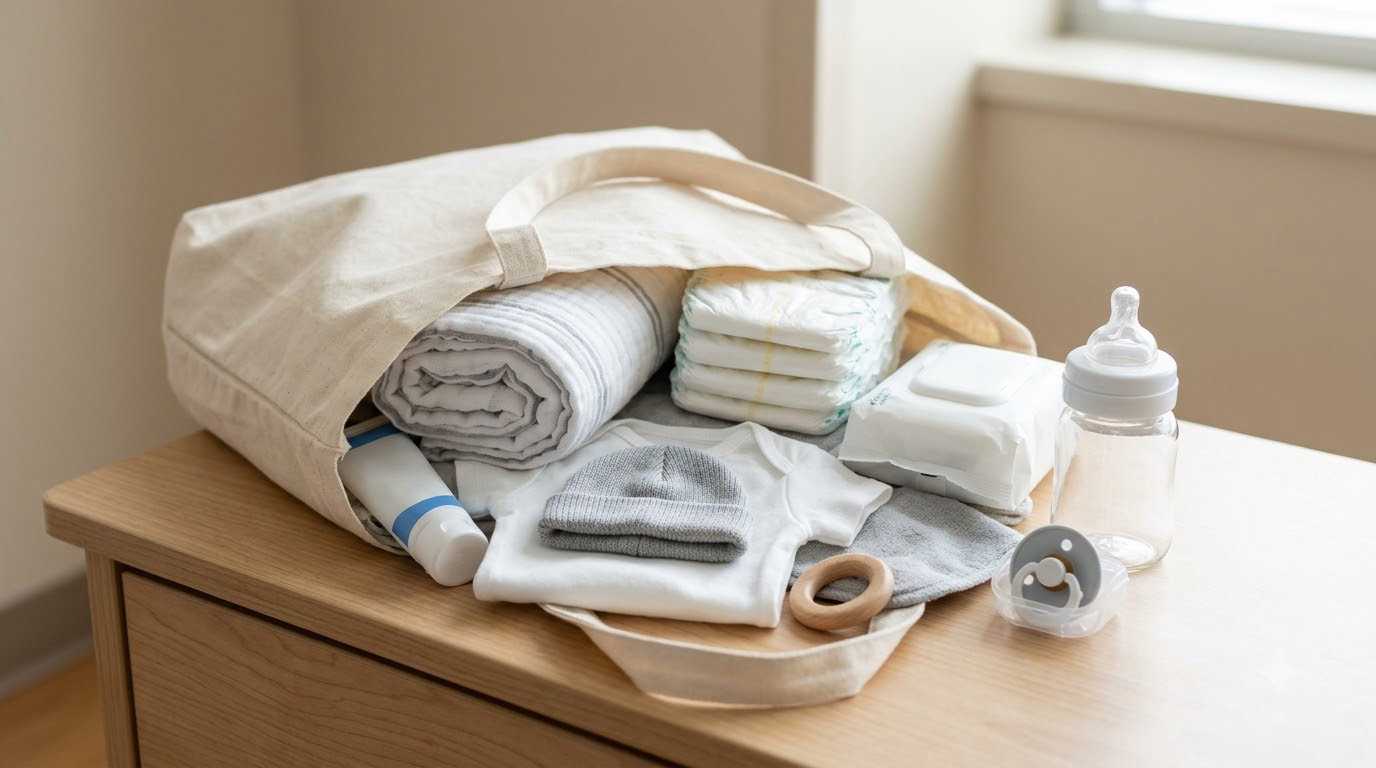
What to pack in a hospital bag for the baby is a short list, not a wardrobe: a rear-facing infant car seat, two going-home outfits in different sizes, one warm layer, a receiving blanket, and a hat. Everything else is optional. Most hospitals supply diapers, wipes, blankets, shirts, and even a starter outfit for the trip home, so your baby bag only has to cover clothing, warmth, comfort, and the ride out the door.
That’s the opposite of what most checklists suggest. Parents pack a full newborn wardrobe and use three of it. In the Reddit threads that surface for this question, the same pattern repeats over and over: diapers and wipes were already in the room, the hospital-supplied tops did the work, and the only baby item anyone genuinely needed was something to get the baby home.
So this is the version I’d hand a friend. Twelve items, grouped by what they’re actually for, with the reasoning and the quantities. Where hospital policy varies, I’ll say so and tell you to call yours rather than guess. Anything medical, take from your own clinician.
Table of Contents
- What to Pack in a Hospital Bag for the Baby at a Glance
- 1. A Going-Home Outfit
- 2. Newborn Diapers and Wipes
- 3. Feeding Supplies You May Need
- 4. A Hat and Warm Layer
- 5. Receiving Blankets
- 6. A Change of Clothes
- 7. Pacifiers and Soothing Items
- 8. Health and Identification Information
- 9. A Small Washcloth and Hand Soap
- 10. Transportation and Weather Essentials
- 11. Items to Leave at Home
- 12. A Simple Packing Checklist
- Frequently Asked Questions
- What should I pack in a hospital bag for the baby?
- How many diapers should I bring to the hospital?
- Does the hospital provide diapers, blankets, and a going-home outfit?
- What baby items are safe to pack for the ride home?
- Should I bring a pacifier or bottles to the hospital?
- When should I pack the hospital bag?
- Conclusion
What to Pack in a Hospital Bag for the Baby at a Glance
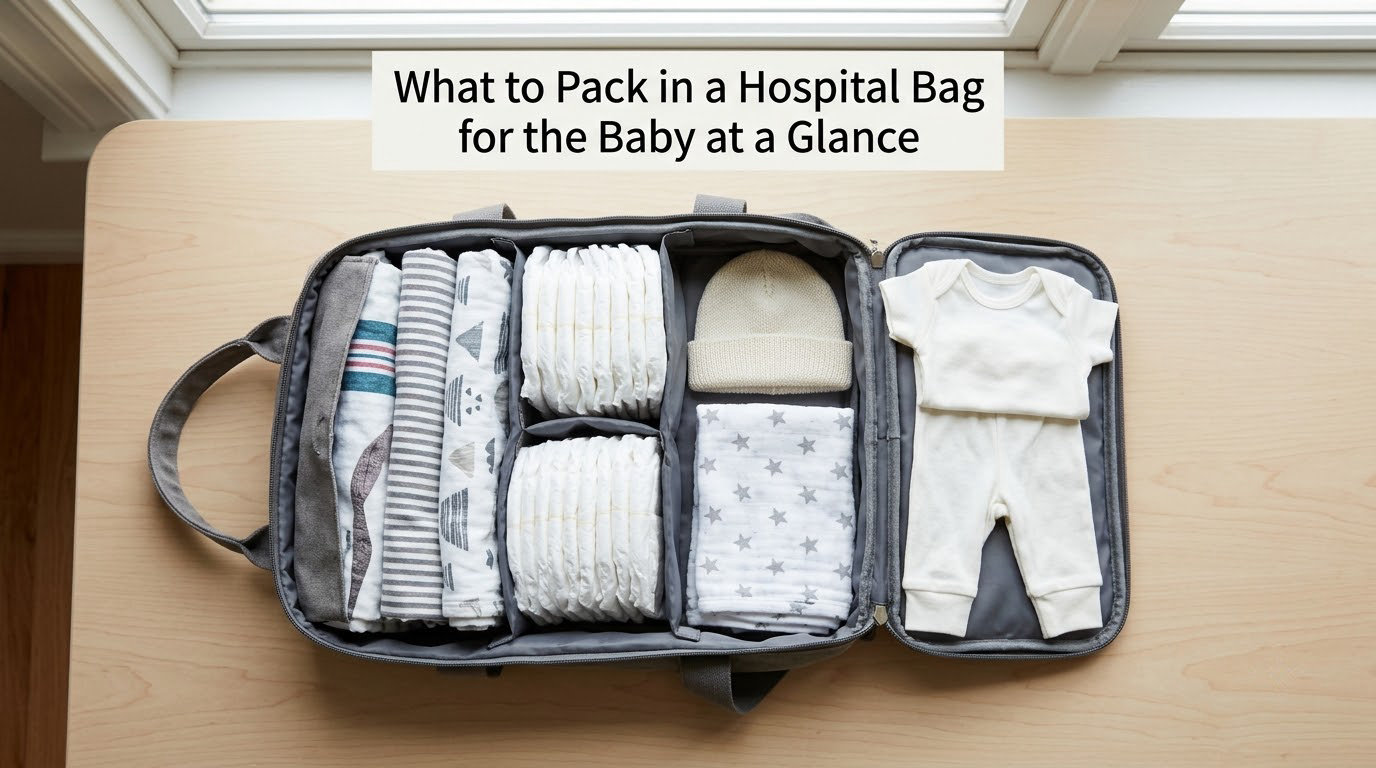
The fastest way to think about this: three buckets. Essentials, nice-to-have, and leave-at-home. If an item isn’t in the first bucket and it isn’t comfort, it can wait for the car ride home from the maternity ward.
Essential baby items
- Infant car seat, installed: the only item you cannot skip, because you cannot legally discharge without one.
- Going-home outfit in newborn size: plus a second in 0-3 months.
- Hat: newborns lose heat through the head faster than anywhere else.
- Receiving blanket or muslin: one or two is plenty.
- One change of clothes: a sleeper or onesie for the hours after delivery.
- Health and ID information: name if you’ve chosen one, pediatrician contact, any instructions your hospital gave you.
Optional, nice-to-have
- One or two bottles: if you might need them, packed empty and clean.
- Nipple shields: worth having in your own bag, not the baby bag.
- Burp cloths: two is a realistic number for a 24-hour stay.
- Pacifier: some families love them, some babies refuse them.
- A small washcloth: for the first bath or a quick clean-up.
What to leave at home
- Bulk formula and cases of ready-to-feed bottles
- A sterilizer, bottle warmer, or breast pump
- The whole newborn wardrobe
- Loose bedding, crib sheets, and sleep positioners
- Jewellery, valuables, and anything you’d be sad to lose
Keep the baby items in a separate pouch inside your main bag, ideally with the going-home outfit in the top pocket. Forum threads about hospital packing keep landing on the same practical point: under stress, your partner or a nurse needs to find one outfit in ten seconds, not dig through a duffel.
1. A Going-Home Outfit
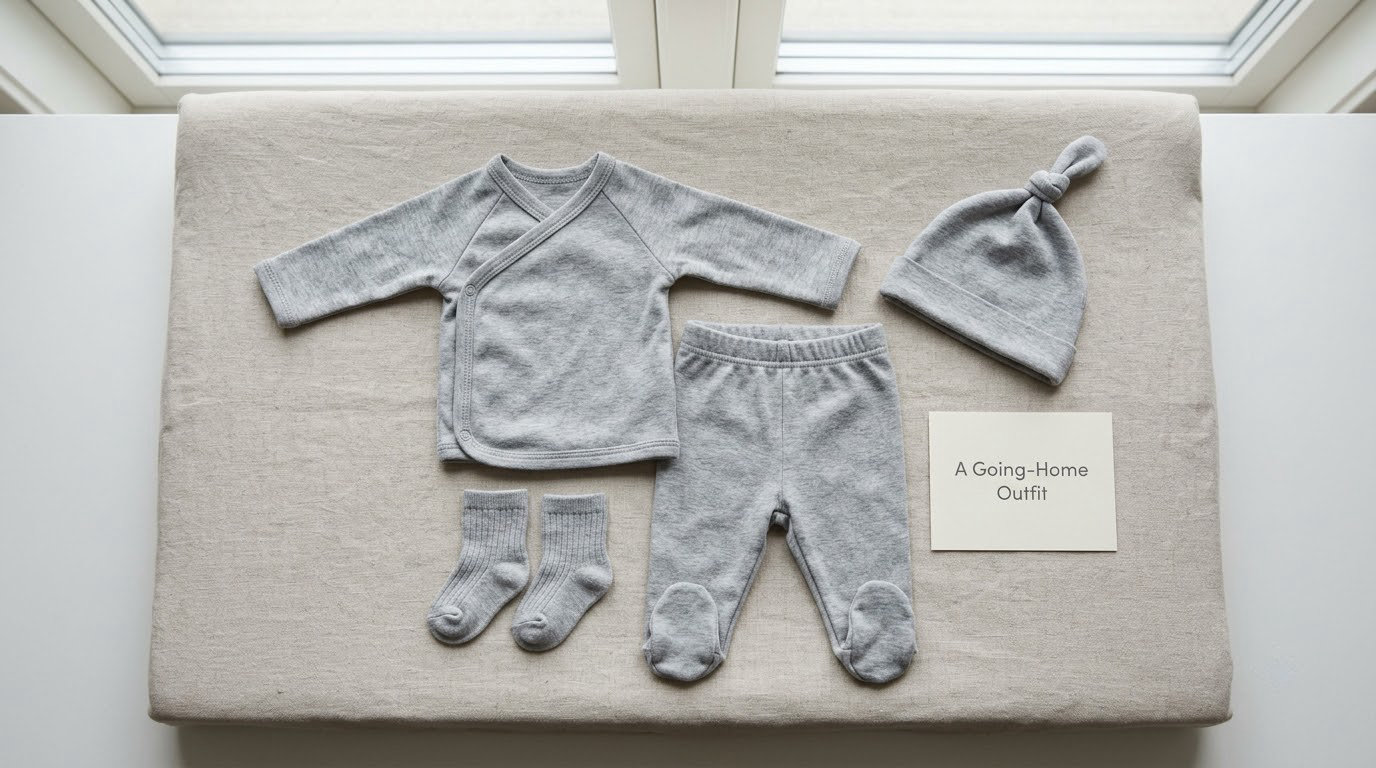
Pack two going-home outfits, one in newborn size and one in 0-3 months. Nobody can predict your baby’s length, and a 3.8 kg baby in a newborn sleeper is a diaper under the belly and a snaps fight you don’t need on the drive home.
Choose something boring and easy. A plain sleeper or a onesie with side snaps, plus socks and a hat. Skip anything with ties, zippers down the back, or a neck opening you’d have to work over a damp newborn head. Front-opening and side-snap clothing is also easier for skin-to-skin contact and for the on-rooming nurse who needs to change your baby quickly.
Should you bring 0-3 month clothes to the hospital when you’re unsure? Yes. The 0-3 outfit is your insurance policy, and it costs you nothing but the space. If your baby is small, you use the newborn one and the bigger one goes home unwashed for the next week.
Two more things worth doing. Pre-wash everything you pack at least once, ideally with fragrance-free detergent, because manufacturing residue and leftover detergent are a common trigger for newborn rash. And check whether your hospital provides a going-home outfit; many do, and when they do, one of your two is a backup rather than the main event.
2. Newborn Diapers and Wipes
How many diapers should you bring to the hospital? Realistically, zero is enough if your hospital supplies them, and most do. If you want a backup, bring about ten in one small pack rather than a full pack of forty.
Here’s what usually happens: you hand your baby to the nurse, and the nurse brings back a diaper from the hospital’s own supply, and the hospital bills your insurance or your hospital fee for those. Parents often assume their own pack is being used, then find out later that the whole newborn-size pack went home unused.
Newborn-size diapers are also the item most likely to be wasted. Plenty of babies start in regular or small size and skip newborn entirely, and you cannot know in advance. Tiny sizes aren’t a requirement; they’re a guess.
On wipes, similar logic. Many maternity units provide them, and some UK trusts advise against wipes for the first weeks because newborn skin is still developing its barrier. Cotton wool and water is the gentler default in those settings. Ask your own unit what they use and follow their guidance.
3. Feeding Supplies You May Need
Pack feeding supplies as options, not as a plan. Whether you breastfeed, pump, or formula feed is your decision and your clinician’s business, not a packing decision.
Reasonable items to include: one or two newborn-size bottles if you might want them, a nipple shield or two, and two burp cloths. The burp cloths will probably earn their space more than the bottles will, because babies spit up and gowns get covered.
Don’t pack a sterilizer, a bottle warmer, or a full case of formula. Do you need to bring formula to the hospital? Usually no, because the unit supplies it if you need it and there are policies around it. Bring your own only if your hospital has told you to, and check that policy before you pack rather than after labour starts.
A breast pump, if you’re planning to use one, belongs in your own bag and only if your hospital’s policy allows it. Ask in advance. The unit may have a hospital-grade pump, and it may have rules about when and where you can use it.
4. A Hat and Warm Layer
Bring one hat. Maternity wards are often warm, then the car is cold, and a newborn’s head is a large share of their surface area. A single soft hat covers both.
For the warm layer, match it to the season where you live rather than the season on the calendar at your due date. A cotton sleeper or a long-sleeved onesie is a reasonable mild-weather layer. In winter, add a fleece sleepsuit or a cardigan that goes on over the top, not under the harness straps.
The balance matters in both directions. The American Academy of Pediatrics advises keeping newborns warm, but the same guidance is clear that babies should not be bundled or layered so heavily that they overheat in an indoor setting. One extra removable layer beats two that cannot come off. If they feel hot to the back of your neck, take one off.
5. Receiving Blankets
One or two receiving blankets are enough. A thin muslin wrap and a slightly warmer fleece-backed blanket covers most situations, including the walk to the car in January.
Receiving blankets are for holding, swaddling if that’s what you and your baby do well with, and covering the car seat on the ride home. They are not sleep bedding. A loose blanket in a crib, a cot, or a hospital bassinet is not a safe sleep surface for an infant; the sleep surface should be flat, firm and bare.
Can you bring your own swaddle to the hospital? Often yes, though some units prefer their own for the first hours while they do assessments. Bring yours, expect to set it aside, and don’t be surprised either way. Ask about their policy when you call about parking and visiting hours, and slip the swaddle question into the same call.
If your baby is born early or small, get specific sizing advice. Hospitals often keep preemie-sized or special-care clothing for babies who need it, and those items are handled by the neonatal team rather than by you.
6. A Change of Clothes
Bring one extra sleeper or onesie beyond the going-home outfit. Spills happen, delays happen, and babies wear hospital-provided kimono-style tops and blankets for most of the stay anyway. One spare is realistic. Three is theatre.
Pick something that opens from the front or snaps down the sides. Umbilical cord stump care is easier in clothing that doesn’t need to be pulled over the belly, and nurses will thank you for making their job faster.
7. Pacifiers and Soothing Items
A pacifier is optional. Should you bring one? If you have already decided to use one, pack it in a clean bag; if you’re undecided, don’t decide in the delivery room. Plenty of babies take to them easily, and plenty never touch them, and both are completely normal.
Ask your hospital about their policy, because some units restrict pacifiers in the first hours for specific reasons. Also ask about anything else you’d want to use, like a small comfort toy. Many postnatal units don’t allow loose items in the cot for safe-sleep reasons, so anything soft usually goes on the baby, not in the sleep space.
For soothing beyond that, your own presence does most of the work. Holding, skin-to-skin contact, and feeding on cue are the things babies actually want in the first day.
8. Health and Identification Information
Put a single sheet of paper in the front pocket: the name you’ve chosen for your baby if you’ve chosen one, the birth date and time once you know it, your pediatrician’s or GP’s contact details, and any written instructions your hospital or midwife gave you before admission.
Write the pediatrician’s number clearly. It’s the number you’ll use from a corridor outside a nursery at two in the morning, not the moment you have time to search your phone.
Keep it light on documents. Bring your own hospital paperwork and ID as your unit requires, but you don’t need to pack medical records or copies of everything into the baby bag. The hospital holds your maternity notes, and the newborn’s details are entered into their system during admission.
9. A Small Washcloth and Hand Soap
A small, soft washcloth is genuinely useful for the first bath and for spills in the first 24 hours, before you’ve worked out where the sinks and supplies are in the room.
If you bring a cleanser, choose one fragrance-free and suitable for newborn skin, and use it sparingly in the early weeks. Plain water and a cloth covers most of what a newborn’s skin needs, and a newborn’s skin does better with less.
Skip the full bath kit. The hospital provides somewhere to bathe a baby and plenty of newborn-rated supplies, and your house is forty minutes away.
10. Transportation and Weather Essentials
Install the car seat before you go into labour, not after. It is the one thing on this list you cannot improvise, and a badly installed seat is the single most common packing failure in forum threads on this topic.
What’s safe to pack for the ride home: a rear-facing infant car seat with its base correctly installed, a going-home outfit, a hat, and a blanket to go over the top of the buckled harness. If you want warmth, the blanket goes over the straps, never underneath them. A blanket under the harness can bunch and change the harness fit. Bulky coats and snowsuits under the harness have the same problem, so buckle your baby in first and add a coat or blanket over the top.
On the bag itself, keep it light and easy to carry. You will be holding a baby and managing everything else with one functional arm, so a small pouch that hangs on the car seat handle beats a large wheeled case.
Layer for the weather at the door, not the weather in the hospital. A simple rule: if your baby would be comfortable in that setup for a ten-minute car ride in your local conditions, you’re fine.
11. Items to Leave at Home
First-time parents consistently overpack the baby bag. The list of things worth leaving behind is short, and it’s the section most packing guides skip.
Cases of formula and ready-to-feed bottles. Units supply these if needed, and they have policies about them. Ask before you pack.
Sterilizing and warming equipment. Maternity units have it, and it’s not yours to manage.
A breast pump, unless your hospital confirms you should. Check by phone in advance.
The full newborn wardrobe. Pack two outfits. Hospital-supplied tops and blankets cover the stay, and you’ll do laundry more often than you’d like anyway.
Loose bedding, sleep positioners, and weighted sleep products. Crib sheets, bumpers, and nest-type products don’t belong in an infant sleep space at home or in hospital.
Valuables and irreplaceable items. A hospital room is not the place for jewellery, electronics you’d be upset to lose, or anything you can’t replace quickly.
A large diaper stockpile. Covered above, and it’s the biggest space waster in most bags.
Hospital policies vary a lot, so none of this is a rule about your specific unit. It’s a sensible default that you adjust after one phone call.
12. A Simple Packing Checklist
Print this, tape it inside the lid of the baby pouch, and let someone else work from it. If you’re the one recovering from a birth or feeding around the clock, you shouldn’t be the person hunting for the going-home outfit.
Baby bag — pack these
- Rear-facing infant car seat, installed
- Going-home outfit, newborn size
- Going-home outfit, 0-3 months
- One spare sleeper or onesie
- One hat
- Two pairs of socks
- Two receiving blankets or muslins
- Two burp cloths
- One or two bottles, if you might want them
- Nipple shields, if you plan to use them
- Pacifier, optional
- One small washcloth
- Fragrance-free cleanser, optional
- Information sheet: name, birth details, pediatrician number
Leave at home
- Formula cases and sterilizing equipment
- Full newborn wardrobe
- Loose bedding and sleep products
- Valuables
- Bulk diaper packs
Before you pack
- Call your unit and ask what they provide for babies
- Ask about pacifiers, your own swaddle, and a breast pump
- Install the car seat and have someone check the install
- Pre-wash every item of baby clothing
- Stage the bag by the door, or in the trunk, at 36 weeks
On timing: most people pack somewhere between 35 and 37 weeks and stop adjusting at 38 weeks. Early is calmer. Bagging at 32 weeks is early enough to feel organised and late enough to skip the half-packed version that gets finished at 2am. If you’re planning a home birth, the same bag becomes your contingency bag and should live where someone can grab it.
Frequently Asked Questions
What should I pack in a hospital bag for the baby?
A rear-facing infant car seat installed before labour, two going-home outfits in newborn and 0-3 month sizes, one spare sleeper, a hat, two pairs of socks, two receiving blankets, two burp cloths, and a sheet with your baby’s name and your pediatrician’s contact details. Add bottles, a pacifier, and a washcloth if you want them. Most hospitals supply diapers, wipes, shirts, blankets, and often a going-home outfit.
How many diapers should I bring to the hospital?
Ten at most, and often none. Maternity units generally provide diapers for the baby during the stay and may bill them to your insurance or your hospital fee. Newborn-size diapers are also the item most likely to go unused, since plenty of babies start in regular or small size. Bring a small pack as backup, and ask your own hospital what its policy is before you pack.
Does the hospital provide diapers, blankets, and a going-home outfit?
Most do, which is why your baby bag can stay small. Units routinely supply diapers, wipes, hats, blankets, and kimono-style tops, and a number of hospitals also provide a starter going-home outfit. Policies differ, so call yours and ask what they provide for babies, whether you may use your own swaddle, and what they say about pacifiers and pumping.
What baby items are safe to pack for the ride home?
A rear-facing infant car seat installed correctly, a going-home outfit, a hat, socks, and a blanket placed over the buckled harness rather than under it. Blankets tucked under the straps can bunch and change the harness fit, so add warmth over the top. Avoid a bulky coat or snowsuit under the harness for the same reason, and buckle your baby in first.
Should I bring a pacifier or bottles to the hospital?
Both are optional, and both depend on your own plan and your hospital’s policy. If you’ve decided to use a pacifier, bring one and expect it to be refused in some units. If you might need bottles, bring one or two empty and clean rather than a case of formula. Ask about pumping and formula rules before you pack, not after labour starts.
When should I pack the hospital bag?
Most families pack between 35 and 37 weeks and stop adjusting around 38 weeks. Packing earlier means you are not finishing at 2am, and pre-washing clothes takes a couple of cycles. Install the car seat before labour starts, keep the baby pouch in the top of the bag, and put the printed checklist inside it so a partner or nurse can pack from the list.
Conclusion
Start with four things and you are covered for almost any birth: the rear-facing car seat installed, a going-home outfit in two sizes, a hat, and one or two receiving blankets. Add one spare sleeper, two burp cloths, and the information sheet with your pediatrician’s number, and your baby bag is done.
Then adjust for two things you can actually check: what your hospital provides, and what the weather is like at your front door. One call to the unit covers the first. Everything else in this list is preference, and preference is a good reason to keep the bag small.