If you are wondering how to use a birth ball during labor, the short answer is this: sit on it with your feet flat and wide, keep your knees level with or slightly below your hips, then move slowly through rocking, hip circles, figure-eights and gentle bouncing while switching positions often. That is genuinely the whole technique. Most of the difficulty people describe is not the ball itself, it is arriving at the hospital owning one with no idea what to do with it. Here is the practical version, from choosing the right size to the moment you should put it aside and call your midwife.
I have watched a lot of first-time parents arrive holding a ball they bought in the third trimester, sit on it once, and then abandon it. Usually the reason is that nobody showed them how to get off the ball without wobbling, or that the wrong size made their legs burn inside two minutes. Both are fixable with about five minutes of practice beforehand.
This guide covers general comfort and positioning during labor. Your midwife, obstetrician or labor and delivery nurse knows your specific situation, and their instructions come first.
Table of Contents
- What You Need
- What size ball do I need?
- The rest of your setup
- Step-by-Step: How to Use a Birth Ball During Labor
- How to Use a Birth Ball During Labor for Comfort
- How to Use a Birth Ball During Labor Safely
- How to use the ball at each stage of labor
- When to Stop Using the Ball and Ask for Help
- Common Mistakes
- Tips for Using a Birth Ball With a Support Person
- Frequently Asked Questions
- When should you start using a birth ball during labor?
- What is the best way to use a birth ball during labor?
- Does bouncing on a birth ball help you dilate?
- When should you not use a birth ball during labor?
- Conclusion
What You Need
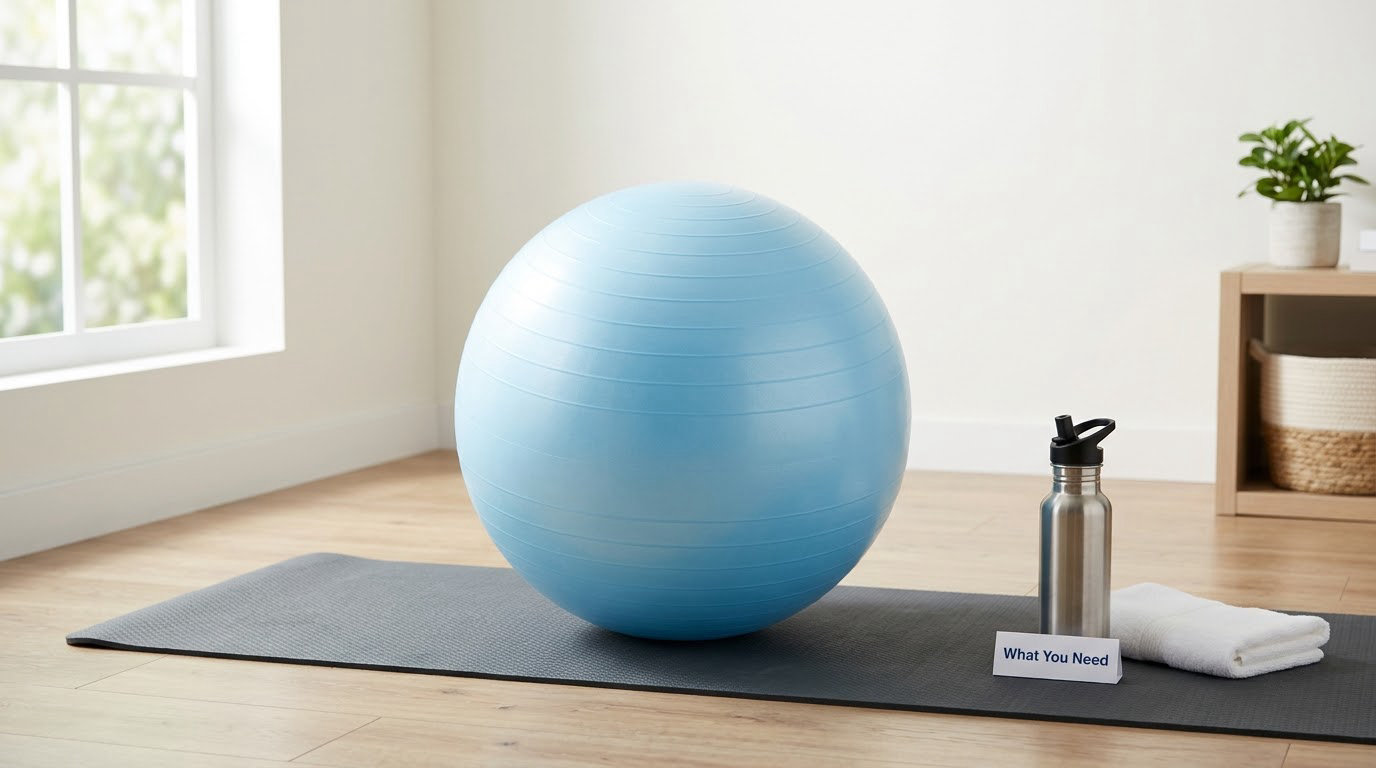
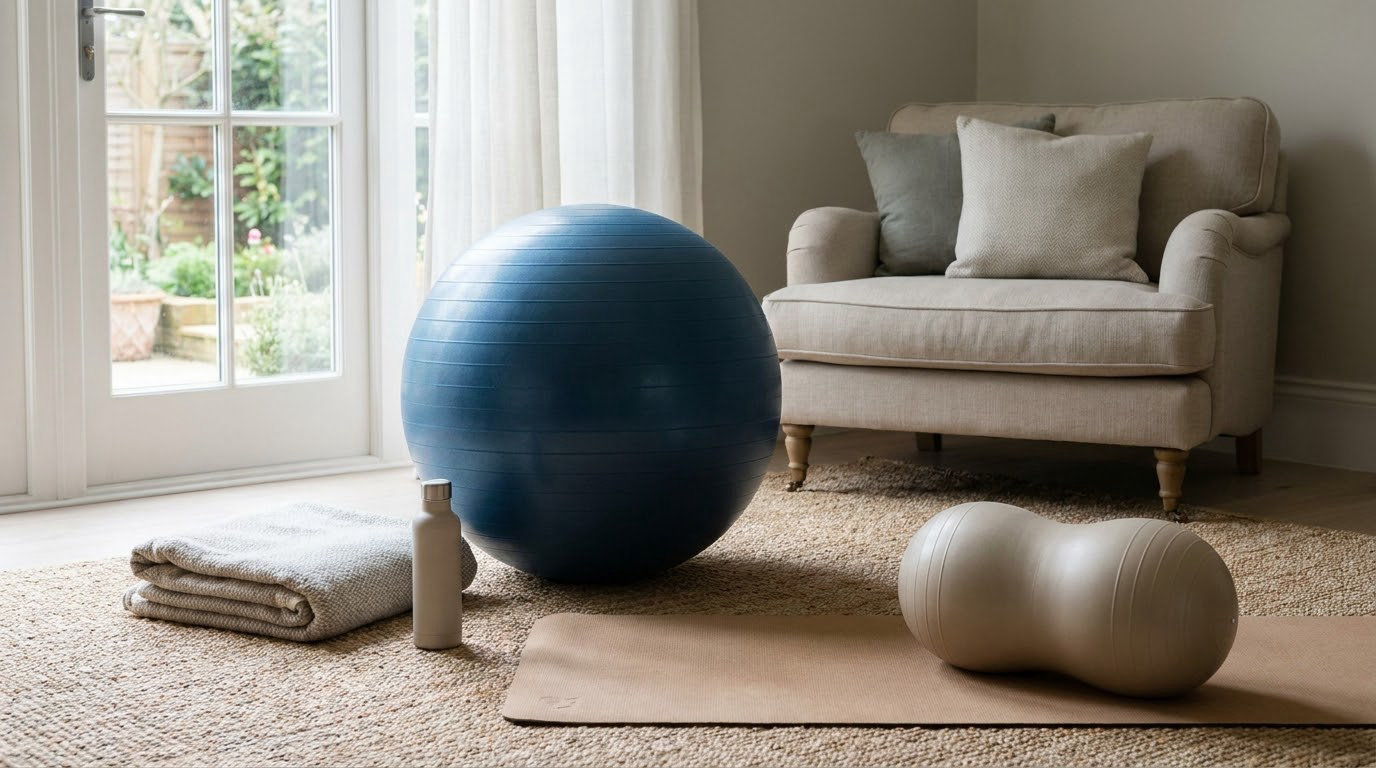
A birth ball is a large inflatable exercise ball, a little bigger and softer than a gym ball, that you sit on, kneel over or lean against to stay upright during labor. Upright position matters because gravity helps the baby’s head press down through the pelvis, and because sitting tall spreads your weight across the sit bones instead of loading your lower back and tailbone.
What size ball do I need?
Pick a diameter that puts your knees at about 10cm (4 inches) lower than your hips when you are seated. That single check beats any height chart, because it accounts for your own proportions.
- Under 1.6m (5ft 3in): a 55cm (22 inch) ball, or a 65cm (26 inch) ball if you want a higher seat.
- 1.6m to 1.73m (5ft 3in to 5ft 8in): a 65cm (26 inch) ball. This is the most common size and the safest default.
- Over 1.73m (5ft 8in): a 75cm (30 inch) ball. Test it before committing; if your knees end up above your hips, it is too tall.
Feet should land about hip-width apart, roughly 60cm (24 inches) between centers, so your knees fall slightly outward.
The rest of your setup
- A non-slip surface. A mat, rug or carpet edge. Never a wet tiled floor. Grip socks also help if your feet tend to slip.
- An anti-burst ball. Check the label for the burst pressure or load rating. These are made from thick, load-tested material that resists popping under body weight.
- A pump. Most come with one. Inflate to the point where it feels firm but gives slightly when you press it.
- Water and snacks your care team allows. Sipping through labor is usually fine unless you have been told otherwise.
- A support person within arm’s reach. Someone whose only job at that moment is to steady you and watch your face.
- A clear space. Wipe up any spilled drinks before you get on. This matters more than people expect, because a slip during a contraction is how people get hurt.
Step-by-Step: How to Use a Birth Ball During Labor
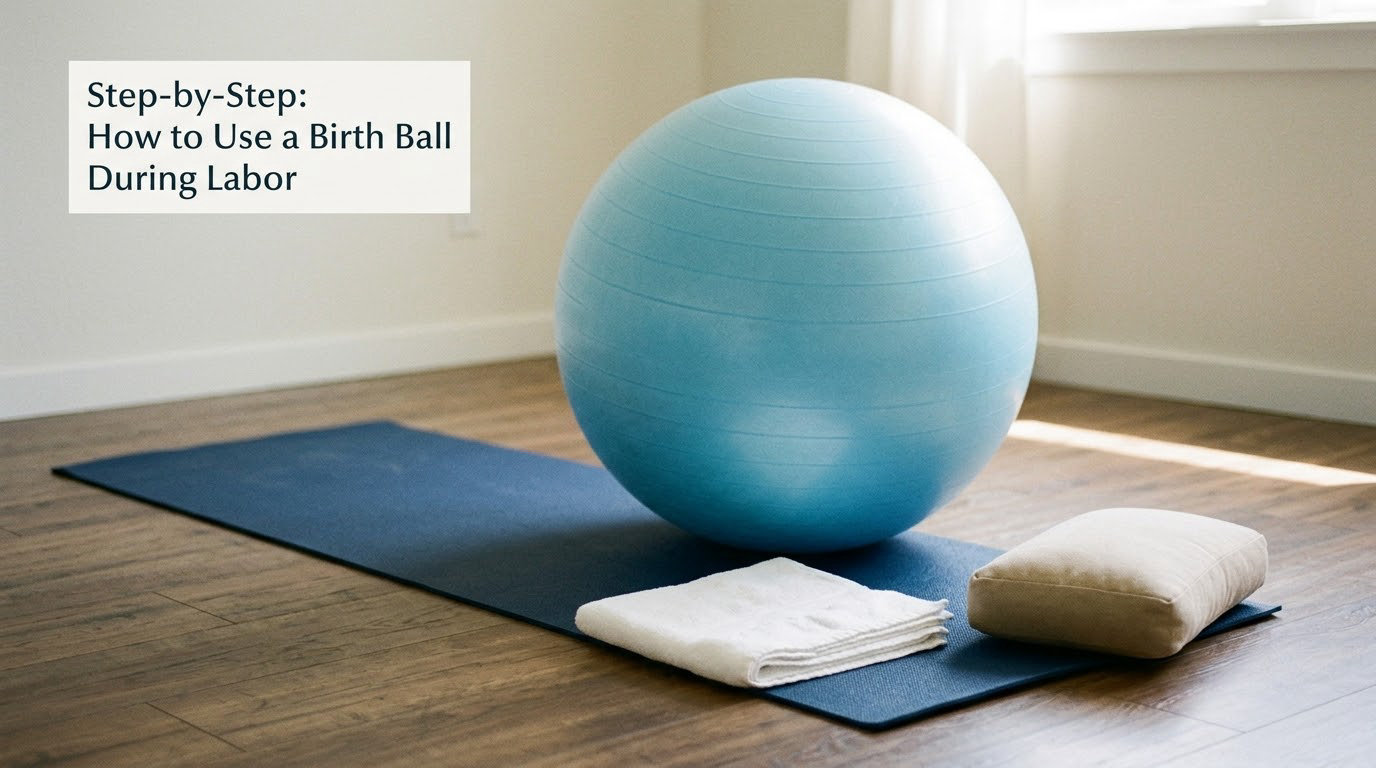
Work through this once before labor starts, when you are calm and can stop whenever you want. Practising is what separates people who use the ball for hours from people who give up on it in twenty minutes.
- Check the inflation and the floor. Sit on the ball before you are in labor. If it rolls more than an inch in any direction without you moving, it is underinflated. Inflate it until pressing with your palm leaves a shallow dent. Clear the floor and lay a non-slip mat down.
- Set your footing. Sit tall, feet flat and about hip-width apart, toes pointing slightly outward. Check the knee-to-hip height. If you cannot hold the position for two minutes without your legs shaking, the ball is the wrong size.
- Find your balance with a partner. Have your support person stand behind you with hands on your shoulders or your lower ribs while you rock for the first contraction. Once they let go and you stay steady, you do not need them for balance, only for comfort.
- Add movement, not speed. Start with slow side-to-side rocking for two or three contractions. Then try wide hip circles, a figure-8, or gentle bouncing. Movements that are too fast or too large are what make people feel unsafe on a ball.
- Rest between contractions. Stop moving when the contraction fades and sit still, or step off and stand. Thirty to sixty seconds of stillness between contractions does more for comfort than constant movement.
- Change position every hour or so. Sitting is not the only option, and holding one position for a long stretch is what builds up back and hip pain. See the positions below.
- Check in with your body between contractions. Ask whether the pain is easing, staying the same or climbing. If it is climbing even with position changes, tell your midwife. That usually means a different position, not a better ball.
- Stop when you want to stop. The ball is a tool, not a test. Nobody is keeping score on how long you used it.
How to Use a Birth Ball During Labor for Comfort
These are the positions worth knowing before you are in labor. Each one is aimed at a specific pain, which matters because the right position for a tailbone ache is not the right position for a lower back ache.
| Position | How to set up | What it helps with | Best for |
|---|---|---|---|
| Sitting and rocking | Feet flat, hip-width apart, knees below hips. Rock side to side, then forward and back. | Lower back ache and general contraction pain; keeps you upright | Early and active labor |
| Hip circles and figure-8 | Stay seated, widen your stance, and draw slow circles with your hips for five to six repetitions each way. | Pelvic stiffness, hip binding, pressure in the lower pelvis | Early labor, or any pause |
| Gentle bouncing | Small vertical bounces, only a few centimeters, with your core held tall. | Back pressure and the sense of stalling | Active labor |
| Forward lean over the ball | Kneel on a mat, drape your chest over the ball, forehead and forearms resting, hips over knees. | Intense back labor, tailbone pain, a posterior baby | Active labor and transition |
| Hugging the ball | Stand or kneel, wrap your arms and chest around the ball, let it support your upper body weight. | Deep aching in the back and pelvis | Active labor and transition |
| Standing lean | Stand, rest your forearms on the ball held at waist height, let your pelvis sway. | Upright rest without sitting down; useful between contractions | Any stage, especially in early labor |
| Side lunge over the ball | Wide stance, one leg bent, ball under the bent side for support, shift weight slowly side to side. | Hip and pelvic girdle pain, sciatica-type leg pain | Late pregnancy and early labor |
| Peanut ball under one leg in bed | Side-lying, peanut ball between knees or under the top leg, foot of bed raised. | Pelvic opening when you cannot get up; commonly used with an epidural | Active labor with epidural |
Forward-leaning over the ball is the position that comes up most often from people in labor, particularly for back pain. It takes weight off the lower back completely and lets the pelvis hang in a way sitting cannot.
Pair every movement with a slow breath. Breathe in as you start the movement and exhale as you complete it, because exhaling is what lets the pelvic floor soften downward rather than lift.
How to Use a Birth Ball During Labor Safely
Most ball injuries come from a slippery floor, feet placed too close together, and fast movement during a strong contraction. Those three are easy to avoid.
- Feet wide, toes slightly out. A narrow stance makes the ball wobble under your weight.
- Keep a hand on something stable. A partner’s shoulder, the bed rail, or a wall. Use it for balance, not for pulling yourself upright.
- Move through the contraction, rest between. This is the main pacing rule. Big slow movements during a contraction, stillness after it.
- Do not bounce to fix a stall. Aggressive bouncing for hours does not start labor and only exhausts you.
- Expect your waters to break at some point. This is normal and not dangerous, but sitting on a ball with wet floor underneath is a slip hazard. Put a towel down under the ball once your waters break.
- Drink when your care team allows it. Dehydration makes contractions harder to ride out.
- Know your limits. If you are exhausted, dizzy or have an epidural with limited leg control, the ball may not be the right tool right now. Say so.
How to use the ball at each stage of labor
- Early labor: sitting, rocking, standing leans and side lunges. Movement and upright posture help you settle into a rhythm before things intensify.
- Active labor: seated hip circles, figure-eights, gentle bouncing, then forward lean. Change position about every hour.
- Transition: hugging the ball or leaning over it. Many people stop sitting by this point and find forward lean more tolerable than upright sitting.
- Pushing: the ball usually comes out of the picture, or gets used only between pushes. A peanut ball in bed under one leg is often more useful at this stage.
One honest limit: a birth ball on its own will not start labor. It is a comfort and position tool, not a way to induce. If you are past your due date and want an induction planned, that is a conversation with your midwife or obstetrician.
When to Stop Using the Ball and Ask for Help
Get off the ball and call your birth team if any of these happen. Do not wait to see if it settles on its own.
- Dizziness, lightheadedness, or a feeling like you are going to faint
- Pain that is sharp, or that keeps building despite position changes
- Any bleeding, or bleeding that increases
- Fluid leaking from the ball area, especially if it changes color or smells
- Difficulty breathing, chest pain, or a racing heart
- A noticeable reduction in the baby’s movement compared with earlier in the day
- A general feeling that something is wrong, even without a specific symptom
That last one is the one people hesitate about most. You do not need to justify it. Say the words out loud to your midwife and they will come and check you.
Common Mistakes
Using the wrong size. Too tall and your knees sit above your hips, which pushes the pelvis into a position that increases back ache and makes you feel unstable. The fix is the 10cm knee check before labor starts, every time.
Sitting with feet close together. This is the most common setup error and the most common cause of wobbling. Move your feet to hip-width, toes out, and re-check your balance.
Forcing a position that hurts. If leaning forward makes your pain worse rather than better, go back to sitting. There is no prize for finishing a position. The fix is switching every hour rather than committing to one thing for the whole labor.
Moving fast. Big bouncing and fast circles feel energetic and usually make you feel less safe. Slow movement is what actually eases pressure between contractions.
Bouncing to induce labor. Hours of bouncing does not dilate anything by itself and leaves you tired before the hard part. The fix is treating the ball as comfort, not as a plan.
Treating it as a substitute for care. The ball sits alongside your midwife’s monitoring, not instead of it. Anything abnormal goes to your birth team first.
Leaving it on the floor near a drink. Small slip, big consequences. Put the ball somewhere away from water and clear the floor before you start.
Tips for Using a Birth Ball With a Support Person
A birth partner or doula can make the ball usable or make it another thing to worry about. The difference is mostly about what they do with their hands.
- Set the ball up before labor starts. Inflate it, find the right spot, lay the mat, and put the water bottle within reach. During labor your partner should be helping you, not engineering.
- Steady, then release. Hands on your shoulders or lower ribs during the first contraction, then let go. Constant physical contact can feel confining for some people; ask.
- Call out the timing. “Contraction starting,” “peaking,” “easing.” Many people cannot track time once contractions get long, and being told is genuinely useful.
- Offer position changes, do not force them. “Want to try leaning over it instead?” is better than physically repositioning you.
- Handle the peanut ball if you have an epidural. Placed between the knees or under the top leg in side-lying, it is a genuinely useful tool for keeping the pelvis open when you cannot get out of bed.
- Follow your lead. The best support person in labor is the one who is watching you, not performing a plan.
Frequently Asked Questions
When should you start using a birth ball during labor?
You can use a birth ball as soon as you are in labor and feel ready, usually in early labor when contractions are still far apart. Many people also practise on it during the last weeks of pregnancy so the position feels familiar before labor begins. There is no need to wait for a specific dilation figure. If you are not sure, ask your midwife or nurse when you arrive.
What is the best way to use a birth ball during labor?
Sit with both feet flat on the floor, about hip-width apart, toes slightly out, and your knees level with or below your hips. Then move slowly through side-to-side rocking, wide hip circles, a figure-8 and gentle bouncing, resting between contractions. Change position every hour or so and lean forward over the ball when your back or tailbone aches.
Does bouncing on a birth ball help you dilate?
Not on its own. A birth ball cannot start labor or dilate the cervix by itself, and bouncing hard for long stretches mostly tires you out. What it does do is keep you upright, soften your pelvis between contractions and give you more positions to work with, which many people find makes the rest of labor more manageable. Talk to your midwife about induction plans if that is what you are considering.
When should you not use a birth ball during labor?
Do not use it if you feel dizzy, lightheaded or unsteady, if you have pain that sharpens rather than eases, if there is bleeding, or if you have an epidural with limited leg control and no one beside you. Stop and tell your birth team if you feel unwell, if the fluid around the ball changes, or if the baby’s movement drops compared with earlier in the day. Their guidance overrides any position advice.
Conclusion
Start by inflating the ball to the right height and checking that your knees sit about 10cm below your hips with your feet hip-width apart. Then begin seated and slow: rocking first, then circles or a figure-8, resting between contractions and switching positions about every hour. Forward-leaning over the ball is the one to learn in advance if your pain is in your back. And if anything on the warning list above shows up, stop and tell your birth team straight away.