How to care for a c section incision at home comes down to four things: wash it gently once a day, keep it dry afterward, protect it from friction, and know the difference between normal healing and a wound that needs a clinician. Most people manage the first week without drama. The trouble starts when instructions contradict each other, or when a small infection is mistaken for a scar that is simply healing. Your own discharge sheet always outranks anything written here.
This guide covers cesarean section (C-section) aftercare for the first six weeks and beyond. It is general education, not medical advice, and it does not replace instructions from your obstetrician, midwife or surgical team. If anything here conflicts with what you were told at discharge, follow your team and ask them about the conflict.
Time-wise, the hands-on care is light: a minute or two of washing a day, a dressing change only if you have been told to do one, and ten seconds of looking at the scar each day. The harder part is knowing when a small change is worth a phone call.
Reviewed for accuracy against published guidance from ACOG, the NHS, the CDC and MedlinePlus (U.S. National Library of Medicine). Updated for 2026.
Table of Contents
- What You Need
- Step-by-Step
- 1. Follow your discharge instructions first
- 2. Keep your C-section incision clean and dry
- 3. Change dressings only as instructed
- 4. Support comfortable movement
- 5. Check the incision regularly
- 6. Know when to contact your care team
- Common Mistakes
- Frequently Asked Questions
- How often should I clean a C-section incision at home?
- When can I shower after a C-section, and can I bathe or swim?
- What can I use to clean my C-section incision, and what should I avoid?
- When do C-section stitches, staples or steri-strips come off?
- Is it normal for a C-section scar to be numb, itchy or hard?
- Can a C-section incision get infected weeks after the birth?
What You Need
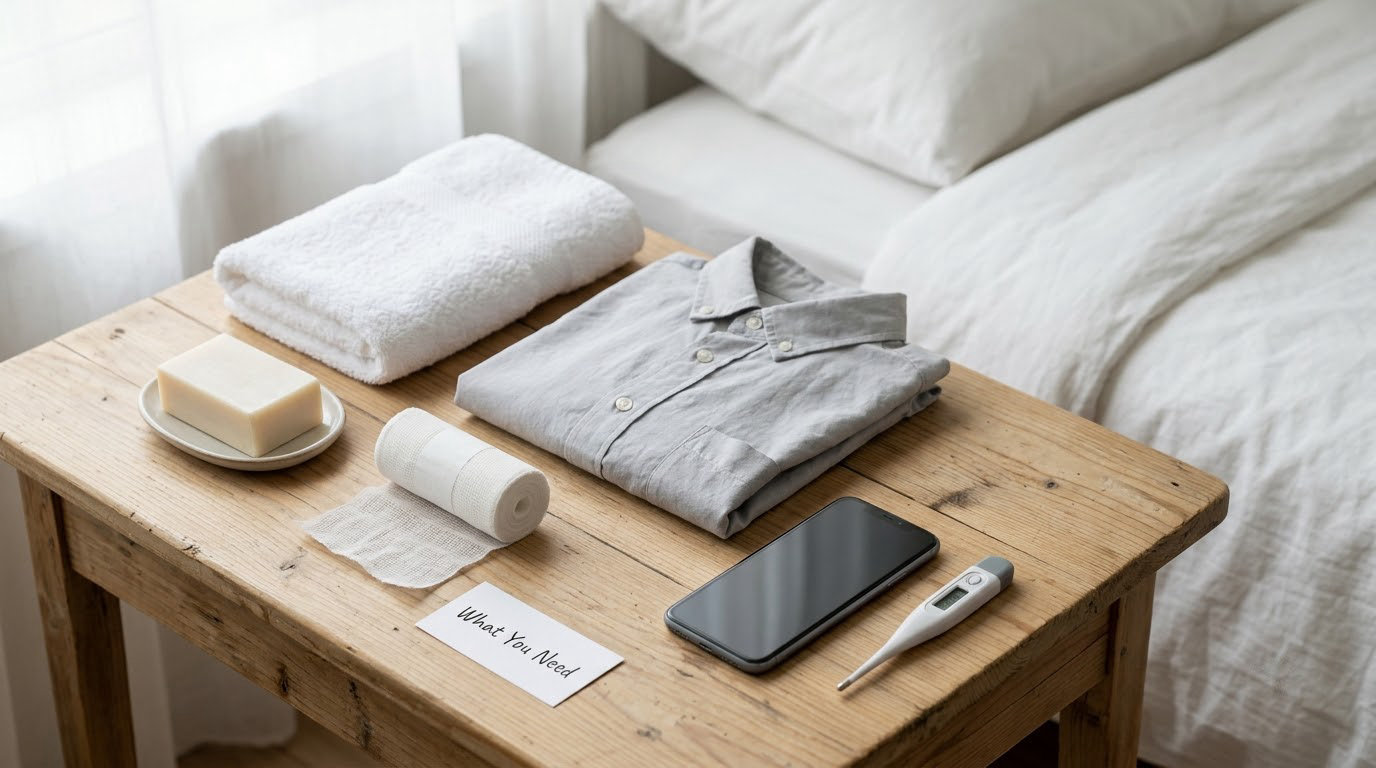
Gather these before you get home, because the first three days are the worst time to go shopping. Most of them you already own.
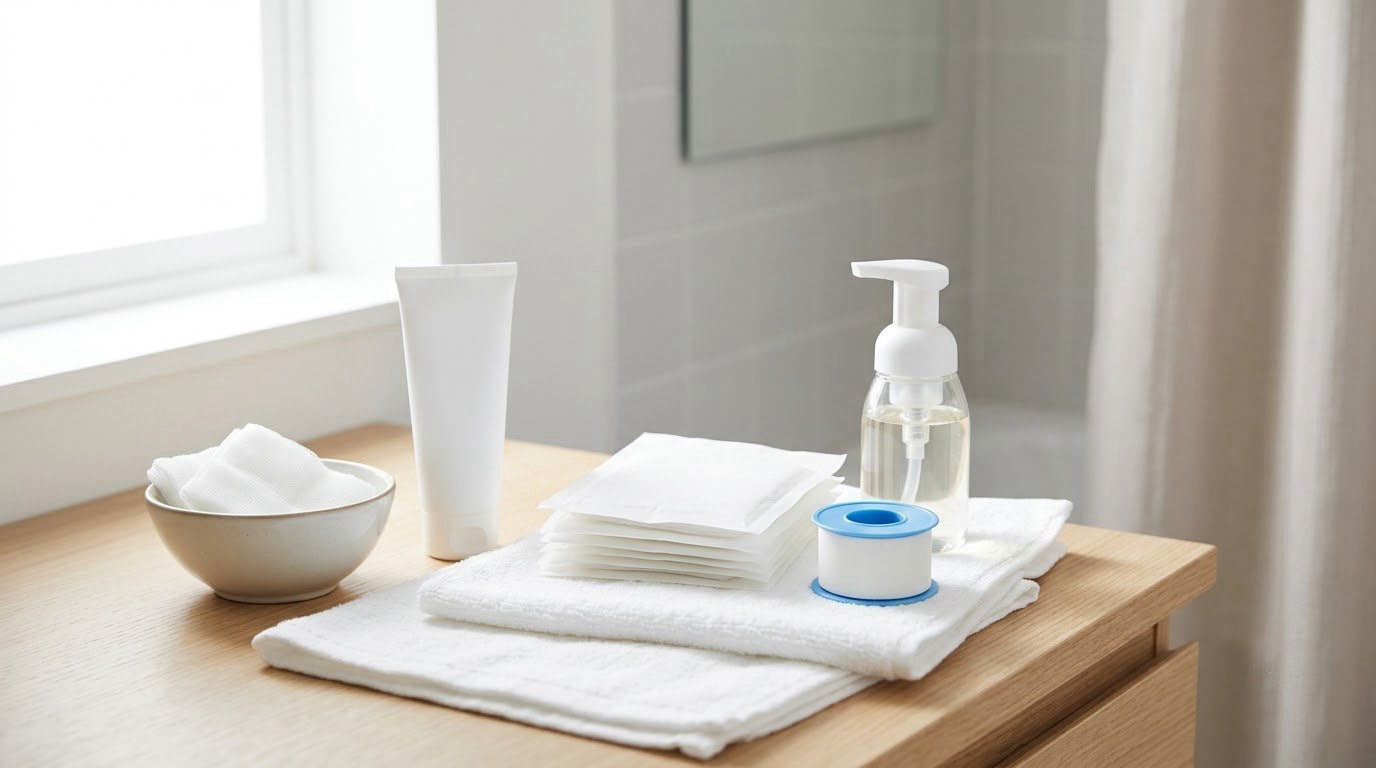
- Clean water and mild, unscented soap. Liquid soap without fragrance or dyes works well. This is the only cleanser most people need.
- Clean, soft towels or a fresh washcloth. One towel for your face, one for your body, and ideally a dedicated small towel or paper towels for the incision itself.
- A hairdryer. Set it to cool. Air drying a low, hard-to-reach incision with moving air is often easier and faster than patting it with a towel.
- Plain gauze or non-stick dressing if your surgeon sent you home with one, plus tape. Ask before you buy anything medicated.
- Loose clothing and high-waisted cotton underwear. Nothing elastic across the scar, and nothing that rubs.
- A thermometer. You need a number, not a guess, if you are deciding whether to call.
- A written list of phone numbers: your obstetrician or midwife, an after-hours line, your surgical team, and whoever is covering for them.
Two questions worth asking before you leave the hospital: when exactly do my staples, strips or sutures come out, and what is the number I call at 2 a.m. if the wound opens or I spike a fever. Write both down. Nobody remembers them from a discharge conversation on no sleep.
Step-by-Step
1. Follow your discharge instructions first
Your discharge sheet is the instruction set that matches your surgery, your closure type and your risk factors. Read it before you read anything else online.
It should tell you when to shower, what lifting limit applies, which medications to take, when your wound check and 6-week postpartum check are, and who to call with a concern. If any of those are missing or unclear, ring the ward before you leave. Asking on day one is far easier than guessing on day nine.
Expect lifting limits around 10 to 15 pounds for the first couple of weeks, which is roughly a fully loaded diaper bag, and expect no driving until your provider clears you at the postpartum check. Driving hurts in two ways: the seat belt presses on the scar, and an emergency stop you cannot brace for is exactly the abdominal strain you are avoiding.
2. Keep your C-section incision clean and dry
Wash once a day, ideally in the shower, with mild unscented soap and warm water. Wash your hands first, let soapy water run over the wound rather than scrubbing or rubbing it, rinse, then dry.
The single most common question in online C-section communities is what you may put on the wound, and the answer is short. Nothing beyond water, mild soap, and whatever your own team prescribed.
| Use this | Avoid this |
|---|---|
| Warm water | Hydrogen peroxide |
| Mild unscented soap | Rubbing alcohol |
| Sterile saline, if your team told you to | Iodine or betadine paint |
| Plain gauze or non-stick dressing | Antiseptics and wound washes not prescribed for you |
| A medication your own prescriber recommended | Over-the-counter antibiotic ointments, including neomycin |
| Nothing at all, ideally | Fragranced soaps, lotions, powders, talc, baby powder, antiseptics |
Those last two columns are the ones people get wrong. Peroxide, alcohol and iodine damage the tissue cells you are trying to grow, and fragranced products and powders sit on the skin and invite irritation. Perfumed scar creams and heavy ointments belong to the after-closure phase, and only once your provider says the wound is fully closed.
Do not scrub, do not pick at scabs, do not soak. Showers are generally fine once your team says so, often around day 3; baths, hot tubs, swimming pools and lakes are off the table until the wound is fully closed, because standing water and pool chemicals invite infection into an open incision.
For drying, blot with a clean towel or a cool hairdryer held at a distance. This is the one piece of practical advice that almost nobody in the mainstream hospital pages mentions, yet it comes up constantly in patient forums, and the reason is obvious: a low abdominal incision is awkward to pat dry, and lingering moisture in a skin fold slows healing.
If your incision sits under an overhang or in a skin fold, take extra care there. Dry the fold itself rather than only the scar line, change your position regularly so one area is not pressed flat all day, and fold a strip of clean dry gauze into the crease for short periods if your provider is fine with it. Tell your clinician about the fold at your wound check, because moisture trapped in it is a common route to a superficial infection.
For dressing: once the dressing your surgeon applied is off, most people are told to leave the incision open to air. If clothing rubs it or you are in a fold, a dry non-stick pad held loosely in place is reasonable, but ask your team rather than assuming.
3. Change dressings only as instructed
Do not change a dressing just because it looks a bit grubby. Change it on the schedule you were given, or sooner if it is wet, soiled or stuck to the wound.
Leave whatever your surgeon applied in place until the removal visit, which is typically 5 to 7 days for staples or non-dissolving sutures. Steri-strips and tape strips usually come off on their own in about a week; never pull one off to speed things up, because the adhesive is holding the wound edges together. If a strip peels up early, leave the rest alone and phone your team for a same-week look. Dissolving sutures need no removal, and skin glue just flakes away over a week or two like a scab.
When you do change a dressing: wash and dry your hands, remove the old dressing slowly, support the skin, and if gauze sticks, moisten it with a little clean water rather than pulling. That last trick ends a lot of anxious tugging.
4. Support comfortable movement
Short, frequent walks starting the day you get home do more for healing than rest alone, because they prevent clots and get gas moving. Everything else is about protecting the abdominal wall while your deep tissue repairs.
- Cough, sneeze, laugh or sit up: press a pillow, a folded towel or your hand over the incision first. It feels silly and it genuinely works.
- Getting in and out of bed: roll to your side, push up with your arms, and swing your legs over the edge. Do not sit straight up from flat.
- Sitting: recline slightly rather than perching forward, which is what most nursing positions ask of you.
- Feeding: a nursing pillow under the baby takes the weight off the scar. Side-lying with a pillow behind your back works at night.
- Clothing: high-waisted cotton underwear that sits above the scar, and loose tops that do not press against it. Skip belts, tight waistbands and shapewear.
- Seat belt: always wear it, above the scar where possible, with a towel or small pillow between the belt and your belly.
Gas and constipation are common after abdominal surgery and are not a wound problem, but the pressure feels like one. Fluids, fiber, movement and whatever laxative your team recommends usually sort it out. Vaginal bleeding, tampons, douching and intercourse are all off the table until your provider says otherwise at the 6-week check.
For pain relief while breastfeeding, acetaminophen and ibuprofen are the usual first choices, and UK and Irish guidance advises against codeine-containing products while nursing. Confirm your own options with your prescriber or pharmacist, and take them as directed rather than pushing through significant pain, which makes you move stiffly and guards your abdomen.
Keep moving your ankles and calves, and consider what your team said about blood thinners. Clots can present as a painful, swollen, warm calf on one side, or as sudden chest pain or breathlessness. Those are emergencies.
5. Check the incision regularly
Look at your incision once a day, in good light, usually after your shower. Ten seconds is enough. You are comparing it with yesterday, not grading it.
Healing runs in three overlapping stages. In the first days, the inflammatory stage, the area can look red, raised, puffy and tender while the body clears debris. Over the next few weeks, the proliferation stage rebuilds tissue and lays down collagen, so the scar often looks darker, firmer and slightly raised. Over months, the remodeling stage reorganizes that collagen and the scar flattens, softens and fades.
This is why the surface can look closed at 10 to 14 days while the underlying repair continues for weeks, and why the scar keeps changing for 6 to 12 months. Deep tissue repair lagging behind the surface is exactly why your lifting limits and your 6-week checkup still matter when the scar looks fine.
Expected: mild tenderness, a tight or pulling feeling, some numbness, itching, a pink or brown line that lightens over months, and small amounts of clear or pinkish fluid in the first days or two. Itching and numbness are nerve endings reattaching, not a warning.
Worth a call: redness that is spreading, warmth to the touch, swelling that is increasing rather than settling, yellow or green drainage, a bad smell, a hard lump, pain that is getting worse when it had been improving, wound edges pulling apart, a fever above 100.4°F (38°C), or a feeling of being generally unwell. The most-missed early sign is not the wound at all. People in C-section forums frequently describe headache, fever and no appetite arriving before anything obvious was visible in the incision, and that is a reason to call the same day.
| Normal healing | Call your provider the same day | Go to the emergency department |
|---|---|---|
| Tenderness that slowly improves | Redness spreading beyond the incision line | Fever with chills, shaking or confusion |
| Mild swelling that settles by day 5 | Warmth to the touch with increasing pain | Wound edges opening or gape open |
| Itching, tingling or numbness | Yellow, green or foul-smelling drainage | Severe or escalating abdominal pain |
| Clear or pinkish fluid in the first days | Fever above 100.4F (38C) | Chest pain, shortness of breath, coughing blood |
| A firm scar line that flattens over months | A lump, or the wound gaping slightly | Heavy bleeding, fainting, cold sweats |
| Redness that fades to pink then pale | No appetite, headache, feeling generally off | One calf painful, swollen, red or warm to touch |
A week-by-week view helps, because it separates “expected at this stage” from “not expected.”
| Timeframe | What is happening | What to do | What to watch for |
|---|---|---|---|
| First 72 hours at home | Most swelling, most soreness, drainage at its peak | Walk short and often, keep the wound clean and dry, take only the medications you were given | Anything beyond mild soreness, or bleeding that soaks a pad every couple of hours |
| Days 4 to 7 | Swelling should start to recede, closure removal visit for staples or sutures | Keep the strips or dressing on as instructed, keep lifting light | Redness spreading, a new lump, fever, or a strip lifting off early |
| Week 2 | Surface usually closing or closed, scar firm and slightly raised | Look at it daily, no scrubbing, no scar products yet | Drainage that is yellow rather than clear, new pain, a wound that is separating |
| Weeks 3 to 6 | Deep tissue repair continues, scar begins to flatten and fade | Return to activity gradually within your limits, keep sun protection in mind once healed | Infection can still appear here, which surprises most people |
| Week 6 and beyond | Remodeling continues for 6 to 12 months | Postpartum check, scar care, sun protection, talk about future births | A scar growing raised, hard or shiny, or one that never settles |
Two things that get missed. First, once the wound is fully closed and your provider approves, silicone sheets or silicone gel and plain unscented moisturiser are reasonable, and a broad-spectrum SPF 30 on a healed scar helps prevent darkening, especially if the scar sits below clothing. Scar massage with light circular pressure is often suggested from around week 3 or 4, but check the timing with your own clinician first. If a scar becomes raised, hard, shiny or grows past its original borders, ask about a hypertrophic scar or a keloid, because those respond better to early treatment.
Second, some pain after a C-section has nothing to do with the incision. Gas, uterine involution cramps, a urinary tract infection, a blood clot in the calf, shoulder-tip pain referred from the diaphragm, or a stitch pulling on the uterus can all be blamed on the scar because the scar is the thing you can see. If the pain does not match what you have felt before, do not assume it is the wound.
6. Know when to contact your care team
Call your obstetrician, midwife or surgical team the same day for spreading redness, warmth, increasing swelling, pus or foul-smelling drainage, wound edges separating, pain that is worsening rather than improving, a fever above 100.4°F (38°C), or simply feeling unwell without a clear cause.
Go to an emergency department, or call your local emergency number, for fever with chills or shaking, confusion, a racing heart, the wound gaping open, severe abdominal pain, heavy bleeding, fainting, chest pain, shortness of breath, or a painful swollen calf. Sepsis is a medical emergency and it moves fast.
Do not treat a suspected infection yourself. Do not use leftover antibiotics, do not start a course someone else was prescribed, and do not wait to see whether it settles overnight. Take your temperature, write down when the symptoms started and what the drainage looks and smells like, keep the area clean and uncovered, and ring your team. Say if you are breastfeeding, because some antibiotic choices are not compatible with nursing and your prescriber needs to know that in advance.
And here is the point that most pages leave out: a surgical site infection usually shows up in the first week, but it can also appear any time up to about 30 days after delivery, and occasionally later. If you felt fine for two weeks and then develop a fever and a red, tender lump, that is a wound question until proven otherwise, not a bad day.
Common Mistakes
- Using peroxide, alcohol or betadine on the incision. They are more aggressive than the wound needs and they damage the tissue trying to repair. Use mild soap and water unless your clinician told you otherwise.
- Scrubbing, soaking or picking. Scabs and crusts are doing work. Clean around the line and let them fall off on their own.
- Applying untested creams, oils or scar products too early. Perfumed scar creams and heavy ointments belong after full closure, with your provider’s okay. Early use can irritate and trap moisture.
- Letting the wound sit in moisture. Blot or cool-air dry properly, especially in a skin fold, and change position during long feeds or naps.
- Wearing tight waistbands, belts or shapewear. Friction and pressure slow healing and leave marks. High-waisted cotton and loose tops are kinder.
- Lifting too much because the scar looks fine. The surface closes long before the deep tissue is ready. The lifting limit is about the fascia, not the skin.
- Ignoring early warning signs. A temperature and a phone call cost less than a week of antibiotics. Especially do not wait, because infection can still appear in weeks 2 to 6.
- Stopping prescribed care once the scar looks good. If you were given a course, wound check or injection schedule, finish it. Feeling better is not the same as being healed.
Frequently Asked Questions
How often should I clean a C-section incision at home?
Once a day is the usual guidance, and the shower is the easiest place to do it. Wash your hands, let mild unscented soap and warm water run over the wound without scrubbing, rinse, then pat or air dry with a clean towel. Cleaning more than once a day does not speed healing and can irritate the skin. If your own discharge instructions give a different schedule, follow those instead.
When can I shower after a C-section, and can I bathe or swim?
Most people are cleared to shower about 48 to 72 hours after surgery, once your provider confirms it. Let water run over the incision, keep soap off the line itself, and dry it properly afterwards. Baths, hot tubs, pools and lakes stay off the table until the wound is fully closed, because standing water and pool chemicals carry infection into an open incision.
What can I use to clean my C-section incision, and what should I avoid?
Warm water, mild unscented soap and sterile saline if your team recommended it. Skip hydrogen peroxide, rubbing alcohol, iodine and betadine, unprescribed antibiotic ointments, antiseptics, fragranced soaps, lotions and powders. Anything medicated belongs on the list only if your own prescriber wrote it, since some products are fine on skin and harmful on an open wound.
When do C-section stitches, staples or steri-strips come off?
Staples and non-dissolving sutures usually come out at a wound visit 5 to 7 days after surgery. Dissolving sutures need nothing and absorb on their own. Steri-strips and tape strips usually fall off in about a week, and you should not pull them off early. Skin glue flakes away over a week or two. If a strip lifts before the visit, leave the others in place and call your team.
Is it normal for a C-section scar to be numb, itchy or hard?
Yes, all three are common during healing. Numbness, tingling and intense itching come from the nerves in the abdominal wall reconnecting as swelling goes down, and a hard raised line is early collagen being laid down. The itching usually fades over several weeks. Get it checked if the numbness spreads, the itching comes with a rash, or a lump appears that does not soften over time.
Can a C-section incision get infected weeks after the birth?
Yes. Most surgical site infections appear within the first week, but they can show up any time up to about 30 days after delivery, and sometimes later. A fever, spreading redness, warmth, yellow or foul-smelling drainage, a lump, or pain that worsens after improving deserves a same-day call, even if the scar looked perfect for weeks. Fever with chills, confusion, a gaping wound or severe pain is an emergency.
If you do one thing from this guide, make it the ten-second daily look. Watch it the way you would watch a slow change rather than a sudden event, and ring your maternity care team the same day something turns warm, yellow or feverish. Your discharge instructions come first, and a clinician who knows your surgery should always have the final word on your C-section incision care at home.