Planned home birth appears comparably safe for a genuinely low-risk pregnancy when a qualified, certified midwife attends the birth and a written transfer plan puts a hospital within reach. Professional guidance from ACOG and the AAP still names hospital or accredited birth center birth as the safest setting. This guide lays out the evidence on both sides so you can ask better questions.
This is general educational information, not medical advice. Nothing here determines whether your pregnancy is safe for home birth. Only your own obstetric clinician can assess that. Last medically reviewed October 2026.
Table of Contents
- Is Home Birth Safe for Low-Risk Pregnancies?
- Planned, unplanned, and unassisted are three different things
- What Counts as a Low-Risk Pregnancy?
- Home Birth Safety for Low-Risk Pregnancies vs Hospital Birth Outcomes
- How to read conflicting statistics
- How Risk Is Assessed Before Choosing a Home Birth
- What Makes a Planned Home Birth Safer?
- What Is the Emergency Transfer Plan?
- How Do Midwives Monitor Labor at Home?
- When Is Home Birth Not the Safer Choice?
- What disqualifies you from a home birth
- How to Prepare for a Home Birth
- Before labor begins
- Questions to Ask Before Labor
- About the provider
- About monitoring and emergencies
- About the birth and after
- What Do the Guidelines Say?
- Key studies at a glance
- How Does Home Birth Safety Differ by Risk Level?
- Frequently Asked Questions
- Is home birth safe for a low-risk pregnancy?
- Is a home birth safer than a hospital birth?
- What qualifications should a home-birth midwife have?
- How quickly can a home birth transfer to a hospital?
- Can I change plans and go to the hospital during labor?
- Conclusion
Is Home Birth Safe for Low-Risk Pregnancies?
Yes, with conditions. Large registry studies and meta-analyses find that planned home birth, attended by a certified midwife and backed by quick hospital access, produces outcomes close to planned hospital birth for people whose pregnancies are genuinely low risk. The disagreements you will read about are about which populations the studies cover and how well out-of-hospital systems are integrated with hospitals.
ACOG’s Committee Opinion No. 697 on Planned Home Birth frames safety as four conditions that must all hold at once: the candidate must be appropriate, the provider must be qualified, consultation must be readily available, and transport must be safe and timely. If any one of those fails, the argument for home birth weakens quickly.
Planned, unplanned, and unassisted are three different things
Most of the alarming statistics people quote come from unplanned or unassisted births, not planned home births with a midwife. ACOG notes that a meaningful share of US out-of-hospital births were not planned at all, and those cases carry far higher mortality. When you compare studies, check which category they counted before you accept a conclusion.
Home birth with a certified midwife and a written transfer plan is not the same thing as giving birth with no attendant. Those two situations have very different numbers attached to them, and most consumer articles blur them together.
What Counts as a Low-Risk Pregnancy?
A low-risk pregnancy is defined operationally, not by feeling healthy. Research registries and clinical criteria generally converge on the same short list, and roughly 70% of pregnancies meet it.
- A single baby, not a twin or higher-order pregnancy
- Head-down (cephalic) presentation confirmed late in pregnancy
- Term gestation, roughly 37 weeks or later, with a spontaneous onset of labor
- No pre-existing maternal disease such as diabetes, hypertension, epilepsy or clotting disorders
- No new significant illness during this pregnancy, including pre-eclampsia or gestational diabetes
- No placenta previa or other placental problem
- Normal prenatal blood pressure and glucose screening throughout
That is the Bovbjerg and colleagues definition used in their 2024 analysis of more than 110,000 community births in the United States, published in Medical Care. The same study found planned home birth just as safe as planned birth center birth for this group, and reported lower transfer rates for home births than for birth center births.
Two things worth holding onto. “Low risk” is reassessed throughout pregnancy, not assigned once at the start. And a checklist on a web page, including this one, is a way to understand the conversation, not a tool for deciding your own eligibility.
Home Birth Safety for Low-Risk Pregnancies vs Hospital Birth Outcomes
Here is how the two settings generally compare in the research. Read it as a pattern across large observational studies, not a promise about any individual birth.
| Outcome | Planned home birth with a certified midwife | Planned hospital birth |
|---|---|---|
| Cesarean birth | Uncommon | More common |
| Episiotomy | Rare | More common |
| Induction of labor | Less common | More common |
| Operative vaginal delivery | Rare | More available |
| Third and fourth degree perineal tears | Lower reported rate | Higher reported rate |
| Low 5-minute Apgar score | Higher in US registry data | Lower in US registry data |
| Neonatal intensive care admission | Less common | More common |
| Intrapartum transfer to hospital | 23 to 37 percent for a first birth; 4 to 9 percent for a later birth | Not applicable |
| Birth experience score | 9.7 out of 10 in one 2023 Irish survey | 5.5 out of 10 in the same survey |
| Breastfeeding initiation | Typically higher | Typically lower in cohort data |
ACOG’s US analysis of singleton, term, vertex births reported intrapartum-related mortality of about 1.3 per 1,000 planned out-of-hospital births compared with 0.4 per 1,000 in hospital, and neonatal mortality of 0.76 per 1,000 compared with 0.17 per 1,000. Those are absolute differences of roughly one baby per 1,000 and a fraction of one per 1,000 in a system where home birth is not universally regulated.
Hutton and colleagues, in their 2019 Lancet systematic review and meta-analysis, found that among low-risk women with well-integrated midwife systems, planned home birth was associated with fewer obstetric interventions and no clear increase in perinatal mortality. In North America they did find a higher risk of a 5-minute Apgar score below 7 among planned home births. US systems are generally less integrated than the Canadian, British, Dutch and New Zealand systems behind the favorable findings, which is the single biggest reason organizations here read the evidence more cautiously.
How to read conflicting statistics
Four habits help. Separate relative risk from absolute risk, since a doubling of a very rare event can still be a handful of births per 1,000. Check the parity split, because first births and later births behave differently. Check whether the home birth was planned and attended. And notice that no randomized controlled trials of planned home birth exist, because withholding a chosen setting is considered unethical, so every conclusion here rests on observational data.
How Risk Is Assessed Before Choosing a Home Birth
Risk assessment is a conversation that repeats across pregnancy rather than a single appointment. Early on, providers review medical and obstetric history, medications, blood pressure and glucose screening, blood work and group status, and any prior pregnancy outcomes. Presentation is typically confirmed late, around 36 to 38 weeks, because babies change position right up until labor starts.
Each prenatal visit re-checks blood pressure, fetal growth and movement, and any new symptom. If something shifts during pregnancy, the plan is revisited. High blood pressure, a growth concern, reduced fetal movement, bleeding, fever or a change in fetal heart rate are prompts to stop planning ahead and get clinician-directed assessment, usually in a hospital with monitoring available.
What Makes a Planned Home Birth Safer?
Safety at home is a set of conditions you can actually check, and readers are right to ask about each one before committing.
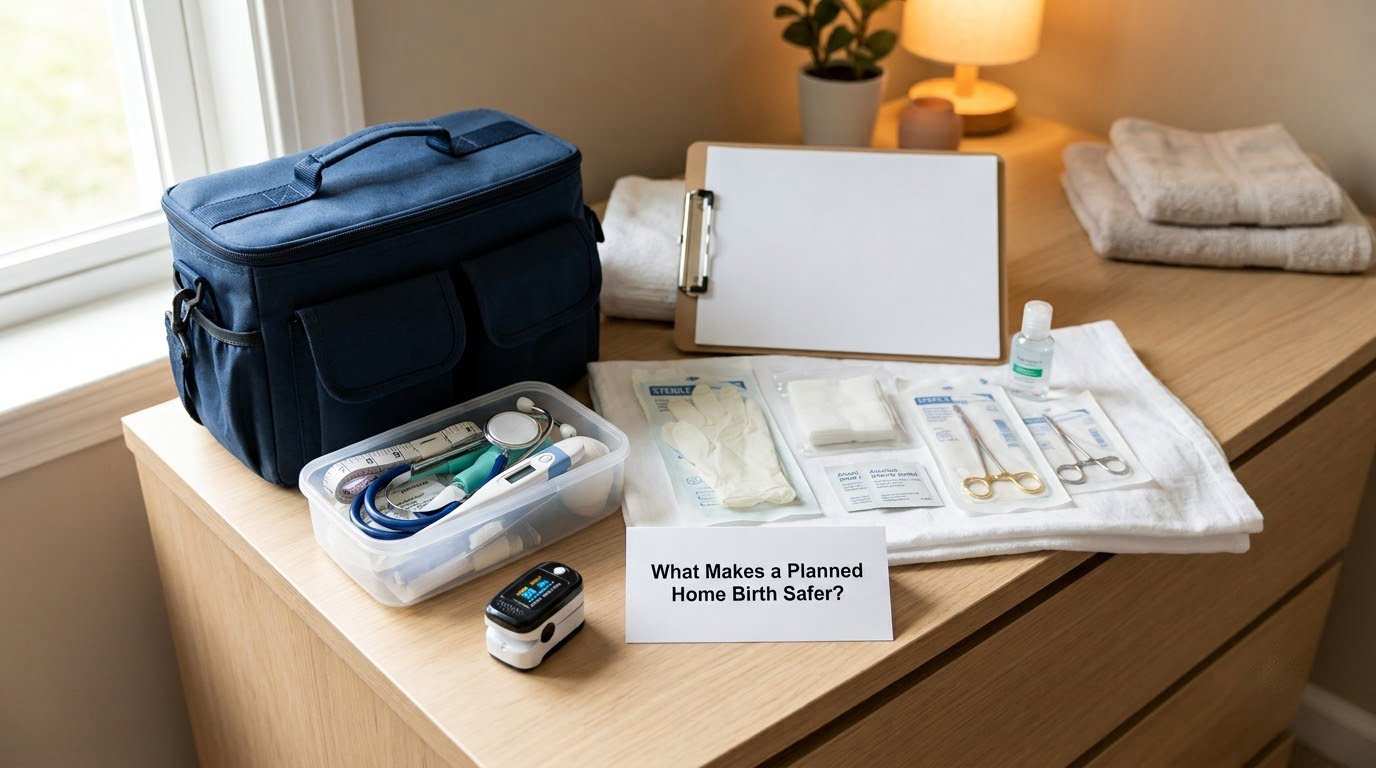
- A qualified attendant present continuously, not called in when labor starts
- Complete prenatal care with the screening and lab work a hospital birth would include
- Screening and supplies reviewed ahead of labor, including oxygen, newborn resuscitation gear and a heat source
- Newborn care planned from the first minute, not improvised afterward
- A written transfer agreement naming the receiving hospital and the route to it
- Reliable phone and vehicle access, plus a second person who can drive at any hour
- A clear agreement that you can change your mind at any point without justifying it
People who have had a planned home birth often say the presence of a trained midwife who knows which signs matter is what makes them feel safe, more than the physical location of the birth. That matches the structure of the safety argument: the provider and the transfer plan carry most of the weight.
What Is the Emergency Transfer Plan?
The transfer plan is written down before labor, agreed with a named receiving hospital, and understood by everyone in the room including the family. It should state the route, approximate travel time, who makes the call, who drives, and what happens on arrival. Cleveland Clinic notes that most transports, cited at 10 to 40 percent of home births, are for stalled labor, a change of mind about pain relief or reassessment rather than a true emergency, which is worth remembering when you imagine the worst case.
Travel time is the piece most often argued over. Common guidance suggests a delivering hospital within about 15 to 20 minutes, and the AAP has said that even 15 to 20 minutes can be too long in some circumstances. If you live further out, ask your provider directly what they consider acceptable and how the plan changes.
Warning signs that prompt urgent transfer include heavy or increasing bleeding, a change in fetal heart rate or pattern, signs of fetal distress, a seizure, severe headache or visual changes with high blood pressure, cord prolapse, and any maternal condition the midwife judges to be worsening. Your midwife follows their own protocol and your local system’s guidance, not a list on a website.
How Do Midwives Monitor Labor at Home?
Routine assessment at home covers more than most people expect. A midwife typically checks maternal vital signs, how labor is progressing, fetal heart rate and movement, hydration and nutrition, and comfort measures, and after birth observes the newborn’s breathing, temperature, color, tone and feeding. Practices vary by setting, training and risk level, so ask your provider what they record and how often.
Some attendants use a handheld Doppler or a monitor that records a tracing for a defined period; some rely on intermittent listening. Continuous electronic monitoring in a hospital is not automatically reproducible in a house, and that difference is part of what the studies are measuring. Unusual findings are the trigger for consultation, then for transfer.
The honest framing on pain: there is no epidural at home, so the birth is managed with movement, position changes, water, support people, and medication your midwife is licensed to give. Some people are relieved by that, others are not. It is reasonable to weigh this when deciding whether a home setting fits you.
When Is Home Birth Not the Safer Choice?
This is the question that matters most, and the one most consumer guides answer worst. Here is the list to raise with your obstetric clinician rather than argue from a web page.
What disqualifies you from a home birth
- Fetal malpresentation, such as breech or transverse, at the time of planning
- Multiple gestation, including twins
- A previous cesarean birth, where uterine rupture risk changes the calculation
- Pre-eclampsia, gestational hypertension or uncontrolled high blood pressure
- Diabetes before or during pregnancy, or a pregnancy complication requiring hospital monitoring
- Preterm labor or a pregnancy expected to end before 37 weeks
- Placenta previa or another known placental problem
- A known fetal anomaly requiring immediate specialist care at delivery
- No qualified midwife able to attend continuously, or no access to timely transport
ACOG names the first three as absolute contraindications. The rest are conditions in which hospital-based care with continuous monitoring, operating theatre access and neonatology is the recommended setting.
A separate category sits between these: risk factors that are debated or depend on local protocol, such as a very large baby, Group B streptococcus colonization, certain maternal medications, or a previous difficult birth. Those belong in a conversation with your clinician, not in a rulebook you apply yourself.
How to Prepare for a Home Birth
Preparation is mostly practical and mostly decided in advance with your team. Your midwife’s own checklist overrides anything here, since local requirements differ by state and by hospital system.
Before labor begins
- Confirm prenatal visits, screening and lab work are current
- Sign the birth plan and transfer agreement, and give a copy to your midwife
- Prepare the birth space: clear floor space, lighting you control, towels and sheets, a birth pool if you want one
- Set up a supply area your midwife has reviewed, including newborn assessment tools and a heat source
- Arrange a primary and backup driver who are awake and reachable at any hour
- Test the route to the receiving hospital at night and in bad weather
- Charge phones, keep the address and hospital phone number on the fridge, and agree on a code word for an emergency
- Line up postpartum help: food, rest, a plan for the first 48 hours and newborn screening appointments
Home birth is legal in the United States, and in many states birth at home under a midwife is legal, but regulation of midwives varies widely. Some states license and certify midwives; others do not regulate them at all. Ask what credential your attendant holds and how it is enforced where you live.
On cost, US families usually pay out of pocket for home birth and midwifery care, and that varies widely by state and provider. Ask for a written fee schedule, and check whether your insurance covers any part of it, before you are in labor.
Questions to Ask Before Labor
These are the questions that separate a prepared plan from a hopeful one. Ask them early, ideally in a prenatal visit, and ask for specifics rather than reassurances.
About the provider
- What is your certification and license, and how many out-of-hospital births have you attended?
- Who covers for you, and how quickly can a second attendant arrive?
- Which hospitals do you work with, and have you arranged a transfer agreement?
About monitoring and emergencies
- What do you carry, including oxygen, medications for hemorrhage and newborn resuscitation equipment?
- How do you monitor fetal heart rate, and what finding makes you transfer?
- What is your plan for heavy bleeding, and how long is your drive to the nearest delivery unit?
- What happens to my care when I arrive at the hospital?
About the birth and after
- Do you use continuous monitoring or intermittent listening, and what does my record look like?
- Who does newborn assessment, and where does newborn screening happen?
- How long do you stay after the birth, and what postpartum visits are included?
Particularly for Black and Indigenous families, ask directly how the midwife handles a transfer and how the receiving hospital treats you on arrival. The 2024 Bovbjerg and Cheyney work found reports of mistreatment during hospital transfer, which is a documented harm in its own right rather than a side note. Getting a straight answer in advance is worth a great deal.
What Do the Guidelines Say?
The major US organizations do not say the same thing, and understanding why makes the disagreement easier to weigh.
- ACOG, Committee Opinion No. 697, states that although it recognizes the benefits of continuity and a homelike setting, the absolute safety of a planned home birth cannot be established in the current US context, and it recommends hospital or accredited birth center as the safest setting. The opinion was published in 2017 and reaffirmed in 2026 with an interim update on perinatal mortality data.
- The American Academy of Pediatrics takes a similar position for newborns, pointing to travel time to a hospital as a core concern and suggesting that 15 to 20 minutes may already be too long.
- The American College of Nurse-Midwives supports access to qualified midwifery care and out-of-hospital options within a system that includes consultation and transfer.
- The World Health Organization emphasizes skilled attendants and timely access to emergency obstetric and newborn care in every setting.
The disagreement is mostly about evidence transfer. Much of the reassuring research comes from systems where home midwives are salaried, connected to hospitals, and able to admit patients under the same protocol. US home birth happens in a less integrated landscape with less consistent regulation. Whether you find that reassuring or merely a reason to check your own midwife’s integration closely is a fair conclusion to reach.
Key studies at a glance
| Study | Year | Design and size | Headline finding |
|---|---|---|---|
| Hutton et al., The Lancet | 2019 | Systematic review and meta-analysis | Home birth showed no higher perinatal mortality for low-risk women in well-integrated systems; North American samples showed more low Apgar scores |
| de Jonge et al. | 2013 | National cohort, Netherlands | Fewer interventions and lower maternal morbidity with a properly selected population and trained midwives |
| Birthplace in England Collaborative Group | 2011 | Large national cohort | For low-risk women, home and birth center births produced fewer interventions with comparable outcomes |
| Li et al. | 2015 | Cohort analysis, England | Some higher-risk women also did well at home, though selection remains the limiting factor |
| Scarf et al. | 2018 | Cohort study, Australia | Found an increase in serious neonatal adverse events among planned home births |
| Olsen and Clausen, Cochrane | 2023 | Systematic review | Planned hospital birth may add interventions in low-risk women without reducing mortality |
| Bovbjerg and colleagues, Medical Care | 2024 | Two national US community birth registries, over 110,000 births, 2012 to 2019 | Planned home birth was as safe as planned birth center birth for low-risk pregnancies, with lower transfer rates |
| Gregory et al., Ireland | 2023 | Survey of birth experiences | Home birth experience scores averaged 9.7 out of 10 against 5.5 in hospital |
For scale, CDC birth data reported in 2026 show roughly 50,000 home births in 2022, under 2 percent of all US births. That number has been climbing steadily, and most of that growth is in planned, attended births.
How Does Home Birth Safety Differ by Risk Level?
Risk level changes the recommendation more than it changes the statistics. This table is educational context for a conversation, not an eligibility tool.
| Situation | How risk is handled | How the recommendation generally shifts |
|---|---|---|
| Generally low risk | Screening complete, presentation cephalic, term gestation, no maternal disease | Planned home birth is a reasonable option to discuss with a qualified midwife in a system with transfer access |
| Uncertain risk | Unconfirmed position, borderline screening results, unclear history, gestational diabetes controlled with diet | Reassessment first, often a planned hospital or birth center birth until the picture is clear |
| Higher risk | Preeclampsia, multiple gestation, malpresentation, prior cesarean, preterm labor, known fetal anomaly | Hospital birth with continuous monitoring and operating theatre access is the recommended setting |
| Any risk level with poor transport access | Long, unreliable, or weather-exposed route to a delivery unit | Hospital or accredited birth center birth, regardless of how low the risk profile is |
| Any risk level with a change in condition | New maternal illness, bleeding, reduced fetal movement, abnormal fetal heart rate | Transfer for evaluation, promptly and without debate |
The row that surprises people is the last two. Distance from a hospital and any change in condition override an otherwise low-risk profile. That is what the four ACOG conditions amount to in practice.
Frequently Asked Questions
Is home birth safe for a low-risk pregnancy?
Planned home birth appears comparably safe for a low-risk pregnancy when a qualified, certified midwife attends continuously and a written transfer plan puts a delivering hospital within reach. Large studies report few differences in serious outcomes for this group. ACOG and the AAP still recommend hospital or accredited birth center birth as the safest setting, so this is a discussion to have with your own clinician.
Is a home birth safer than a hospital birth?
There is no good evidence that home birth is safer for low-risk pregnancies. The honest answer is that outcomes are close rather than home birth winning on safety. Hospital birth offers continuous monitoring, an operating theatre and neonatology within seconds. Home birth offers fewer routine interventions and, in surveys, a much better-rated experience. Which matters more is a personal judgment about your risk tolerance.
What qualifications should a home-birth midwife have?
Look for a recognized certification: certified nurse-midwife, certified midwife through the American Midwifery Certification Board, or a license that meets International Confederation of Midwives global standards. ACOG names provider qualification as one of four conditions for a safe planned home birth. Ask how many out-of-hospital births they have attended, who covers them, and which hospital they transfer to.
How quickly can a home birth transfer to a hospital?
That depends entirely on where you live. Guidance commonly suggests a delivering hospital within about 15 to 20 minutes, and the AAP has said even that can be too long. Ask your midwife for the actual time from your address at night, in traffic and in bad weather. If the answer is uncertain, hospital or birth center birth is the safer setting.
Can I change plans and go to the hospital during labor?
Yes. A good transfer plan says up front that you can request transfer at any moment without giving a reason, and that your midwife will drive you rather than argue with you. ACOG specifically cites a nonjudgmental demeanor on transfer as part of safe practice. Research on home birth transfers shows most are for stalled labor, reassessment or a change of mind about pain relief, not emergencies.
Conclusion
Start with one conversation, before you are in labor: ask your obstetric clinician whether your pregnancy is genuinely low risk, what credential your attending midwife holds, how many out-of-hospital births they have attended, and exactly how long it takes to reach a delivery unit from your address at night.
Those four answers decide most of this. If they line up, planned home birth is a defensible choice with a well-evidenced safety profile for low-risk pregnancies. If any of them is fuzzy, a hospital or accredited birth center birth is the safer setting, and switching later is always allowed. If warning signs appear at any point during pregnancy or labor, get evaluated promptly rather than waiting.