Baby led weaning vs purees is less a competition than most parent forums make it sound. Baby led weaning means offering soft, graspable pieces of ordinary family food so your baby picks them up and feeds themselves; purees mean you prepare smooth or mashed food and spoon-feed it. Studies comparing the two have not found a meaningful difference in choking frequency or in how picky children become later.
So the honest answer is that the better approach is the one your household can actually run on a Tuesday evening when everyone is tired. This guide compares both methods on safety, nutrition, texture development, mess, pace and caregiver effort, so you can pick based on your family’s real life rather than on how a method is marketed.
This is general information about starting solids, not medical advice. If your baby was born early, has reflux, a swallowing difficulty or is not gaining weight, talk with your pediatrician before starting, and ask again if anything about feeding worries you.
Information below was reviewed in October 2026.
Table of Contents
- Baby Led Weaning vs Purees at a Glance
- What Is Baby Led Weaning?
- What Are Purees?
- How Baby Led Weaning Differs From Purees
- How baby led weaning vs purees explained in practice
- Which Approach Is Safer?
- Which Approach Better Supports Nutrition and Development?
- Which Is Easier for Parents?
- Can You Combine Baby Led Weaning and Purees?
- Which Should You Choose?
- Frequently Asked Questions
- Is baby led weaning safer than purees?
- When should I start baby led weaning or purees?
- Does baby led weaning provide enough iron?
- Are purees better for babies who are not ready for finger foods?
- Can I use jars or homemade purees with baby led weaning?
- How do I know my baby is ready for more texture?
- Conclusion
Baby Led Weaning vs Purees at a Glance
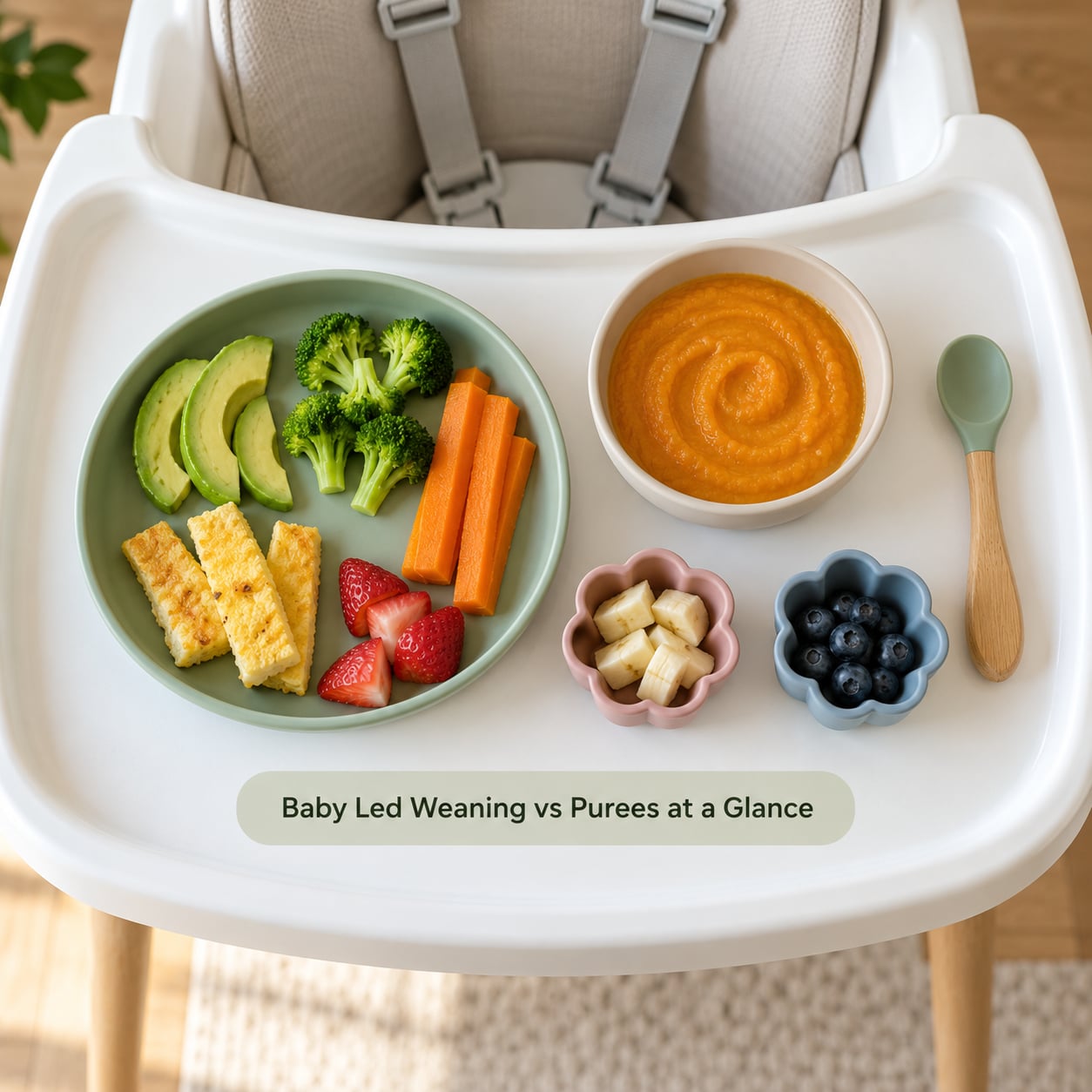
The table below sets baby led weaning and purees side by side across the factors parents ask about most. Nothing here is a winner on every row, because the two approaches trade convenience against caregiver control.
| Factor | Baby Led Weaning | Purees |
|---|---|---|
| What the baby eats | Soft, graspable pieces of the same food the family eats | Smooth, mashed or finely chopped food prepared separately |
| Who controls portions | The baby decides what and how much | The caregiver controls what goes in and how much |
| How it reaches the mouth | Hands, sometimes a spoon the baby picks up | Spoon held by an adult |
| Typical pace | One or two exposures a food per day, progress over weeks | Faster introduction of new foods, quicker texture progression |
| Prep time | Mostly none, food is cooked for the family anyway | Blending, portioning, freezing, storing |
| Mess and waste | Considerable, especially in the first few months | Much lower, food usually goes in the mouth |
| Texture exposure | Wide range from the start, including lumps and lumps-to-crumb | Smooth first, then gradually lumpier |
| Nutritional risk | Risk of low iron and low energy if the menu is narrow | Risk of low energy and low texture exposure if smooth food continues too long |
| Choking evidence | No increased choking frequency found in the studies reported to date | No increased choking frequency found in the studies reported to date |
| Works best when | Meals are shared, mess is manageable, baby sits well upright | You want more control over intake, or baby is not ready to self-feed |
What Is Baby Led Weaning?
Baby led weaning is an approach to starting solids in which the adult offers appropriate food and the baby does the rest. Food is cut into shapes a small hand can hold and a mouth can manage, then presented on a tray or plate rather than spoon-fed.
The principle underneath it is responsive feeding: the caregiver decides what is offered and when, the baby decides whether to eat it and how much. That division is the part that matters, because it is what keeps the approach from turning into unrestricted access to whatever is in reach.
Two things baby led weaning is not. It is not responsive feeding abandoned halfway, where the adult hands over everything including whole grapes and uncut nuts. And it is not a rule that food must always come as chunks, since a responsive approach can include mashed and spooned foods too.
Most babies who do it start at the same point as everyone else, around 6 months of age, once they can sit upright with support and show the usual readiness signs.
What Are Purees?
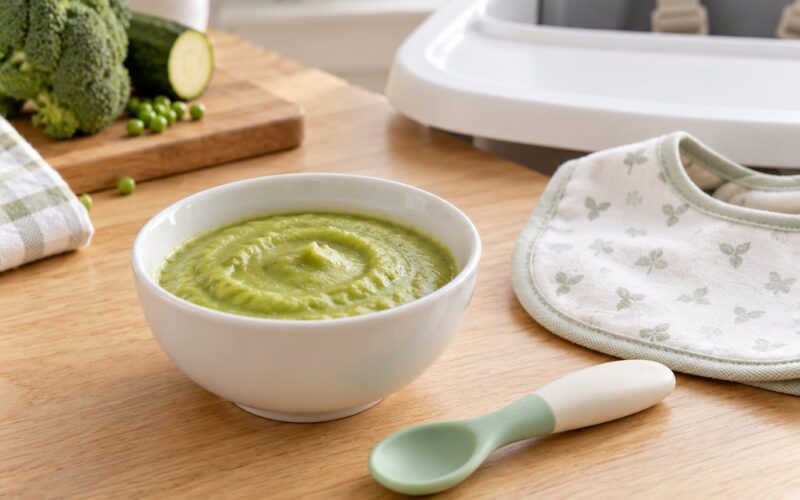
Purees are smooth, blended foods that a caregiver feeds to a baby with a spoon, usually from a bowl or straight from the jar. The approach starts thin and thickens over weeks or months as the baby’s chewing and swallowing skills develop.
Traditional spoon-feeding also includes mashed foods, and it is more flexible than its reputation suggests. Many families begin with a smooth puree, move to mashed and lumpy textures, and then offer soft finger foods alongside the spoon.
The difference from baby led weaning is one of degree rather than kind. In a puree-led approach the adult has more control over the portion, the pace and the texture the baby meets at each meal.
How Baby Led Weaning Differs From Purees
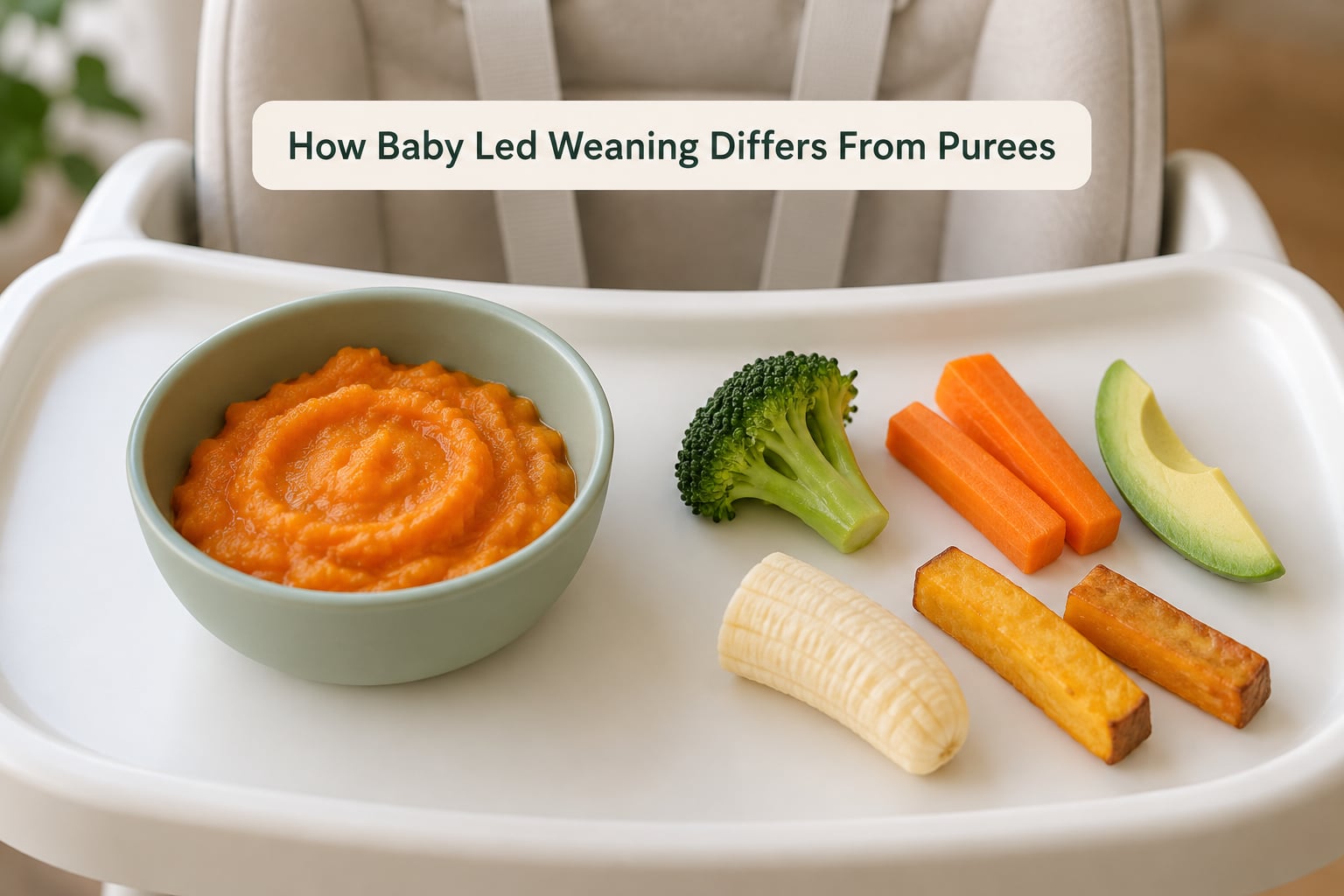
How baby led weaning vs purees explained in practice
In practice the difference shows up in one meal. With purees you prepare a bowl, hold the spoon, and decide how many spoonfuls go in. With baby led weaning you put a few pieces on the tray, sit beside your baby, and let them pick them up. Both meals can end with the same food and the same amount eaten.
Across food presentation, texture, pacing, iron intake and caregiver involvement, the two approaches differ in these ways:
- Texture exposure. Baby led weaning offers a wider range of textures early, from soft lumps to soft-crumb. Purees narrow that range until you deliberately widen it.
- Self-feeding practice. Grasping, bringing food to the mouth and rotating food in the mouth all get rehearsed. Spoon-feeding rehearses none of those.
- Pacing. Self-paced meals usually take longer and involve more rejected or dropped food. Spoon-fed meals are quicker and more predictable.
- Iron and energy. Both approaches land on the same nutrition if the menu is well planned. Purees make iron-rich foods easier to deliver in volume; finger foods make them harder to eat in enough quantity early on.
- Caregiver role. The adult still decides what is offered and when in both cases. How much physical feeding the adult does is the part that varies most.
The useful way to think about it: baby led weaning changes how food reaches the mouth, purees change how much of it does. Everything else on that list is downstream of those two choices.
Which Approach Is Safer?
No food format removes choking risk, and no study has found that baby led weaning carries more of it. The most-cited work on this, Brown and colleagues published in 2018, reported no association between baby led weaning and increased choking. A New Zealand observational study reported in 2016 reached a similar conclusion, and an earlier observational study by Gillett and colleagues in 2003 found no evidence that self-feeding raised choking risk either.
What actually reduces risk is preparation and attention, whichever method you pick:
- Seat your baby upright in a high chair with a strap, not on a lap, a sofa or a booster.
- Stay at the tray and watch your baby eat. Distraction with a phone or a feeding at another adult’s table adds risk.
- Cut food into shapes a baby can mash with the tongue and hold with fingers, and remove bones, pips and stones.
- Grate hard raw vegetables and cook firm fruits and vegetables until soft.
- Whole grapes, whole nuts, popcorn, hard chunks and uncut raw carrot stay off the menu at this age.
- Never prop a bottle or pouch and walk away from it.
Gagging and choking are not the same thing, and telling them apart takes some practice. Gagging is noisy, brief and pushes food forward out of the mouth; choking is silent or unable to make sound, and the baby cannot breathe. Parents on parenting forums describe gagging as frightening for the first stretch and then fading within a couple of weeks.
For any individual concern about your baby’s swallowing, feeding or growth, a pediatrician is the right first call, and a feeding therapist if the problem persists.
Which Approach Better Supports Nutrition and Development?
Both approaches can support adequate nutrition when planned well, and neither has been shown to win on growth outcomes. The differences worth knowing sit in three places.
Iron. Iron needs climb sharply in the second half of the first year, and iron-rich foods matter more than almost anything else in the menu. Under baby led weaning, a small volume of beef, lentils or fortified cereal may be all your baby manages at first, so offer iron-rich foods at every meal rather than once. Purees make it easier to deliver a reliable amount of iron because you control the portion, and this is the most common nutritional worry parents raise about baby led weaning.
Energy and variety. A baby who self-feeds tends to eat smaller, more frequent amounts, which can work out fine. Puree-fed babies often take larger, more reliable volumes. Neither pattern guarantees the other, so watch your baby’s growth curve rather than assuming.
Oral-motor and motor skills. Self-feeding gives repeated practice at reaching, grasping, chewing and swallowing textures that need real work. Spoon-feeding does not, which is the developmental argument baby led weaning advocates make. It is a reasonable argument, though the long-term research linking it to better chewing is thinner than the marketing suggests.
Allergens fit here too. There is no strong evidence that delaying introduction makes allergies less likely, and professional bodies generally favour introducing well-cooked egg and smooth nut products once your baby is developmentally ready, one at a time, so you can watch for a reaction. Check current guidance with your own clinician.
Which Is Easier for Parents?
Purees take more work up front. You buy jars or batch-cook, blend, portion into containers and freeze, and you will find leftovers you forget about. With baby led weaning there is nothing much to prepare beyond the family dinner, which is a genuine advantage in week one and keeps getting larger as your baby eats the same food as everyone else.
Cleanup runs the other way. Floor, table, high chair tray, hands, clothes and occasionally hair all take the meal. Food waste in the early weeks is real, and parents report it falls away as babies get better at getting food into their own mouth.
Shared caregiving is the factor people underestimate. Daycare, grandparents and split shifts work much more smoothly with spoon-feeding and jars or pouches. Exclusive baby led weaning asks every adult involved to be trained, attentive and willing to serve it the same way.
Stress is the final factor, and it counts. A method that makes you tense at every meal is a poor fit, however well it scores in a study.
Can You Combine Baby Led Weaning and Purees?
Yes, and the mixed approach is the one most commonly defended among pediatric dietitians, occupational therapists and parents. It is also the approach most closely aligned with WHO, AAP and ESPGHAN guidance, which emphasise responsiveness rather than a specific food format.
A workable mixed routine looks like this:
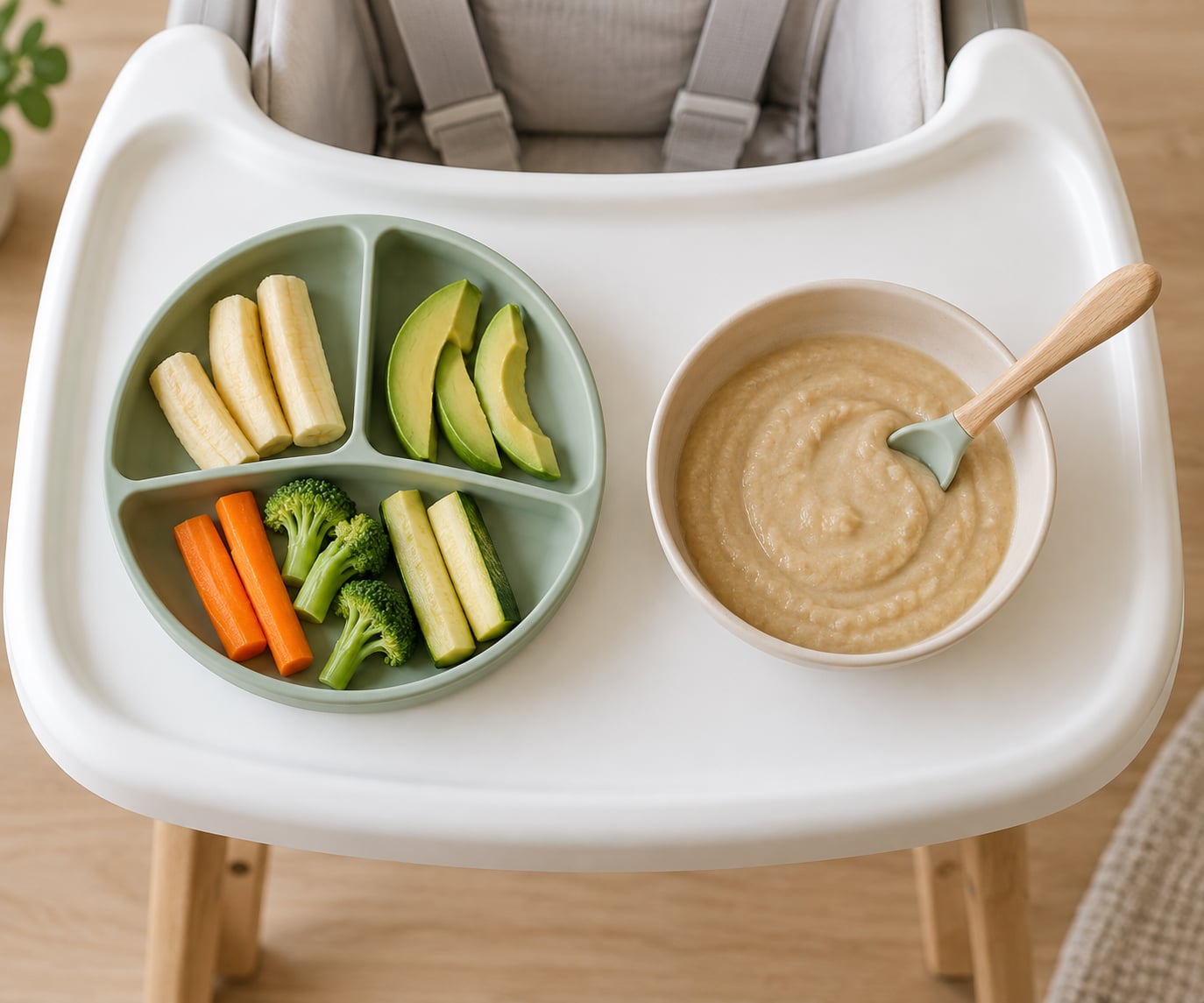
- Offer at least one finger food at every meal. Soft sticks of cooked vegetables, a slice of ripe avocado, a piece of banana, a flaked piece of fish. Whatever the rest of the meal looks like.
- Keep an iron-rich anchor. A spoon of puree, or self-fed soft meat, lentils or egg, so nutrient density does not depend on your baby mastering finger foods immediately.
- Offer puree and finger food separately on the tray. Many families serve them as separate items rather than mixing them, which keeps the texture contrast visible to your baby.
- Keep the pace responsive. Your baby may eat four spoonfuls of puree and throw the banana on the floor. That is a normal meal, not a failure.
If you started with purees and want to move toward more self-feeding, treat it as a gradual shift rather than a switch. Keep the spoon available, add one finger food per meal for a week, then two. Parents who have made that move describe it as easier than they expected.
Which Should You Choose?
Choose baby led weaning if your baby sits well upright, your meals are shared with the family, you have a high chair setup you can supervise properly, and you are comfortable with mess and slower progress. It suits families who want the whole household eating the same food from the start.
Choose a puree-led approach if you want more control over portions and texture, if your baby is not yet managing to self-feed reliably, or if feeding happens with multiple caregivers who cannot all commit to the same style. It also suits families whose baby has reflux or a swallowing issue that a clinician has told you to watch closely.
Choose the combined approach if you want the benefits of both and can hold a simple routine. For many families this is the lowest-stress option, and it is fully compatible with professional guidance.
Do not choose based on guilt. Forum threads make it obvious that parents feel judged for either choice, usually by people who have not been in the same kitchen on the same evening.
Frequently Asked Questions
Is baby led weaning safer than purees?
No method is safer overall. Studies, including Brown and colleagues published in 2018, have not found that baby led weaning carries more choking risk than spoon-fed purees. Safety comes from upright positioning, close supervision at every meal, safe food shapes and no distraction while your baby eats.
When should I start baby led weaning or purees?
Most babies are ready at around 6 months. Signs include good head and neck control, sitting upright with support, interest in what adults are eating, and the ability to bring objects to the mouth. Starting before readiness signs appear tends to go badly, whichever format you choose.
Does baby led weaning provide enough iron?
It can, but it takes planning. Babies self-feeding often eat small amounts at first, so offer an iron-rich food at every meal: soft meat, lentils, beans, egg, fortified cereal or a puree you spoon alongside. If growth stalls or your baby looks pale or very tired, ask your pediatrician about iron.
Are purees better for babies who are not ready for finger foods?
Usually yes, for a short while. A baby who cannot yet sit upright or bring food to their mouth gains more from smooth, thicker food that is easy to swallow. Readiness changes quickly at this age, so keep offering soft finger foods alongside the puree and let your baby’s skills set the pace.
Can I use jars or homemade purees with baby led weaning?
Yes. Nothing about baby led weaning bans purees. Responsive feeding means the adult decides what is offered and the baby decides whether to eat it. Offering a puree plus some self-fed finger food at each meal is a well-supported hybrid approach, not a contradiction.
How do I know my baby is ready for more texture?
Watch for a good sitting posture, a stronger grasp, and a gag reflex that is working well enough to push unwanted lumps forward rather than swallow them. Many babies accept thicker textures easily once they are around 7 months. If gagging persists or they seem to swallow everything without chewing, check with your pediatrician.
Conclusion
Start with the readiness signs around 6 months, not with a method. Then give yourself one finger food at every meal, keep an iron-rich option on the tray, and keep the spoon in reach even if you lean toward baby led weaning.
Over the next few weeks, watch how your baby manages textures and how much iron-rich food actually goes in. Those two observations will tell you more than any article, including this one, about which approach fits your family.