A postpartum recovery plan is a written outline of how you want the first weeks after birth to go: who takes the 3am feed, who brings meals, which visitors you turn away, and how you will keep track of your own healing. You write it before delivery, when you still have the energy to make decisions, then revise it as your body and your baby tell you something different.
Most people who read this are somewhere between 20 weeks pregnant and about six weeks after birth, and their real question is usually narrower than the search phrase: who exactly do I ask for what. This guide answers that. It walks through what a postpartum recovery plan actually is, what to put on the page, how to build yours in six steps, and how to rewrite it when reality does not match the plan.
One thing to hold onto as you read. Nothing here is medical advice, and no plan on the internet can tell you how your body will heal or when your baby will sleep. Your own midwife, obstetric provider or other clinician sets the clinical instructions. This is the organisational scaffolding around those instructions.
Table of Contents
- What You Need to Make Your Postpartum Recovery Plan
- What a postpartum plan is not: your birth plan
- Postpartum plan at a glance
- Step-by-Step: Create a Postpartum Recovery Plan
- 1. Start With Your Care and Support Team
- 2. Break Recovery Into Phases
- 3. Track Physical and Emotional Recovery
- 4. Build the Practical Care Schedule
- 5. Name What Is Not Your Responsibility
- 6. Review and Revise the Plan
- Common Mistakes and How to Fix Them
- Treating recovery as a fixed checklist
- Planning only for the baby
- Waiting too long to ask for help
- Assigning every task to one parent
- Relying on unverified remedies
- Ignoring warning signs
- Frequently Asked Questions
- How do I make a postpartum recovery plan?
- Who can help me create a postpartum recovery plan?
- How long should a postpartum recovery plan last?
- What if I do not have much help after the baby is born?
- What warning signs mean I should contact a healthcare professional?
- Conclusion
What You Need to Make Your Postpartum Recovery Plan

The short version of what a postpartum recovery plan is: a document that moves decisions out of the exhausted first days and onto paper beforehand. You list what you need, attach a named person to each item, write down the preferences that matter most to you, and sketch what happens if the plan does not work. Then, when the baby arrives, you are communicating a decision instead of making one at 4am with a screaming infant and no idea who is on duty.
It covers four things at once, which is why it feels bigger than it is: physical healing, feeding and infant care, emotional and mental health, and the ordinary logistics of a household that now has an extra person in it. The research behind this is not subtle. A survey figure cited by the postpartum support brand From Day One puts the share of new mothers who felt blindsided by postpartum recovery at 85%, and the most common regret in parenting forums is not having written anything down beforehand.
Ideally you write it in the third trimester, when you can still compare options and say no to things. It stays useful for far longer than that, though. Plenty of people start one in the first two weeks, or after a C-section, or during month four when the leave has ended and nobody is helping and the plan is more urgent than ever. A plan you write late still beats the plan you never write.
What a postpartum plan is not: your birth plan
People mix these two up constantly, and they serve opposite purposes. A birth plan guides your preferences during labour and delivery. A postpartum recovery plan covers the weeks and months after the birth, once you are the one recovering and the baby is the one who needs everything. A birth plan is read by your clinical team in a hospital. A postpartum plan is read by your partner, your mother, your meal train and your doula, usually from a phone, usually at a bad moment.
Worth writing both. Just do not hand your midwife a birth plan and assume the rest has been handled.
Postpartum plan at a glance
This is the shape of a complete plan. Nine rows, and most families find that the first three are the ones nobody thinks of until it is too late to arrange them calmly.
| Plan element | Why it matters | Who helps |
|---|---|---|
| Your care team and follow-up | Postpartum visit timing, healing checks and referrals all come from your own clinician | Midwife, OB or family doctor |
| Overnight and sleep help | Fragmented sleep is the single biggest driver of exhaustion in the early weeks | Partner, doula, night helper, family |
| Meals, hydration and food | Cooking competes directly with rest, and recovery needs fuel | Partner, family, meal train, delivery |
| Infant feeding support | Breastfeeding, pumping, combination feeding and bottle preparation all have learning curves | Lactation consultant, clinician, partner |
| Mental health check-ins | Perinatal mood and anxiety disorders affect roughly 20-25% of pregnant people and new parents, per Postpartum Support International | Perinatal psychologist, GP, support group |
| Household roles and errands | Tasks that feel small individually are the ones that decide whether you ever lie down | Partner, family, paid help |
| Visitor boundaries | Unannounced guests take rest and privacy in the first weeks, the hardest time to refuse | Whoever answers the door |
| Childcare logistics | Return to work has a real deadline that recovery does not respect | Partner, employer, childcare provider |
| Contingency plan | Birth complications, a sick baby or a sick parent change everything, usually without warning | Written down before it is needed |
Two preparation items cover most of the ground. First, the birth paperwork and discharge instructions from your provider, which tell you the follow-up schedule your own clinicians want. Second, a named list of people with phone numbers, what each one is good for, and when they are reachable. A list of names is not the same as an agreement, and this is where most plans quietly fail.
Step-by-Step: Create a Postpartum Recovery Plan
Six steps, in order. Most of the work happens in one sitting of about ninety minutes, and the rest happens in the weeks after birth.
1. Start With Your Care and Support Team
Write down the names and contact details of everyone whose guidance you will be following: your obstetric provider or midwife, your baby’s pediatrician, your primary care clinician, and any specialist you already see. Then add the practical people, not just the clinical ones: a lactation consultant, a pelvic health physiotherapist, a perinatal psychologist, a postpartum doula, your closest family member, your nearest friend who would actually show up.
Ask your own clinicians the questions for your situation, including when they want to see you and what they want you to watch for in between. The general pattern most families are given is a postpartum visit somewhere around six weeks and another later in the first year, but your provider sets that, and a C-section recovery, a complicated birth or a pre-term baby changes the schedule entirely. Write the date you were actually given in the plan, not the one you assumed.
If you do not yet have a number for a mental health professional, get one before the birth rather than during week three. Postpartum Support International runs a helpline and text line, and it is there for partners and co-parents as well as birthing parents. Organised support goes in the plan too: DONA International, CAPPA, the International Lactation Consultant Association, La Leche League and Postpartum Men are the ones most families name when they go looking, and all of them can point you to local directories.
2. Break Recovery Into Phases
Divide the plan into phases, because the tasks in each phase are genuinely different and one flat list will not tell you what matters on any given week. Three phases cover most plans:
- Early recovery. The first days and the first two weeks. Bleeding, pain, perineal or incision healing, whatever your provider has told you to watch, and building your support system. The plan here is almost entirely about other people: who brings food, who handles visitors, who does the nights.
- The first several weeks. Feeding gets established or it does not, sleep fragments, visitors arrive and stay too long, and the six-week check approaches. This is where the plan gets its first real rewrite.
- Later follow-up. Pelvic floor and core recovery, mental health review, return to work, childcare arrangements, and the relationship between two tired people.
Do not attach fixed dates to the phases. Healing timelines vary widely between people, between births, and between one week and the next for the same person, and the phase you are in is defined by what your body is doing rather than by the calendar. A six-week clearance for one parent says nothing useful about another parent’s six weeks.
3. Track Physical and Emotional Recovery
Build a simple weekly page, on paper or in a note on your phone, and keep it next to wherever you feed the baby. Record a short list each week: how you slept, how your mood has been, what you have managed to eat and drink, any pain or bleeding that has changed, how often you are getting outside, and every question you want to ask your clinician at the next visit.
List your medications exactly as prescribed, with the timing, and take them as directed. That sounds obvious, but sleep-deprived people lose track of doses constantly, and a written schedule is the fix.
Movement, meals and hydration go in the same place. What you can do physically depends entirely on your birth and your healing, so follow your clinician’s instructions rather than a general timeline you found online. If pelvic pressure, leaking or pain shows up and does not settle, ask about a pelvic health physiotherapist; parents ask this question on forums constantly and it is the most recommended, least accessed intervention in this whole area.
Mood tracking is not optional bookkeeping. Baby blues and perinatal mood and anxiety disorders are not the same thing, the second can start weeks or months after the birth, and the tracking page is often the only record you will have when you try to describe what has been happening. Persistent sadness, anxiety that will not quiet, intrusive thoughts, or anything involving self-harm needs same-day contact with your clinician or a mental health professional, not a note in a journal.
4. Build the Practical Care Schedule
Now write the actual week, hour by hour if that helps. Who is with the baby and who is not. When meals happen and who cooks them. Laundry, groceries, bins, the school run for an older child, driving, appointments, pet care, and the visitor list. Put protected rest in it as a line item with a name against it, not as the leftover space after everything else.
Then handle the 3am gap specifically, because this is the one nearly every plan skips and every family notices. Decide who gets the first night feeds, who covers the second half of the night, and whether anyone is awake and reachable after midnight at all. Options include a partner taking a block, a night helper, a doula, or simply a realistic rule that one parent is never solely responsible between midnight and 5am for the whole first month.
Build the handoff plan for the same period. Even in the best households, the primary caregiver will hit a moment where she needs ten minutes alone and a shower, and without a named plan that moment never arrives. Write who steps in, and what the handover looks like: feeding, nappy, settled or not, next feed time.
Keep it honest. A schedule that assumes you will cook, clean, breastfeed, entertain and sleep is not a schedule, it is a fantasy with a calendar around it.
5. Name What Is Not Your Responsibility
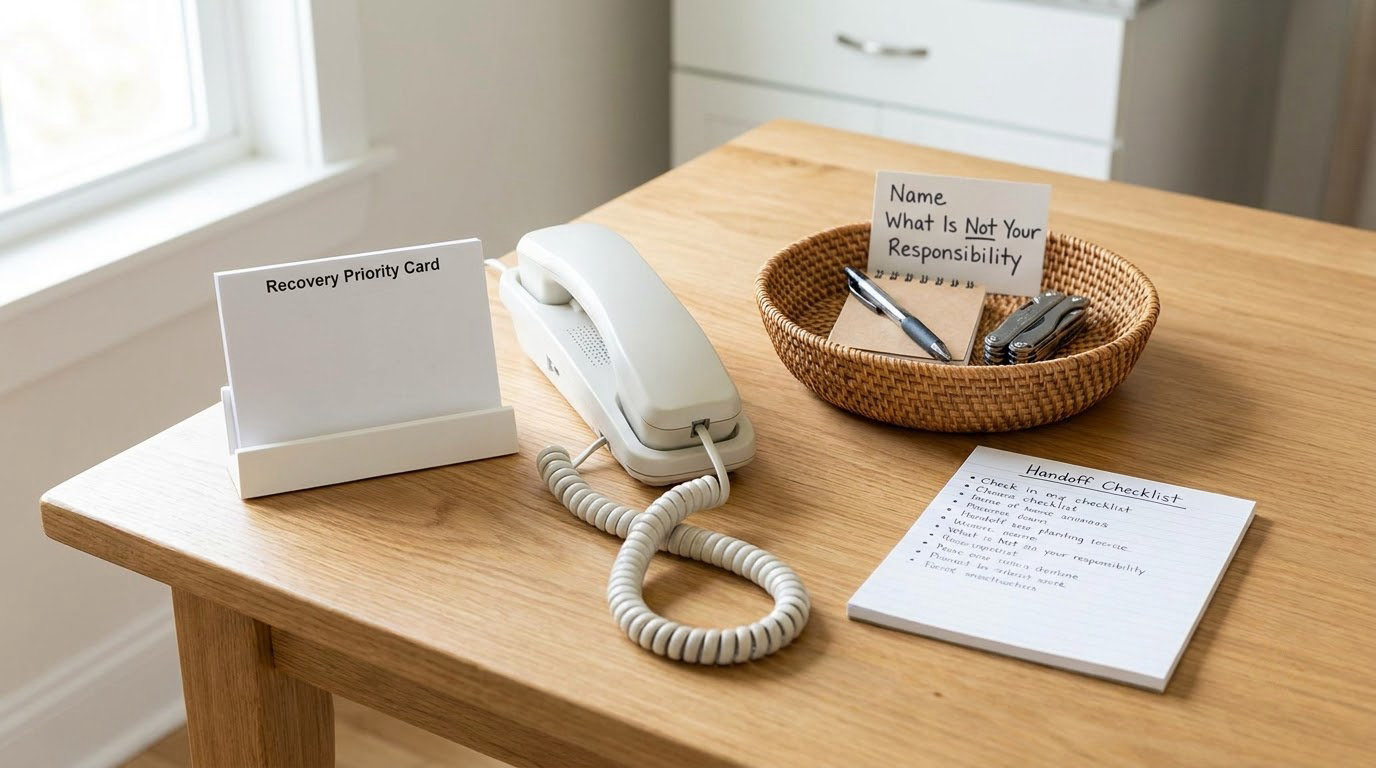
This is the step that changes the most for people who do it, and the one most likely to be skipped out of politeness. List the tasks that will arrive, and assign each one to a named person or mark it explicitly as yours. Anything assigned to nobody is a task you will do in your fourth week while bleeding.
Guilt is the main obstacle, and it is worth naming that almost every new parent describes feeling indebted about accepting help, and that the awkwardness is a cultural artefact rather than a debt. You are not borrowing from friends. You are giving them something they frequently want to do.
Scripts help more than willpower. Sending one of these the day after the birth does most of the work before anyone has to ask:
“Thank you for offering. We are not taking visitors for the first two weeks. If you would like to help, the thing that would actually help most is dinner for two nights this week, or a laundry load, or an hour of holding the baby while I sleep.”
“Please come after 11am and leave by 4pm. If you are unwell or have been near anyone with a cold this week, please stay home this time. We can do a proper visit soon.”
“Can you take the older children on Saturday afternoon? I am not managing that at the moment.”
Being clear about paid help is not a failure of the plan. Paid options include a postpartum doula, a night nurse or newborn care specialist, a cleaner, a meal service, and paid childcare. Financial constraints are real, so if the budget is tight, price the categories separately and choose where help saves you the most: night cover, meals and cleaning usually pay back faster than anything else. Community options exist too: parent groups, local breastfeeds and postpartum support circles, mutual aid networks, and family members doing shifts.
6. Review and Revise the Plan
A postpartum recovery plan has a review schedule, not an expiry date. Check it at the end of the first week, at every appointment, any time the caregiving arrangements change, and whenever something feels off.
Put the review in the plan itself: a standing fifteen minutes on a specific day, with one question attached. What did I hand over, and did it happen? What did I keep doing that I should have given away? What did I not write down that I should have?
Expect the first version to be wrong in useful ways. Most parents find the plan assumed more capacity than they had, or that the person they counted on for nights was also working full time. Finding that out in week one is a correction. Finding it out in week five is a breakdown.
So: here is how to make a postpartum recovery plan that works in your actual circumstances rather than on paper. Name the people, split the work, decide the preferences, protect the rest, and plan the revision. The plan that survives contact with week three is the one that is short, written down, and reviewed by someone other than you.
Common Mistakes and How to Fix Them
Six mistakes come up again and again, and each has a straightforward correction.
Treating recovery as a fixed checklist
Week four looks identical in the plan and completely different in your life. The fix is to review dates rather than achievements, and to write flexibility in as a feature. Every plan should have a line that says what changes first when the plan does not work, because the plan will not.
Planning only for the baby
A schedule with feeding and nappies but no line item for your own food, hydration, rest or appointments is not a care plan. It is a rota. The parent who is not fed does not recover, so the person writing the plan has to appear in it as an entry, not as an assumption.
Waiting too long to ask for help
The request gets harder with every week you wait, not easier. Ask during pregnancy, or in the first week, while you can still type. The version of this that surprises people most is accepting a modest amount of help early, then discovering that help given early is what makes the rest of the month survivable.
Assigning every task to one parent
Unless you have arranged real overnight cover, the default plan hands the same person every night shift and every daytime shift. Partners describe this in forums as the norm and it is the source of a great many of the exhaustion complaints. Write the shifts down, put your partner’s work schedule and commute into the plan, and renegotiate once leave ends rather than hoping it settles itself.
Relying on unverified remedies
Advice arrives from relatives, feeds and forums, and much of it is well meant and not evidence based. Follow your clinician’s instructions on medications, supplements, wound care and activity. If you want to try something else, that is a question for your provider or your pharmacist, not for a thread.
Ignoring warning signs
Soaking pads rather than spotting, fever, spreading redness or warmth at an incision or tear, flu-like feelings with breast pain, heavy cramping, a headache with vision changes, chest pain, shortness of breath, or any thought of harming yourself or the baby. These need contact with a healthcare professional promptly rather than a place in the review notes. The FAQ below covers the ones people most often wait on.
Three habits help more than anything else in the list. Ask for help earlier than feels comfortable. Keep the plan visible, because a plan in a drawer is a plan nobody uses. And cut one thing from your week, repeatedly, without replacing it.
Frequently Asked Questions
How do I make a postpartum recovery plan?
Gather your clinician’s follow-up instructions, then list your care team and the people who will help. Break recovery into early, middle and later phases. Assign a named person to every task, write down your preferences for feeding, visitors and rest, and add a contingency section for complications. Put a weekly fifteen-minute review in your calendar and revise the plan whenever circumstances change.
Who can help me create a postpartum recovery plan?
Start with your midwife, obstetric provider or family doctor, who can tell you what follow-up you need. A postpartum doula, a lactation consultant, a pelvic health physiotherapist and a perinatal psychologist each cover different parts of it. Peer support also helps: a parent group, La Leche League, Postpartum Support International, or a partner who will actually read the plan with you.
How long should a postpartum recovery plan last?
Keep it useful for at least the first year, and expect the most active revision during the first six to twelve weeks, which many people call the fourth trimester. Keep reviewing it after that, especially at the return to work and during the three to six month window when leave has ended but recovery is often not finished. A plan you still check monthly in the first year is doing its job.
What if I do not have much help after the baby is born?
Then the plan becomes a triage document rather than a wish list, and the order matters more than the size. Name the minimum set of tasks that must not fall on you: feeding, food, laundry and transport. Then look at paid help, which is not a failure, at community supports such as parent groups and local services, and at what can simply be postponed. Ask your clinic what social support options exist locally.
What warning signs mean I should contact a healthcare professional?
Contact your provider or urgent care promptly for soaking through a pad in an hour, passing large clots, fever, chills, worsening pain, or redness, warmth, swelling or discharge from an incision or perineal tear. Seek same-day help for breast pain with fever, a severe headache with vision changes, chest pain, shortness of breath, leg swelling, or any thought of harming yourself or your baby. For mental health crisis support in the US, the 988 Suicide and Crisis Lifeline is available by call or text.
Conclusion
One action, today: write down three things. Your next medical appointment and who you will ask for the follow-up date. The support you need most, and the one person you will tell first. And three tasks that can be shared or delayed.
A postpartum recovery plan is a flexible guide, not a scorecard. It will need rewriting in week one, again around six weeks, and again when leave ends, and treating each rewrite as a failure is the fastest way to abandon the thing that was helping you.
For anything about your own healing, your medications, your feeding or your baby’s health, talk to a qualified clinician rather than a checklist. And if any of the warning signs above show up, contact a healthcare professional the same day.