Newborn hearing screening explained in one line: it is a quick, painless check done before most babies leave the hospital, using either a small earphone or soft sensors to see whether sound travels from the ear through the auditory nerve to the brain. It is a screen, not a diagnosis. Most babies pass, and most of the babies referred for a second look pass that one too.
I know how that sentence lands when you are lying in a postpartum room holding a newborn you are still getting used to. It sounds clinical until you realize what it actually is: a few minutes of noise, a paper card with two words on it, and a lot of waiting.
Table of Contents
- What Is Newborn Hearing Screening?
- How Does Newborn Hearing Screening Work?
- What Do Newborn Hearing Screening Results Mean?
- What Happens After an Inconclusive or Failed Newborn Hearing Screening Result?
- Why Is Early Detection Important?
- Can Newborns Have Temporary Hearing Problems?
- What If Your Baby Was Not Screened at the Hospital?
- How Do Parents Prepare for Follow-Up Testing?
- Frequently Asked Questions
- Does a failed newborn hearing screening mean my baby is deaf?
- How accurate is newborn hearing screening?
- Do babies need sedation for follow-up hearing tests?
- How is hearing screening different for premature babies?
- Does insurance cover follow-up hearing tests?
- What if there is a family history of childhood hearing loss?
- Conclusion
What Is Newborn Hearing Screening?
Newborn hearing screening is a routine check that looks for hearing loss which is significant enough to affect speech and language development. It is offered to nearly every newborn in US hospitals and birthing centers, usually before discharge and always no later than one month of age.
All 50 states run an early hearing detection and intervention program, commonly called EHDI, and every one of them includes newborn screening. In practice that means the test is standard care rather than something you have to request, though asking for the results and keeping the paperwork is entirely reasonable.
Why screen everyone, including babies with no risk factors at all? Because roughly 3 in every 1,000 babies are born with permanent hearing loss outside the typical range, and most of them have hearing parents with no family history of hearing problems. The American Academy of Pediatrics has put the US figure at around 6,000 children born each year who fall outside the typical hearing range.
The critical distinction to hold onto: a screening answers one narrow question, which is whether this baby needs a closer look. A complete hearing evaluation, also called a diagnostic audiologic evaluation, is a much longer and more detailed appointment that maps hearing across frequencies and both ears. Screening never tells you what a child’s hearing will look like at five years old. It tells you whether to keep going.
How Does Newborn Hearing Screening Work?
Two automated methods do almost all of the newborn hearing screening in US hospitals. Both are non-invasive, both usually take five to ten minutes, and both are designed to work on a sleeping or calm baby. Neither involves radiation or anything painful.
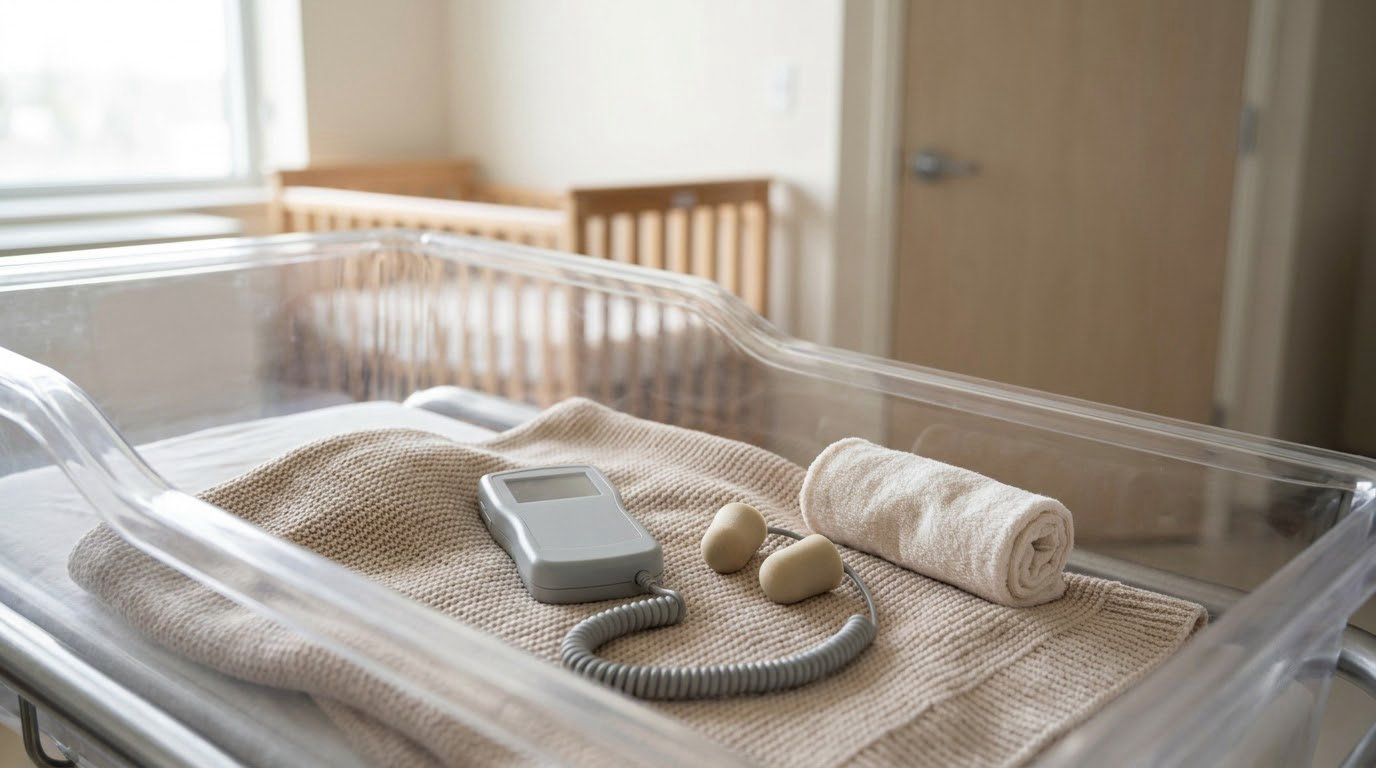
The otoacoustic emissions test, usually called OAE, places a small earphone in the ear canal and plays soft clicks or tone bursts. The inner ear’s cochlea makes its own tiny echo of those sounds, and the device picks that echo up. If the echo comes back clearly, the outer and middle ear are working well enough to pass sound through, which is a good sign for the hair cells inside.
The automated auditory brainstem response, or AABR, works from the other end. Small electrodes go on the baby’s head and neck, an earphone or sound system sends the same kinds of clicks, and the machine measures the electrical response that travels from the ear to the auditory nerve and into the brainstem.
| What to compare | OAE test | AABR test |
|---|---|---|
| What it measures | The echo the cochlea produces | The nerve and brainstem response to sound |
| How it is done | A small earphone sits in the ear canal | Soft electrodes are placed on the head and neck |
| How long it takes | About 5 to 10 minutes | About 10 to 15 minutes |
| What the baby feels | Nothing but soft clicks | Nothing but soft clicks |
| Most useful for | Routine well-baby screening | Babies who spent time in the NICU or have risk factors |
| Common refer reason | Fluid or debris blocking the ear canal | A noisy or unsettled room, movement, fluid |
Hospitals usually test with both methods for babies who were in the neonatal intensive care unit, because AABR is more reliable when an infant has had middle ear fluid, been given certain medications, or needed support right after birth. Parents of NICU babies say being told that difference in advance makes the day feel much less arbitrary.
Results are recorded on a card or report and, in most states, passed along to the state EHDI program so a tracking system exists. That system is why the hospital is usually able to tell you a specific appointment date rather than leaving the follow-up entirely to you.
What Do Newborn Hearing Screening Results Mean?
A screening report contains one of a few words, and they are easier to read than they sound.
Pass means the screen found enough response to sound in both ears. It is a reassuring result. It is not a guarantee that hearing will never change, which is why routine listening checks at pediatric visits still matter.
Refer means the screen did not find a clear response from one or both ears. Parents often hear the word as a diagnosis, and it is not one. Referring simply means the baby needs more testing before anyone can say anything definite.
Inconclusive means the equipment could not get a usable reading, often because the baby moved or was awake. It says something about the test conditions and nothing at all about the child’s hearing.
Missed or deferred means screening was not completed at all, whether the baby was too unwell to test, was transferred, or the family was discharged early.
Screening is also directional in an unhelpful way: a pass result is far more dependable than a refer result, because far more babies are referred than turn out to have a lasting problem. The reason so many refer stories end well is simple, and it is the same reason the first screening sometimes gets repeated. Roughly 2 to 10 percent of newborns are referred at some point, and the large majority go on to pass follow-up testing.
What Happens After an Inconclusive or Failed Newborn Hearing Screening Result?
The US pathway follows a simple idea known as the 1-3-6 rule, and it is worth memorizing because it tells you exactly how fast things are supposed to move.
- Screen by 1 month. The initial or repeat screening is completed before a baby turns one month old. A home or birth center baby is screened by a pediatrician’s referral rather than in the hospital.
- Diagnose by 3 months. A full diagnostic audiologic evaluation by a pediatric audiologist, typically including a diagnostic ABR, OAE testing, ear canal measurements and middle ear testing.
- Intervene by 6 months. If hearing loss is confirmed, a referral to early intervention and, where appropriate, a hearing aid fitting or cochlear implant evaluation begins.
After a refer result, most families start with a repeat screening, sometimes using the other method, and many do not need the full evaluation at all. If the evaluation does confirm loss, the audiologist reviews whether genetic counseling makes sense, since a good share of hearing loss with no family history turns out to have a genetic basis. From there, your baby’s pediatrician stays in the loop alongside the audiologist and the early intervention team.
One thing worth saying plainly: if someone tells you to wait and see, you can still ask what date the 1-3-6 target looks like for your baby. Parents have told forums that they had to push for that appointment themselves. Asking is not rude.
Why Is Early Detection Important?
Children learn language by hearing other people talk, long before they read anything. Early detection matters because it opens the door to that exposure at the age when it happens fastest, whether through hearing aids, a cochlear implant, sign language, amplified communication, or a combination of those choices.
That is the honest framing. It is not a promise about how a particular child will develop, and it is not a prediction that a screening result can make. Two babies with identical results can have very different developmental paths, and a child’s own clinicians are the right source of guidance about that child.
What the guidance does say is that the earlier a hearing problem is found and addressed, the fewer months of sound a child misses while the brain is building its language circuits. That is the whole argument for screening every newborn, including the ones who look perfectly healthy.
Can Newborns Have Temporary Hearing Problems?
Yes, and this is a large part of why a refer result is not the same thing as a diagnosis. A newborn ear system is still settling in the days after birth.
Fluid in the middle ear can persist for weeks after delivery, and it dampens sound before it ever reaches the cochlea. Vernix, the waxy coating present at birth, can sit in the ear canal and block the earphone. A baby who is crying, arching or kicking during the test produces movement the equipment reads as an unreadable signal. Probe placement is also easier to get wrong than anyone admits, and a noisy hospital room or a cool baby does not help.
Prematurity and a stay in the NICU add their own factors, including prolonged oxygen support, certain medications that can affect hearing, and a longer than typical course of middle ear fluid. None of these mean a baby has permanent hearing loss. They do mean the reading needs to be repeated by a clinician who can assess your baby rather than by a parent reading a results card.
What If Your Baby Was Not Screened at the Hospital?
Ask your baby’s pediatrician directly, and ask for it to be documented at the next visit. It happens more often than the general public realizes, particularly with home births, very short hospital stays, transfers between facilities, and premature infants who were moved before screening happened.
Do not accept a behavior-based milestone check as a substitute. Watching whether a baby reacts to a loud sound is a useful developmental observation, but it is not a measurement and it can miss a lot. A quiet baby with moderate hearing loss can look like a calm baby with normal hearing.
Screening can be arranged through a pediatrician’s referral, a pediatric audiology clinic, a hospital outpatient program, or in some areas through the state EHDI program directly. If you gave birth at home, contact your midwife and your pediatrician together, since either can usually point you at the nearest screening provider.
How Do Parents Prepare for Follow-Up Testing?
Bring the paperwork. The screening card from the hospital, your insurance card, and any notes from the birth record make the appointment faster and prevent a repeat of the first test. If your baby has been in the NICU, bring the discharge summary too.
Time the visit around a nap or a feed rather than a hungry stretch. A diagnostic evaluation takes considerably longer than a screen and needs a settled baby, so a calm window matters more than arriving first thing in the morning.
Write your questions down before you go. A useful set: which frequencies and both ears are being tested, is this evaluation the full diagnostic one or another screen, what does a result of no response actually mean for this baby, and who handles the early intervention referral if we end up needing it.
Ask about support early, not after the third rescheduled appointment. Language interpretation, transportation help, and financial assistance programs exist in most states, and clinics are used to being asked. State EHDI programs also track babies who are referred, which means someone can often follow up with you if an appointment gets missed.
Frequently Asked Questions
Does a failed newborn hearing screening mean my baby is deaf?
No. A refer result means the screen did not get a clear response from one or both ears, so your baby needs more testing. Screening is much less reliable when it refers than when it passes, and most referred babies pass their follow-up evaluation. Common causes of a refer include fluid in the middle ear, wax or vernix in the ear canal, movement, and a noisy room.
How accurate is newborn hearing screening?
Screening is very dependable on a pass, because it is designed to catch babies who need a closer look rather than to diagnose. On a refer, accuracy drops sharply, since many babies are referred for reasons that clear up on their own. In practice that means a pass is reassuring, while a refer mostly tells you the next appointment matters more than the word on the card.
Do babies need sedation for follow-up hearing tests?
Usually not. A diagnostic audiologic evaluation for an infant is non-invasive, uses soft sound and small sensors, and is generally done while the baby is asleep. Sedation is not part of a standard infant evaluation and can usually be avoided. Practically speaking, you are being asked for a calm baby rather than an unconscious one, so timing around a nap helps more than anything.
How is hearing screening different for premature babies?
Premature babies are more likely to be screened with AABR rather than OAE alone, because babies who spent time in the NICU have a higher chance of middle ear fluid and other factors that can affect an OAE reading. Screening may be repeated during the NICU stay. These babies also enter follow-up tracking earlier, which is good practice rather than a sign of concern.
Does insurance cover follow-up hearing tests?
In most US states, a diagnostic audiologic evaluation ordered by a clinician is covered by health insurance, though copays and coverage for rescheduled appointments vary by plan. Coverage for hearing aids and related equipment is a separate question with different limits. Ask your insurer and the clinic for a written estimate before the evaluation, and ask the state EHDI program about assistance programs.
What if there is a family history of childhood hearing loss?
Tell your baby’s pediatrician before the screening and again at any follow-up appointment, even if your baby passed. A family history does not change the screening test itself, but it changes how carefully the results are interpreted and may warrant a diagnostic evaluation even after a pass. Hearing loss that skips a generation is common in genetic conditions, so the history is worth writing down and bringing with you.
Conclusion
Newborn hearing screening is a short, painless check, not a verdict. If your baby passed, that is a good result and your pediatrician will keep watching listening skills as your child grows.
If your baby did not pass or the test was inconclusive, sit down with your baby’s clinician this week rather than waiting to see if it sorts itself out. Bring the screening card, book the follow-up, and remember the 1-3-6 targets: screened by one month, diagnosed by three, supported by six.