Learning how to choose a safe crib mattress comes down to four things: the surface must be firm, it must fit the crib with no more than a two-finger gap, it must be made from materials you can identify, and the sleep setup around it must stay bare. Those four checks take about fifteen minutes once you have the crib, a tape measure, and the mattress in front of you.
Most of the anxiety I hear from parents comes from marketing language, not from the mattress itself. Terms like non-toxic, breathable, and organic mean very different things depending on who is using them, so it helps to have a fixed order of inspection. Start with fit, then firmness, then materials, then the rest.
If you are still setting up the room from scratch, start with how to set up a safe nursery without extra gear so you know what the mattress has to fit into. If you want the fuller picture on positioning and sleep surface, safe sleep guidelines for babies explained covers the rest.
Table of Contents
- What You Need
- Step-by-Step
- Step 1: Check the Label and Intended Use
- Step 2: Measure the Crib and Mattress
- Step 3: Test Firmness and Support
- Step 4: Inspect Cover, Fill, and Seams
- Step 5: Evaluate Airflow and Heat Management
- Step 6: Check the Mattress Before Every Safe-Sleep Setup
- Step 7: Pair the Mattress With a Safe Sleep Setup
- Common Mistakes
- Frequently Asked Questions
- How firm should a crib mattress be?
- Should I flip or rotate a dual-sided crib mattress?
- Do I need a waterproof mattress pad for a crib?
- Is it normal for a new crib mattress to have an odor?
- When should I stop using a crib mattress?
- Does a softer innerspring mattress feel safer for a baby?
- Where to Start
What You Need
None of this requires special equipment. You need the crib itself, the manufacturer’s specification sheet or crib manual, and a tape measure. Add a firm flat surface like a table or the floor with a board under it, and a way to look up the mattress label.
Bring the mattress to the crib if you can. Measuring in the nursery is faster than measuring twice, and it is the only way to see the gap where it actually matters.
Keep the care instructions nearby too. Washing rules tell you more about how a mattress will hold up over a few years than any marketing page does. And if your baby has a doctor appointment coming up, choosing a pediatrician before your baby arrives gives you a place to bring specific questions later.
Step-by-Step
Seven checks, in the order that catches the most problems first. Work through them once when the mattress arrives and again whenever something changes.
Step 1: Check the Label and Intended Use
Start by confirming the mattress is marketed for infant sleep in a crib. The label should state the intended age or size range, and the packaging should name a country of manufacture and a manufacturer contact. If a mattress is labeled for a child’s bed or a travel cot, do not assume it meets crib requirements.
Look for a size range and a maximum thickness on the label. Federal crib rules set the standard interior mattress size at about 27.25 by 51.625 inches and cap the thickness at 6 inches, so anything thicker can create a suffocation gap at the crib edge.
How do you verify safety standards? Search the manufacturer name with the mattress model plus the certification name printed on the label, and check that the listing names the finished product rather than only the raw materials. A certification is evidence about emissions and materials, not proof that a sleep setup is safe.
Step 2: Measure the Crib and Mattress
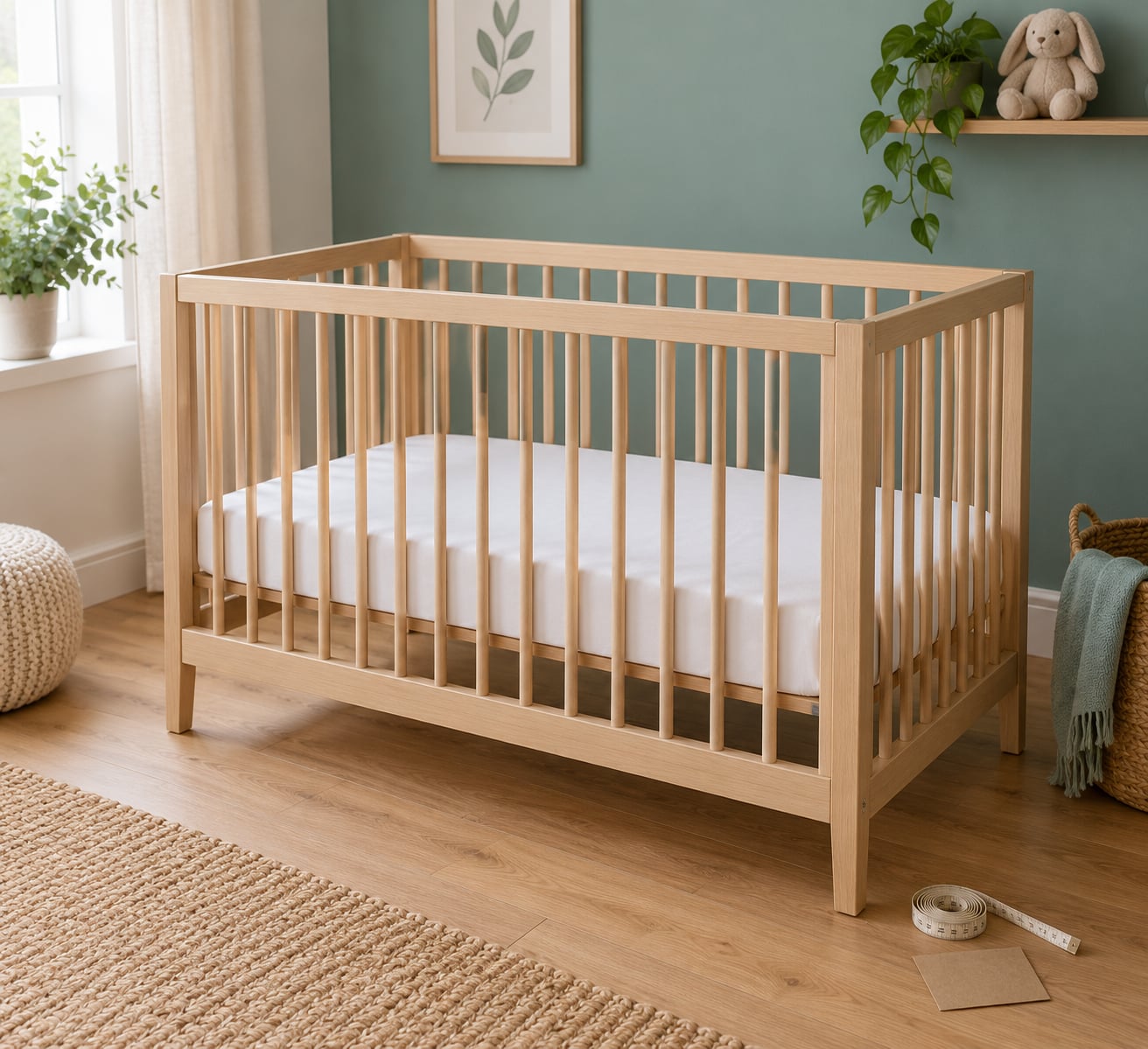
Measure the inside of the crib where the mattress sits, then measure the mattress itself, top to bottom and side to side. Compare the two numbers, then run the two-finger test: slide two fingers between the mattress edge and the crib wall at several points around the perimeter.
If you can fit more than two fingers anywhere, the gap is too wide. How do you fix a gap rather than fill it? You do not fill it, and you never wedge towels, rolled blankets, or bumper pads along the edge. The fix is a mattress that fits, or returning the one you bought. If the gap only appears at one corner, the mattress may be slightly undersized for that frame.
Mini cribs and portable cribs have their own interior dimensions, and standard crib mattresses do not fit them. Measure the smaller crib rather than assuming the full-size mattress works.
Step 3: Test Firmness and Support
Put the mattress on a firm flat surface, then press down firmly with your hand in the middle and at the edges. A proper infant surface resists the press, stays level, and springs back without leaving a lasting dent. If your hand sinks in easily, or the surface stays compressed, it is too soft for an infant.
Flip the mattress and repeat. On a two-stage or dual-sided model, both sides need to be firm enough for the stage they are labeled for, so test each one separately rather than assuming the second side is the same.
Firm does not mean rock hard. A very rigid surface with no give at all can pressure the shoulders and hips of a baby who spends fourteen or more hours a day lying on it. You want a surface that does not conform around the face.
Step 4: Inspect Cover, Fill, and Seams
Work around the mattress by hand. Check that the cover fits tightly with no loose fabric, the zipper or seam is intact, and the quilting is even. Look for loose fibers, hard lumps or clumps, tears, or a cover that has stretched out of shape.
Smell it too. A strong chemical odor on a new mattress is a reason to let it air out in a well-ventilated room before first use and to look for published emissions testing. A musty smell that appears later usually means moisture got into the core.
Crib mattresses do not need to be waterproof or cushioned. A fitted sheet is the only thing that goes on top, so a mattress that cannot handle an occasional wash is a maintenance problem in waiting.
Step 5: Evaluate Airflow and Heat Management
Heat matters more than most shopping features. What matters for airflow is a firm surface, a breathable cover, a ventilated room, and appropriate sleep clothing, not a special cooling layer. Parents on the safe sleep guidelines will already know that infants should be dressed in one layer more than an adult would wear in the same room.
Watch for the terms marketing uses loosely. Breathable usually describes the cover fabric, and it does not mean air circulates through the mattress core. Cooling claims often refer to gel or foam layers that raise the surface temperature rather than lowering it. Treat any cooling feature as a comfort extra, not a safety one.
Placement counts too. Keep the crib out of direct sun and away from radiators, heating vents, and drafty windows, since temperature swings show up in the sleep space long before they show up on a thermostat.
Step 6: Check the Mattress Before Every Safe-Sleep Setup
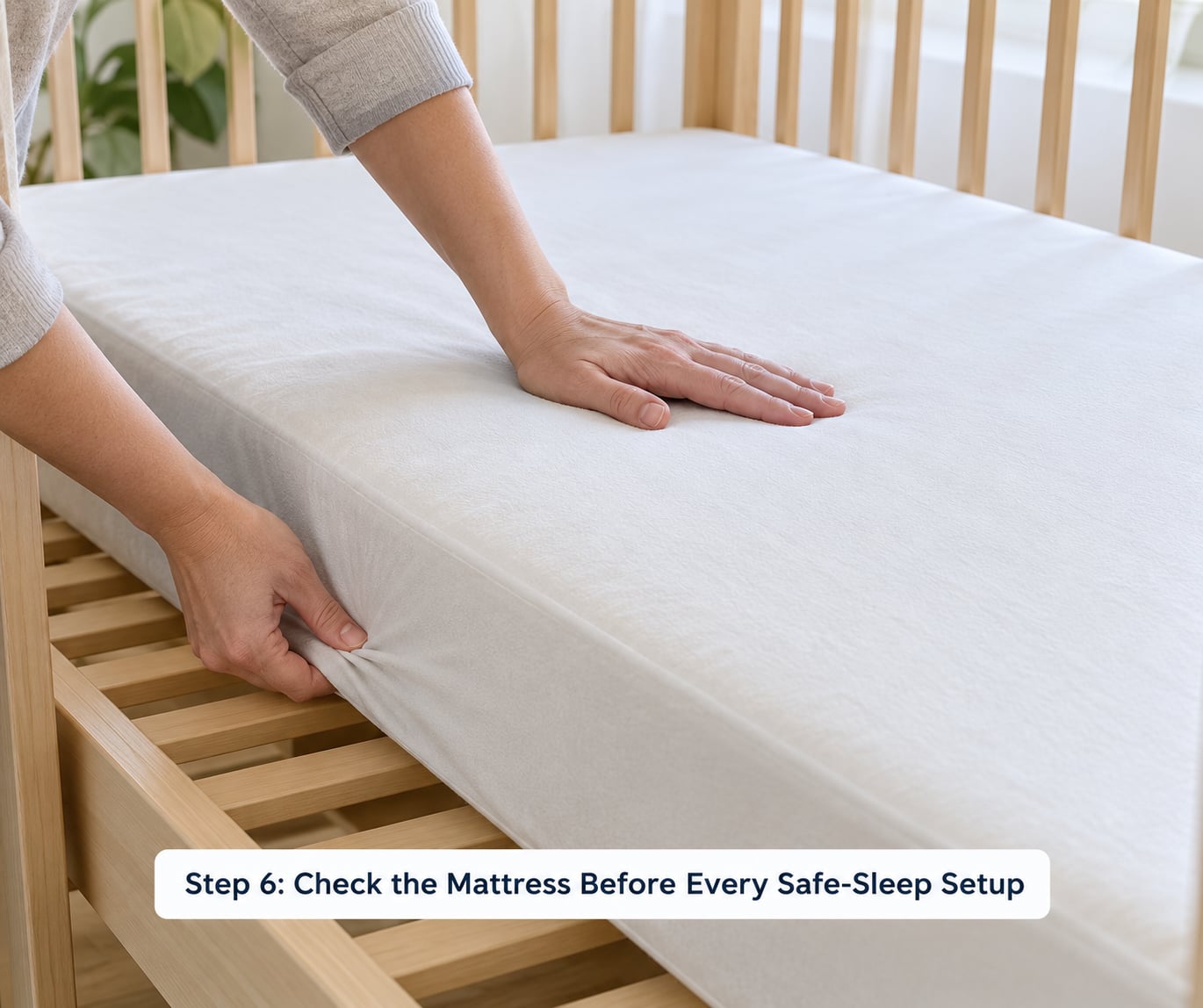
Make the final inspection part of the bedtime routine, not a one-time purchase task. It takes under a minute: run your hand across the surface, check the corners, and confirm the sheet is still tight.
Pay extra attention after cleaning, after any move, or after the baby has been climbing or rolling on it for a few months. New dents, a sagging middle, or a sheet that no longer stays put all mean the setup has changed and needs a look.
Step 7: Pair the Mattress With a Safe Sleep Setup
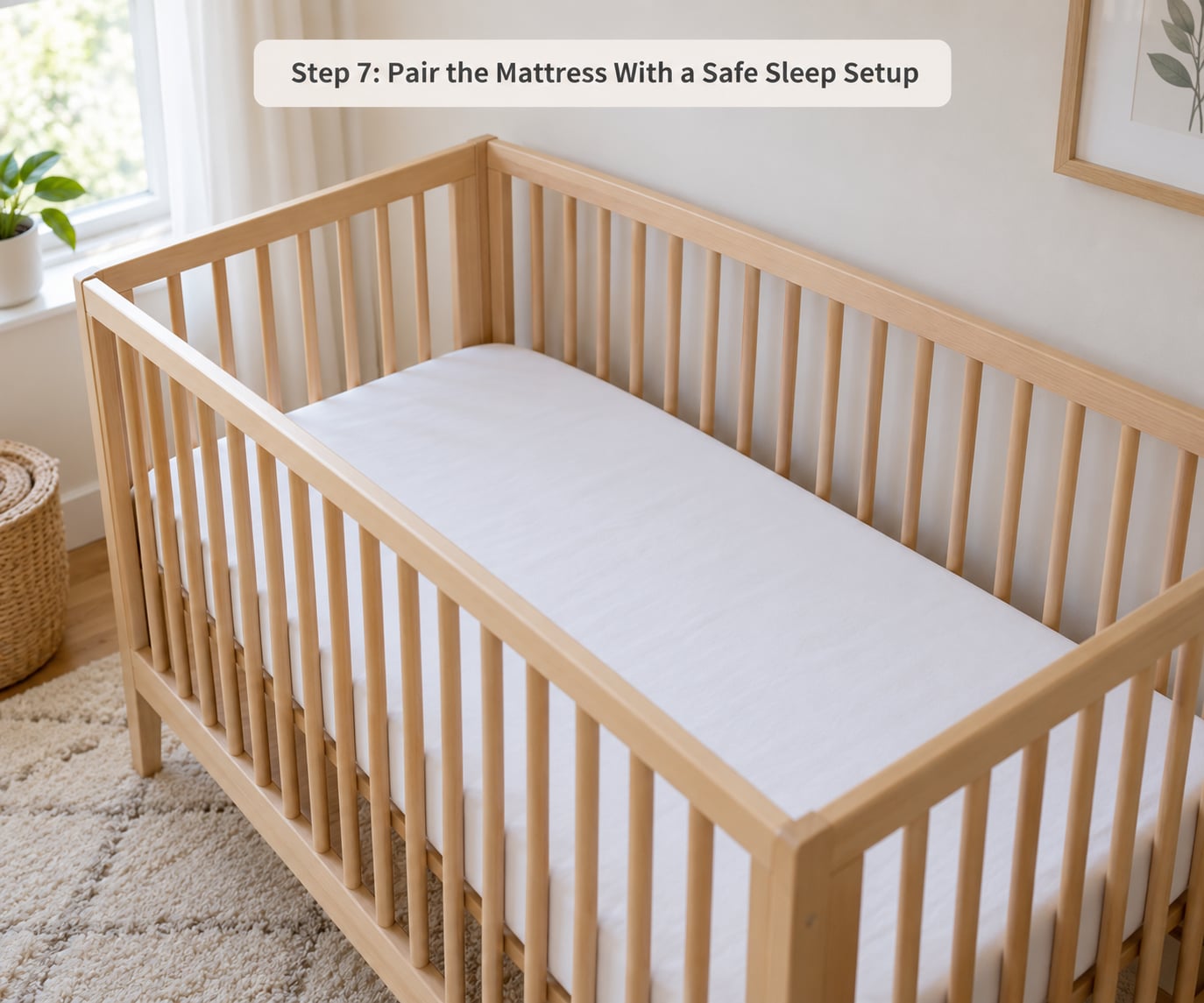
The mattress only does its job inside a bare sleep space. Put it in the crib flat and level, use one fitted sheet, and leave everything else out. No pillows, no bumpers, no blankets, no loveys, no positioners, and no mattress toppers.
Follow the baby’s weight and age limits for the crib, and adjust the mattress height as your baby grows so the rail stays above the top of the shoulders while they are on all fours. Follow the same setup every sleep, whether the nap is at home or elsewhere.
Common Mistakes
Buying by thread count. A high thread count says something about fabric softness, not about firmness, fit, or emissions. Judge the mattress on the hand press and the two-finger test instead.
Assuming organic or luxury materials are automatically safer. A certified organic cover on a polyurethane foam core still leaves the core in the sleep space. Certification only means something when it names the finished product, and when you know which substances it screens for.
Buying an oversized mattress. Extra width or length means gaps at the crib wall, and gaps are the entrapment risk the fit check exists to catch. Buy the size the crib manual specifies.
Adding a waterproof pad. Pads, toppers, and cooling gel layers raise the height of the sleep surface and can block airflow. Skip them and deal with spills through the sheet.
Using a second-hand mattress with unknown history. You cannot verify the age, the storage conditions, or whether a recalled or recalled-era product was involved. The cost of a new mattress is not worth an unknown history in a sleep space.
Overlooking the cleaning instructions. If the cover cannot be removed and washed, spills soak into the core and the mattress loses its life early. Read the care label before you commit.
Frequently Asked Questions
How firm should a crib mattress be?
Firm enough that it does not conform around your baby’s face or cheeks, soft enough to support the curve of the body. Press the center of the mattress with your palm on a firm surface: it should resist, stay level, and spring back without a lasting dent. Avoid anything your hand sinks into easily. Discuss your baby’s specific needs with your pediatrician.
Should I flip or rotate a dual-sided crib mattress?
No, not while your baby is sleeping in a crib on the infant side. Flip or rotate it only when your baby has reached the weight or age limit for that stage, usually well past a year. Test both sides yourself beforehand so you know which side is the firmer infant side. Keep the crib bare during the changeover and follow the crib manual for the supported height.
Do I need a waterproof mattress pad for a crib?
No. Pads add height to the sleep surface and can reduce airflow, and they are not part of a safe sleep setup. Use a single fitted sheet instead, and choose a mattress whose cover can be removed and washed so spills are handled at the sheet level. If your baby has reflux or a medical reason for a different arrangement, ask your pediatrician before changing the setup.
Is it normal for a new crib mattress to have an odor?
A mild new-product smell is common, usually from the foam or the adhesives used in assembly, and it usually fades with time in a ventilated room. A strong or chemical odor is a reason to air the mattress out before first use and to look for published emissions testing. If the odor persists for weeks, contact the manufacturer. Share any concerns about chemicals with your pediatrician.
When should I stop using a crib mattress?
Stop when your baby outgrows the crib by weight or by height, since the mattress then no longer meets the crib’s intended use. Replace it earlier if the core sags, the surface has deep dents that do not spring back, the cover is torn or stretched, or odor returns after cleaning. Also replace it if you cannot confirm where an inherited mattress came from or how it was stored.
Does a softer innerspring mattress feel safer for a baby?
No. Innerspring mattresses are often built with more cushioning and a softer feel than infant foam models, and that extra give is exactly what you do not want in a crib. The inner-spring construction itself is not the concern; the softness is. Judge every model with the same hand press test so you compare surfaces rather than marketing language.
Where to Start
If you only remember one thing from this guide on how to choose a safe crib mattress, start with fit and firmness. Those two checks take five minutes and catch the problems that matter most in a sleep space.
Everything else, materials, certifications, airflow, room temperature, is worth attention, but it layers on top of a mattress that fits the crib and does not give under a palm. Get those two right first, then apply the same order of checks to any replacement you consider later.