
Carpal tunnel during pregnancy, explained simply, comes down to one thing: swelling narrows a tight passage inside your wrist and presses on the median nerve, the nerve that carries sensation from your thumb, index, middle and thumb-side half of your ring finger. Symptoms most often show up in the second or third trimester and usually settle after delivery.
Most cases are manageable with small changes to how you use your hands, how you sleep and how you position your wrists. This guide covers what the condition actually is, why pregnancy makes it so common, which symptoms deserve a phone call to your prenatal team, and what to ask when you get there.
The same worries come up again and again: when will this go away, why is it worse at night, and is it hurting the baby. Those get their own answers below.
Table of Contents
- What Is Carpal Tunnel During Pregnancy?
- Why Does Carpal Tunnel Happen During Pregnancy?
- What Symptoms Are Common?
- How Carpal Tunnel During Pregnancy Is Usually Recognized
- What Can Safely Help With Wrist Symptoms?
- Do Pregnancy Changes or Treatments Affect the Baby?
- When Should You Contact a Healthcare Professional?
- What Questions Can You Ask at a Prenatal Visit?
- Will Carpal Tunnel Go Away After Pregnancy?
- Frequently Asked Questions
- Is carpal tunnel common in early pregnancy?
- When is wrist numbness during pregnancy not just ordinary swelling?
- Can repetitive work make pregnancy-related carpal tunnel worse?
- Are wrist splints safe to use during pregnancy?
- Can carpal tunnel symptoms return after the baby is born?
- Conclusion
What Is Carpal Tunnel During Pregnancy?
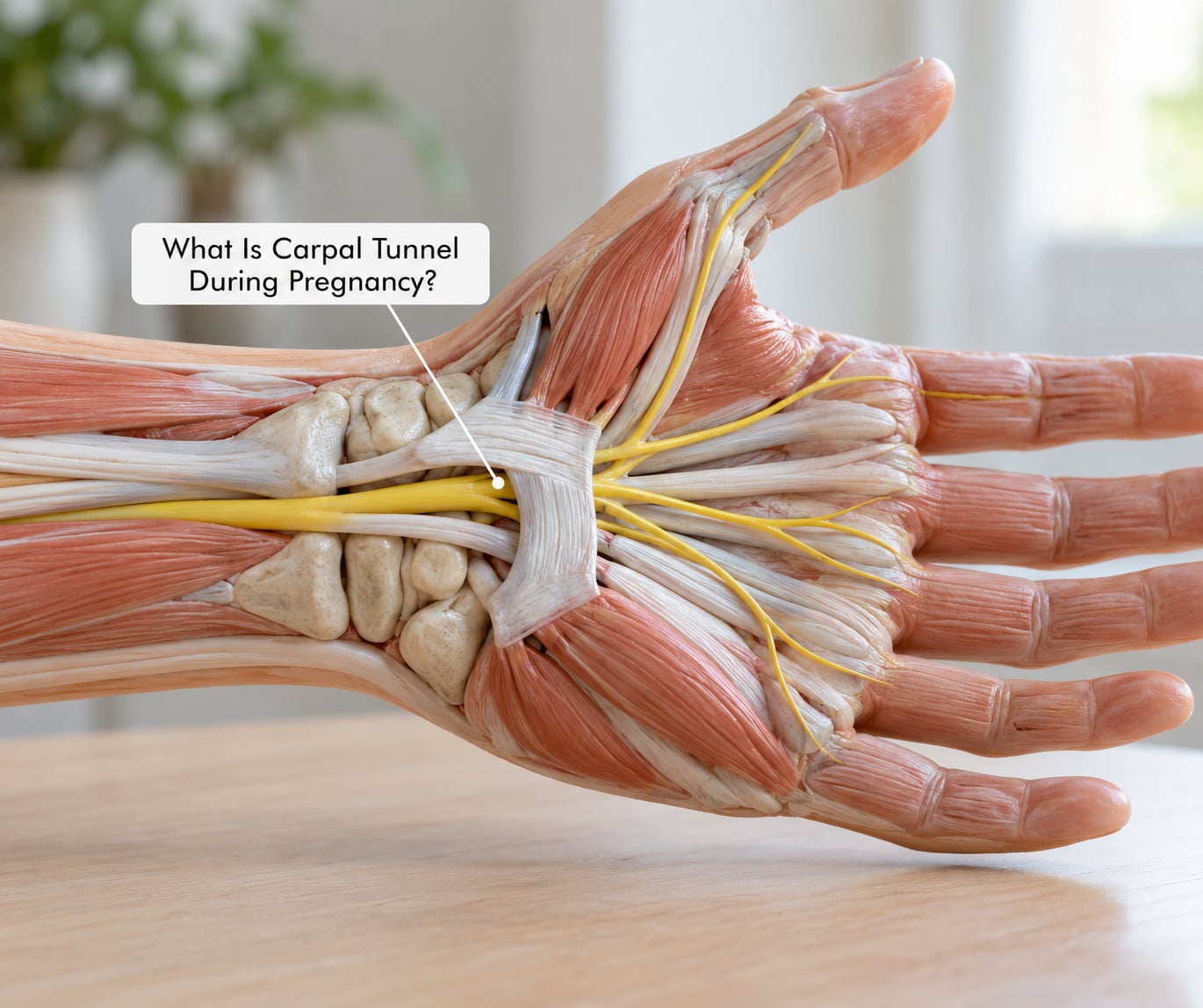
Carpal tunnel syndrome during pregnancy is pressure on the median nerve at the wrist. The median nerve runs from the forearm into the hand and passes through a narrow passage formed by wrist bones and a firm band of tissue called the transverse carpal ligament. Nine flexor tendons share that same passage, so there is very little spare room.
Anything that increases pressure inside that passage makes the nerve unhappy. During pregnancy, the tissues around the tendons become thicker and the tunnel fills with fluid. The result is numbness, tingling or burning in the fingers the nerve supplies, sometimes with aching that travels up the forearm.
How common is it? Carpal tunnel syndrome affects roughly five percent of the general population, but hand and wrist symptoms during pregnancy are reported far more often. One study of more than 2,000 pregnant women published in BJOG found somewhere between a third and two-thirds reported wrist and hand symptoms, and about half of those were in both hands rather than one.
Those numbers describe reported symptoms, not confirmed diagnoses, which is worth keeping in mind. A swollen wrist from pregnancy in general is not the same thing as nerve compression, and it is easy to assume it is.
Distinguishing matters because other conditions can mimic carpal tunnel. De Quervain tenosynovitis causes pain along the thumb-side of the wrist when you lift. Thumb joint arthritis flares with pinching and gripping. Nerve irritation in the neck or lower back can send tingling into the hand. Gestational diabetes occasionally shows up first as hand numbness. Pregnancy-related carpal tunnel is the one that wakes you up at night.
Why Does Carpal Tunnel Happen During Pregnancy?
Hormonal changes and fluid retention do most of the work. Progesterone shifts how your body handles fluid, and estrogen changes the structure of connective tissue, so tendons and their linings become more pliable and thicker. Everything inside the wrist tunnel gains volume at the same time.
Weight gain adds to it. Carrying extra load changes your posture and how you hold your arms, and any position that bends the wrist for long stretches narrows the tunnel further. Fatigue and poor sleep do not cause carpal tunnel, but they make symptoms feel heavier the morning after a bad night.
Repetitive hand use is often the final straw rather than the first cause. Typing all day, holding a phone, gripping a steering wheel, or supporting your weight on your hands getting out of a chair keeps the tendons inside the tunnel moving against a compressed nerve.
Pregnancy does not make the condition inevitable. Plenty of people with significant fluid retention never develop it, and plenty who do have a naturally narrow tunnel or a history of the condition elsewhere. How ultrasound dating works in early pregnancy matters here only because knowing your week count tells you whether what you are feeling matches the typical window.
| When symptoms usually appear | What is happening |
|---|---|
| First trimester | Less common. Hormonal shifts are already underway, but fluid load is still modest. Symptoms at this stage deserve a mention at your next visit rather than watchful waiting. |
| Second trimester | Often when symptoms first appear. Fluid accumulates steadily and hand use at work or home continues unchanged. |
| Third trimester | The most common window. Retention peaks, weight gain adds load and the tunnel has had months to narrow. |
| First weeks after birth | Swelling should be falling. Symptoms that stay level or get worse deserve reassessment. |
What Symptoms Are Common?
Numbness in the thumb, index, middle and the thumb-side half of the ring finger is the classic pattern. The little finger is usually spared, because a different nerve supplies it. Many people describe the hand as falling asleep, or as feeling thick and puffy in the morning.
Tingling and a pins-and-needles sensation are equally common. A burning or aching quality often travels from the wrist into the forearm or up into the upper arm, and it tends to be worse at night.
Clumsiness shows up in the small things. Dropping a phone, a cup, or a baby bottle. Struggling to fasten nappies or unscrew a jar lid. Reaching for something without looking and finding you cannot feel it properly.
Weakness in the grip is the symptom people worry about most, and it is the one to report. If you are noticeably less able to make a fist, hold a fist for several seconds, or lift your thumb away from your palm, that is nerve involvement rather than general soreness.
What separates it from ordinary pregnancy wrist ache? General swelling tends to feel heavy and diffuse, affects both hands, and is worse at the end of the day. Nerve compression is specific to particular fingers, alternates between numbness and tingling, and is often worst at night or first thing in the morning.
How Carpal Tunnel During Pregnancy Is Usually Recognized
Clinicians diagnose from a combination of the symptom pattern, your history and a hands-on examination. Tinel’s test involves tapping over the front of the wrist to see if that produces tingling in the fingers. Phalen’s maneuver asks you to hold the backs of your hands together with the wrists bent, to see whether symptoms appear within about a minute. Some clinicians also use a compression test, pressing on the tunnel for about half a minute.
They will also check sensation in individual fingers, look at the muscles at the base of the thumb, and ask how much your grip has changed. None of these is definitive on its own, which is why the whole picture matters.
Nerve conduction studies and electromyography exist, and your clinician may order them if the picture is unclear, if symptoms are severe, or before considering a procedure. During pregnancy, many clinicians prefer to watch and treat conservatively first, because symptoms often improve after delivery.
Self-diagnosis has hard limits. You can track your own symptoms well, but you cannot assess whether a muscle is wasting or whether a nerve is responding abnormally. If you are reading this and wondering which one you have, that is a reasonable thing to bring to a prenatal appointment rather than something to settle at home.
What Can Safely Help With Wrist Symptoms?
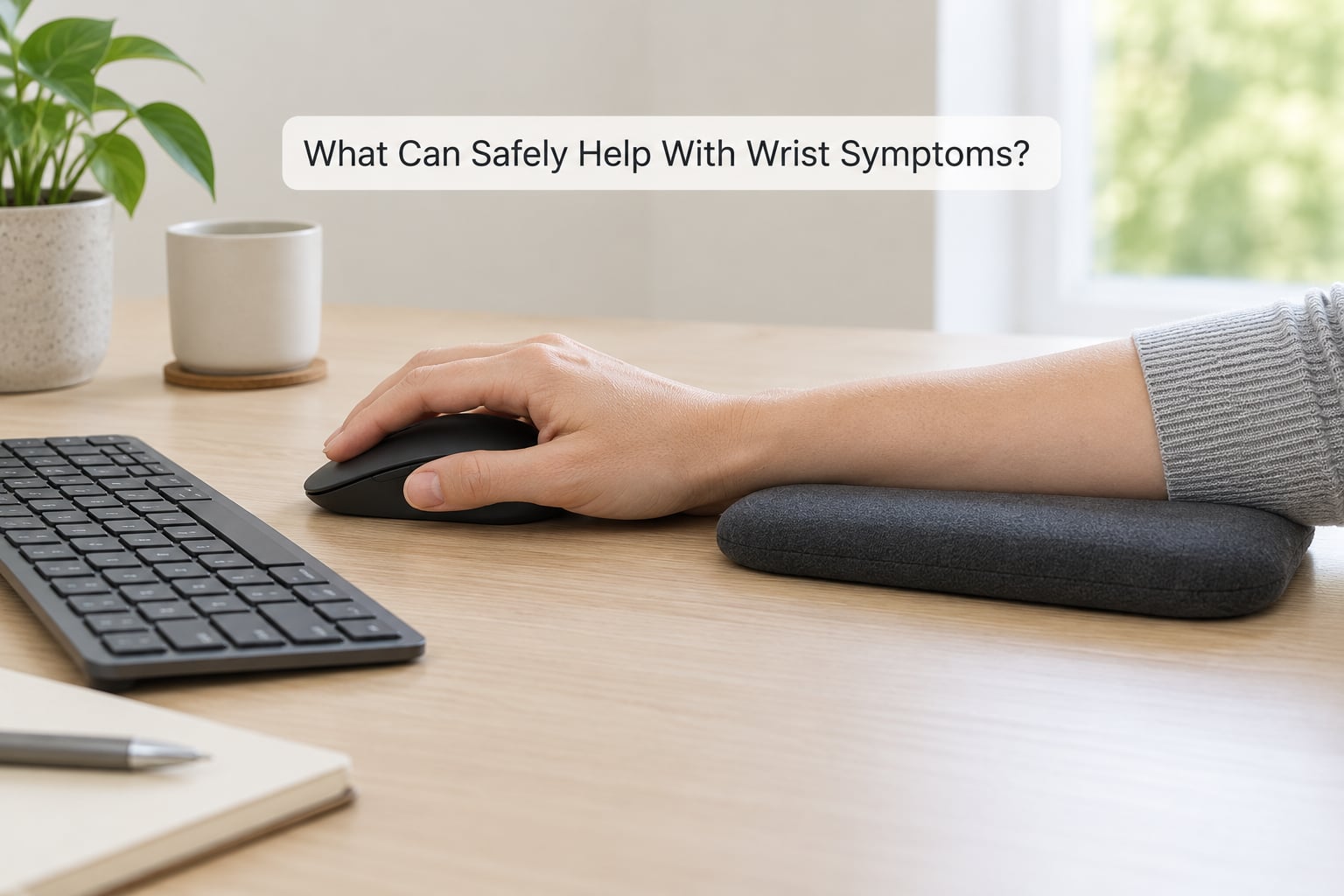
Start by changing what aggravates the nerve. The tunnel is narrowest when the wrist is bent toward the palm or pushed back, so keeping the wrist straight takes pressure off it without any product at all.
Some low-risk measures people commonly discuss with their prenatal team:
- Split up repetitive tasks. Alternate typing, phone use, household jobs and lifting rather than doing one of them for an hour solid.
- Reduce sustained gripping. Prop yourself up on your forearms instead of pushing off with your hands, and set heavy containers down instead of carrying them across a room.
- Adjust your workstation. Raise the chair or add a forearm support so your hands rest level with your elbows rather than at an angle.
- Keep the wrist neutral at night. Sleeping with the arms bent sharply at the wrist or tucked under your head makes pressure worse. Pillows supporting the forearm help the hand stay straight.
- Use cold briefly. A wrapped cold pack for short spells can settle aching, though avoid applying cold directly to skin.
- Move the hand gently through range. Slow open-and-close movements and gentle wrist circles help keep the fingers moving without loading the tunnel.
Wrist splints are often worth discussing. Keeping the wrist in a straight position overnight can meaningfully reduce night symptoms, but fit is the hard part during pregnancy. Swelling changes week to week, and a splint that is too tight adds another source of pressure. Ask a clinician or hand therapist to check the fit rather than buying the smallest size and hoping.
Breastfeeding adds its own load. Supporting the weight of a feeding baby in the crook of your arm for twenty minutes at a time keeps the wrist bent. Propping the baby up instead of holding the whole weight, and taking the weight on your forearm rather than your hand, makes a real difference.
For pain relief, ask your prenatal clinician or pharmacist what is appropriate for you. Over-the-counter anti-inflammatories such as ibuprofen and naproxen are generally avoided during pregnancy, and your team will know what options fit your situation.
Do Pregnancy Changes or Treatments Affect the Baby?
No. Carpal tunnel syndrome itself does not affect fetal development, and it is not a pregnancy complication in the way that blood pressure or blood sugar disorders can be. It is a nerve compression problem that happens alongside a healthy pregnancy.
The treatment decisions are a different question. Every medication, supplement, injection, manual therapy technique and procedure should be discussed with your prenatal clinician, because what is appropriate depends on your trimester, your history and your individual pregnancy.
That conversation is easier to have early. Some clinicians are cautious about anything injected or surgical during pregnancy, and prefer to try splinting, rest and activity changes first. Steroid injections into the tunnel are used in some pregnancies, and surgery is rarely needed, but both are decisions for your clinician rather than for an internet article.
One more thing worth saying plainly: carpal tunnel syndrome is not a symptom of preeclampsia. The two are unrelated conditions that happen to both show up in pregnancy.
When Should You Contact a Healthcare Professional?
Some symptoms fit comfortably into a routine conversation at your next prenatal visit. Numbness and tingling that come and go, mild aching, and waking once or twice at night with a sore hand all belong in that category. Mentioning them is worthwhile, because your team can watch the pattern and adjust approach over the following weeks.
Other symptoms should not wait for the next scheduled appointment:
- Weakness in your grip, or difficulty making and holding a fist
- Dropping things regularly because you cannot feel them
- Numbness that is getting worse rather than settling, or affecting more of the hand
- A hot, red or visibly swollen hand, or pain that keeps you awake most of the night
- Any hand injury, including a fall onto an outstretched hand
- Numbness that spreads up the arm or comes with neck pain
These usually mean you need an in-person assessment rather than another two weeks of waiting.
Separately, wrist or hand swelling is not a sign of preeclampsia, and carpal tunnel symptoms do not predict it. Preeclampsia has its own warning signs, and if you have sudden swelling along with a rapid weight gain, a persistent severe headache, visual changes, or pain under your ribs on the right, seek urgent medical care rather than attributing it to your wrist.
What Questions Can You Ask at a Prenatal Visit?
Appointments go quickly, so writing questions down beforehand helps. Some that tend to get useful answers:
- Do my symptoms look like nerve compression, or is this general swelling?
- Should I be tracking symptoms daily, and what should I write down?
- Is there any sign of muscle weakness I should watch for?
- Is a wrist splint worth trying, and who should fit it?
- Could I see someone who treats hand and wrist problems, or is this something you manage?
- What changes should I make at work, or is there anything I can say to my employer?
- Who can lift the baby for me in the first few weeks after birth?
- If pain relief is needed, what is safe for me at this stage?
- What would tell you that this needs more than conservative care?
Your appointments around this stage of pregnancy already involve a fair amount of discussion, and hand symptoms can easily get squeezed out. On the question of what gets checked and when, what an anatomy scan at 20 weeks checks covers a different part of the same schedule, but raising the wrist at the start of the visit is what gets it addressed.
Will Carpal Tunnel Go Away After Pregnancy?
Usually, yes, in the sense that most pregnancy-related cases improve once fluid levels fall and the tunnel has room again. The practical expectation is days to weeks rather than an overnight fix, and many people notice the change first as night symptoms stop waking them.
Not everyone is that lucky. Studies following women after delivery have found a substantial minority still had symptoms three months or more postpartum, and some report symptoms lasting considerably longer. Nobody can predict in advance which group you will fall into.
What is worth knowing is that persistence after delivery deserves a fresh look rather than more waiting. Once pregnancy-related swelling is no longer an explanation, the same symptoms may have a different cause, and different causes need different handling. Your clinician might reassess, refer you to a hand specialist, or suggest testing to see how the nerve is responding.
That is also why the third trimester is a reasonable time to plan rather than only react. If you know a feeding position, a splint or a household arrangement that you will want, you can sort it out before you are holding a newborn with a hand that has gone numb.
Frequently Asked Questions
Is carpal tunnel common in early pregnancy?
Less common than later on, but not unheard of. Most symptoms appear between the second and third trimester, when fluid retention and weight gain peak. If you have hand symptoms in the first trimester, say so at your next visit rather than assuming it is nothing, especially if you already have a history of carpal tunnel or a naturally narrow wrist.
When is wrist numbness during pregnancy not just ordinary swelling?
Numbness confined to the thumb, index, middle and thumb-side half of the ring finger points to nerve compression rather than general swelling. Tingling, a burning quality and night-time waking are also nerve features. Ordinary pregnancy swelling tends to feel heavy and diffuse across the whole hand and both sides. The little finger being unaffected is another clue for the nerve.
Can repetitive work make pregnancy-related carpal tunnel worse?
Yes. The tendons that share the tunnel with the median nerve swell with use, and sustained gripping keeps pressure on a nerve that is already compressed. Typing, phone use, lifting, pushing up on your arms and holding a feeding baby are common triggers. Alternating tasks, resting the wrist in a neutral position and taking weight on your forearms usually does more than any single product.
Are wrist splints safe to use during pregnancy?
A splint that holds the wrist straight is a low-risk option that many clinicians suggest, particularly overnight. Fit is the catch, because swelling changes during pregnancy and a splint that is too tight adds pressure of its own. Ask your prenatal clinician or a hand therapist to check the size and position rather than buying one blind, and remove it if your fingers tingle or change colour.
Can carpal tunnel symptoms return after the baby is born?
Symptoms usually improve as swelling falls, but not always quickly. Research following women after delivery has found a substantial minority still symptomatic three months or more later, and some for considerably longer. If symptoms stay the same or get worse once postpartum fluid loss is underway, ask for a reassessment rather than assuming it will pass, since another cause may need looking at.
Conclusion
Carpal tunnel during pregnancy is common, uncomfortable and usually temporary. It comes from fluid retention and hormonal changes narrowing a passage the median nerve already has very little room in, and it most often appears in the second and third trimester.
The first thing to do is start noticing the pattern. Write down when symptoms hit, which fingers are involved, and whether your grip is changing. Take that to your next prenatal visit rather than waiting, because small adjustments to your tasks, workstation and sleep position are usually where the improvement comes from.
Go sooner than that if grip strength is dropping, if you are dropping things, or if numbness is spreading. And separate the two concerns people often merge: the condition itself does not affect your baby, but it does not tell you anything about preeclampsia either, so keep attending to the pregnancy warning signs that do.