
Yes, some people notice changes in the week or so before a period is late, but the honest answer is that early signs of pregnancy before a missed period overlap almost completely with premenstrual symptoms, and no single symptom can tell you for certain. What actually happens is this: after conception, an embryo implants in the uterine lining and the body starts producing human chorionic gonadotropin (hCG) plus a steep rise in progesterone and estrogen. Those hormones cause the sensations people describe. The two-week wait between ovulation and an expected period is the hardest stretch, because everything you feel could be either one.
This guide is written for anyone who is trying to conceive and watching their body closely, and also for people with irregular cycles who cannot use a missed period as a signal at all. It is general education, not diagnosis. If you want a plain-language answer first, start with the list below. If you want the reasoning behind the testing advice, the sections on hCG and test timing are where the useful detail sits.
Table of Contents
- Early Signs of Pregnancy Before a Missed Period
- What Are the Earliest Possible Symptoms?
- Early Signs of Pregnancy Before a Missed Period by Timing
- Can You Tell If You Are Pregnant Without a Test?
- How Do Home Pregnancy Tests Work?
- When Is the Best Time to Take a Pregnancy Test?
- Why Can Early Pregnancy Symptoms Feel Different From Usual Period Symptoms?
- What Should You Do If the Test Is Positive?
- When Should You Contact a Healthcare Professional?
- Frequently Asked Questions
- Can implantation bleeding happen before a missed period?
- How early can a home pregnancy test detect pregnancy?
- What does a faint line on a pregnancy test mean?
- Can anxiety or stress cause symptoms that feel like early pregnancy?
- What should I do if my pregnancy test is negative but my period is late?
- What to Do First
Early Signs of Pregnancy Before a Missed Period
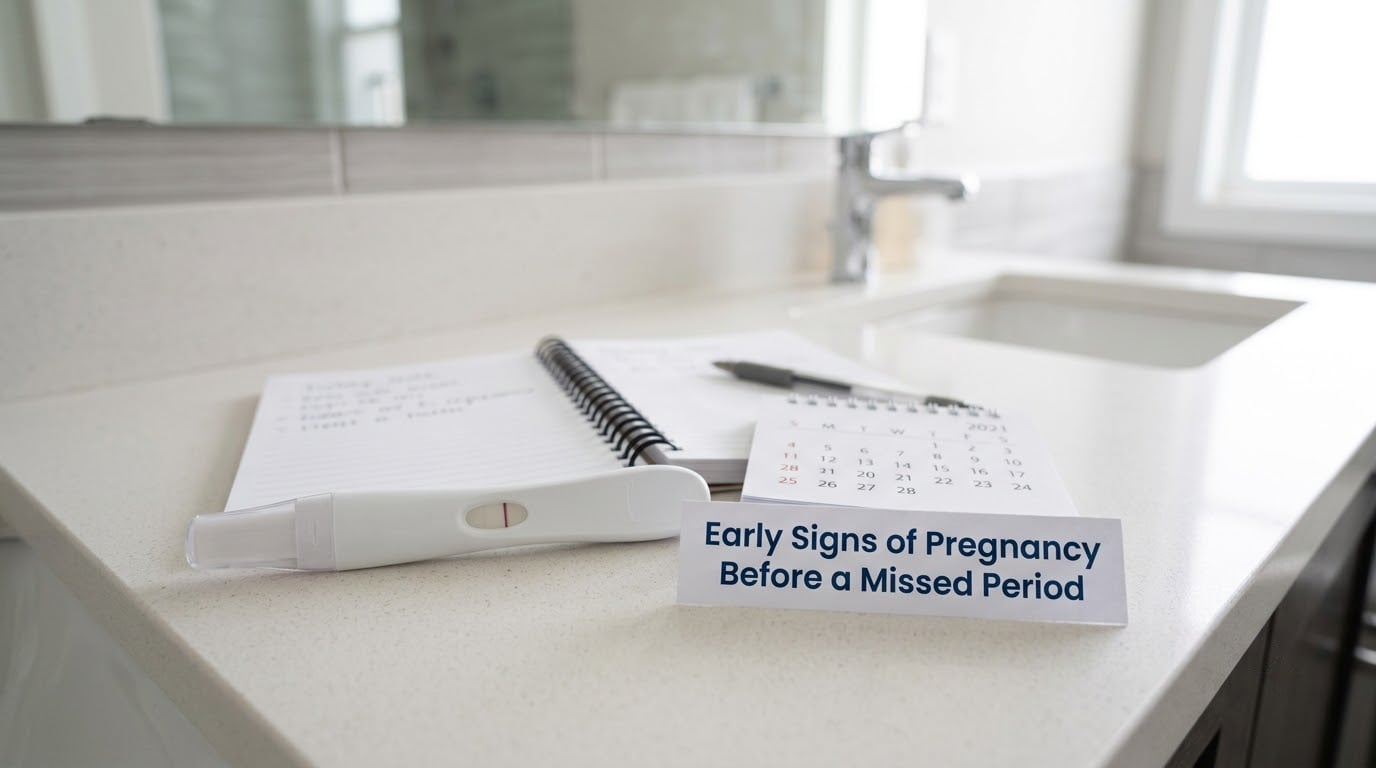
Here is what the most commonly reported possible signs are, roughly in the order people tend to notice them. The timing column is approximate, because conception dates are estimates unless ovulation was tracked precisely, and hCG rises at its own pace in every body.
| Possible sign | Typical timing | How it may feel |
|---|---|---|
| Implantation spotting | 6 to 12 days after ovulation | Light pink or brown discharge, no cramping that builds |
| Breast tenderness | About a week after conception | Heavy, sore, nipples sensitive to fabric |
| Fatigue | One to two weeks after conception | Tiredness that sleep does not fix |
| Heightened sense of smell | Two to four weeks | Coffee, perfume or cooking odors suddenly intolerable |
| Metallic taste | Two to four weeks | A faint metal or soap taste that appears without cause |
| Bloating and constipation | Two to four weeks | Pants feel tight by mid-afternoon |
| Frequent urination | Two to four weeks | Needing to get up at night, more noticeable than usual |
| Mild cramping or tugging | 6 to 12 days after ovulation | Brief pinching low in the belly, not a steady ache |
| Mood swings | Two to four weeks | More reactive, tearful or restless than the usual cycle |
| Headaches and nasal congestion | Two to four weeks | Dull headache, stuffed nose, occasional nosebleed |
Read that table as a list of possibilities, not a checklist to score yourself against. Symptoms are also entirely optional. A large share of pregnancies are confirmed by a test with no symptoms at all beforehand, and plenty of people who are pregnant notice nothing until well past the point where a period is late.
What Are the Earliest Possible Symptoms?
Breast changes usually get named first. The chest feels heavy and full, and the nipples become tender enough that a shirt seam is uncomfortable. Some people also notice the areolae darkening, which happens because rising hormone levels stimulate pigment-producing cells. That darkening is a real change once it appears, but it is not something to look for deliberately, and many pregnant people never notice it.
Fatigue is the other big one. People describe it as flu-like without the flu, and the reason is partly hCG and partly the extra work a body does when it starts supporting a new tissue. It can show up within a couple of weeks of conception, which is annoyingly early, because it is indistinguishable from a bad week at work.
Spotting, often called implantation bleeding, is a light pink or brown discharge that appears when the embryo embeds in the uterine lining. It is usually scant, brief, and it does not get heavier over several days the way a period does. Cramping that goes with it is more often described as a brief pinch or tug than as cramps that build and radiate to the lower back.
Changes in taste and smell tend to arrive a little later, around the fourth or fifth week. Food odors, coffee, and perfume can become genuinely unpleasant, and many people report an unexplained metallic taste. Nasal congestion is a lesser-known one: a stuffy nose or a nosebleed can show up in early pregnancy, sometimes because small blood vessels in the nose swell.
Frequent urination, bloating, constipation, and headaches all belong on the list, mostly because of rising progesterone and estrogen changing how fluid moves through the body and how quickly the body burns energy. Headaches in particular are easy to blame on stress, and often are.
Then there are the changes that read as coincidence even when they are not. Vaginal discharge often increases, staying thin and white rather than becoming foul-smelling or textured. On basal body temperature charts, some people see a sustained shift that stays up across many mornings rather than dipping. Nausea can technically appear this early, but genuine morning sickness most often starts later, and some people never get it at all.
Less reliable, and worth being skeptical about, are the ones with no measurable basis: vivid dreams, an intuition that something is different, a sudden dislike of a food you loved last week, or spotting a few days after ovulation when you were not tracking anything at all. The first two may be real experiences. They are just not evidence.
Early Signs of Pregnancy Before a Missed Period by Timing
Nothing in the first stage, before ovulation, tells you anything. There is no embryo yet, so there is no hCG and no pregnancy symptom. People who track basal body temperature do sometimes see a temperature rise in the days after ovulation, but that reflects progesterone from the corpus luteum, which happens whether or not you conceive.
In the days right after conception, most people feel nothing at all. Fertilization and the beginning of the hormone shift are physical events far below conscious awareness. A few people describe breast tenderness appearing about a week after conception, and that is at the early edge of what anyone can claim.
The implantation window, roughly six to twelve days after ovulation, is where spotting and the first noticeable tiredness tend to show up. This is the first stage where the timing itself carries information, because implantation bleeding cannot happen without an implanting embryo. It is still not proof, because cervical or uterine spotting happens for other reasons, and the spotting could be coincidental.
By the time a period would have arrived, the picture changes. hCG is usually high enough for a reliable test, and symptoms tend to be more consistent than they were a week earlier. How ultrasound dating works in early pregnancy covers what happens when you want a clinician to confirm dating rather than guess from a cycle length.
Cycle lengths and ovulation dates vary, which is why every timeline here should be read as a map rather than a schedule. If your cycles run 24 days instead of 30, every stage shifts earlier.
Can You Tell If You Are Pregnant Without a Test?
No. Without a test, you cannot establish that you are pregnant, only that your body feels like it usually does not. Basal body temperature tracking can show a pattern worth noticing: a rise that persists for 18 or more days after ovulation is a commonly used hint, and cervical mucus that stays thick and slippery is another. Both are indirect, both have real false readings, and neither is a diagnosis.
What tracking is genuinely good for is learning your own baseline. If you record symptoms across several cycles, you can see that your tired week always lands on a particular day, or that your spotting is never brown. That is useful context when you talk to a clinician, and it is a relief to many people during the two-week wait. Treat it as information gathering, not as a verdict.
How Do Home Pregnancy Tests Work?
Home tests detect human chorionic gonadotropin in urine. hCG is produced by the placenta after implantation, and its level roughly doubles every 48 to 72 hours in early pregnancy. A test has a detection threshold, usually around 25 mIU/mL, so a test can only say yes once your urine contains more hCG than that threshold.
That is the whole explanation for why an early test can be negative during a real pregnancy. The hormone has not arrived yet. Early in a cycle, a day or two of diluted urine from drinking a lot of water can also push the level under the threshold.
Follow the directions rather than improvising. Use first-morning urine, which is the most concentrated, do not drink for a couple of hours beforehand if the test says not to, and read the result within the window the instructions give you. A line that appears after ten minutes may be evaporation and not a result at all. Check the expiration date on the wrapper, since an expired strip loses sensitivity and reads negative even when hCG is present.
Digital and early-detection tests are not a different technology. They are the same antibody chemistry with a lower detection threshold, which moves the possible answer a day or two earlier, not to certainty.
When Is the Best Time to Take a Pregnancy Test?
The most reliable answer is to wait until the day your period is due, or a day or two after. At that point hCG has had time to build, and false negatives become far less common.
Testing earlier is allowed. Some people take a test about ten days after ovulation because they would rather know. Understand the trade: an early negative is genuinely ambiguous. It means your urine did not yet contain enough hCG for that test, not that you are not pregnant.
If you test early and get a negative, do not test again the same day. Retest after a few days, following the timing in the product directions or your clinician’s advice. Repeated same-day testing is expensive and produces anxiety without new information.
A faint line is not automatically a negative. A visible line within the reading window, however pale, is a positive result, and the usual next step is to repeat the test in a couple of days to confirm. A blood test measures hCG in serum and can detect much lower levels, which is why clinicians use it when timing matters.
Why Can Early Pregnancy Symptoms Feel Different From Usual Period Symptoms?
Mostly because pregnancy is not the only thing that raises progesterone and estrogen. In the second half of every cycle, whether or not you conceive, those hormones rise. Many pregnancy symptoms are simply a stronger version of what you already get before a period.
| Feeling | More typical of PMS | More typical of early pregnancy |
|---|---|---|
| Breast soreness | Builds in the week before a period, eases once bleeding starts | Arrives earlier and stays for weeks |
| Fatigue | Settles once bleeding begins | Persists past the point a period would have arrived |
| Cramps | Build and stay, radiating to the lower back | Brief, low, and pinching |
| Spotting | Darkens and increases over several days | Light, one or two days, pink or brown |
| Nausea | Uncommon before a period | Possible but usually later, around weeks 5 to 6 |
| Headaches | Common in the days before a period | Possible, and easily caused by stress anyway |
Two comparisons help more than any single symptom. The first is duration: PMS symptoms typically begin easing within a day or two of the period arriving, and pregnancy symptoms do not. The second is the eventual outcome. A missed period is the single most reliable early signal, which is why a week of symptoms without one is a reason to test rather than a reason to keep guessing.
Stress, illness, thyroid problems, polycystic ovary syndrome, perimenopause, intense exercise, and a change in routine can all produce late periods and PMS-like symptoms. So can breastfeeding and some medications. If your cycle is irregular, this overlap is the normal state of affairs rather than a temporary puzzle.
What Should You Do If the Test Is Positive?
Write down the date of the positive test and the brand you used. If the result is faint or hard to read, repeat the test in a couple of days rather than guessing at it.
Then arrange a visit with a primary care clinician, an OB-GYN, or a midwife. Bring the test itself if you can, and bring the date of your last period. That is the practical first step, and everything after it is a conversation about your care rather than something to sort out alone.
That conversation is a good moment to ask about a prenatal vitamin containing folic acid, and about anything else you take. A clinician can tell you what is appropriate for you rather than what an article can, including interactions with prescriptions or supplements.
Expect that early appointments may include review of your health history rather than an immediate scan. Carrier screening before pregnancy explained is a useful read if you have not thought about it, since some results are better known ahead of conception than during.
When Should You Contact a Healthcare Professional?
Book an appointment rather than waiting when any of these apply: your cycle is irregular enough that you cannot predict a period, you have had a positive test and want to start prenatal care, you have had a negative test and your period is more than a week late, or a test result was unclear. A clinician can order a blood test, review your cycle history, and talk through whether your symptoms fit anything worth investigating.
Seek prompt medical attention for severe pain on one side of the lower abdomen, bleeding heavy enough to soak through protection, fainting or dizziness, shoulder tip pain, a fever, or symptoms that get worse rather than better. Severe one-sided pain with bleeding or shoulder pain can point to an ectopic pregnancy, which is uncommon and needs urgent assessment. Waiting is not the safer choice.
Some people find it hard to take early symptoms seriously, including clinicians who are seeing a lot of cycle-related complaints. If you feel dismissed, it is reasonable to ask what would change their assessment and when to follow up. Understanding how to read a medical consent form before signing helps when you want to know exactly which decisions you are agreeing to.
This article is general education. It cannot diagnose pregnancy, a chemical pregnancy, or an ectopic pregnancy, and it does not replace advice from a clinician who knows your history.
Frequently Asked Questions
Can implantation bleeding happen before a missed period?
Yes, it can. Implantation bleeding usually shows up about six to twelve days after ovulation, which is often several days before a period would be due. It is typically light, pink or brown, lasts a day or two, and does not increase the way period bleeding does. Because cervical spotting has other causes, it is a possible sign rather than proof. A test taken after it appears gives a more useful answer.
How early can a home pregnancy test detect pregnancy?
Standard home tests usually detect around 10 to 14 days after ovulation, and early-detection tests may work from roughly 8 to 9 days after. The exact day depends on how quickly your hCG level rises, and implantation can happen anywhere in a six to twelve day window. Testing before your period is due is allowed, but a negative result that early is ambiguous and should be repeated after a few days.
What does a faint line on a pregnancy test mean?
A faint line that appears within the reading window is a positive result, however light it looks. The lines darken as hCG rises, so a faint early line is simply a lower concentration. Check the timing on the instructions, since a line appearing after the window may be evaporation. A digital test or a repeat test in a couple of days usually settles the question, and a clinician can order a blood test if you want certainty sooner.
Can anxiety or stress cause symptoms that feel like early pregnancy?
Yes, and for a lot of people it is the bigger factor during the two-week wait. Stress shifts your cycle length, can delay ovulation, and produces its own fatigue, breast tenderness, cramping, and headache. The result is that anxiety-based symptoms mimic the exact list people are scanning for, which makes symptom spotting during this stretch unusually unreliable. Tracking across several cycles is more informative than any single week of watching yourself.
What should I do if my pregnancy test is negative but my period is late?
Repeat the test after a few days rather than the same day, following the directions on the test or your clinician’s advice. Late periods with negative tests have ordinary explanations: ovulation shifted, stress, illness, intense exercise, thyroid problems, or PCOS. A blood test measures hCG more sensitively than a urine test. If your period is more than a week late or your cycle is hard to predict, arrange an appointment to discuss it.
What to Do First
Pull up your last few cycle dates. Knowing when you last had a period turns every vague symptom above into something you can time, and it tells you when a test would actually be worth taking.
Then test on the day your period is due rather than during the two-week wait, and if you test early, believe a positive result but treat a negative one as unanswered. Repeat only as the instructions say, spaced by days.
Book a clinician visit for an uncertain test, an irregular cycle, or any of the warning signs described earlier. Until then, symptom lists are useful for noticing your own patterns, and unhelpful for reaching a conclusion.