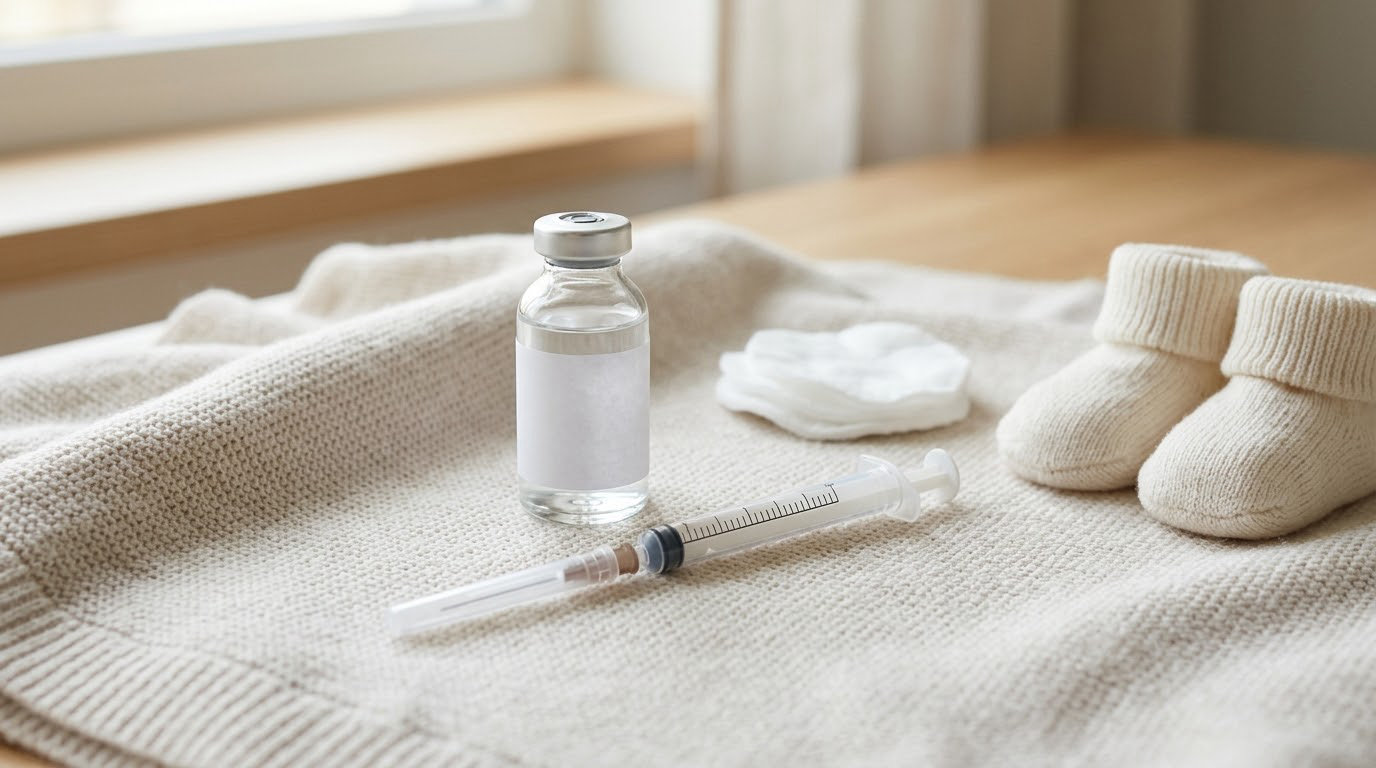
The vitamin K shot for newborns is a single intramuscular injection of phytonadione (vitamin K1) given to a baby shortly after birth to prevent vitamin K deficiency bleeding, a rare clotting disorder that can cause bleeding in the brain or gut. The CDC notes that newborns who skip it are 81 times more likely to develop severe bleeding.
Most babies get it without fuss and it is over in seconds. It is also one of the routine steps that some parents research hard before saying yes, because the injection is given to a newborn hours after delivery, the ingredient list raises questions, and the condition it prevents is rare enough that it never feels urgent. This guide walks through what the shot is, why it is recommended, what the risks actually are, and how to make a decision you feel good about later.
Table of Contents
- What Is the Vitamin K Shot for Newborns?
- Why Is the Vitamin K Shot Recommended?
- The three forms of vitamin K deficiency bleeding
- How Does Vitamin K Work in Newborns?
- Why the Vitamin K Shot for Newborns Is Hard to Avoid
- What Are the Benefits and Possible Risks?
- When Is It Given and What Should You Ask First?
- How Parents Can Make an Informed Decision
- Frequently Asked Questions
- Does the newborn vitamin K shot hurt?
- Is the vitamin K injection the same for breastfed and formula-fed babies?
- Why is vitamin K given by injection when vitamin K is available in formula?
- Can a newborn have an allergic reaction to the vitamin K shot?
- What information should I ask for before the newborn vitamin K shot?
- What to Do First
What Is the Vitamin K Shot for Newborns?
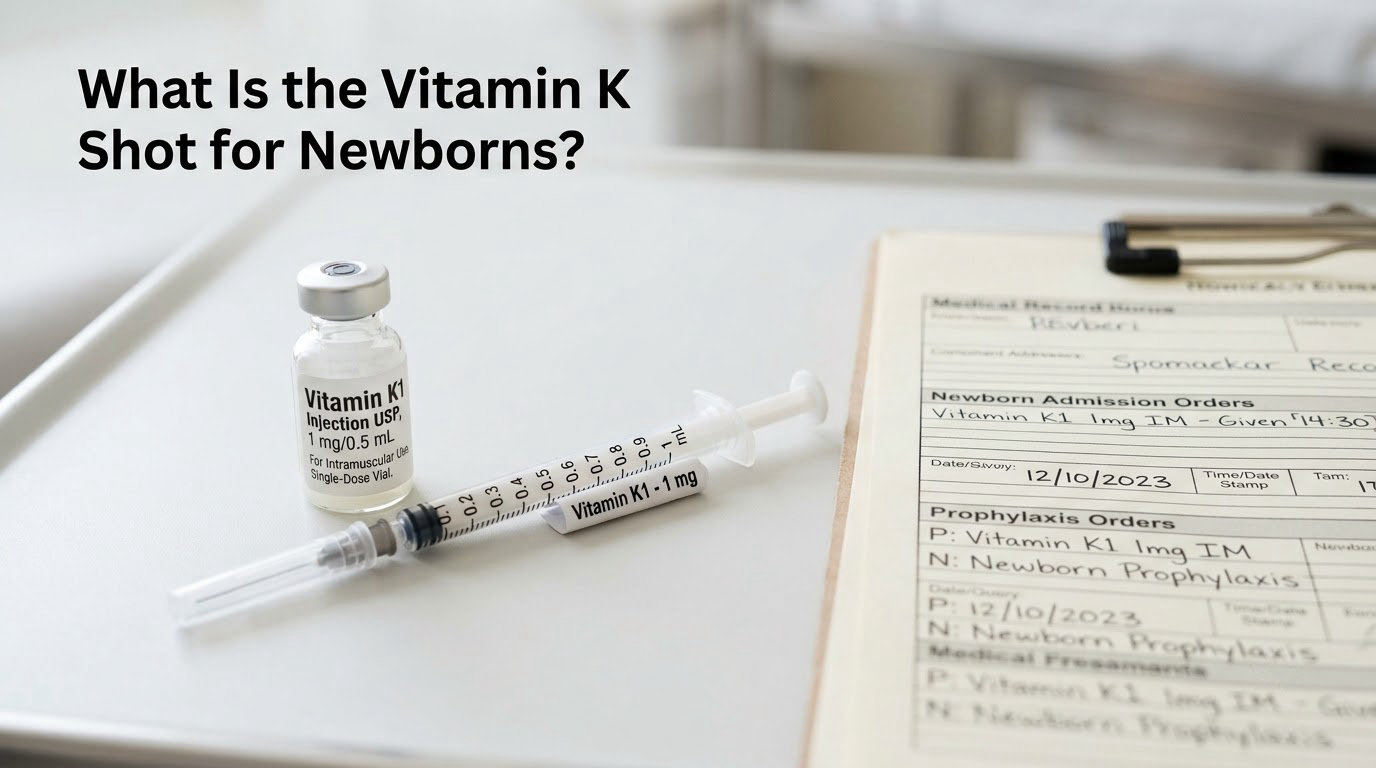
It is an injection of vitamin K1, also called phytonadione, into the newborn’s thigh muscle. In US hospitals it is given once, usually within the first few hours of life and before the baby goes home.
The injection is a very small dose. It is not a vaccine and it does not contain an organism, a preservative that makes the baby sick, or anything that competes with breastfeeding. Vitamin K is a nutrient the body cannot manufacture on its own, and babies cannot store enough of it before birth to bridge the gap until their diet supplies more.
Since 1961, when the connection between vitamin K and hemorrhagic disease of the newborn was firmly established, the injection has been standard care in the United States and is recommended by the CDC and the American Academy of Pediatrics for all newborns.
Why Is the Vitamin K Shot Recommended?
Three things line up to make newborns the one age group where a short vitamin K shortfall can cause real harm: very little vitamin K is stored before birth, breast milk is a thin source, and the baby’s own gut bacteria that would eventually help make vitamin K have not arrived yet.
Vitamin K does not pass through the placenta efficiently, so babies are usually born with almost none of it on hand. Their liver stores run out within days. When clotting proteins are built without adequate vitamin K, the blood loses the ability to clot properly, and bleeding can appear at the umbilicus, in the gut, in the nose, or worse, inside the skull.
The CDC’s headline figure is that newborns who do not receive the shot are 81 times more likely to develop severe bleeding. Severe bleeding is rare overall, which is exactly why clinicians describe this as low probability and high consequence.
The three forms of vitamin K deficiency bleeding
| Type | When it appears | Typical presentation |
|---|---|---|
| Early VKDB | Within the first 24 hours | Often tied to maternal medication, and can be severe |
| Classical VKDB | Days 2 to 7 of life | Bleeding from the umbilical stump, bruising, nose or gum bleeding |
| Late VKDB | Between 2 weeks and 6 months | Most often intracranial; Yale Medicine cites estimates from about 1 in 14,000 to 1 in 2,000 unprotected babies in this window |
Late-onset bleeding is the outcome the recommendation is really aimed at, because it is the hardest to predict and the most damaging. It often shows up in a baby who seemed entirely well, with fussiness, pallor, vomiting, or a bulging fontanelle, and the bleeding has been building for weeks.
How Does Vitamin K Work in Newborns?
Blood clotting is a chain reaction, and four of the proteins in that chain need vitamin K to become active. Without enough of the vitamin, the liver builds clotting factors that are present but not functional, which is why a lab test called prothrombin time can look abnormal even when a baby appears healthy.
The injection puts vitamin K straight into muscle, from where it is absorbed into the bloodstream and taken up by the liver. The liver then stores it and builds working clotting factors. That single dose has been shown to protect an infant for several months, which covers the vulnerable stretch between birth and when solid foods add meaningful vitamin K to the diet.
An important detail: the shot covers the gap, it does not replace nutrition. Breast milk is naturally low in vitamin K, which is fine after the early months because the baby then gets it from a mixed diet, and most breastfed babies need no extra supplements beyond what the shot provides. Some babies born prematurely or with certain liver or bile conditions need ongoing vitamin K. That is a separate conversation with the baby’s own clinician.
Why the Vitamin K Shot for Newborns Is Hard to Avoid
In US hospitals it is part of routine newborn care and refusal is an active choice a parent has to make, usually with a written form. Understandably, that friction gives people time to look for reasons, and a few common ones come up again and again in parent forums.
One is low perceived risk of bleeding. Bleeding disorders are rare, and a parent who never sees a case may reasonably think the precaution is exaggerated. Another is ingredient anxiety. The standard preparation contains benzyl alcohol as a preservative plus polysorbate 80 and propylene glycol as inactive ingredients, and lists of that length read as alarming until someone explains what the quantities mean.
A third strand is a cancer concern traced to a 1990 British study that reported a small increase in leukemia among children who had received the vitamin K shot. Later analyses have not confirmed that link, and pediatric bodies still describe it as unproven. It still circulates, often with the original study’s caveats removed.
Two more concerns are practical rather than medical: wanting uninterrupted skin-to-skin time in the first hour after birth, and distrust of routine interventions offered by institutions. None of those make a parent’s question unreasonable. They do make it worth talking through with someone who can answer specifics for your baby.
What Are the Benefits and Possible Risks?
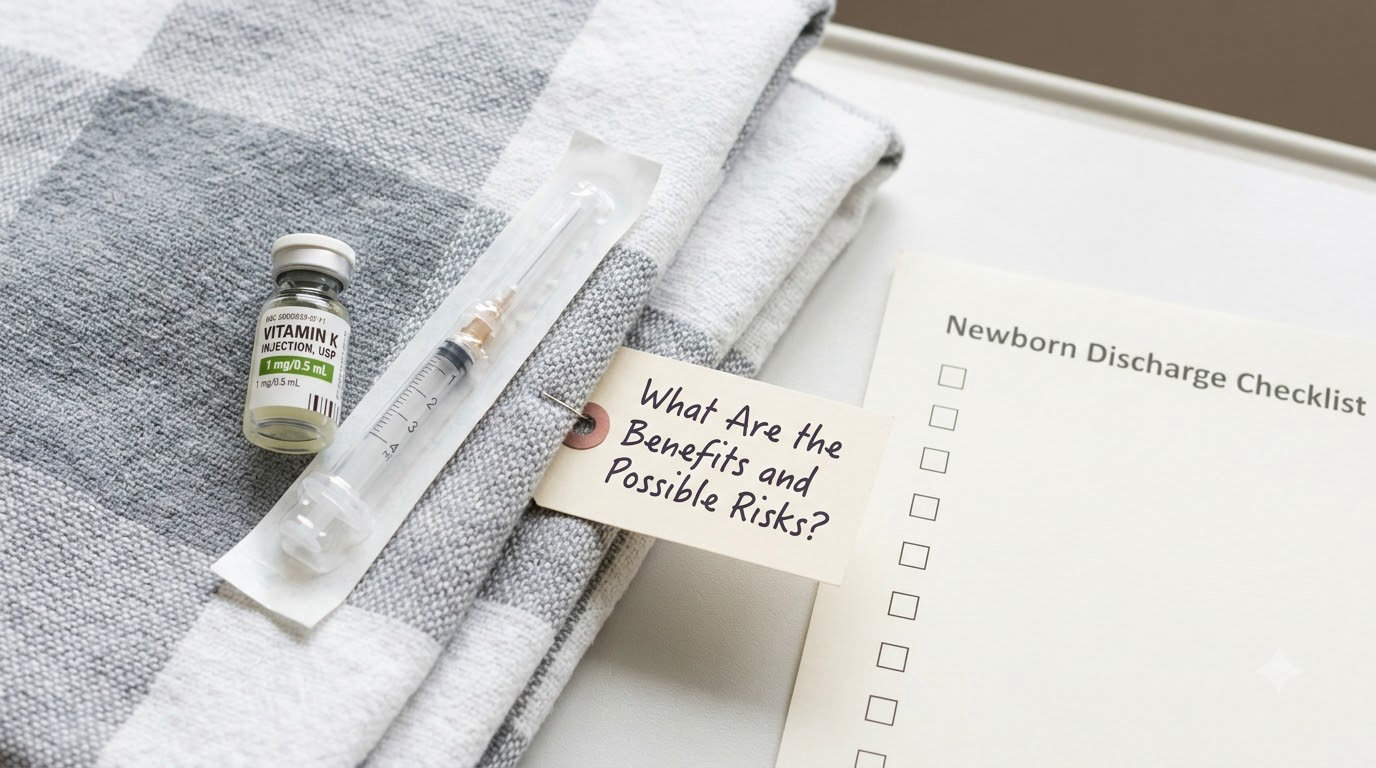
The benefit is specific and large in scope: one injection during a period when the baby cannot make enough vitamin K, preventing a condition that can cause brain damage, lifelong disability, or death. It works whether the baby is breastfed or formula-fed, in a hospital, birth center, or at home, and it has been in routine use for more than six decades.
The common reported side effects are the ordinary ones from any newborn injection: brief fussiness, a small lump or redness at the site, and occasionally some swelling over the following days. Some parents describe a pink or raised bumpy rash appearing a few days later. These resolve without treatment.
Severe allergic reactions to vitamin K injection have been reported and are treated the same way as any other reaction in a hospital setting, with epinephrine and observation. That is a real, if very uncommon, risk, and it belongs on the same page as the benefit rather than being hidden.
The distinction worth holding onto is between observed risks and circulated claims. Injection-site irritation and rare anaphylaxis are documented in medical literature. The leukemia link, claims about aluminum or neurotoxicity, and suggestions that the shot causes autism have not been supported. If a claim matters to you, ask for the study behind it and read the conclusion, not just the abstract.
Formula-fed babies sometimes get vitamin K in their formula, and some parents assume that makes the shot unnecessary. Fortified formula does contain vitamin K, but the amount is not sufficient to cover the first days of life, which is the period the injection is designed to cover.
When Is It Given and What Should You Ask First?
In most US hospitals the injection happens in the birth suite, often within the first hour and always before discharge. Parents who want uninterrupted skin-to-skin contact can usually ask for the shot after the first hour, which most hospitals will accommodate. Circumcision is another practical deadline, since clinicians generally want clotting protection in place beforehand.
Premature infants and babies of mothers who take certain medicines during pregnancy, including some seizure medicines and blood thinners, fall into higher-risk groups and are usually handled with a specific protocol. Mention any maternal medications before birth rather than after delivery.
Before you say yes or no, it helps to have questions ready. What is the exact product, and is a preservative-free formulation available at your facility? How is refusal documented, and what happens to the rest of your hospital stay and newborn care afterward? What monitoring would you arrange if you decline? Is there a follow-up appointment, and who do you call at any hour?
Asking these is not adversarial. It is the same courtesy you would want from anyone making a decision on your family’s behalf.
How Parents Can Make an Informed Decision
A decision you can live with comes down to five things, and none of them require you to be a clinician to work through.
- Name the outcome you are actually afraid of. For most parents this is brain bleeding in a baby who looked healthy, not the injection itself. Write it down in one sentence.
- Weigh that against the actual frequency. Severe bleeding is uncommon, and the CDC’s 81-times figure exists precisely because the comparison matters more than the raw percentage.
- Get the counseling in writing. Ask for the material your clinician recommends, including the CDC and AAP pages, so you are reading the same sources rather than forum summaries.
- Know what happens next either way. If you accept, note when it was given. If you decline, ask what documentation the hospital needs and what follow-up your baby’s clinician recommends.
- Set up a specific follow-up plan. Know which number to call at 2 a.m. and which signs mean go in now rather than call in the morning.
Parent communities are also a useful source here, with one caution: the stories you read are almost always the babies who were fine, because that is what gets posted. That is survivorship bias, not evidence of a low rate.
Frequently Asked Questions
Does the newborn vitamin K shot hurt?
Most babies feel a quick pinch and then cry, as they do for any injection. The cry usually stops within a minute or two. Some babies have a small firm lump or redness at the injection site on the thigh for a few days, which is common and resolves on its own. You can hold your baby during the injection, and asking for a moment of skin-to-skin afterward helps settle many newborns.
Is the vitamin K injection the same for breastfed and formula-fed babies?
The recommendation is the same for both, and the same product is typically used. The reason is timing rather than long-term nutrition. Formula does contain vitamin K, but not enough to cover the first days of life, which is exactly the window when a deficiency is most dangerous. After the early months, breastfed babies get what they need from a mixed diet, so most need no additional vitamin K.
Why is vitamin K given by injection when vitamin K is available in formula?
Formula levels are designed to meet average needs over time, not to build up a reserve in the first week of life. An oral route also depends on a newborn absorbing it reliably, which varies a lot in the first days. Several countries, including the Netherlands, Germany, Denmark and the UK, use repeated oral dosing instead of an injection. Those regimens require more doses over several months and adherence to each one matters.
Can a newborn have an allergic reaction to the vitamin K shot?
Yes, though it is uncommon. Injection-site redness, a small lump, and occasionally a pink raised rash a few days later are the reactions most often reported, and these settle without treatment. Severe allergic reactions have occurred and are treated in hospital with the same protocol used for any other emergency reaction. Ask your clinician what the newborn protocol is where your baby will be born.
What information should I ask for before the newborn vitamin K shot?
Ask which product is used, whether a preservative-free formulation is stocked, and what the timing is relative to skin-to-skin contact and discharge. If you are leaning toward declining, ask what documentation is required, how refusal is recorded in your baby’s chart, and what follow-up your clinician recommends. Ask for the CDC and AAP information sheets in writing so you can read them without pressure in the room.
What to Do First
Ask one question before you leave the hospital: what exactly happens if my baby does not get this, and how would we know early. That answer usually settles the decision faster than any amount of reading, and it puts the conversation with the person who knows your baby’s chart.
Whatever you decide, write it down, ask for the written version, and set the follow-up before you go home. Talk it through with your pediatrician or midwife, and take any warning sign seriously once you are home.