Gestational hypertension vs preeclampsia comes down to one thing: whether an organ other than the blood vessels is involved. Gestational hypertension is new high blood pressure that starts after 20 weeks of pregnancy with no protein in the urine and no sign of organ damage, while preeclampsia is new high blood pressure plus proteinuria or dysfunction of another organ such as the liver, kidneys, blood, or lungs. Both are diagnosed by your maternity clinician, not by symptoms at home. This guide covers the difference between the two so you can prepare better questions for your next prenatal visit.
This article is educational, not medical advice. It is written for readers and families trying to understand a prenatal diagnosis, and it cannot tell you which condition you have. Every threshold below is described as guidelines define it, and your own blood pressure numbers, lab results, and delivery plan belong in conversation with your OB-GYN or maternal-fetal medicine specialist.
If you are reading this because a number on a cuff surprised you, the fastest useful thing you can do is write down the reading, the time, and any symptoms, then call the office rather than searching. Blood pressure trends matter more than a single number, and your team has the full picture that a search result does not.
Table of Contents
- Gestational Hypertension vs Preeclampsia at a Glance
- What Is Gestational Hypertension?
- What Is Preeclampsia?
- How Are Blood Pressure and Proteinuria Interpreted?
- Gestational Hypertension vs Preeclampsia: Symptoms and Signs
- What Risks Can Develop?
- How Are the Conditions Monitored and Managed?
- Can Gestational Hypertension Turn Into Preeclampsia?
- When to Seek Urgent Medical Care
- Which Should You Choose?
- Frequently Asked Questions
- Can you have preeclampsia without protein in your urine?
- Does gestational hypertension always develop into preeclampsia?
- What blood pressure reading requires urgent medical attention during pregnancy?
- Is gestational hypertension the same as chronic high blood pressure?
- Does preeclampsia go away completely after delivery?
- Conclusion
Gestational Hypertension vs Preeclampsia at a Glance
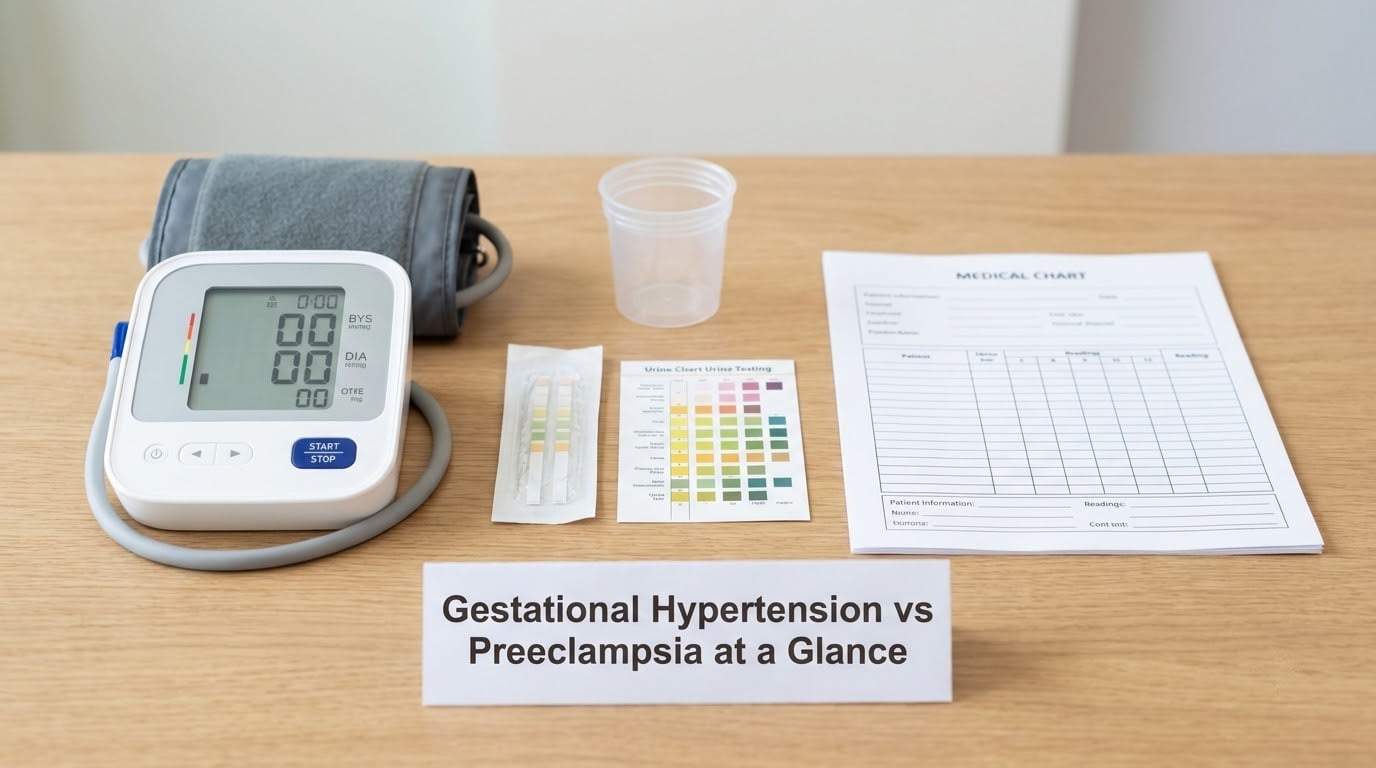
| Feature | Gestational hypertension | Preeclampsia |
|---|---|---|
| When it appears | After 20 weeks 0 days of pregnancy in a person who was previously normotensive | After 20 weeks 0 days, usually alongside new hypertension |
| Blood pressure | 140/90 mm Hg or higher on two readings at least 4 hours apart | Same threshold, and 160/110 mm Hg or higher counts as a severe feature |
| Protein in urine | Absent | Present, but not required |
| Other organ involvement | None | Kidneys, liver, blood platelets, lungs, or brain |
| Symptoms | Often none at all | Often none; when present, headache, visual changes, upper abdominal pain, swelling of face or hands |
| How often it occurs | About 6 to 8 percent of pregnancies in US estimates, higher in some populations | About 3.4 percent of US pregnancies |
| Typical management | More frequent blood pressure checks, urine and lab testing, fetal monitoring, sometimes delivery around 37 weeks | Medication, closer surveillance, and earlier delivery are more often recommended |
| After delivery | Blood pressure usually settles within about 12 weeks | Can persist after delivery, and postpartum preeclampsia can first appear up to 6 weeks later |
| Long-term note | Associated with later chronic hypertension | Associated with raised lifetime cardiovascular and stroke risk |
Read that table as a map rather than a verdict. Most of these rows describe ranges, and an individual pregnancy can move between them as blood pressure and labs change.
What Is Gestational Hypertension?
Gestational hypertension is a rise in blood pressure to 140/90 mm Hg or higher, confirmed on two readings at least four hours apart, that begins after 20 weeks 0 days in someone whose blood pressure was normal before pregnancy. It is a diagnosis of what is absent as much as what is present: no protein in the urine, and no laboratory or clinical sign that another organ is involved.
It is also distinct from chronic hypertension, which is high blood pressure that was already present before pregnancy or diagnosed before the 20-week mark. That distinction matters because chronic hypertension carries its own risk profile and its own monitoring plan, and because preeclampsia can develop on top of it as superimposed preeclampsia.
Gestational hypertension is common, affects roughly 6 to 8 percent of pregnancies in US estimates, and often causes no symptoms at all. Most cases resolve after delivery. The reason clinicians watch it closely rather than treating it as nothing is that a meaningful minority of cases, roughly 10 to 25 percent, go on to meet the criteria for preeclampsia.
What Is Preeclampsia?
Preeclampsia is a syndrome defined by new-onset hypertension after 20 weeks of pregnancy accompanied by either protein in the urine or evidence that another organ system is affected. Kidney, liver, platelet, lung, and brain findings all qualify, and under current ACOG guidance, proteinuria is one route to the diagnosis rather than a mandatory one.
That last point corrects one of the most common misconceptions in this search space. People often hear a reassuring urine test and conclude they cannot have preeclampsia. A low platelet count, liver enzymes running twice the upper limit of normal, elevated creatinine, fluid in the lungs, or a new headache or visual symptoms that do not settle with usual measures can establish the diagnosis on their own.
Preeclampsia affects about 3.4 percent of US pregnancies. It resolves with delivery of the placenta, which is why delivery timing is such a central part of the conversation, but it can also first declare itself after the baby is born, most often within the first 72 hours and up to 6 weeks postpartum.
How Are Blood Pressure and Proteinuria Interpreted?
A diagnosis is never made from a single number. Clinicians look at the pattern: repeat readings, cuff size, position, timing, and whether lab findings moved at the same time. Here is how the standard thresholds are usually written.
| Measure | Finding that counts |
|---|---|
| Blood pressure, non-severe range | 140 systolic or 90 diastolic mm Hg or higher, on two occasions at least 4 hours apart |
| Blood pressure, severe range | 160 systolic or 110 diastolic mm Hg or higher, confirmed over a short interval so treatment is not delayed |
| Urine protein | 300 mg or more in a 24-hour collection, or a protein-to-creatinine ratio of 0.3 or higher on a spot sample |
| Platelets | Below 100,000 per microliter |
| Liver enzymes | Twice the upper limit of normal |
| Creatinine | Above 1.1 mg/dL, or double baseline |
| Lungs | New fluid in the lungs, or shortness of breath from pulmonary edema |
| Neurologic | New headache or visual symptoms that do not respond to usual medication |
What changed, and why it matters: an earlier version of ACOG guidance treated measurable proteinuria as central to the definition. The 2019 clarification made proteinuria optional when another organ criterion is met, because a substantial share of patients with true preeclampsia never show meaningful protein in their urine.
If you have a home cuff, the numbers are only useful if the technique is right. Sit quietly for five minutes, feet flat, back supported, arm at heart level, use a cuff the manufacturer sized for your arm, and take two readings a minute apart and log both with the time and any symptoms. Wrong cuff size alone can shift a reading by enough to change the conversation at your next visit.
Gestational Hypertension vs Preeclampsia: Symptoms and Signs
The honest answer on symptoms is that they are a poor guide to which condition you have, because many people with preeclampsia report feeling completely normal. Relying on how you feel is exactly the kind of self-diagnosis this article exists to discourage.
Gestational hypertension typically produces no symptoms. When people describe anything at all, it is often mild headache or swelling in the feet and ankles, both of which are common in an average pregnancy and are not diagnostic on their own.
Preeclampsia can also be silent, but when symptoms do appear they tend to cluster differently:
- A headache that persists or does not ease with rest, fluids, or usual pain relief
- Visual changes such as blurring, flashing lights, spots, or temporary vision loss
- Pain in the upper right abdomen, under the ribs, or sometimes the shoulder
- Sudden swelling of the face or hands, which differs from ordinary ankle edema
- Shortness of breath, which can signal fluid in the lungs
- Quick weight gain over a day or two from fluid retention
Treat that list as a reason to call, not a way to rule anything in or out. Forum threads in r/pregnant and r/preeclampsia describe the same frustration repeatedly: patients sorting their own symptoms into two bins because nobody explained that the bins are clinical, not personal.
What Risks Can Develop?
With uncomplicated gestational hypertension, most pregnancies end well. The risks that shape management are the possibility of progression, the possibility of a severe reading, and the effects on the placenta and fetal growth.
Preeclampsia carries more. Severe features include a blood pressure of 160/110 mm Hg or higher, low platelets, impaired liver function, impaired kidney function, pulmonary edema, new-onset headache or visual symptoms unresponsive to medication, or eclampsia. Eclampsia is new-onset seizures in a person with preeclampsia and is a medical emergency.
HELLP syndrome is a rare and serious complication. The acronym stands for Hemolysis, Elevated Liver enzymes, and Low Platelet count. It usually occurs alongside severe preeclampsia, though it can occasionally appear without markedly high blood pressure, which is why clinicians watch the labs and not only the cuff.
For the birthing parent, risks across both conditions include placental abruption, severe headache, vision loss, stroke, kidney injury, liver rupture in severe cases, and blood clots. For the baby, they include restricted fetal growth, low birth weight, preterm birth, and, in severe cases, stillbirth. The reason a well-managed case can still end early is that the placenta, not the pregnancy as a whole, is the source of the problem.
Looking past the pregnancy, the American Heart Association recognizes preeclampsia as a risk factor for later cardiovascular disease and stroke, and both conditions are linked to higher rates of chronic hypertension later in life. That is a reason to keep up with routine blood pressure checks, not a reason for alarm during pregnancy.
How Are the Conditions Monitored and Managed?
Management differs mainly in intensity and timing. For gestational hypertension, it commonly means more frequent prenatal visits, blood pressure checks at home, repeat urine protein assessment, blood tests, and fetal monitoring. For preeclampsia, medication, more frequent laboratory testing, and a lower threshold for delivery become part of the plan.
Fetal surveillance typically includes fetal movement counting, a nonstress test, a biophysical profile, and Doppler blood flow studies. If delivery before 37 weeks looks likely, antenatal corticosteroids may be offered to help mature the baby’s lungs. Blood pressure medications used in pregnancy include labetalol, nifedipine, and methyldopa, and the choice depends on your full picture.
Delivery timing comes up so often that it is worth stating plainly. Many people with gestational hypertension are monitored to term, but delivery is commonly discussed around 37 weeks when blood pressure stays elevated, and for preeclampsia without severe features the discussion often starts near 37 weeks and 6 days. Earlier delivery follows severe features. Bringing this up early, rather than in the last week, usually makes the decision feel less abrupt.
After birth, monitoring continues. Blood pressure is checked in hospital and again before discharge, then again during the first 72 hours, around days 7 to 10, and at the 6-week postpartum visit. Patients have reported blood pressure spikes days after discharge, which is why a written discharge plan matters more than a verbal one.
People building a family through assisted reproduction may also want the same conversation early. Understanding how the gestational surrogacy process works and where a monitoring plan is documented is useful context before a first pregnancy baseline is established.
Some readers ask whether an MFM specialist is needed. Referral is reasonable when blood pressure is difficult to control, when kidney function or liver enzymes are abnormal, when there is fetal growth restriction, or when the diagnosis keeps changing. An MFM specialist also manages the terminology: it is common to hear gestational hypertension described as mild preeclampsia on the same spectrum, which looks contradictory next to the definitions above but reflects how the severity is graded clinically.
Can Gestational Hypertension Turn Into Preeclampsia?
It can, and it does often enough that clinicians do not treat gestational hypertension as a settled diagnosis. Most estimates put progression at roughly 10 to 25 percent, with higher risk when blood pressure reaches 160/110 mm Hg, when protein appears in the urine, or when there is a background of chronic hypertension, diabetes, kidney disease, age 35 or older, obesity, multiple gestation, or a prior hypertensive pregnancy.
Patients describe the transition happening in days, sometimes five, with no symptom to mark the moment. That is the honest reason for the follow-up: what changes the diagnosis is usually a lab result or a repeated blood pressure, not something you feel.
Risk factors also shape planning before a future pregnancy. Aspirin prophylaxis is recommended for some high-risk patients, typically started early in the first trimester after a clinician assesses risk, and preconception review of blood pressure, kidney function, and medication is worth arranging. Recurrence risk in a later pregnancy is higher after a hypertensive pregnancy, so mention it to your provider rather than assuming each pregnancy starts clean.
When to Seek Urgent Medical Care
Seek urgent assessment, using your local emergency number or maternity triage, for a severe or persistent blood pressure reading, and for any of the symptoms listed earlier that appear suddenly or do not settle. Persistent headache, visual changes, pain under the right ribs, shortness of breath, chest pain, or a seizure are emergencies in any pregnancy.
Thresholds for urgent care vary by country, clinic, and individual, so take the number printed on your own care plan over any number in this article. If you have no written plan, that is a reasonable thing to request at your next visit, along with a clear statement of which symptoms mean call during the day, which mean call at night, and which mean go in.
Postpartum, the same list applies for the first 6 weeks. New headache, visual changes, or a reading above your discharge threshold days after you went home is a reason to call rather than wait for the 6-week visit.
Which Should You Choose?
Neither is a choice to make. These are diagnoses your clinician assigns from blood pressure, urine, and blood work, and the meaningful decision is what happens next rather than which label you prefer.
That said, the situations look different in practice. If your blood pressure is mildly elevated after 20 weeks with normal labs and no symptoms, management is usually monitoring, home checks, and a plan for delivery around 37 weeks if the numbers stay up. If proteinuria or another organ criterion is present, expect closer surveillance, discussion of medication, and a lower threshold for delivery. With severe features, the conversation shifts to urgency and hospital-based care.
What you can influence is preparation. Bring your cuff readings and log to each visit, ask which findings would change the diagnosis, and ask for the postpartum blood pressure plan in writing before you leave the hospital.
Frequently Asked Questions
Can you have preeclampsia without protein in your urine?
Yes. Since the 2019 ACOG clarification, proteinuria is one way to meet the criteria for preeclampsia but not the only way. A low platelet count, liver enzymes running twice the upper limit of normal, elevated creatinine, fluid in the lungs, or new headache and visual symptoms that do not respond to medication can establish the diagnosis on their own. A reassuring urine test does not rule preeclampsia out.
Does gestational hypertension always develop into preeclampsia?
No. Most cases of gestational hypertension resolve after delivery, and estimates of how many progress to preeclampsia range from about 10 to 25 percent. Risk rises when blood pressure reaches 160/110 mm Hg, when protein appears in the urine, or when there is a history of chronic hypertension, diabetes, kidney disease, or a prior hypertensive pregnancy. Follow-up visits and repeat labs are what catch the change, not symptoms.
What blood pressure reading requires urgent medical attention during pregnancy?
A reading of 160 systolic or 110 diastolic mm Hg or higher is treated as a severe feature and is handled urgently, with treatment started before waiting for a repeat reading if you have symptoms. A reading of 140/90 or higher is not an emergency but does need to be reported the same day. Your clinic sets your own thresholds, so follow the plan you were given rather than any general rule.
Is gestational hypertension the same as chronic high blood pressure?
No. Chronic hypertension is high blood pressure that existed before pregnancy or was diagnosed before 20 weeks. Gestational hypertension begins after 20 weeks in someone who was previously normotensive. The difference changes the monitoring plan and the risk of superimposed preeclampsia, which is preeclampsia developing on top of pre-existing chronic hypertension. If you do not know which one you have, ask your provider to define it for you.
Does preeclampsia go away completely after delivery?
Delivering the placenta removes the cause, and blood pressure usually returns toward normal within about 12 weeks. It is not always immediate, and preeclampsia can first appear after birth, most often within the first 72 hours and sometimes up to 6 weeks postpartum. That is why blood pressure checks continue after discharge, again around days 7 to 10, and at the 6-week visit.
Every answer here reflects general guidance from ACOG, CDC, and similar bodies. Your own diagnosis, thresholds, and delivery plan come from your maternity care team.
Conclusion
The central difference is simple to state and easy to get lost in. Gestational hypertension is new high blood pressure after 20 weeks with no proteinuria and no organ involvement. Preeclampsia is new hypertension after 20 weeks plus protein in the urine or evidence that the kidneys, liver, blood, lungs, or brain are affected, and proteinuria is not required for that second diagnosis.
Do this next: review your last few blood pressure readings and any lab results with your clinician, ask which findings would change your diagnosis, and leave with a written postpartum monitoring plan. If you are not sure which diagnosis you were given, ask your provider to draw the distinction with you, and if anything on this list matches how you feel right now, call them rather than waiting for your next visit.